A curved monitor can make it easier to see the apex, mirrors, and cars alongside you without building a triple-screen rig. The right choice depends on more than width: resolution, screen curvature, and how close you sit all affect what you see from the cockpit.
These 10 options span compact 34-inch ultrawides, 49-inch super-ultrawides, and a 57-inch flagship. Use the buying guide below to match a screen to your rig, PC, and budget.
Best 10 Curved Gaming Monitor for Sim Racing Picks for 2026
Best for Versatile Connectivity
INNOCN 49C1G 49-Inch Ultrawide

- 49-inch 32:9, 1800R screen
- Up to 144Hz over DisplayPort
- 65W USB-C and adjustable stand
Best For: Wide-view racing and laptop workstations
Best for Dual-System Setups

- 49-inch 32:9, 1800R display
- 144Hz with Adaptive Sync
- KVM, PIP/PBP, and 65W USB-C
Best For: Racing desks shared by two computers
Best Compact Ultrawide
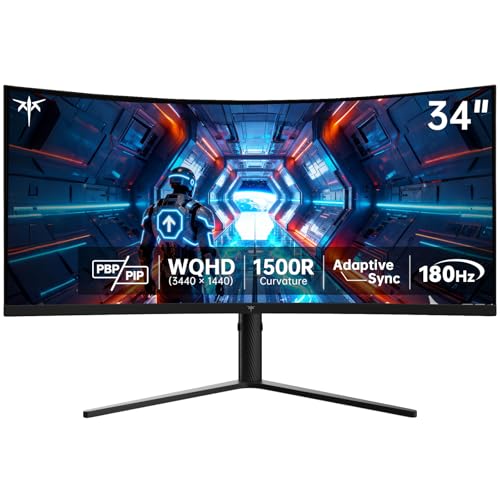
- 34-inch 21:9, 1500R screen
- 3440 × 1440 resolution
- Up to 180Hz over DisplayPort
Best For: Smaller rigs seeking ultrawide 1440p
Best High-Detail Panorama

- 49-inch 32:9 at 5120 × 1440
- Pronounced 1000R curve
- 144Hz and DisplayHDR 600
Best For: Detailed single-screen racing cockpits
Compact Super-Ultrawide
Gawfolk 44.5-Inch 185Hz Dual QHD

- 44.5-inch 32:9 screen with 1500R curve
- 5120×1440 resolution at up to 185Hz
- PBP/PIP and four video inputs
Best For: Racers seeking a smaller super-ultrawide
49-Inch Racing View

- 49-inch 32:9 panel with 1500R curve
- 5120×1440 resolution and up to 165Hz
- Height-adjustable stand; no built-in speakers
Best For: Racers wanting a wide screen with adjustable height
Maximum-Detail Cockpit
Samsung 57-Inch Odyssey Neo G9

- 57-inch 32:9 Dual 4K panel with 1000R curve
- 240Hz and FreeSync Premium Pro
- Mini LED with 2,392 local dimming zones
Best For: Large rigs and PCs built for Dual 4K gaming
Best OLED Immersion
Samsung 49-Inch Odyssey OLED G9

- 49-inch 32:9 Dual QHD QD-OLED
- 144Hz; stated 0.03ms response
- G-Sync compatible and FreeSync Premium Pro
Best For: Wide-screen racing with OLED contrast
Best 240Hz Super Ultrawide

- 49-inch 1000R Dual QHD screen
- 240Hz with stated 1ms GtG response
- FreeSync Premium Pro; adjustable stand
Best For: High-refresh, wraparound sim racing
Best Simple Pick
SANSUI 34-Inch 240Hz Curved Monitor

- 34-inch 21:9 UWQHD display
- 240Hz with stated 1ms MPRT response
- Two HDMI 2.1 and two DP 1.4 inputs
Best For: Smaller desks needing a fast ultrawide
Best for Versatile Connectivity – INNOCN 49C1G 49-Inch Ultrawide
If you want a curved gaming monitor for sim racing that can also serve as a laptop workstation, the INNOCN 49C1G combines a 49-inch, 1800R screen with USB-C connectivity. Its 3840 × 1080 resolution gives you a wide 32:9 view without the pixel count of a dual-QHD display.
Best For: Racers who want a wide display with flexible connections for gaming and work.
Pros:
- 49-inch 32:9 screen provides a seamless, expansive view.
- Supports up to 144Hz over DisplayPort 1.4 with Adaptive-Sync.
- USB-C with 65W power delivery, built-in speakers, and height, tilt, and swivel adjustments add versatility.
Cons:
- 3840 × 1080 spreads 1080 vertical pixels across a large screen, so it offers less detail than a 5120 × 1440 option.
The 49C1G is a practical choice when screen width and connection options matter more to your setup than maximum sharpness.
Best for Dual-System Setups – Deco Gear DGVIEW490 49-Inch
The Deco Gear DGVIEW490 is a curved gaming monitor for sim racing buyers who also manage two computers. Its 49-inch, 1800R display pairs a 32:9 racing view with KVM and picture-by-picture features for a shared desk setup.
Best For: Sim racers who switch between a gaming PC and a second work system.
Pros:
- 3840 × 1080 resolution offers a wide view with fewer pixels to drive than dual-QHD.
- 144Hz refresh rate and Adaptive Sync support smoother motion.
- KVM, PIP/PBP, and 65W USB-C power delivery suit multi-device desks.
Cons:
- 1080-pixel vertical resolution limits fine detail compared with 1440-pixel ultrawides.
- No audio output port; connect headphones or speakers to the computer or console.
Choose this model if switching systems is part of your routine. Its productivity features are the clearest reason to pick it over a simpler 49-inch racing display.
Best Compact Ultrawide – KTC H34S5 34-Inch
If a 49-inch screen will not fit your rig, the KTC H34S5 is a curved gaming monitor for sim racing in a more manageable 34-inch format. Its 1500R curve, 21:9 aspect ratio, and 3440 × 1440 resolution balance a wider view with 1440-pixel vertical detail.
Best For: Racers with limited desk space who still want an ultrawide 1440p display.
Pros:
- 180Hz refresh rate is available over DisplayPort 1.4, alongside Adaptive Sync.
- 3440 × 1440 resolution provides more vertical pixels than the 3840 × 1080 models here.
- Stand supports height, tilt, and swivel adjustments; 100 × 100mm VESA mounting is supported.
Cons:
- 21:9 is less panoramic than the 49-inch 32:9 alternatives.
- HDMI 2.0 input is specified for up to 100Hz at 3440 × 1440, rather than the full 180Hz.
This is the sensible middle ground if you value resolution and refresh rate but do not need a screen spanning nearly four feet.
Best High-Detail Panorama – Samsung Odyssey G9 G91F
For a curved gaming monitor for sim racing with both a broad view and higher resolution, consider the Samsung Odyssey G9 G91F. Its 49-inch, 1000R screen uses a 5120 × 1440 panel, providing a 32:9 panorama with more detail than dual-FHD alternatives.
Best For: Racers who prioritize a large, sharply detailed single-screen cockpit view.
Pros:
- 5120 × 1440 resolution combines 32:9 width with 1440-pixel vertical detail.
- 1000R curvature creates a more pronounced wraparound shape than the 1800R models listed here.
- 144Hz, AMD FreeSync Premium Pro, and DisplayHDR 600 round out its gaming features.
Cons:
- 5120 × 1440 demands more graphics processing than 3840 × 1080 at comparable settings.
- At 45.18 inches wide and 34.4 pounds, it calls for a substantial desk or appropriately rated mount.
The G91F makes the most sense if your PC and mounting space are ready for dual-QHD. Its resolution is the key advantage over the lower-pixel-count 49-inch choices.
Compact Super-Ultrawide – Gawfolk 44.5-Inch 185Hz Dual QHD
If you want a curved gaming monitor for sim racing without stepping up to a 49-inch screen, this Gawfolk offers a 44.5-inch, 32:9 display. Its 5120×1440 resolution and 1500R curve provide a seamless view across your cockpit.
Best For: Sim racers who want a smaller super-ultrawide with a high refresh rate and room for other desktop tasks.
Pros:
- 185Hz refresh rate with FreeSync and G-Sync compatibility.
- VA panel offers a stated 3000:1 contrast ratio and HDR10 support.
- Two HDMI 2.1 and two DisplayPort 1.4 inputs support PBP and PIP.
Cons:
- Stand adjusts for tilt but not height.
- Ambient backlighting is not customizable.
The combination of Dual QHD detail and 185Hz makes this a flexible racing display. If positioning matters to your rig, note the limited stand adjustment; a compatible 100×100mm VESA arm is another option.
49-Inch Racing View – CRUA 49-Inch 165Hz Dual QHD
For drivers seeking a full-size curved gaming monitor for sim racing, the CRUA pairs a 49-inch, 32:9 screen with a 1500R curve. Its 5120×1440 resolution gives you a continuous wide view without a center bezel.
Best For: Sim racers who prioritize a 49-inch field of view and want height adjustment built into the stand.
Pros:
- Dual QHD resolution across a 49-inch super-ultrawide panel.
- Up to 165Hz refresh rate and AMD FreeSync support.
- Stand supports height and tilt adjustment; wall mounting is also supported.
Cons:
- No built-in speakers; audio requires another device connected through the available jack or your system.
- The 49-inch panel needs ample horizontal setup space.
This is a straightforward choice when screen width and adjustable positioning matter most. Check that your desk or racing rig can accommodate the stated 46-inch monitor width before committing.
Maximum-Detail Cockpit – Samsung 57-Inch Odyssey Neo G9
The Samsung Odyssey Neo G9 is a curved gaming monitor for sim racing setups built around a very large display. Its 57-inch, 32:9 panel combines a tight 1000R curve with 7680×2160 Dual 4K resolution for a wide, detailed driving view.
Best For: Sim racers planning a large cockpit display and seeking Dual 4K detail, high refresh rates, and Mini LED HDR.
Pros:
- 57-inch Dual 4K screen with a 1000R curve.
- 240Hz refresh rate, DisplayPort 2.1, and AMD FreeSync Premium Pro.
- Mini LED backlighting with 2,392 local dimming zones and DisplayHDR 1000 certification.
- Stand supports swivel, tilt, and height adjustment.
Cons:
- Its stated 52.3-inch width and 41.9-pound weight call for a substantial setup.
- Driving 7680×2160 at high refresh rates places considerable demands on a PC.
This is the most expansive, detail-focused option of the three, but it makes the most sense when your rig has the space and your PC can make good use of its resolution and refresh rate.
Best OLED Immersion – Samsung 49-Inch Odyssey OLED G9
If you want a curved gaming monitor for sim racing with expansive views and deep blacks, the 49-inch Odyssey OLED G9 pairs a 32:9 Dual QHD screen with QD-OLED contrast. Its 144Hz refresh rate and stated 0.03ms response time suit fast-moving racing scenes.
Best For: Sim racers who prioritize OLED picture quality and a wide single-screen setup.
Pros:
- 49-inch, 5120 × 1440 display provides a broad 32:9 view.
- QD-OLED delivers true blacks without pixel light bleed.
- Supports G-Sync compatibility and FreeSync Premium Pro.
- Height- and tilt-adjustable stand helps position the screen.
Cons:
- 144Hz refresh rate is lower than the 240Hz alternatives in this roundup.
- OLED’s static-image precautions remain relevant despite built-in protective features.
Choose this model for its screen width and OLED contrast rather than the highest refresh rate. Its thermal management, static-image dimming, and inactivity screen saver are useful additions for a display that may also show desktop content.
Best 240Hz Super Ultrawide – Samsung 49-Inch Odyssey G9
For a curved gaming monitor for sim racing that emphasizes speed and wraparound viewing, this Odyssey G9 combines a 49-inch, 1000R curved 32:9 screen with 5120 × 1440 resolution and a 240Hz refresh rate. Its VA LCD panel also carries a VESA DisplayHDR 1000 rating.
Best For: Sim racers seeking a deeply curved, high-refresh-rate super ultrawide.
Pros:
- 1000R curvature and 32:9 format provide a broad, enveloping view.
- 240Hz refresh rate and stated 1ms GtG response time support smooth motion.
- FreeSync Premium Pro helps reduce tearing and stutter.
- Height, tilt, and swivel adjustments offer flexible placement.
Cons:
- At 45.2 inches wide and 34.4 pounds, it needs substantial desk space and support.
- Its VA LCD panel does not offer the OLED panel technology of the other 49-inch Samsung here.
This is the stronger fit when 240Hz and pronounced curvature matter more than OLED. Picture-by-Picture and Picture-in-Picture add flexibility if your racing setup shares the display with another source.
Best Simple Pick – SANSUI 34-Inch 240Hz Curved Monitor
If a 49-inch display is too wide for your desk, this SANSUI is a curved gaming monitor for sim racing in a more compact 34-inch, 21:9 format. It pairs 3440 × 1440 resolution with a 240Hz refresh rate and FreeSync support.
Best For: Sim racers who want an ultrawide racing view without dedicating space to a 49-inch screen.
Pros:
- 34-inch UWQHD display balances ultrawide viewing with a smaller footprint.
- 240Hz refresh rate and stated 1ms MPRT response time target smooth motion.
- Two HDMI 2.1 and two DisplayPort 1.4 inputs provide connection options.
- Supports Picture-in-Picture, Picture-by-Picture, and 100 × 100mm VESA mounting.
Cons:
- 21:9 format shows less horizontal screen area than the 49-inch 32:9 models.
- Included stand offers tilt adjustment, but height adjustment is not listed.
- No built-in speakers.
This is a practical pick when desk space takes priority over maximum screen width. Its fast refresh rate and multiple inputs are appealing, but plan on separate audio and check whether tilt-only stand adjustment suits your seating position.
How We Picked the Best Curved Gaming Monitor for Sim Racing
We focused on curved ultrawide displays that could make sense on a racing rig, from 34-inch 21:9 screens to larger 32:9 models. The comparison emphasizes listed size, resolution, refresh rate, curvature, and display features. We did not treat a higher specification as an automatic win: a wide screen is only useful if your PC can drive it, your rig can hold it, and you can position it comfortably.
Quick Comparison: Which Size and Resolution Fit?
The 34-inch, 3440 × 1440 options from KTC and SANSUI are practical starting points if you want more peripheral view without committing to a huge display. The 49-inch 3840 × 1080 INNOCN and Deco Gear screens provide a broad 32:9 view with fewer pixels to render than dual-QHD models, but noticeably less vertical detail. For a sharper 49-inch 32:9 setup, compare the dual-QHD options from Samsung and CRUA; the Gawfolk offers a similarly wide 5120 × 1440 canvas at 44.5 inches. Samsung’s 57-inch Neo G9 is the largest, highest-resolution option here, demanding the most space and substantial GPU capability.
Key Buying Factors for a Curved Gaming Monitor for Sim Racing
Field of View, Size, and Seating Distance
Screen width can improve side visibility, but it does not set your in-game field of view for you. Measure the distance from your eyes to the screen, configure FOV in your sim, and check that the display will clear your wheelbase. A 1000R curve wraps more sharply than a 1500R or 1800R curve; whether that feels natural depends on your viewing distance and placement.
Resolution and PC Performance
Higher resolution makes distant braking markers and cockpit text easier to distinguish, while increasing the load on your graphics card. A 5120 × 1440 display renders substantially more pixels than 3840 × 1080; the 57-inch dual-4K format pushes further still. Check your GPU’s outputs, supported refresh rates, and the monitor’s required cable or connection standard before buying.
Motion, Panel Type, and Practical Fit
A high refresh rate can make steering inputs and passing traffic look smoother when your PC produces enough frames. Adaptive sync can help when frame rates vary; confirm compatibility with your GPU. OLED offers strong contrast but warrants attention to image retention if you leave static sim HUDs on-screen for long periods. Also check stand depth, VESA-mount support, rig capacity, and return terms—especially for large curved panels.
Who Should Buy Which Curved Gaming Monitor for Sim Racing?
Choose a 34-inch UWQHD model if space or GPU headroom is limited. Pick a 49-inch 3840 × 1080 screen if your priority is 32:9 width without dual-QHD rendering demands. Step up to 49-inch dual QHD for a stronger balance of wraparound view and detail, or consider OLED if contrast matters most and you can manage static-content exposure. The 57-inch Neo G9 suits racers with a deep rig, capable PC, and room for its scale. Whatever you choose, confirm the physical fit and your sim’s ultrawide support before ordering.