Physical optical media remains useful for photographers who want an offline backup, long-term project archive, or portable way to share large image collections. The right external Blu-ray drive can also read DVDs and CDs while fitting easily into a laptop-based workflow.
This roundup compares 10 compact Blu-ray drives with attention to connection options, disc support, portability, and practical photo-archiving needs.
Best 10 Blu Ray Drives for Photographers Picks for 2026
Premium Portable Pick

- BDXL and M-Disc support
- USB-A and USB-C connectivity
- Compact 240-gram design
Best For: Portable photo archiving with a branded external burner
Card-Transfer Value

- Built-in SD and TF card slots
- Reads Blu-ray and burns DVD/CD
- USB-A and USB-C support
Best For: Photographers transferring cards while reading optical media
High-Capacity Burner

- Reads and writes Blu-ray media
- Supports discs up to 100GB
- Includes multiple ports and card readers
Best For: Large photo backups and flexible desktop connectivity
Travel Hub Choice

- Blu-ray reader with DVD/CD burning
- Multiple USB ports and card slots
- Includes pouch and four disc sleeves
Best For: Traveling photographers needing an all-in-one media hub
Premium UHD Choice

- Supports M-DISC BD-R archival media.
- Reads and writes regular Blu-ray, DVD, and CD.
- UHD features require compatible PC hardware and software.
Best For: Photographers building disc-based archives on PC
Portable Connectivity Pick

- Built-in SD/TF slots support photo and video transfers.
- Offers USB 3.0, USB-C, and two additional USB ports.
- Slim and portable, but does not support 4K UHD discs.
Best For: Traveling photographers transferring card files and using discs
Photo Transfer Hub

- SD and TF slots simplify camera-card photo transfers.
- Adds four USB ports as a 7-in-1 hub.
- Reads and burns BD, DVD, and CD media.
Best For: Photographers needing card transfer and disc tools in one device
Best All-in-One Pick
8-in-1 Blu-ray Drive and Card Reader
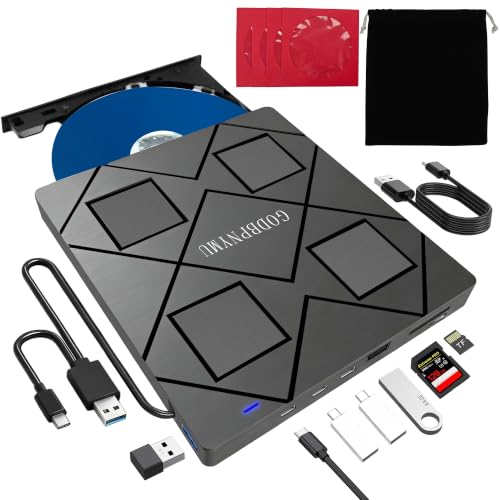
- Burns Blu-ray, DVD, and CD media
- Includes SD/TF card reader and four USB ports
- Portable design with case and disc sleeves
Best For: Photographers needing disc backups and memory-card transfers in one device
Best for Stable Connections

- Reads and writes Blu-ray, DVD, and CD media
- Supports USB 3.0 and Type-C connections
- Includes an extra USB power cable for stability
Best For: Laptop photographers wanting flexible connectivity and portable disc handling
Best Budget-Friendly Reader
Portable Blu-ray Player and DVD Burner

- Reads Blu-ray and burns CDs/DVDs
- Provides USB 3.0 and Type-C connectivity
- Compact design for travel or desktop use
Best For: Photographers who need Blu-ray reading but not Blu-ray disc burning
Premium Portable Pick – ASUS Slim BDXL M-Disc Burner
ASUS SBW-06D5H-U BDXL External Ultra Slim Blu-ray and MDisc Burner USB 3.1 USB-C 2 Cables Black
Check Price On AmazonFor photographers seeking blu ray drives for photographers, the ASUS SBW-06D5H-U is a compact external burner with USB-A and USB-C connectivity. It supports BDXL and M-Disc media, making it suitable for creating physical archives when paired with compatible software and discs.
Best For: Photographers who want a slim, recognizable-brand drive with BDXL and M-Disc support for computer-based backups.
Pros:
- Supports BDXL and M-Disc media.
- Includes both USB 3.1 Type-A and USB 3.1 Type-C interfaces.
- Ultra-slim 240-gram design is easy to carry.
- Offers multiple optical write speeds, including up to 10x listed support.
Cons:
- The supplied notes do not specify 4K Ultra HD Blu-ray support.
- Software for playback or burning is not listed.
- Its listed digital storage capacity is only 10 GB, so confirm media compatibility before purchase.
This is a practical choice when portability, dual-cable connectivity, and archival media support matter more than built-in card readers or extra USB ports.
Card-Transfer Value – 5-in-1 Blu-ray Reader and Hub
This 5-in-1 external drive suits photographers looking for blu ray drives for photographers that also simplify memory-card transfers. It reads Blu-ray discs, burns DVDs and CDs, and adds USB-A, USB-C, SD, and TF connectivity for compatible computers.
Best For: Photographers who want one portable accessory for optical-disc reading, DVD/CD burning, and moving images from SD or TF cards.
Pros:
- Includes SD and TF card slots plus USB 3.0 and USB 2.0 ports.
- Reads Blu-ray, DVD, and CD formats and burns DVD and CD media.
- Dual-interface cable supports computers with USB-A or USB-C.
- Supports Windows, macOS 10.6 and later, and Linux systems.
Cons:
- It does not burn Blu-ray discs.
- It does not support 4K Blu-ray playback.
- SD and TF cards cannot be used simultaneously, and playback software is required for 3D Blu-ray.
Choose this model if card-reader convenience is central to your workflow. It is less suitable if your photo archive requires writing directly to Blu-ray media.
High-Capacity Burner – 100GB Blu-ray Backup Drive
For photographers comparing blu ray drives for photographers, this external burner stands out for its stated 100GB Blu-ray read/write capability. It also combines optical burning with SD and TF readers, making it useful for moving camera files and building disc-based backups from a computer.
Best For: Photographers who want Blu-ray writing, large-capacity media support, and several connectivity options in one portable unit.
Pros:
- Reads and writes CDs, DVDs, and Blu-ray discs, with BD speeds up to 6x.
- Supports Blu-ray media capacities up to 100GB.
- Includes USB 3.0, USB 2.0, two USB-C ports, SD, and TF readers.
- Works with Windows, macOS, and Linux and includes an extension cable and power cord.
Cons:
- It does not support 4K Ultra HD Blu-ray discs.
- Blu-ray playback software is not included.
- SD and TF cards cannot be used at the same time.
This is the strongest fit for photographers who prioritize actual Blu-ray recording and high-capacity discs. Budget for compatible software if you also need Blu-ray playback.
Travel Hub Choice – 8-in-1 Blu-ray Drive
This 8-in-1 model is aimed at photographers who want blu ray drives for photographers with added travel utility. It reads Blu-ray discs, burns DVDs and CDs, accepts SD or TF cards, and provides USB-A, USB-C, and USB 2.0/3.0 connections in a slim package.
Best For: Mobile photographers who need optical-disc access, card transfers, peripheral connectivity, and included carrying accessories.
Pros:
- Combines Blu-ray reading, DVD/CD burning, USB hub functions, and card slots.
- Includes two USB-C ports, USB 3.0, and USB 2.0.
- Reads BD-XL 100GB discs and supports DVD/CD burning speeds up to 8x and 24x.
- Comes with a pouch and four CD/DVD sleeves for travel organization.
Cons:
- BD-XL 100GB is listed as read-only.
- It does not work with TVs, tablets, phones, or in-car devices.
- Third-party playback software is required, and SD and TF cards cannot be read simultaneously.
The combination of card access, ports, and carrying accessories makes this a useful travel companion. Select another model if you specifically need to write 100GB Blu-ray discs.
Premium UHD Choice – Aluminum 4K Blu-ray Writer
archgon Premium Aluminum External USB 3.0 UHD 4K Blu-Ray Writer Super Drive for PC and Mac
Check Price On AmazonFor photographers seeking blu ray drives for photographers, the archgon Premium Aluminum drive is a strong choice for archiving data to regular Blu-ray discs or M-DISC BD-R media. Its USB connection and aluminum enclosure suit PC and Mac setups, though UHD playback has important software and platform limitations.
Best For: Photographers who want an external writer with M-DISC support and regular Blu-ray, DVD, and CD compatibility.
Pros:
- Reads UHD Blu-ray and reads/writes regular Blu-ray, DVD, and CD with appropriate software.
- Supports M-DISC BD-R for archival storage.
- Premium CNC aluminum body with USB connectivity.
- Up to 12x optical write speed and 6x Blu-ray read speed.
Cons:
- UHD playback requires compatible PC hardware and separately purchased CyberLink PowerDVD.
- Mac users cannot currently play or write UHD Blu-ray according to the supplied notes.
- Compatibility should be checked with the Ultra HD Blu-ray Advisor before purchase.
This is the most archive-focused option in the group, especially for photographers interested in M-DISC media. Verify your computer and software compatibility first, particularly if UHD functionality matters.
Portable Connectivity Pick – 5-in-1 USB-C Blu-ray Drive
For photographers comparing blu ray drives for photographers, this BUNUD model adds useful card and USB connectivity to a slim external Blu-ray drive. Its SD/TF slots can help transfer photos and videos, while USB 3.0 and USB-C connections support a range of computers.
Best For: Photographers who want a portable disc drive with built-in SD/TF card access and extra USB ports.
Pros:
- Includes SD and TF card slots for transferring photos and videos.
- Provides two USB ports to expand connectivity.
- Supports USB 3.0 and Type-C connections with plug-and-play operation.
- Compatible with Windows PCs, Macs, MacBooks, and desktops.
Cons:
- Does not play 4K Ultra HD discs.
- Not compatible with tablets, iPads, projectors, TVs, Chrome OS, cars, or smartphones.
- Its listed Blu-ray write capability is not specified in the supplied speed details.
The integrated card slots make this a practical travel companion for moving camera files, while its disc functions cover everyday Blu-ray, DVD, and CD use. Choose another model if 4K UHD disc playback is essential.
Photo Transfer Hub – Portable 4K Blu-ray Drive
This Wbacon drive stands out among blu ray drives for photographers because its built-in card slots and USB hub can support both photo transfers and optical-disc tasks. It reads and burns CD, DVD, and Blu-ray media, while its portable design fits laptop-based workflows.
Best For: Photographers who want one portable accessory for camera-card transfers, USB expansion, and Blu-ray, DVD, or CD use.
Pros:
- Includes SD and TF slots for transferring photos and videos from camera cards.
- Functions as a 7-in-1 hub with one USB 3.0 port and three USB 2.0 ports.
- Supports CD, DVD, and BD reading and burning with listed speeds up to 6x for BD.
- Compatible with Windows, Linux, and Mac OS 10 or higher according to the supplied notes.
Cons:
- Requires suitable software for disc playback and burning.
- 4K/UHD playback compatibility depends on the computer, software, and disc setup.
- Not compatible with cars, projectors, tablets, iPads, or mobile phones.
Its combination of card readers, hub ports, and optical writing makes it especially versatile for photographers working from a laptop. Check system compatibility and install the recommended disc software before relying on UHD playback or burning.
Best All-in-One Pick – 8-in-1 Blu-ray Drive and Card Reader
For photographers comparing blu ray drives for photographers, this 8-in-1 model stands out by combining disc burning with SD/TF card access and extra USB ports. It reads and burns Blu-ray, DVD, and CD media, while supporting photo transfers from compatible memory cards.
Best For: Photographers who want one portable device for optical-disc backups, memory-card transfers, and USB connectivity.
Pros:
- Reads and burns BD, DVD, and CD media, with Blu-ray recording up to 50GB.
- Includes SD/TF card reading plus two USB-C, one USB 3.0, and one USB 2.0 port.
- Supports Windows and macOS, includes a carrying case and four disc sleeves, and weighs about 300 grams.
Cons:
- Cannot provide 4K playback, and Blu-ray playback requires third-party software.
- SD and TF cards cannot be read simultaneously.
- Not compatible with TVs, tablets, smartphones, or in-car devices.
This is the most versatile option in the group for photographers who need both disc archiving and direct card transfers. Its hub and storage features add convenience, though users should plan on supplying compatible playback software.
Best for Stable Connections – Dainty External Blu-ray Drive
This Dainty drive is a practical choice among blu ray drives for photographers who want a compact reader and burner with both USB 3.0 and Type-C connectivity. Its included auxiliary power cable is designed to help maintain stable operation during disc reading and writing.
Best For: Laptop users who value flexible connections, portable storage, and additional power support for optical-disc work.
Pros:
- Reads Blu-ray, DVD, and CD media, and supports disc writing with listed speeds up to 6x for BD-R and 24x for CD-R.
- Offers USB 3.0 and Type-C connections with an additional USB power cable.
- Works with Windows, macOS, and Linux computers and has a compact, lightweight design.
Cons:
- Playback and writing require separately obtained third-party software.
- Not compatible with TVs, tablets, PS4, iPads, Chromebooks, projectors, or vehicles.
- Does not include Blu-ray playback software.
The Dainty model makes sense when connection flexibility and power stability matter more than extra hub or card-reader features. It is a straightforward optical drive for compatible computers, provided you already have suitable software.
Best Budget-Friendly Reader – Portable Blu-ray Player and DVD Burner
Photographers looking for blu ray drives for photographers may prefer this simple 2-in-1 design when Blu-ray reading is enough and CD/DVD burning is the priority. It connects through USB 3.0 or Type-C and is built for portable use with Windows, Mac, and Linux computers.
Best For: Users who need Blu-ray playback and CD/DVD burning but do not need to record Blu-ray discs.
Pros:
- Reads Blu-ray at up to 6x, DVD at 8x, and CD at 24x.
- Burns CDs and DVDs and supports fast USB 3.0 transfers up to 5Gbps.
- Includes both USB-A and USB-C connectors in a lightweight portable enclosure.
Cons:
- Can read but cannot burn Blu-ray discs.
- Blu-ray playback requires third-party software such as PowerDVD or Leawo.
- Not compatible with Chromebooks, TVs, tablets, iPads, or vehicles.
This drive is best treated as a Blu-ray reader paired with a CD/DVD burner rather than a full Blu-ray archiving solution. Its dual connector design and compact build make it convenient for photographers who mainly read finished Blu-ray media and burn smaller optical backups.
How We Picked the Best Blu Ray Drives for Photographers
We focused on external drives that are practical for modern photo workflows rather than desktop-only optical burners. Key considerations included Blu-ray writing capability, support for high-capacity BDXL or M-DISC media where stated, USB-A and USB-C connectivity, portability, and compatibility with common Windows and Mac setups.
We also considered useful extras such as built-in card readers, USB hubs, 4K playback claims, bundled cables, and slim designs. Features can vary by operating system, disc type, and playback or burning software, so confirm the manufacturer’s specifications before purchasing.
Quick Comparison
| Best For | Features to Prioritize | Recommended Drive Type |
|---|---|---|
| Long-term photo archiving | BDXL and M-DISC support, reliable writing | Dedicated Blu-ray burner |
| USB-C laptops | USB-C cable or included adapter | Modern slim external drive |
| Travel and field work | Lightweight body, bus-powered operation | Portable single-purpose drive |
| Desk organization | Card reader or USB hub | Multi-function 5-in-1 or 8-in-1 model |
| Video playback | UHD support and compatible software | 4K-capable Blu-ray drive |
Key Buying Factors for Blu-Ray Drives for Photographers
Writing Format and Capacity
For image archives, check whether the drive writes BD-R, BD-RE, and higher-capacity BDXL discs. M-DISC support may appeal to photographers building long-term offline archives, but the media costs more and your burning software must support the format.
Connections and Power
USB 3.0 provides adequate transfer speed for large photo folders, while USB-C is convenient on newer laptops. A drive that is bus-powered is easier to travel with, although some computers may require a second USB connection or powered hub for stable operation.
Software and Operating-System Support
Reading a disc is not the same as playing commercial movie content or burning an archive. Check whether software is included and verify support for your version of Windows or macOS. Some UHD playback features require specific hardware, software, and copy-protection support.
Portability and Build Quality
A slim drive is convenient for photographers who work between studios, offices, and client locations. Aluminum housings can provide a more refined, durable feel, while compact plastic models may keep weight and cost lower.
Workflow Extras
Built-in SD card readers and USB hubs can reduce cable clutter, but they may add bulk or cost. Choose these features when they solve a real workflow problem rather than treating them as essential to Blu-ray archiving.
Who Should Buy Which Blu Ray Drives for Photographers?
- Choose a dedicated Blu-ray burner if your priority is creating dependable photo backups and you already have card readers or hubs.
- Choose a BDXL- or M-DISC-compatible model if you want larger archives or are building a more deliberate long-term storage strategy.
- Choose a USB-C model for a newer laptop with limited USB-A ports, especially when the required cables are included.
- Choose an 8-in-1 drive if card access and extra ports are valuable in your mobile editing setup.
- Choose a 4K-oriented drive only if UHD playback is important and your computer, display, and software meet the required specifications.
Whichever model you select, verify discs after burning, keep more than one backup copy, and store at least one copy separately from your primary workstation. Blu-ray is best used as one part of a broader 3-2-1 backup plan, not as the only copy of irreplaceable photographs.