If you’re looking to elevate your gaming and streaming experience, upgrading to a 10Gb network card could be a game-changer. With speeds reaching up to 10 Gbps, these cards provide the stability and performance needed for intense online activities. From TP-Link’s TX401 to the versatile 10Gtek models, there’s a range of options tailored for different needs. But which one suits you best? Let’s explore the top contenders to find your ideal match.
TP-Link 10GB PCIe Network Card (TX401)
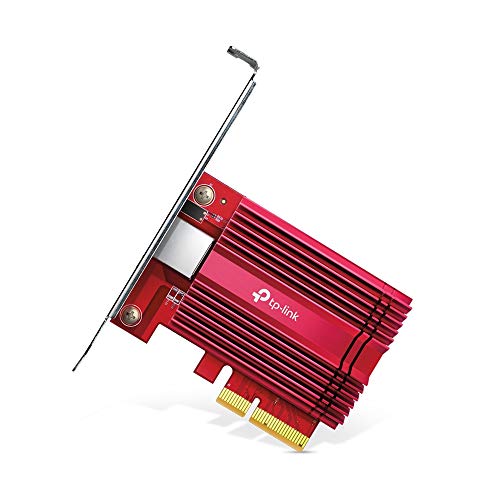
If you’re a gamer or a content creator looking to supercharge your network, the TP-Link 10GB PCIe Network Card (TX401) is a top choice. This PCIe to 10 Gigabit Ethernet adapter delivers blazing speeds of up to 10 Gbps, making it ten times faster than standard Gigabit adapters. Utilizing 10GBase-T technology, it’s backward compatible with various speeds, ensuring versatility. With Quality of Service (QoS) technology, you’ll experience prioritized performance and reduced network congestion during intense gaming sessions. Plus, it’s compatible with multiple Windows versions and Linux, and comes with low-profile and full-height brackets for easy installation. Enjoy industry-leading support and peace of mind!
Best For: Gamers and content creators looking for high-speed network performance and reduced latency.
Pros:
- Delivers speeds up to 10 Gbps, making it ten times faster than standard Gigabit adapters.
- Quality of Service (QoS) technology ensures prioritized performance, reducing network congestion during gaming.
- Compatible with multiple operating systems, including various Windows versions and Linux, with easy installation options.
Cons:
- May require a compatible motherboard with available PCIe slots for installation.
- Potentially higher cost compared to standard Gigabit network cards.
- Limited to wired connections, which may not suit users preferring wireless networking solutions.
10Gtek 10Gb Dual RJ45 Port Network Card with X540 Controller

The 10Gtek 10Gb Dual RJ45 Port Network Card with X540 Controller is an excellent choice for server administrators seeking high-speed connectivity and reliable performance. This PCIe Ethernet LAN adapter supports Windows, Linux, and ESX servers, making it versatile for various setups. Equipped with the original Intel X540 controller chip, it guarantees stable operation with intelligent offloads. You’ll appreciate the dual RJ45 ports for seamless connections up to 100 meters using Category-6A cables. Installation is simple, thanks to the included low-profile bracket. Plus, enjoy peace of mind with a 30-day free return policy and a three-year warranty.
Best For: Server administrators seeking high-speed connectivity and reliable performance in various operating environments.
Pros:
- Supports multiple operating systems, including Windows, Linux, and ESX servers.
- Equipped with the original Intel X540 controller chip for enhanced stability and performance.
- Easy installation with included low-profile bracket for small form factor cases.
Cons:
- Does not support hot swapping, requiring shutdown for installation or replacement.
- Manual setup may be required for compatibility with Windows 11.
- Limited to copper RJ45 connections, which may not suit all networking needs.
YuanLey 10G PCIe Network Card with Marvell Controller
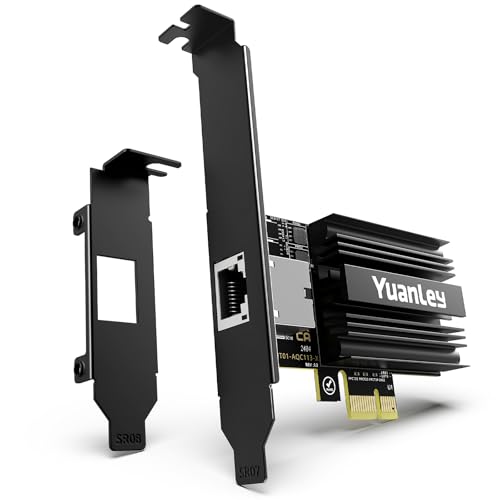
For gamers and content creators who demand ultra-fast networking capabilities, the YuanLey 10G PCIe Network Card with Marvell Controller stands out as an excellent choice. With its Marvell AQC113 chipset and PCIe 4.0 x1 interface, you’ll experience impressive speeds of up to 10GBASE-T, making it ideal for gaming and streaming. It supports various PCIe slots, ensuring compatibility with most desktops and workstations. Plus, installation is a breeze with included dual brackets. Enjoy plug-and-play convenience and lifetime technical support for peace of mind. The gold-plated connectors and solid capacitors guarantee durability, delivering reliable performance for all your data needs.
Best For: Gamers and content creators seeking ultra-fast networking capabilities for seamless gaming, streaming, and data-intensive tasks.
Pros:
- Ultra-fast speeds of up to 10GBASE-T suitable for high-demand applications.
- Broad compatibility with various PCIe slots and included dual brackets for easy installation.
- Durable design with gold-plated connectors and solid capacitors for reliable long-term performance.
Cons:
- May require a compatible motherboard with PCIe 4.0 support to achieve maximum performance.
- Limited to wired connections, which may not suit users preferring wireless networking.
- Potentially higher cost compared to standard network cards, which may deter budget-conscious buyers.
VIMIN 10G PCI-E Network Card with Dual RJ45 Ports

Designed for those who need blazing-fast connectivity, the VIMIN 10G PCI-E Network Card with Dual RJ45 Ports delivers a remarkable 10Gbps network speed. Equipped with the Intel X540-T2 controller, it guarantees high-speed data transmission, making it perfect for servers and high-end devices. Its excellent heat dissipation with a heat sink keeps temperatures ideal during heavy usage. Compatibility isn’t an issue, as it works seamlessly with Windows, Linux, and VMware. Plus, with standard and slim brackets available, installation is flexible. Enjoy stable connections thanks to the well-designed gold finger interface that minimizes interruptions for consistent performance.
Best For: Professionals and businesses that require high-speed data transmission for servers and high-end devices.
Pros:
- Delivers up to 10Gbps network connection speed for efficient data handling.
- Excellent heat dissipation with a heat sink for optimal performance during heavy usage.
- Compatible with multiple operating systems, including Windows, Linux, and VMware.
Cons:
- May require a PCI Express x8 or x16 slot, limiting compatibility with some older systems.
- Higher cost compared to standard network cards.
- Installation may be complex for users unfamiliar with hardware setups.
10Gtek 10Gb PCI-E NIC Network Card with Intel 82599EN Controller
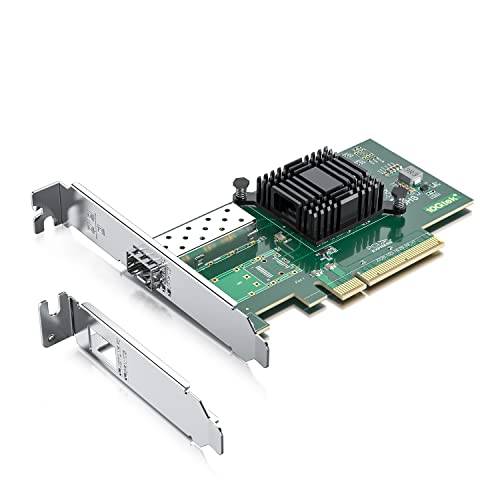
Engineered with the Intel 82599EN controller, the 10Gtek 10Gb PCI-E NIC Network Card is an ideal choice for those looking to enhance their PC’s networking capabilities, especially in data center environments. This card features a single SFP+ port, supporting 10G Ethernet for high-speed connections. It’s compatible with various operating systems, including Windows and Linux, but requires proper driver setup for Windows 10 on Windows 11. With its PCI-E X8 design, you can easily install it in most systems. Plus, it comes with a 3-year warranty and lifetime tech support, ensuring you’ve got assistance when needed.
Best For: Those seeking a high-performance networking solution for data center environments or advanced home setups with 10G Ethernet capabilities.
Pros:
- Supports high-speed 10G Ethernet connections for enhanced data transfer rates.
- Compatible with a wide range of operating systems including Windows and Linux.
- Includes a 3-year warranty and lifetime tech support for peace of mind.
Cons:
- Not compatible with 1G/2.5G/5G networks, limiting flexibility.
- Requires proper driver setup for Windows 10 to function on Windows 11.
- Installation not designed for hot swapping, which may inconvenience some users.
10G Base-T PCI-e Network Card (Marvell AQC113 Controller)
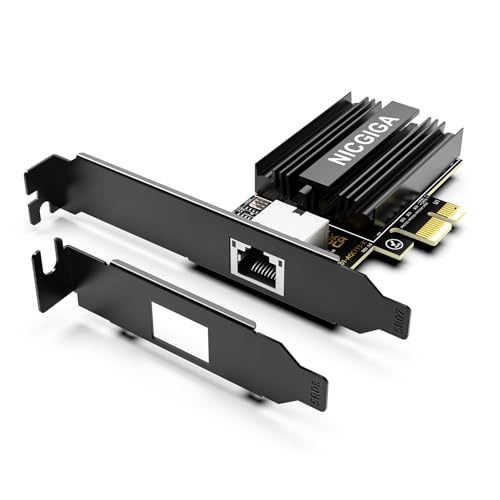
The 10G Base-T PCI-e Network Card featuring the Marvell AQC113 Controller is an ideal choice for gamers and professionals who demand high-speed connectivity. With speeds up to 10 Gbps, it guarantees stable internet access and local data transmission while preventing packet loss. This card is compatible with Windows 10/11, Windows Server, and Linux, making it versatile for various setups. Plus, its backward compatibility with multiple speeds allows seamless connection adjustments. Designed for desktops, workstations, and servers, it includes both standard and slim brackets for easy installation. With lifetime technical support and a solid 4.5-star rating, it’s a reliable option.
Best For: Gamers and professionals seeking high-speed connectivity and reliable network performance.
Pros:
- Provides speeds up to 10 Gbps, ensuring fast internet and data transmission.
- Backward compatibility with various speeds allows for flexible connection options.
- Includes both standard and slim brackets for easy installation in different setups.
Cons:
- Only compatible with PCIe slots, not PCI slots.
- May require additional setup or configuration for optimal performance on certain operating systems.
- The price point may be higher compared to standard network cards.
TP-Link 2.5GB PCIe Network Card (TX201)

If you’re looking to enhance your gaming experience or streamline high-bandwidth tasks, the TP-Link 2.5GB PCIe Network Card (TX201) is an excellent choice. This adapter delivers speeds up to 2.5 Gbps, making it 2.5 times faster than standard Gigabit solutions. It’s compatible with various operating systems, including Windows and Linux, and automatically negotiates between different speeds. With QoS technology, it prioritizes your gaming performance while reducing congestion. Plus, the Wake on LAN feature lets you power devices remotely. Weighing just 1.76 ounces, it includes both low-profile and full-height brackets, ensuring a perfect fit for your PC.
Best For: Gamers and users requiring high-bandwidth tasks looking for a fast and reliable network connection.
Pros:
- Delivers speeds up to 2.5 Gbps, significantly improving network performance over standard Gigabit adapters.
- Supports multiple operating systems, including Windows and Linux, ensuring compatibility across various setups.
- Includes both low-profile and full-height brackets, allowing for easy installation in different computer cases.
Cons:
- Limited to PCIe slots, which may not be available on older motherboards.
- Higher cost compared to standard Gigabit network cards, which may not be justified for casual users.
- May require driver installation, which could be a hurdle for less tech-savvy individuals.
ASUS XG-C100C 10G Network Adapter PCI-E Card

Looking for a network card that can handle bandwidth-intensive tasks without missing a beat? The ASUS XG-C100C 10G Network Adapter PCI-E Card is your go-to solution. With hyper-fast 10Gbps speeds, it delivers up to 10X faster data transfers, supporting 10/5/2.5/1Gbps and 100Mbps for seamless compatibility. This card connects easily through a single RJ-45 port, upgrading your desktop with standard copper cables. It’s fully compatible with Windows and Linux, ensuring flexible integration. Plus, built-in Quality-of-Service (QoS) technology prioritizes your bandwidth, giving you a smooth online experience for gaming and streaming. Upgrade today and release your network’s potential!
Best For: Users seeking high-speed network solutions for gaming, streaming, and bandwidth-intensive tasks.
Pros:
- Hyper-fast 10Gbps speeds provide up to 10X faster data transfer rates.
- Seamless compatibility with various network standards (10/5/2.5/1Gbps and 100Mbps).
- Built-in Quality-of-Service (QoS) technology ensures prioritized bandwidth for a smooth online experience.
Cons:
- May require a compatible motherboard with an available PCI-E x4 slot.
- Limited to a single RJ-45 port, which could be a drawback for multi-device setups.
- Higher cost compared to standard network adapters, which may not be justifiable for casual users.
WAVLINK 10G PCIe Network Card (AQC113 Controller)

For gamers and content creators seeking unparalleled speed, the WAVLINK 10G PCIe Network Card with the AQC113 Controller stands out as an exceptional choice. This adapter delivers lightning-fast transmission speeds of up to 10,000 Mbps, perfect for seamless HD streaming and lag-free gaming. It’s compatible with PCIe x4/x8/x16 slots and works well with both Windows 11/10 and Linux systems. Installation is a breeze thanks to the included low-profile bracket. Plus, the robust metal shielding minimizes interference, ensuring stable connections. With a stellar rating of 4.7 stars, it’s clearly a top contender in the 10Gb network card market.
Best For: Gamers and content creators who demand high-speed internet for seamless streaming and online gaming.
Pros:
- Lightning-fast speeds: Offers transmission speeds up to 10,000 Mbps for quick file transfers and smooth streaming.
- Wide compatibility: Works with PCIe x4/x8/x16 slots and supports both Windows and Linux operating systems.
- Easy installation: Comes with a low-profile bracket for versatile installation in various computer setups.
Cons:
- PCIe only: Not compatible with PCI slots, limiting installation options for older systems.
- Limited customer reviews: Only 31 reviews, which may not provide a comprehensive view of long-term performance.
- Potential overkill for casual users: The high-speed capabilities may exceed the needs of users with standard internet plans.
10Gtek 10Gb PCI-E NIC Network Card

The 10Gtek 10Gb PCI-E NIC Network Card stands out with its Broadcom BCM57810S chipset, making it an excellent choice for those seeking reliable performance in demanding server environments. You’ll appreciate the dual SFP+ ports, allowing connections to various 10 Gigabit modules, DAC, and AOC. This card’s compatibility with multiple operating systems, including Windows Server and Red Hat Enterprise Linux, guarantees seamless integration. Installation is a breeze, thanks to the included profile brackets for both standard and low-profile cases. Plus, with a one-year warranty and lifetime tech support, you can trust its durability and assistance whenever needed.
Best For: The 10Gtek 10Gb PCI-E NIC Network Card is best for server administrators and IT professionals seeking high-performance network solutions in data center environments.
Pros:
- Reliable Performance: Features the Broadcom BCM57810S chipset for enhanced stability in demanding applications.
- Versatile Connectivity: Dual SFP+ ports support various 10 Gigabit modules, DAC, and AOC for flexible networking options.
- Easy Installation: Comes with both standard and low-profile brackets for compatibility with different case sizes.
Cons:
- No Hot Swapping: The card does not support hot swapping, requiring a system shutdown for installation or replacement.
- Limited OS Support: While it supports several operating systems, it may not be compatible with all Linux distributions or newer versions.
- Potential Overkill for Small Networks: The 10Gb capability may be excessive for smaller, less demanding network setups.
Factors to Consider When Choosing a 10GB Network Card for PC
When choosing a 10GB network card for your PC, you need to contemplate several key factors. Speed and performance metrics, compatibility with your operating system, and installation ease are essential to ensuring ideal functionality. Don’t overlook connection types and build quality, as they can greatly impact your network experience.
Speed and Performance Metrics
Choosing a 10GB network card for your PC hinges on understanding speed and performance metrics that can greatly impact your experience. A 10GB network card can reach speeds up to 10 Gbps, making it perfect for demanding tasks like gaming and video streaming. Many cards also support backward compatibility with lower speeds (5 Gbps, 2.5 Gbps, and 1 Gbps), ensuring flexibility with existing networks. Look for Quality of Service (QoS) technology, which prioritizes data packets to minimize latency during high-traffic situations. The chipset matters too; some controllers enhance stability and optimize performance with features like Intelligent Offloads. Additionally, most cards fit various PCIe slots (X1, X4, X8, X16), making installation a breeze across different systems.
Compatibility With Operating Systems
Compatibility with operating systems is a key factor in selecting the right 10GB network card for your PC. Make sure the card supports your operating system, whether it’s Windows 10, 11, or various Linux distributions, as some may need specific configurations for peak performance. If you’re using older versions of Windows Server, check compatibility with Server 2003, 2008, and 2012, especially for enterprise setups. Look for cards with backward compatibility for lower speeds like 1Gbps and 100Mbps, ensuring versatility in different network environments. Also, confirm the PCIe slot compatibility (X1, X4, X8, or X16) with your motherboard. Finally, consider cards that support Wake-on-LAN (WOL) and auto-negotiation features for enhanced functionality across systems.
Installation Ease and Flexibility
Selecting a 10GB network card also involves considering how easy it is to install and how flexible it is for different setups. Look for network cards that come with both full-height and low-profile brackets to fit various PC cases, including compact systems. Cards that offer plug-and-play installation are a bonus, simplifying the setup by reducing complex configurations. Guarantee the card is compatible with multiple PCIe slot types—like x1, x4, x8, and x16—for added flexibility across different motherboards. It’s also wise to check if the card supports Wake-on-LAN (WOL) for convenient remote management. Finally, opt for products that provide clear installation instructions or customer support to help you tackle any setup challenges you might face.
Connection Types and Ports
When it comes to 10GB network cards, the type of connection ports you choose plays an essential role in guaranteeing compatibility with your current network setup. You’ll typically find options like RJ45 for standard Ethernet cables and SFP+ for fiber connections, which can greatly impact your network’s performance. Consider cards with dual ports for redundancy and load balancing, enhancing reliability during heavy data loads. It’s important to verify that the card supports backward compatibility for various speeds, from 10Gbps down to 100Mbps, so you’re flexible as your network needs change. Also, look for cards that include both standard and low-profile brackets for easy installation in different PC configurations, and check compatibility with your operating system for peak functionality.
Durability and Build Quality
While you might focus on speed and connectivity when choosing a 10GB network card, durability and build quality are just as vital for long-term performance. Look for cards with gold-plated connectors to reduce signal degradation and enhance longevity. A well-refined PCB design not only boosts durability but also guarantees stable performance even under heavy usage. Opt for solid capacitors, as they provide a longer lifespan and improved stability compared to standard options. Robust metal shielding is important too, minimizing electromagnetic interference that can affect reliability over time. Finally, excellent heat dissipation features, like integrated heat sinks, help maintain ideal temperatures, further prolonging your network card’s lifespan and assuring reliable operation.
Support and Warranty Options
Support and warranty options play an essential role in your decision-making process for a 10GB network card. Look for cards that come with at least a 1 to 3-year warranty, protecting you against defects and malfunctions. Many manufacturers also offer lifetime technical support, which can be invaluable for troubleshooting installation issues or optimizing performance. Additionally, consider options with a 30-day free return policy; this lets you test the product and return it if it doesn’t meet your needs. Ascertain the warranty covers various operating systems, as compatibility can differ greatly. Finally, check if the card includes both standard and low-profile brackets, enhancing installation flexibility with different PC cases.
Power Consumption Considerations
Power consumption is an essential factor to keep in mind as you choose a 10GB network card for your PC, especially since higher performance cards can draw more energy. Many cards operate within a power range of 5W to 25W, influenced by features like multiple ports and advanced processing capabilities. Always check the specifications for idle and maximum power consumption; cards with power-saving features can considerably reduce energy use during low-traffic periods. Evaluating the Thermal Design Power (TDP) helps you understand heat generation, which affects cooling needs and overall system efficiency. By selecting a network card that balances performance with lower power consumption, you can save on energy bills, particularly in data-intensive environments.
Price and Value Assessment
When choosing a 10GB network card for your PC, understanding price and value is crucial. These cards typically range from around $100 to over $300, so it’s essential to evaluate what features you need. Look for cards that support speeds up to 10 Gbps and are backward compatible with 1 Gbps or 100 Mbps. Factor in warranty and support; longer warranties and 24/7 technical assistance often add value. Don’t forget to take into account additional costs for accessories like cables or installation brackets, which can increase your total expenditure. Finally, analyze user reviews and ratings; higher-rated cards usually justify a higher price point due to their reliability and performance.