The ACEMAGIC M1 Mini PC review starts with a simple question: can a small desktop really feel fast enough for serious everyday work?
In this case, the answer is mostly yes.
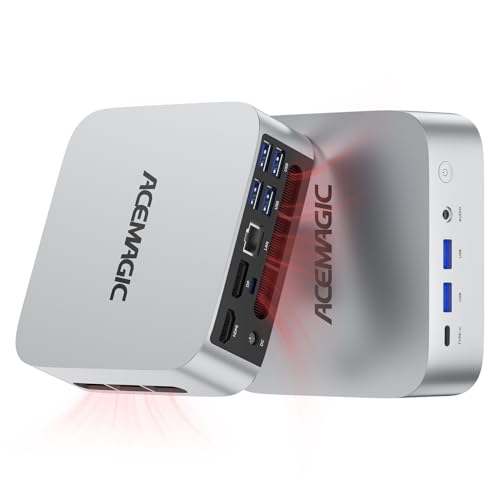
ACEMAGIC M1 Review Summary
The ACEMAGIC M1 Mini PC is a compact Windows 11 Pro desktop built for buyers who want serious productivity performance in a small footprint.
It pairs an Intel Core i9-11900H, 32GB of DDR4 memory, and a 1TB SSD, which makes it especially appealing for office users, students, home workers, media consumers, and anyone building a tidy dual- or triple-monitor workstation.
If you want a mini PC that feels closer to a full desktop than an entry-level office box, the ACEMAGIC M1 Mini PC is a compelling option.
It is best for multitasking, productivity, 4K media, photo work, and light gaming, while its upgradeable RAM and extra SSD slot give it more flexibility than many compact systems in this class.
Scorecard
| Category | Score | Why It Matters |
|---|---|---|
| Performance | 9.0 | Intel Core i9-11900H with 8 cores, 16 threads, and up to 4.9GHz handles demanding everyday workloads well. |
| Multitasking & Memory | 9.0 | 32GB dual-channel DDR4 is excellent for many open apps, tabs, and productivity tools. |
| Storage Flexibility | 8.0 | 1TB SSD plus an extra M.2 PCIe 3.0 slot gives useful expansion room. |
| Display Support | 9.0 | Triple-display output and 4K at 60Hz suit modern workspaces well. |
| Connectivity | 8.0 | WiFi 6, Bluetooth 5.2, and 2.5G Ethernet support modern networking needs. |
| Port Selection | 8.0 | Front and rear USB options plus HDMI, DP, Type-C, and audio make setup convenient. |
| Size & Practicality | 9.0 | Its compact mini PC design is easy to place, mount, and keep out of the way. |
Bottom line: the ACEMAGIC M1 Mini PC is a strong choice if you need a compact Windows desktop with more muscle than basic mini systems.
It is not a gaming-first machine, but for business, home office, and multitasking users, it offers a very practical balance of speed, ports, and upgradability.
Key Features and Specifications of ACEMAGIC M1
Here is a clear look at the core specifications that shape the ACEMAGIC M1 Mini PC experience.
These are the details buyers should weigh before choosing a mini desktop over a laptop or larger tower.
| Specification | Details |
|---|---|
| Processor | Intel Core i9-11900H |
| Cores / Threads | 8 cores / 16 threads |
| Max CPU Speed | Up to 4.9GHz |
| Memory | 32GB DDR4 dual-channel (2 x 16GB) |
| Maximum Memory | Up to 64GB |
| Storage | 1TB M.2 2280 SSD |
| Expansion Storage | Additional M.2 PCIe 3.0 slot |
| Graphics | Integrated Intel UHD Graphics |
| Operating System | Windows 11 Pro |
| Video Outputs | HDMI 2.0, DisplayPort 1.4, Type-C with DP1.4 video |
| Display Support | Triple display, 4K at 60Hz |
| Networking | WiFi 6, Bluetooth 5.2, Ethernet up to 2.5G listed |
| USB Ports | 2 x front 10Gbps Type-A, 4 x rear 5Gbps Type-A |
| Other Ports | USB Type-C, 3.5mm audio jack, DC input |
| Cooling | Air and heat pipe cooling with silent high-speed centrifugal fan |
| Weight | 1.33 kg |
| Color | Silver |
| Warranty | 3-year limited warranty |
| Certifications | FCC, ROHS, CE |
| Recycled Material | 50%+ certified recycled material |
From a buyer’s perspective, the most important features are the high-core-count CPU, large memory allocation, and triple-display support.
Those three elements define the ACEMAGIC M1 Mini PC more than anything else.
The included 1TB SSD is also a meaningful advantage because it reduces the need for immediate storage upgrades.
One design choice that stands out is the mix of front and rear USB ports.
Having two front 10Gbps Type-A ports is helpful for quick access to external drives, flash storage, and accessories.
Meanwhile, the rear panel keeps the permanent cables tidy for monitors, networking, and audio.
Pros and Cons of ACEMAGIC M1
Every mini PC has trade-offs, and the ACEMAGIC M1 Mini PC pros and cons are easy to understand once you look at its intended use.
This is a compact productivity system first, and a gaming system only in a limited sense.
| Pros | Cons |
|---|---|
| Strong Intel Core i9 CPU for everyday speed and demanding multitasking | Integrated graphics limit serious AAA gaming and heavy 3D creation |
| 32GB RAM is excellent for productivity and browser-heavy workflows | Mini PC design means expansion is mostly limited to RAM and storage |
| 1TB SSD provides a solid out-of-box storage base | Thermals and acoustics can vary depending on workload and placement |
| Triple-display output supports efficient workstation setups | Some listing details appear mixed, so buyers should verify the exact port/network configuration |
| WiFi 6, Bluetooth 5.2, and Ethernet make it flexible for modern setups | Availability may be inconsistent |
| Compact, low-clutter form factor is ideal for small desks | Not the best match for users wanting a graphics-upgrade path |
Best strengths: speed, multitasking, display flexibility, and desk-friendly design.
Main drawback: integrated graphics keep it from competing with gaming desktops or workstation PCs with dedicated GPUs.
Performance for Office, Editing, and Light Gaming
The ACEMAGIC M1 Mini PC is positioned as a mini desktop that can cover office work, media, education, and some lighter creative tasks, and that is exactly where it makes the most sense.
The Intel Core i9-11900H brings 8 cores and 16 threads, which is a major reason this machine feels more capable than basic low-power mini PCs.
For office use, this should feel fast in Microsoft Office, browser-heavy workflows, bookkeeping tools, messaging apps, cloud dashboards, and video calls.
The 32GB of DDR4 RAM is especially important here, because it gives the system enough headroom for lots of open tabs and background tasks without immediately feeling cramped.
For editing, the ACEMAGIC M1 Mini PC should handle light-to-moderate photo work and casual content creation well, especially if the workload is more CPU- and memory-driven than GPU-heavy.
The included 1TB SSD also helps with quicker boot times, project loading, and general responsiveness.
Light gaming is realistic, but only within limits. Integrated Intel UHD Graphics are fine for older games, emulation, indie titles, and lighter competitive games at modest settings.
If you want dependable performance in modern AAA games, however, this is not the right class of machine.
That distinction matters because many buyers searching for an ACEMAGIC M1 Mini PC review are comparing it to small gaming-capable boxes.
In practice, the M1 is better described as a high-performance productivity mini PC than a gaming mini desktop.
Ports and Multi-Monitor Setup
One of the biggest reasons to consider the ACEMAGIC M1 Mini PC is its display flexibility.
It supports triple displays through HDMI, DisplayPort, and Type-C, and it can output 4K at 60Hz.
That makes it much more useful than basic mini PCs for users who want a true workstation feel.
If you work across spreadsheets, dashboards, browser tabs, and documents, adding a second or third monitor can dramatically improve efficiency.
The M1’s output options are especially appealing for home offices, accounting setups, trading desks, reception areas, and small business workstations.
Port selection is also practical.
The combination of front 10Gbps Type-A ports and rear USB ports helps separate everyday accessories from permanent connections.
Add in Bluetooth 5.2 for wireless peripherals and WiFi 6 for stable networking, and the system is well equipped for modern desktop use.
One thing to note is the listing’s mixed wording around networking, particularly the reference to 2.5G Ethernet alongside gigabit language.
Buyers who need a very specific wired networking configuration should verify the final spec before purchase.
For most office and home users, though, the included networking package is more than sufficient.
Storage and Upgrade Path
The ACEMAGIC M1 Mini PC starts with a sensible storage setup: 1TB SSD included.
That is enough for Windows 11 Pro, productivity applications, media files, and a fair amount of personal data without forcing an immediate upgrade.
The more important detail for long-term value is the extra M.2 PCIe 3.0 expansion slot.
This gives you room to add or expand storage later, which is a major advantage for buyers who expect their library of files, games, or project assets to grow over time.
Memory is expandable too, with support up to 64GB RAM.
For most users, 32GB is already more than enough, but the ceiling matters if you plan to keep the machine for several years or use heavier multitasking workloads.
That level of upgradeability is one reason the ACEMAGIC M1 Mini PC stands out in the crowded mini PC market.
In other words, the machine is not just fast on day one.
It also offers a realistic path for keeping pace with future workload growth, which is a major buying factor in this category.
Cooling, Noise, and Everyday Usability
Cooling is one of the make-or-break concerns for any compact PC.
The ACEMAGIC M1 Mini PC uses an air and heat pipe cooling design with a silent high-speed centrifugal fan, which is the right kind of approach for a system built around a powerful mobile CPU.
For light workloads, you should expect a fairly unobtrusive desktop experience.
During heavier multitasking or sustained CPU use, noise will naturally increase, but the main advantage here is that the system is designed to manage heat without requiring a large tower chassis.
That makes it much easier to place on a desk, behind a monitor, or in a space-limited office.
Everyday usability is one of the M1’s biggest wins. The 1.33 kg weight, small footprint, and clean silver finish make it easy to integrate into both home and business setups.
It is the kind of machine you can mount, hide, or position without changing the look of a room.
That said, mini PC buyers should always remember a practical rule: compact systems often demand better airflow around the unit.
If you tuck it into a closed shelf or cram it behind clutter, thermal performance may suffer.
Placement matters.
Best Use Cases for Home and Business
The ACEMAGIC M1 Mini PC makes the most sense in situations where space, responsiveness, and multi-display support matter more than raw GPU power.
It fits several buyer profiles particularly well.
- Home office users who want a quiet, compact Windows desktop for email, documents, calls, and web work.
- Small business buyers who need dependable everyday performance for staff workstations, front-desk use, or back-office tasks.
- Students and remote workers who value a small footprint and enough power for multitasking.
- Media and family PC users who want a tidy system for streaming, browsing, and general household use.
- Light creative users doing photo editing, content prep, and project organization.
It is less ideal for buyers who want a desktop for high-end gaming, 3D rendering, or GPU-accelerated professional workloads.
Those users should look at systems with discrete graphics or larger desktops with better upgrade room.
ACEMAGIC M1 Mini PC Pros and Cons in Real-World Context
If you are narrowing down your choices, the real question is not whether the ACEMAGIC M1 Mini PC is fast enough in isolation.
It is whether it offers the right balance of speed, size, and flexibility for your setup.
Why it stands out: the processor and memory combination is unusually capable for a mini form factor, and the storage-plus-expansion setup gives you better longevity than many entry-level systems.
The triple-display support is also a meaningful productivity advantage.
Where it falls short: integrated graphics cap its ambitions.
If your idea of a mini PC includes modern gaming at high settings or demanding creative workloads, this is the wrong class of machine.
Also, the mixed spec presentation means detail-oriented buyers should confirm the exact configuration before ordering.
That makes the ACEMAGIC M1 Mini PC a smart purchase for buyers who value practical desktop performance over flashy specs.
It is not trying to be a gaming rig.
It is trying to be a compact, capable, low-clutter Windows desktop—and that is where it performs best.
Alternatives to Consider
If you are comparing the ACEMAGIC M1 Mini PC against other compact desktops, a few Amazon-friendly alternatives are worth checking.
These options are broad enough to compare without locking you into one narrow configuration.
- Beelink mini PC – a popular alternative if you want to compare similar compact Windows systems with strong everyday performance.
- MINISFORUM mini PC – often considered by buyers who want a mini desktop with a different balance of ports, chips, and upgrade paths.
- Intel NUC mini PC – a common benchmark for compact PCs, especially for business and home office use.
- Ryzen 7 mini PC – worth considering if you want to compare AMD-based alternatives for productivity and integrated graphics performance.
- small form factor office desktop – a good category to explore if you prefer a slightly larger chassis with different expansion options.
In most cases, your choice will come down to CPU platform, port layout, cooling behavior, and whether you want a more office-oriented machine or something better suited to mixed creative use.
Who Should Buy ACEMAGIC M1?
The ACEMAGIC M1 Mini PC is a strong fit for buyers who need a compact Windows 11 Pro desktop with real multitasking headroom.
It is particularly well matched to home offices, business workstations, students, and users who want dual- or triple-monitor productivity in a small footprint.
You should buy it if you care about fast everyday responsiveness, generous RAM, solid storage, and the convenience of a mini PC that can disappear behind a monitor or sit neatly on a desk.
It is also a good fit if you want a system that can grow a bit over time thanks to expandable memory and extra SSD support.
You should probably skip it if your main need is gaming, GPU-heavy editing, or a highly modular desktop that can accept a dedicated graphics card later.
In those cases, a larger desktop or a different mini PC class would be a better match.
Best fit summary: the ACEMAGIC M1 Mini PC is for practical buyers who want speed, convenience, and a clutter-free setup more than raw graphics power.
Is ACEMAGIC M1 Worth It?
Yes, the ACEMAGIC M1 Mini PC is worth it for the right buyer. If you need a compact desktop for productivity, home office work, media, and multitasking, it delivers an appealing combination of CPU power, 32GB RAM, 1TB storage, and triple-display support.
The biggest reasons to choose it are straightforward: strong everyday performance, useful upgrade options, modern connectivity, and excellent desk practicality.
The biggest reason to avoid it is also straightforward: integrated graphics keep it from being a true gaming or heavy-creation machine.
If that trade-off fits your needs, this is a smart mini PC to consider.
If you want a cleaner, more capable workspace without giving up responsiveness, the ACEMAGIC M1 Mini PC makes a lot of sense.
For most buyers in the productivity-first category, it is a solid buy and a better value than many underpowered mini desktops.