A forward-tilting seat can help bring your hips closer to a neutral working position, especially when reading, typing, or leaning toward a desk. The right chair should pair that feature with supportive lumbar adjustment, comfortable cushioning or mesh, and stable, precise controls.
We compared 10 ergonomic office chairs with forward tilt across adjustability, weight capacity, posture support, materials, and practical desk-day comfort. Use the guide below to narrow the list by your workspace, body type, and preferred sitting style.
Best 10 Ergonomic Office Chair with Forward Tilt Picks for 2026
Best for Big-and-Tall Users

- 330-pound capacity for a spacious fit
- 8° forward tilt for focused desk work
- Dual-mode lumbar and adjustable seat depth
Best For: Big-and-tall users needing customizable forward-tilt support
Best High-Capacity Premium Option
FLEXISPOT ErgoX Forward-Tilt Chair

- 400-pound maximum weight recommendation
- Adjustable tilt, depth, lumbar, headrest, and arms
- Includes recline and nap footrest features
Best For: Users wanting extensive adjustability and a high-capacity design
Best for Commercial-Grade Stability

- ANSI/BIFMA X5.1 and SGS durability testing
- 3D arms and adjustable padded lumbar
- Three-stage recline with tension control
Best For: Workspaces seeking tested stability and flexible positioning
Best Overall Adjustment Range

- 14 adjustment points for a personalized fit
- Forward tilt supports active sitting
- 5D armrests and two-way lumbar support
Best For: Desk workers who want extensive ergonomic customization
Soft-Cushion Comfort Pick

- Memory-foam seat for softer all-day comfort
- Adaptive lumbar support follows posture changes
- Three lockable recline angles and adjustable headrest
Best For: Home-office users who prefer cushioned seating and flexible ergonomic adjustments
Forward-Tilt Adjustment Pick

- Dedicated seat-forward and forward/backward tilt functions
- Eight backrest-height and four seat-depth adjustments
- Breathable mesh back with supportive foam seat
Best For: Focused desk work requiring precise posture and seat-position adjustment
Maximum Adjustability Pick

- Multi-directional 3D lumbar adjustment
- 3D armrests and 2D adjustable headrest
- 350-pound capacity with breathable mesh
Best For: Users seeking highly customizable back, arm, and head support
Flexible Mesh Support
MOLENTS Ergonomic Office Chair
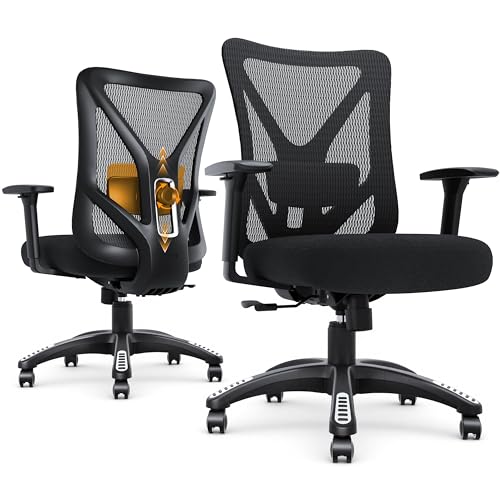
- Adjustable lumbar support and 3D armrests
- Breathable mesh with a wide seat
- 90°–120° tilt-back range
Best For: Everyday office work with customizable back and arm support
Recline-and-Rest Comfort

- 90°/110°/135° reclining positions
- Adjustable lumbar, headrest, and 3D arms
- 300-pound capacity with retractable footrest
Best For: Workstations that double as comfortable reclining areas
Heavy-Duty Precision Support

- Eight-level micro-adjustable lumbar support
- 400-pound weight recommendation
- 90°/110°/125° backrest positions
Best For: Long desk sessions and larger users needing robust support
Best for Big-and-Tall Users – Axis One Forward-Tilt Chair
If you need an ergonomic office chair with forward tilt and a higher weight capacity, the Axis One combines an 8° forward-tilt seat with adjustable lumbar support and a spacious fit. Its mesh construction, adjustable seat depth, headrest, and arms make it suitable for focused desk work.
Best For: Big-and-tall users who want forward tilt and customizable lumbar support.
Pros:
- Supports up to 330 pounds and is designed for users from 5’4″ to 6’3″.
- 8° forward tilt supports engaged typing, drafting, coding, and detailed desk work.
- Dual-mode lumbar support, adjustable seat depth, headrest, and arms provide multiple fit options.
- Includes a 125° recline, leg rest, breathable mesh, and 95% pre-assembly.
Cons:
- Its 52-pound weight may make moving or repositioning the chair more difficult.
- The 125° nap mode and leg rest may be unnecessary for shoppers seeking a simple task chair.
The Axis One is a strong choice when capacity, adjustability, and forward-leaning work support matter most. Its extra recline features add versatility, while the five-year product support provides additional long-term reassurance.
Best High-Capacity Premium Option – FLEXISPOT ErgoX Forward-Tilt Chair
The FLEXISPOT ErgoX is an ergonomic office chair with forward tilt designed for users who want broad adjustability and a high weight limit. Its adjustable seat depth, dynamic lumbar support, 3D headrest, 3D arms, and optional footrest make it suited to both work and relaxation.
Best For: Users who want a highly adjustable chair with a 400-pound capacity and reclining features.
Pros:
- Supports up to 400 pounds and fits users from 5’1″ to 6’2″.
- Adjustable seat depth, height, tilt, dynamic lumbar, back angle, and 3D headrest support personalized positioning.
- 3D armrests adjust in height, forward/backward position, and swivel.
- Offers a mesh seat option, recline, nap footrest, and three reclining positions.
Cons:
- Assembly is required.
- The many adjustments may feel more involved than necessary for shoppers seeking a basic office chair.
Choose the ErgoX when maximum capacity and extensive adjustability are higher priorities than simplicity. The footrest and multiple recline positions also make it more adaptable for reading, gaming, and breaks away from active desk work.
Best for Commercial-Grade Stability – GABRYLLY 3-Stage Tilt Chair
This GABRYLLY chair is an ergonomic office chair with forward tilt appeal for shoppers who value adjustable positioning, although the supplied specifications emphasize a three-stage tilt and recline system rather than a dedicated forward-tilt angle. It combines adjustable lumbar support, 3D arms, a waterfall seat, and commercial testing for sustained desk use.
Best For: Home or company workspaces needing a tested task chair with flexible arm and recline adjustments.
Pros:
- Adjustable padded lumbar support moves vertically to personalize lower-back support.
- 3D armrests offer height, forward/backward, and rotational adjustment.
- Passed ANSI/BIFMA X5.1 and SGS durability tests and supports up to 300 pounds.
- Three-stage recline, tension control, breathable mesh, and a waterfall seat support varied work positions.
Cons:
- The supplied notes do not specify a dedicated forward-tilt seat angle.
- Assembly is required, though the product is described as taking under 20 minutes to assemble.
This chair is better suited to buyers prioritizing commercial-grade stability and recline control over a clearly defined forward-tilt feature. Its broad armrest adjustment and waterfall seat make it a practical option for mixed work, gaming, and relaxation use.
Best Overall Adjustment Range – Branch Ergonomic Chair Pro
The Branch Ergonomic Chair Pro is an ergonomic office chair with forward tilt that focuses on precise fit. With 14 adjustment points, a forward-tilting seat cushion, two-way lumbar support, and 5D armrests, it is designed for users who frequently shift between typing, focused work, and reclining.
Best For: Users who want extensive ergonomic adjustments and active-sitting support.
Pros:
- Offers 14 adjustment points for tailoring height, depth, tilt, lumbar, and arm positioning.
- Forward tilt supports posture shifts and leaning toward the desk.
- 5D armrests adjust in height, width, depth, pivot, and pad position.
- Two-way lumbar support and a molded high-density foam cushion provide targeted support.
Cons:
- Its maximum weight recommendation is 275 pounds, lower than several high-capacity alternatives.
- Assembly is required.
- The solid-back design may provide less airflow than a fully mesh back.
The Chair Pro is a compelling pick for shoppers who want to fine-tune nearly every contact point. Its forward tilt and extensive armrest adjustment are especially useful for desk-intensive work, while the cushion adds support for longer sessions.
Soft-Cushion Comfort Pick – SIHOO B100 SE Ergonomic Chair
The SIHOO B100 SE is a practical choice if you want an ergonomic office chair with forward tilt that also feels softer than a traditional mesh seat. Its adaptive lumbar support is designed to follow posture changes, while the memory-foam cushion, adjustable height, headrest, flip-up armrests, and three lockable recline angles support varied work setups.
Best For: Home-office users who prioritize cushioned comfort, adaptive lumbar support, and occasional reclining.
Pros:
- Thick memory-foam cushioning helps reduce pressure on the hips and thighs.
- Dynamic lumbar support follows changes between forward-leaning and upright postures.
- Seat height, headrest, and flip-up armrests offer useful setup flexibility.
- Three lockable angles from 110° to 135° support work, breaks, and relaxation.
Cons:
- The supplied specifications describe tilt angles but do not explicitly confirm a dedicated forward-tilt lock.
- The cushioned seat may feel warmer than a fully mesh seat during extended use.
Choose this model when seat softness is as important as ergonomic adjustment. The 300-pound capacity, SGS and BIFMA compliance, 36-month coverage, and 30-day returns add reassurance for daily office use.
Forward-Tilt Adjustment Pick – boulies OP180 Office Chair
The boulies OP180 is a strong match for shoppers specifically seeking an ergonomic office chair with forward tilt. Its seat-forward function, forward/backward tilt, adjustable seat depth, height-adjustable backrest, and breathable mesh back let you fine-tune the chair for focused typing as well as relaxed sitting.
Best For: Users who want extensive fit adjustment and a clearly stated forward-leaning work position.
Pros:
- Forward tilt and seat-forward adjustment support focused desk work.
- Eight backrest-height levels and four seat-depth settings accommodate different body types.
- Breathable mesh back promotes airflow, while the thick foam seat helps distribute weight.
- Lockable recline ranges from 79° to 103° for upright work and light relaxation.
Cons:
- The 160-kilogram capacity is lower than some higher-capacity office chairs.
- Its extensive adjustment options may require more setup time to dial in.
This is the most directly aligned option for forward-tilt use because the supplied description explicitly highlights leaning forward to focus. Its durable tilt mechanism, smooth nylon casters, quick assembly claim, and two-year warranty further suit regular home or office use.
Maximum Adjustability Pick – Holludle V-Back Mesh Chair
The Holludle V-Back is worth considering if an ergonomic office chair with forward tilt should also provide highly adjustable lumbar and arm support. Its 3D lumbar system moves in multiple directions, while the 2D headrest, 3D armrests, breathable mesh, and three-position tilt lock help tailor the chair for work, gaming, and relaxation.
Best For: Users who want extensive lumbar, armrest, and headrest customization in a breathable mesh chair.
Pros:
- 3D lumbar support adjusts up, down, forward, backward, and rotationally.
- 3D armrests and a 2D headrest provide multiple fit adjustments.
- Breathable mesh and a three-position tilt lock support different activities.
- 350-pound capacity, BIFMA and EN1335 compliance, and a five-year warranty add confidence.
Cons:
- The supplied details confirm three tilt-lock positions but do not specifically identify a forward-tilt setting.
- The white finish may show marks more readily than a darker chair.
- Assembly is estimated at 20–30 minutes, longer than the quickest-assembly option here.
This chair stands out for users who need to fine-tune back, arm, and neck support rather than rely on basic adjustments. Consider it when breathable mesh and a higher stated weight capacity matter more than a specifically documented forward-tilt feature.
Flexible Mesh Support – MOLENTS Ergonomic Office Chair
If you want an ergonomic office chair with forward tilt, note that this MOLENTS model emphasizes adjustable lumbar and arm support rather than specifying a forward-tilt function. Its breathable mesh seat and back, wide cushion, and 90°–120° reclining range make it a practical option for everyday work at home or in a shared office.
Best For: Users seeking adjustable lower-back and arm support with a breathable mesh build for office work.
Pros:
- Two-way adjustable lumbar support moves vertically and horizontally.
- 3D armrests adjust to support the arms and shoulders.
- Breathable mesh, a wide seat, and three reclining positions support extended work sessions.
- BIFMA X5.1 certification and a stated two-year warranty add practical reassurance.
Cons:
- The supplied specifications describe tilt-back positions, but do not confirm a forward-tilt setting.
- Users needing a different gas-lift height must contact the manufacturer.
- The armrest panels slide and rotate, which may not suit users who prefer fixed armrests.
Choose this chair when breathable materials and adjustable lumbar positioning matter most. For a true forward-tilt mechanism, verify the product controls before ordering.
Recline-and-Rest Comfort – GABRYLLY Chair with Footrest
For shoppers comparing an ergonomic office chair with forward tilt, this GABRYLLY model is designed around reclining comfort instead: it offers 90°, 110°, and 135° positions, plus a retractable footrest. The adjustable lumbar support, 3D armrests, headrest, and large steel base make it suited to workspaces where users also want to relax between tasks.
Best For: People who want a heavy-duty work chair that can transition from upright work to reclining breaks.
Pros:
- Two-way lumbar adjustment provides 3 inches of vertical and 1.6 inches of horizontal movement.
- 3D armrests and an adjustable mesh headrest support personalized positioning.
- 135° recline and a retractable two-level footrest accommodate rest breaks or naps.
- Supports up to 300 pounds and includes a large steel base with silent wheels.
Cons:
- The supplied notes specify reclining positions, not a forward-tilt function.
- Its footrest and reclining design may be more chair than needed for a compact task-focused workspace.
- The stated user-fit range is approximately 5’3″ to 6′ tall.
This is a strong choice for users who prioritize adjustability and relaxation features over forward tilting. Confirm the mechanism details if forward tilt is a must-have feature.
Heavy-Duty Precision Support – Adjustable 400-Lb Mesh Chair
This high-capacity mesh chair is worth considering when evaluating an ergonomic office chair with forward tilt, although its supplied specifications describe three tilt-back positions rather than forward tilt. Its micro-adjustable lumbar support, large cooling seat, adjustable headrest, and flip-up arms are geared toward long desk sessions.
Best For: Taller users and demanding work setups needing extensive lumbar adjustment and a 400-pound weight recommendation.
Pros:
- Eight-level lumbar adjustment provides 2 inches of micro-adjustment.
- The enlarged mesh seat is designed for airflow and extended sitting comfort.
- Backrest locks at 90°, 110°, or 125° for different work and relaxation angles.
- Flip-up 4D arms, adjustable headrest, silent PU wheels, and a stainless-steel base add versatility.
Cons:
- The supplied notes do not confirm a forward-tilt feature.
- Its 45.3-inch listed height and high-back form may be oversized for smaller work areas.
- Assembly is typically about 30 minutes.
Among these options, this model stands out for its 400-pound capacity and highly granular lumbar adjustment. It is a better fit for long workdays and larger users than for shoppers specifically requiring forward tilt.
How We Picked the Best Ergonomic Office Chair with Forward Tilt
We focused on chairs that explicitly offer a forward-tilt seat or a mechanism designed to support a more upright, forward-working posture. We also considered the adjustments that determine whether forward tilt feels useful rather than restrictive: seat height and depth, lumbar support, armrest positioning, backrest recline, headrest movement, and tilt-tension control.
Additional factors included stated weight limits, seat width, breathable materials, base stability, caster design, certification claims, and the range of intended users. Because comfort is subjective, the selections span compact mesh task chairs, larger-capacity models, premium adjustment systems, and chairs with extras such as footrests.
Quick Comparison
- Best for maximum adjustability: Branch Ergonomic Chair Pro and FLEXISPOT ErgoX Premium.
- Best for larger users: the 330-pound dynamic-lumbar chair, SIHOO B100 SE, and 400-pound high-back model.
- Best for breathable everyday use: the boulies OP180 and mesh task-chair options.
- Best for reclining and relaxation: the chair with footrest and 135-degree recline.
- Best for flexible arm support: models with 3D or 4D armrests and flip-up functionality.
Key Buying Factors for an Ergonomic Office Chair with Forward Tilt
Forward-Tilt Range and Control
Look for a clearly defined forward-tilt setting, not just a general rocking mechanism. A lockable position is useful for typing, while adjustable tension helps prevent the seat from feeling unstable. Test whether the front edge remains comfortable when the seat tilts downward.
Seat Fit and Posture Support
Your feet should rest flat on the floor with your knees comfortably supported. Seat depth adjustment is especially valuable because it helps position the back against the lumbar support without pressing the front edge into your legs. A waterfall-style edge or flexible seat pan can improve circulation during long sessions.
Lumbar, Arm, and Backrest Adjustments
Prioritize lumbar support that can move vertically or in depth. Arms should allow your shoulders to relax while your elbows stay near your sides; 3D and 4D designs offer more positioning freedom. A breathable backrest and a recline range are useful when alternating between focused work and recovery.
Capacity, Construction, and Warranty
Choose a weight rating with a comfortable margin rather than matching your body weight exactly. Check the base, casters, gas lift, and warranty terms, particularly for chairs marketed as big-and-tall or commercial models. Certification claims can be helpful, but they do not replace checking fit and adjustment quality.
Who Should Buy Which Ergonomic Office Chair with Forward Tilt?
Choose a highly adjustable premium model if multiple people will share the chair or you spend most of the day at a desk. A mesh task chair is a sensible choice for warm rooms and focused computer work. Larger users should prioritize seat width, a suitable depth, reinforced components, and a generous weight rating over decorative features.
If you alternate between typing and reading, forward tilt is most valuable when paired with easy seat-height and lumbar adjustments. If you want to recline, rest, or take breaks in the chair, select a model with controlled back recline, a headrest, and—if genuinely useful to you—a footrest. Finally, confirm the chair’s dimensions against your desk height and available floor space before ordering.