Robot building kits turn curiosity into hands-on engineering practice, combining construction, electronics, coding, and problem-solving in one project. The right kit can provide a satisfying weekend build or a longer learning path through programmable sensors, motors, apps, and remote controls.
We selected 10 robot kits across several experience levels and project styles, including mechanical builds for younger learners, Arduino-compatible cars, multi-model sets, and more advanced robotics projects. Use the guide below to compare complexity, control options, expandability, and overall fit before choosing.
Best 10 Robot Building Kits for Hobbyists Picks for 2026
Hands-On Mechanical Coding
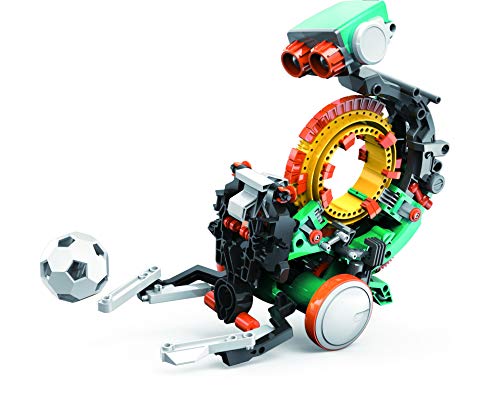
- Mechanical coding wheel controls multiple actions
- Multi-hour assembly project for ages 10+
- Focuses on coding and mechanical engineering basics
Best For: Young builders who prefer hands-on mechanical coding
Connected Arduino Robotics

- Arduino-compatible programmable robot car
- FPV, line tracking, and obstacle avoidance
- Guided wiring with app and IR control
Best For: Beginner makers and coding clubs exploring sensors
Multi-Tool Tracked Robotics

- 975-piece tracked robot arm construction set
- Includes gripper, drill, and bucket heads
- Supports remote control and app programming
Best For: Mechanical building fans who want a versatile robot arm
Build-and-Rebuild RC Robotics
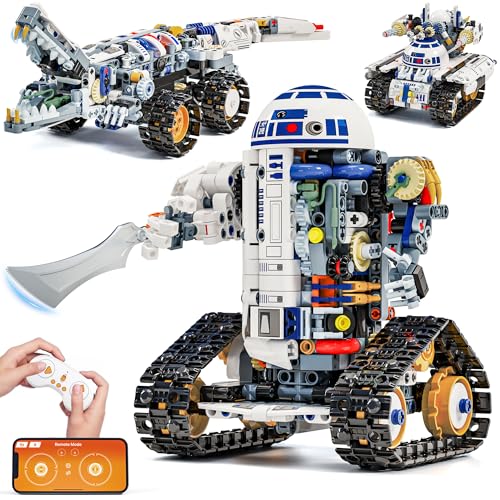
- Builds an automotive robot, crocodile, or tank
- App and remote control with STEM coding mode
- Rechargeable battery offers up to 45 minutes of play
Best For: Families seeking multiple rebuildable RC robot designs
Versatile Starter Pick
5-in-1 App-Controlled Robot Kit

- 337+ pieces build five different models
- Remote and iOS/Android app control
- Beginner-friendly programming and instructions
Best For: Kids ages 8–12 exploring multiple robot builds
Most Rebuildable Set
Sillbird 5-in-1 Programmable Robot

- 488 pieces support five builds and custom creations
- App and remote offer dual control
- Rechargeable battery lasts up to 40 minutes
Best For: Kids and teens wanting varied builds and rechargeable play
Advanced Coding Choice
ACEBOTT Arduino-Compatible Robot Car

- Supports Scratch, Arduino, and Python
- 16 tutorials with videos and illustrated steps
- Mobile, app, and IR remote control support
Best For: Kids and teens building progressive coding skills
Best Progressive Build
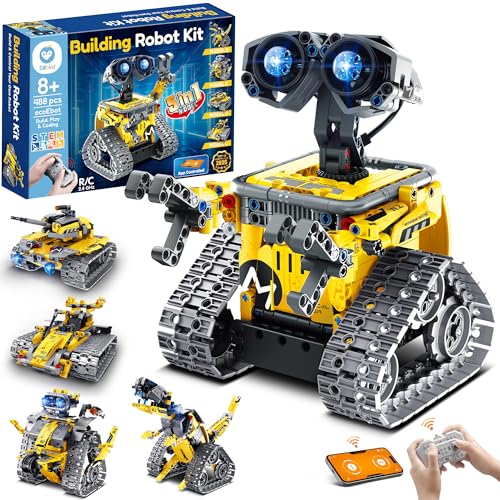
- 488 pieces with five buildable models
- Remote and Bluetooth app control
- Up to 40 minutes of rechargeable play
Best For: Young beginners building STEM and coding confidence
Best Space-Themed Variety
6-in-1 STEM Robot Building Kit

- 780 pieces and six space-themed models
- App and 2.4GHz remote control
- Includes path coding and STEM programming
Best For: Young builders who want bigger, rebuildable projects
Hands-On Mechanical Coding – Mech-5 STEM Robot
For hobbyists looking for robot building kits for hobbyists with a strong learning focus, the TEACH TECH Mech-5 offers a mechanical alternative to screen-first coding. Builders assemble the robot, then program actions by snapping coding buttons onto its wheel. The project is designed for ages 10 and up and can take multiple hours to complete.
Best For: Young builders and beginners interested in mechanical engineering principles, coding basics, and hands-on STEM projects.
Pros:
- Mechanical coding wheel programs actions such as throwing, lifting, kicking, and drawing.
- Detailed assembly process provides a substantial, learn-by-doing STEM experience.
- Mission-based activities encourage problem solving and programming skills.
Cons:
- Requires careful assembly and several hours of build time.
- Uses 2 AAA batteries, which are not listed as included.
- Its recommended age of 10 and up may be less suitable for younger children.
The Mech-5 is a good choice when the building process matters as much as the finished robot. Its button-based mechanical coding is approachable, though it is less appropriate for shoppers seeking advanced app or Arduino programming.
Connected Arduino Robotics – ELEGOO Smart Robot Car V4
The ELEGOO UNO R3 Smart Robot Car V4 is a versatile pick among robot building kits for hobbyists who want to assemble, program, and drive a sensor-equipped vehicle. It combines Arduino-compatible coding with app and IR control, FPV video, line tracking, and obstacle avoidance. The guided wiring and illustrated tutorial make it suitable for beginners with adult guidance.
Best For: Makers, coding clubs, classrooms, and families exploring Arduino robotics, sensors, and programmable driving.
Pros:
- Supports FPV video, line tracking, obstacle avoidance, app control, and IR control.
- Keyed XH2.54 connectors and illustrated instructions help reduce beginner wiring errors.
- Includes an UNO R3 controller, camera and Wi-Fi module, sensors, motors, remote, and rechargeable battery.
Cons:
- Recommended for ages 12 and up, despite some listings describing it as suitable for younger users with guidance.
- The 1.23 kg kit involves more electronics assembly than a simple snap-together toy.
- Manufacturer warranty is listed as six months.
This kit offers the broadest electronics and programming scope in the group. It is especially compelling for hobbyists who want to modify Arduino code and experiment with sensors, rather than simply operate a completed model.
Multi-Tool Tracked Robotics – 3-in-1 Robot Arm Kit
This 3-in-1 robot arm set stands out among robot building kits for hobbyists by pairing a tracked base with interchangeable gripper, drill, and bucket tools. Its 975 ABS plastic pieces create a substantial mechanical build, while the remote control and app programming add interactive play after assembly. The set is recommended for ages 8 to 14 but is also described as suitable for adults.
Best For: Builders who enjoy mechanical construction, tracked vehicles, robotic arms, and multiple tool-head configurations.
Pros:
- Three interchangeable tool heads support gripper, drill, and bucket functions.
- Tracked undercarriage is designed for climbing and crossing obstacles.
- Offers both remote control and app-based programmed action sequences.
Cons:
- Only one tool-head configuration can be used at a time.
- The 975-piece build may require patience and adult assistance for younger builders.
- Requires one 9V battery, though the notes do not specify battery life.
Choose this set if the appeal is a large, displayable mechanical model with several operating modes. It provides more physical variety than a basic robot car, while remaining centered on block construction and remote-controlled movement.
Build-and-Rebuild RC Robotics – 3-in-1 STEM Robot Kit
The Glikid 3-in-1 kit is a flexible option for robot building kits for hobbyists who value rebuilding and remote-controlled play. The 776-piece set can form an automotive robot, track crocodile, or mechanical tank, with app and 2.4GHz remote control available after assembly. A printed manual, app modes, and rechargeable battery round out the project.
Best For: Children, families, and hobbyists who want several themed builds and accessible app-assisted robotics play.
Pros:
- Builds three models from one kit: automotive robot, track crocodile, or mechanical tank.
- Offers remote, Bluetooth app, path, driving, control, and STEM coding modes.
- Built-in 3.7V 500mAh Li-Po battery provides up to 45 minutes of play per charge.
Cons:
- Only one of the three models can be built at a time.
- Remote control requires 2 AAA batteries, which are not included.
- Recommended for ages 8 and up, so younger builders may need assistance.
This is a strong choice for shoppers who want variety without buying multiple kits. Its rebuildable designs and straightforward control options make it more play-oriented than an advanced electronics platform, but the STEM coding mode adds room for experimentation.
Versatile Starter Pick – 5-in-1 App-Controlled Robot Kit
For shoppers comparing robot building kits for hobbyists, this 337-piece set offers a straightforward way to explore building, remote control, and introductory app programming. Its five rebuildable models add variety, while the included guide helps younger builders follow the assembly process.
Best For: Kids ages 8–12 who want multiple robot builds with remote and smartphone control.
Pros:
- 337+ pieces support five models, including a camera robot, lion chariot, battle armor, shooter, and harvester.
- Remote and iOS/Android app control add interactive play.
- App-based programming introduces custom actions and paths.
- Step-by-step instructions and modular construction support rebuilding.
Cons:
- The product listing gives a broad recommended-age range, so adult guidance may be useful for some builders.
- The kit is primarily designed for introductory play rather than advanced robotics work.
This is a practical entry point for families seeking variety and accessible robotics concepts. Choose it when five themed builds and beginner-friendly controls matter more than deeper programming features.
Most Rebuildable Set – Sillbird 5-in-1 Programmable Robot
Among robot building kits for hobbyists, the Sillbird set stands out for its 488 pieces, five model options, and adjustable robot joints. It combines hands-on assembly with app or remote control and includes a rechargeable battery for play sessions of up to 40 minutes.
Best For: Kids and teens who want a larger rebuildable set with rechargeable operation.
Pros:
- 488 pieces can be rebuilt as a robot, car, tank, dinosaur, or custom creation.
- Bluetooth app and remote provide dual-control options.
- Clear, colorful instructions support independent or family assembly.
- Included rechargeable battery provides up to 40 minutes of continuous play.
Cons:
- The supplied notes describe simple programming fun but do not specify programming languages or a detailed coding curriculum.
- Its larger piece count may require more assembly time than simpler kits.
This kit is a strong choice when rebuilding flexibility and convenient rechargeable play are priorities. It offers more pieces than the first model and adds poseable joints for extra creative customization.
Advanced Coding Choice – ACEBOTT Arduino-Compatible Robot Car
For hobbyists ready to move beyond basic remote-controlled builds, the ACEBOTT robotics kit combines an ESP32 controller with Scratch, Arduino, and Python support. Its story-based tutorials, mobile coding compatibility, and no-solder assembly create a clearer path from beginner experiments to more advanced programming.
Best For: Kids and teens ages 8–16 who want a programmable robot car that can grow with their coding skills.
Pros:
- Supports Scratch, Arduino, and Python for different experience levels.
- Includes 16 story-based tutorials plus illustrated instructions and HD videos.
- Can be programmed on computers, tablets, and smartphones.
- App and included IR remote enable immediate testing of robot behavior.
Cons:
- Batteries are not included.
- The broader programming feature set may be more involved than a basic build-and-drive kit.
- The supplied details identify it as a smart car kit rather than a multi-model construction set.
This is the most suitable option here for learners who specifically want coding depth and a longer-term skills path. Its Arduino and Python compatibility make it a better fit for older children, teens, classrooms, or technically focused hobbyists.
Best Progressive Build – 5-in-1 Programmable Robot Kit
For families looking for robot building kits for hobbyists who are still developing their construction and coding skills, this 488-piece Sillbird set offers a gradual introduction. Builders can create five models, including a robot, dinosaur, car, and tank, then control them by remote or Bluetooth app.
Best For: Kids ages 8 and up who want a flexible first robotics project with multiple build levels.
Pros:
- Five build options support progressive skill development.
- Remote and Bluetooth app control include path and basic programming features.
- Colorful, step-by-step instructions support independent or family assembly.
- Rechargeable battery provides up to 40 minutes of play per charge.
Cons:
- Only one model can be built at a time.
- The set is primarily designed for younger builders rather than advanced adult hobbyists.
This is a practical choice for beginners who value variety and clear guidance. Its multiple models and simple programming features make it more suitable for introductory exploration than deep electronics work.
Best Space-Themed Variety – 6-in-1 STEM Robot Building Kit
This 780-piece option stands out among robot building kits for hobbyists who want more construction variety and app-based play. It can be rebuilt into six space-themed models, while the app adds path coding, STEM programming, driving simulation, and gravity control.
Best For: Builders ages 8 and up who enjoy space themes, larger projects, and multiple control modes.
Pros:
- Six models include a space robot, battle robot, tank, fighter, and tracked vehicle.
- Offers both 2.4GHz remote control and mobile app operation.
- App features include path coding, programming, and 360-degree stunt rotation.
- 780 pieces provide a more substantial construction experience.
Cons:
- Only one robot model can be assembled at a time.
- Detailed programming and app features may require adult guidance for younger builders.
Choose this kit when rebuildable variety matters more than a single specialized robot. The larger piece count and broader app functions create plenty of room for repeated projects, though it remains an educational toy rather than a full electronics platform.
Best Advanced Learning Project – ESP8266 Spider Robot Kit
For older learners comparing robot building kits for hobbyists, the ACEBOTT spider robot offers a more technical project than a conventional block-based set. Its ESP8266 motherboard, metal servos, app control, and eight guided lessons introduce programming and electronic hardware principles through a walking quadruped design.
Best For: Teens, adults, and programming enthusiasts who want a guided robotics and electronics project.
Pros:
- Eight lessons cover programming and electronic hardware concepts.
- Six movement modes and nine preset actions provide varied demonstrations.
- Pre-burned programming and a paper manual help beginners get started.
- Type-C charging and MG90 metal servos support convenient, stable operation.
Cons:
- A flat-top battery is required but not included.
- Assembly and electronics work are more demanding than basic construction kits.
- The compact spider design may appeal less to builders seeking vehicle-style robots.
This is the strongest fit for learners ready to move beyond simple assembly into guided coding and hardware principles. Verify the separate battery requirement before buying, and expect the project to reward patience during assembly.
How We Picked These Robot Building Kits for Hobbyists
We compared the kits by build variety, intended age range, control method, programming potential, parts count, and learning curve. Priority went to products that offer more than a display model, such as programmable movement, app control, remote operation, sensor-based behavior, or compatibility with widely used development platforms. We also included a range of prices and difficulty levels so beginners, families, and experienced makers can find a suitable starting point.
Quick Comparison
| Kit type | Best for | Control or coding | What to check |
|---|---|---|---|
| Mechanical coding robot | First-time builders | Built-in coding controls | Age range and assembly support |
| Arduino robot car | Programming practice | Arduino, app, camera, or remote | Board, software, and accessory compatibility |
| Multi-model STEM set | Variety and repeat builds | App and remote control | Instructions and spare-part organization |
| Advanced walking robot | Older learners and adults | App, wireless control, or coding | Electronics experience and setup time |
Key Buying Factors for Robot Building Kits for Hobbyists
Age and Difficulty
Age labels are useful starting points, but motor wiring, small components, and software setup can make a kit more demanding than its box suggests. Younger builders may need adult help, especially during the first assembly. Adults and experienced hobbyists should look for more involved mechanisms, adjustable code, or room for experimentation.
Programming and Control
Remote control is convenient for immediate play, while app control can add driving modes, commands, and customization. Arduino- or Scratch-compatible kits are generally better for learning because users can change behavior rather than simply operate a finished robot. Check whether a phone, computer, batteries, or a separate USB cable is required.
Build Variety and Parts
Multi-in-one kits can provide better long-term value when the included parts support genuinely different mechanisms. A high parts count is not automatically better; clear instructions, labeled components, sturdy connectors, and reliable motors matter more for a successful build.
Expandability and Support
For a hobbyist who wants to keep learning, confirm the controller platform, available tutorials, replacement-part access, and compatibility with common sensors or programming tools. A simpler kit may be preferable if the goal is a quick, guided project rather than an open-ended robotics platform.
Who Should Buy Which Robot Building Kits for Hobbyists?
Choose a guided mechanical or coding robot for a younger beginner who needs a manageable first project. Pick an Arduino-compatible robot car for learners focused on programming, sensors, and customization. Multi-model app-and-remote kits suit families or hobbyists who want several construction options from one box. For advanced users, a walking or crawling robotics kit offers a more technical challenge and greater opportunity to tune movement and wireless control.
Before ordering, verify the current age recommendation, included electronics, power requirements, app availability, and operating-system support. Those details often determine whether the kit is ready to build immediately or requires extra tools and components.