The best STEM robot building kits turn screen-free play into practical lessons in mechanics, electronics, coding, and problem-solving. The right choice depends on the builder’s age, patience, interests, and comfort with apps, remotes, or hands-on assembly.
We compared these 10 kits across construction complexity, control options, educational value, expandability, and overall suitability for young learners, hobbyists, and families looking for a more engaging robotics project.
Best 10 Stem Robot Building Kits Picks for 2026
Best All-Around Build
Sillbird 5-in-1 Programmable Robot
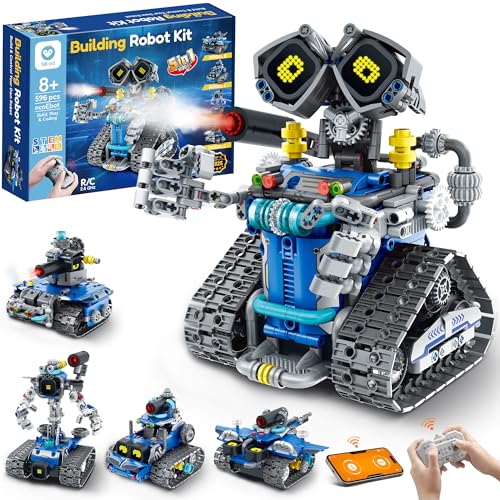
- 596 pieces build five different models
- Remote, app, LED eyes, sounds, and mist feature
- Rechargeable battery offers up to 40 minutes
Best For: Kids ages 8–14 seeking varied, interactive STEM building
Best Hands-On Mechanics
Thames & Kosmos Mega Cyborg Hand

- Wearable mechanical hand powered by air and water
- No motors or batteries required
- Three configurations with adjustable joints
Best For: Young builders exploring hydraulics and pneumatics
Best for Younger Builders

- Builds a guitarist, stunt truck, or road roller
- App offers beginner-friendly driving and coding modes
- 433 pieces and up to 40–50+ minutes of play
Best For: Ages 6–12 learning robotics through guided play
Best for Coding Depth

- Arduino-compatible programming and guided wiring
- FPV camera, line tracking, and obstacle avoidance
- Includes rechargeable 2000 mAh battery
Best For: Ages 12+ building electronics and coding skills
Best All-Around Pick
6-in-1 App-Controlled Space Robot

- 780 pieces build six space-themed models
- App and 2.4GHz remote control
- Includes path coding and STEM programming modes
Best For: Kids wanting varied builds and programmable robot play
Best Solar Learning Kit

- Builds 12 models from 190 parts
- Powered by sunlight or strong artificial light
- Introduces renewable energy concepts
Best For: Kids exploring solar power through screen-free building
Best for Remote-Control Play
Programmable Building Block Robot
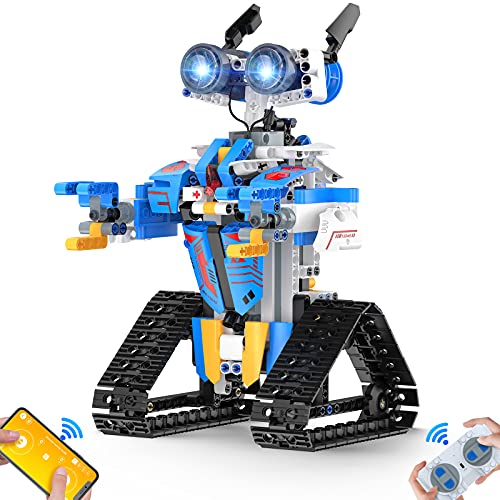
- 468-piece construction kit with stickers
- App and 2.4GHz remote operation
- Includes voice, gravity, path, and programming modes
Best For: Kids who prioritize interactive controls after building
Best Screen-Free Pick
My Robotic Pet: Coding Chameleon

- Screen-free coding with colored action cards
- Three interactive play modes
- 133-piece chameleon with guided lessons
Best For: Animal-loving kids who want hands-on coding
Best 2-in-1 RC Build

- Build a race car or robot vehicle
- 444-piece construction project
- Remote and optional app control
Best For: Young vehicle fans who enjoy RC play
Best Multi-Model Set
Sillbird 5-in-1 Programmable Robot
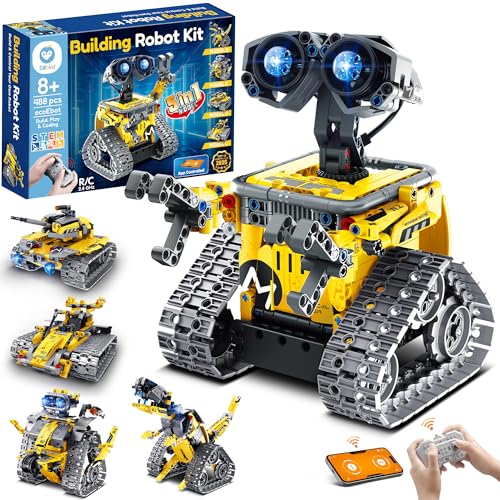
- Five progressively challenging models
- 488 pieces with app and remote control
- Rechargeable play for up to 40 minutes
Best For: Growing builders who want model variety
Best All-Around Build – Sillbird 5-in-1 Programmable Robot
For shoppers comparing stem robot building kits, the Sillbird 5-in-1 set combines construction, remote control, app features, and beginner-friendly coding. Its 596 pieces support five models with graduated difficulty, while LED eyes, sounds, and a mist-spray feature add interactive play.
Best For: Kids ages 8–14 who want a versatile, screen-free building project with remote and app control.
Pros:
- Five build options with different difficulty levels.
- Includes remote control, Bluetooth app access, and creative coding.
- Rechargeable battery provides up to 40 minutes of play.
- Colorful, step-by-step manual supports independent building.
Cons:
- The remote requires two AA batteries, despite the robot having a rechargeable battery.
- The mist-spray feature requires adding water.
This is a strong choice when variety matters. It offers more build paths and interactive features than a single-model kit, while remaining accessible to younger builders.
Best Hands-On Mechanics – Thames & Kosmos Mega Cyborg Hand
Among stem robot building kits, the Thames & Kosmos Mega Cyborg Hand stands out as a wearable engineering experiment rather than a motorized vehicle. Builders use air pressure, water, hydraulic pistons, and their own fingers to operate the mechanical hand.
Best For: Ages 7+ who are especially interested in hydraulics, pneumatics, and hands-on mechanical systems.
Pros:
- Operates without motors or batteries.
- Hydraulic pistons enable gripping and lifting objects.
- Can be configured as a right hand, left hand, or claw.
- Adjustable joints and fit support precision movement.
Cons:
- It focuses on one wearable hand rather than multiple robot builds.
- Assembly includes small hardware such as screws, springs, and tubing.
This kit is best for children who learn by manipulating a real mechanism. Its hydraulic design provides a clear introduction to systems used in industrial robotics, though it offers less coding and electronic play than app-controlled kits.
Best for Younger Builders – 3-in-1 Interactive Robot Kit
This stem robot building kit is designed for ages 6 and up and offers three movable creations: a guitarist robot, stunt dump truck robot, and road roller robot. Remote and app controls add colorful LED effects, sounds, driving modes, and introductory programming.
Best For: Children ages 6–12 who want accessible building, remote-controlled action, and multiple vehicle-style models.
Pros:
- Three models provide repeat-build variety.
- Colorful app modes include path, gravity, programming, and drive modes.
- 433 pieces are designed for repeated assembly and disassembly.
- Rechargeable battery supports approximately 40–50+ minutes of play.
Cons:
- The remote control requires two AA batteries, which are not included.
- Some children may need help with the larger assembly.
With simple app icons, guided building, and multiplayer-capable remote control, this kit offers a gentle entry into robotics. It is a practical pick for families seeking active play rather than advanced Arduino programming.
Best for Coding Depth – ELEGOO UNO R3 Smart Robot Car
For older learners comparing stem robot building kits, the ELEGOO UNO R3 Smart Robot Car is the most programming-focused option here. It combines Arduino-compatible coding with FPV video, line tracking, obstacle avoidance, app control, and guided wiring.
Best For: Ages 12+ interested in electronics, Arduino programming, sensors, and longer-term robotics projects.
Pros:
- Arduino IDE support enables custom routes, reactions, and experiments.
- Includes camera-based FPV video, line tracking, and ultrasonic obstacle avoidance.
- Keyed connectors and an illustrated tutorial help reduce beginner wiring errors.
- Rechargeable 2000 mAh lithium-ion battery is included.
Cons:
- It is recommended for ages 12+ and may require adult guidance for first-time builders.
- The electronics and programming focus can be more demanding than block-based kits.
This is the strongest choice for learners who want to progress beyond assembly. Its sensors and Arduino compatibility create room for experimentation, making it suitable for classrooms, coding clubs, and maker projects.
Best All-Around Pick – 6-in-1 App-Controlled Space Robot
For shoppers comparing stem robot building kits, this 780-piece set stands out for its combination of construction variety, app controls, remote operation, and coding-focused play. Children ages 8 and up can build one of six space-themed models at a time, then dismantle and rebuild for a new project.
Best For: Kids who want a larger, reusable robot kit with app-based programming and remote-control play.
Pros:
- 780 pieces support six different robot and vehicle models.
- Offers both 2.4GHz remote control and mobile-app operation.
- App includes path coding, gravity control, driving simulation, and STEM programming modes.
- Rechargeable battery, motorized movement, and lighting add interactive play value.
Cons:
- Only one model can be built at a time.
- The app features require access to a compatible mobile device.
This is the most feature-rich option in the group for children ready to combine hands-on building with programmable movement. Its larger piece count may also provide more involved assembly than simpler kits.
Best Solar Learning Kit – 12-in-1 Solar Robot Builder
Among stem robot building kits, this solar-powered option gives children a hands-on introduction to renewable energy alongside basic construction. Its 190 parts can be assembled into 12 models, with different difficulty levels intended to grow with a child’s building experience.
Best For: Kids interested in solar power, beginner engineering projects, and screen-free building.
Pros:
- Builds 12 different robots, cars, and other models.
- Runs in sunlight or under a strong artificial light source such as a flashlight.
- Large solar panel is designed to capture more sunlight and provide stronger output.
- Step-by-step instructions support independent or family assembly.
Cons:
- Performance depends on sunlight or a sufficiently strong artificial light source.
- It does not include a battery for stored power.
- With 190 parts, it offers fewer components than the other kits in this roundup.
This kit is a practical choice when the educational focus is renewable energy rather than app control or coding. The increasing build challenges make it approachable for beginners while leaving room for skill development.
Best for Remote-Control Play – Programmable Building Block Robot
This building-block option is a solid choice for families comparing stem robot building kits with interactive controls. The 468-piece kit includes an assembly guide, Bluetooth app operation, and a 2.4GHz remote with multiple control modes for movement, voice input, gravity sensing, and programming.
Best For: Kids ages 8 and up who want a motorized robot with several control methods and an approachable assembly process.
Pros:
- 468 pieces provide a hands-on construction project with included stickers.
- Supports app Bluetooth control and a 2.4GHz remote with a stated range over 20 meters.
- Offers path, voice, gravity-sensor, and STEM programming modes.
- Bagged parts and marked assembly steps are designed to simplify building.
Cons:
- The supplied listing specifies a recommended age range of 8 to 8 years.
- App-based controls require a compatible phone or device.
- It has fewer pieces than the 780-piece kit.
Choose this model if control variety matters more than having the largest construction set. Lights, rotating joints, stunt movement, and multiple operating modes make it especially suited to active floor play after assembly.
Best Screen-Free Pick – My Robotic Pet: Coding Chameleon
If you want stem robot building kits that combine hands-on construction with unplugged coding, this robotic chameleon is a distinctive option. Kids assemble a 133-piece reptile, then use colored action cards, sensors, and physical controls to explore programming without a screen.
Best For: Kids ages 8+ who enjoy animals, screen-free coding, and interactive STEM projects.
Pros:
- Uses color and infrared sensors plus RGB LEDs for hands-on coding activities.
- Offers coding, wild, and pet play modes.
- Includes a 48-page guide covering assembly and engineering concepts.
- Features articulated movement, color changing, and an automatic tongue.
Cons:
- Requires four AAA batteries.
- Adult help is recommended for ages 8+, according to the manual.
- It builds one primary chameleon model rather than multiple vehicles.
This kit stands out for making introductory programming tangible and screen-free. It is especially appealing when a child is motivated by animal-themed play as much as by building.
Best 2-in-1 RC Build – IQKidz Race Car and Robot
Among stem robot building kits, this IQKidz set is a practical choice for kids who want both construction and remote-controlled action. The 444-piece kit can be assembled as a race car or robot vehicle, with optional remote and app control for driving and programming routes.
Best For: Builders ages 6+ who enjoy vehicles, interchangeable models, and RC play.
Pros:
- Provides two build options: a race car or robot vehicle.
- Includes 444 pieces, illustrated manuals, extra parts, and a screwdriver.
- Supports optional remote control and app control.
- App programming can set driving directions and routes.
Cons:
- The product details list differing piece counts in the included components and total specifications.
- App control adds a device requirement for programming features.
- The listed manufacturer age range is 6–10, despite broader title wording.
This is a strong fit for children who measure STEM fun by what the finished build can do. Its two vehicle configurations add replay value, while the manuals support a step-by-step introduction to construction and control.
Best Multi-Model Set – Sillbird 5-in-1 Programmable Robot
This Sillbird set gives stem robot building kits a broader construction focus, with 488 pieces and five possible models. Kids can build a robot, dinosaur, car, tank, and more, then use an app or remote to explore movement, basic programming, and path control.
Best For: Kids ages 8–13 who want progressive builds, multiple models, and rechargeable programmable play.
Pros:
- Offers five buildable models with varying difficulty.
- Combines 488-piece construction with app and remote control.
- Supports basic programming, path planning, and precise movement.
- Rechargeable battery provides up to 40 minutes of play per charge.
Cons:
- The product details give varying recommended age ranges, from 6–16 to 8+.
- App-based features require a compatible device and Bluetooth connection.
- The many models may make assembly more involved than a single-build kit.
Choose this kit when variety matters more than a single showcase model. Its progressive designs and rechargeable operation make it suitable for repeated building sessions as children develop confidence and problem-solving skills.
How We Picked the Best Stem Robot Building Kits
We evaluated each kit for the quality of its building experience, clarity of instructions, range of projects, and the skills it can develop. We also considered whether control is handled through a remote, mobile app, programmable board, sensors, or a combination of methods. Age guidance matters, but so do a child’s fine-motor skills, reading ability, and willingness to troubleshoot.
Because these products vary widely, we gave credit to kits that offer meaningful reusability rather than a single build. Solar-powered models, multi-configuration sets, programmable cars, and sensor-based robots can provide more opportunities for experimentation as the builder gains confidence.
Quick Comparison
| Best For | Look For |
|---|---|
| First-time builders | Clear instructions, fewer parts, and simple remote control |
| Creative project play | Multiple builds, interchangeable modules, and flexible blocks |
| Coding practice | App programming, programmable controllers, sensors, or Arduino compatibility |
| Hands-on science | Solar power, color sensing, mechanical experiments, or visible cause and effect |
| Older children and hobbyists | Larger part counts, cameras, tracked designs, and room to modify code |
Key Buying Factors for Stem Robot Building Kits
Age, Complexity, and Supervision
Check the recommended age alongside the project’s actual difficulty. A younger child may enjoy assembling a straightforward vehicle with an adult, while an older beginner may prefer a larger kit with app controls and guided coding. Small parts and lengthy builds often require supervision and organized storage.
Control and Coding Options
Remote control is usually the easiest starting point, while app control can add programmed movements, sound, lights, or custom commands. Arduino-compatible kits are better suited to learners ready to explore block coding, electronics, and text-based programming. A kit with several control methods can remain useful longer.
Parts, Power, and Durability
Review the piece count, included electronics, batteries, charging requirements, and whether all necessary tools are supplied. Solar kits are useful for demonstrating energy concepts but may depend on strong light. Block-based models should have connectors that are easy to assemble yet secure enough for repeated play.
Learning Value and Replayability
Choose a kit that encourages testing and redesign rather than simply following one set of steps. Multiple configurations, sensors, programmable behaviors, and replaceable components help turn a one-time project into an ongoing STEM activity.
Who Should Buy Which Stem Robot Building Kits?
Choose a simple remote-controlled car or robot for a first project, especially for younger builders who want immediate results. Multi-build and solar sets suit children who enjoy switching between designs and learning through experimentation. App-controlled kits are a strong middle ground for builders who like technology but are not ready for advanced electronics.
For older children, teens, or adults interested in genuine robotics skills, prioritize Arduino compatibility, camera functionality, sensors, and accessible programming support. Families seeking a focused science activity may prefer a color-sensing or mechanical experiment kit, while buyers wanting the broadest long-term play value should favor a high-part-count set with several possible builds.