Large rooms need more than a small bass boost. The right subwoofer can add the output, depth, and impact needed to make movie soundtracks, music, and games feel convincing without overwhelming the rest of your system.
We selected 10 options across standalone powered subwoofers and soundbar packages, with attention to room-filling performance, connectivity, placement flexibility, and value. Use the guide below to match your room, receiver, and listening habits with the most suitable design.
Best 10 Subwoofers for Large Rooms Picks for 2026
Room-Filling Power

- 12-inch high-excursion woofer
- 200W amplifier, 400W peak
- 29–120 Hz response
Best For: Large rooms needing powerful movie and music bass
All-in-One Surround

- 5.1-channel Dolby Atmos system
- 300W peak output with wired subwoofer
- HDMI eARC and app control
Best For: Large rooms wanting simple surround sound with bass
Classic 12-Inch Impact

- 12-inch front-firing woofer
- 400W dynamic amplifier
- Line/LFE inputs and phase control
Best For: Large home theater or music systems
Compact Bass Value
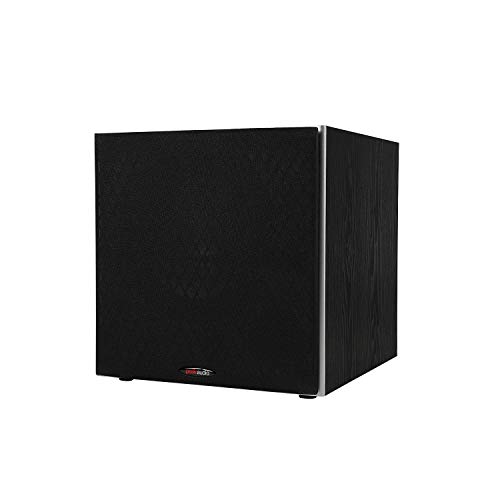
- 10-inch Dynamic Balance woofer
- Up to 100W output
- Adjustable crossover and phase toggle
Best For: Budget upgrades and moderate bass in smaller zones
Compact Studio Precision

- 8-inch woofer reaches down to 30 Hz
- Bluetooth 5.0 plus TRS, RCA, and aux inputs
- Adjustable crossover and room-tuning controls
Best For: Content creation, music listening, and compact monitor setups
Dynamic Home Theater Impact
Klipsch R-100SW 10-Inch Subwoofer

- 10-inch front-firing spun-copper woofer
- 300 watts peak power for movies and gaming
- LFE/RCA inputs with crossover and phase controls
Best For: Wired home theater and gaming systems
Clear Bass Value
Yamaha NS-SW100BL 10-Inch Subwoofer

- 10-inch cone woofer for home theater
- Twisted flare port supports clear, tight bass
- Yamaha Active Servo Technology II
Best For: Traditional wired surround-sound systems
Wireless Room-Filling Sound

- Wireless 2.1-channel soundbar and subwoofer system
- 240W peak output with BassMX technology
- App EQ and clear-dialogue VoiceMX processing
Best For: Large-room home theater setups needing a complete wireless system
Classic Powered Bass Upgrade
Yamaha NS-SW050BL 8-inch Subwoofer

- 8-inch powered woofer with 100W dynamic power
- 28Hz frequency response for deep bass
- Twisted flare port and Advanced YST II
Best For: Wired home theater and music systems needing a dedicated bass upgrade
Adjustable Deep Bass
Edifier T5s 8-inch Powered Subwoofer
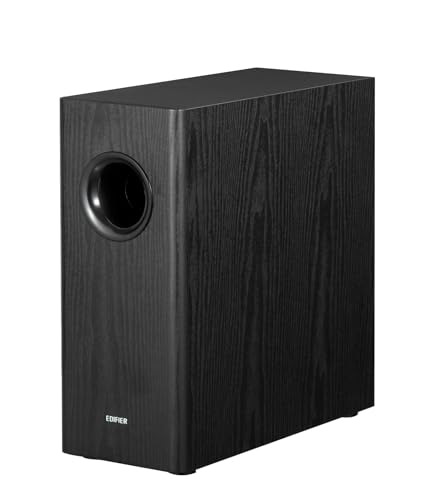
- 70W RMS output and 35Hz bass response
- Adjustable 30Hz–160Hz low-pass filter
- Phase selector and RCA connection options
Best For: Wired stereo or home theater systems requiring flexible bass tuning
Room-Filling Power – Klipsch R-120SW
For shoppers comparing subwoofers for large rooms, the Klipsch R-120SW is a powerful floor-standing option. Its 12-inch high-excursion woofer, bass-reflex enclosure, and 200-watt amplifier provide substantial low-end output for movies and music.
Best For: Large home entertainment rooms that need deep, high-output bass.
Pros:
- 12-inch spun-copper high-excursion woofer.
- 200 watts of amplifier power and up to 400 watts peak output.
- 29–120 Hz frequency range and bass-reflex rear port.
Cons:
- Wired connectivity requires an RCA connection.
- Its 31-pound cabinet needs dedicated floor space.
The R-120SW is a strong match for large-room systems where output and impact matter more than a compact footprint. Its included grille, power cord, and long woofer warranty add practical value.
All-in-One Surround – ULTIMEA Poseidon M60
The ULTIMEA Poseidon M60 combines a wired subwoofer with a 5.1-channel Dolby Atmos soundbar, making it a convenient alternative to assembling separate speakers. For subwoofers for large rooms, its 300-watt peak system output and side-firing drivers help create broad, room-filling sound.
Best For: Large living rooms where simple surround setup and integrated bass are priorities.
Pros:
- Includes Dolby Atmos and 5.1-channel surround processing.
- 300-watt peak output with a dedicated wired wooden subwoofer.
- HDMI eARC, app EQ controls, and Bluetooth 5.4.
Cons:
- The subwoofer is wired rather than wireless.
- Its 45 Hz low-frequency specification is less deep than some dedicated 12-inch subwoofers.
The Poseidon M60 is best viewed as a complete sound system rather than a standalone subwoofer. It favors quick installation, dialogue clarity, and adjustable surround sound over maximum dedicated-subwoofer depth.
Classic 12-Inch Impact – Klipsch R-12SW
The Klipsch R-12SW is a straightforward powered subwoofer for listeners who want strong bass without adding a full surround package. Its 12-inch front-firing copper-spun woofer and 400-watt dynamic amplifier make it a capable choice among subwoofers for large rooms.
Best For: Home theater and music systems needing a high-output, front-firing subwoofer.
Pros:
- 12-inch copper-spun front-firing woofer.
- 400 watts of dynamic amplifier power.
- Low-pass crossover, phase control, and line/LFE inputs.
Cons:
- It is a wired subwoofer with no wireless connection listed.
- It offers fewer setup features than an integrated soundbar system.
With useful integration controls and broad music-and-movie appeal, the R-12SW is a practical dedicated-bass upgrade. Its larger driver is well suited to filling a spacious listening area.
Compact Bass Value – Polk Audio PSW10
The Polk Audio PSW10 is a compact powered subwoofer designed for straightforward system upgrades. While it is aimed at small-to-mid-size rooms rather than the biggest spaces, its 10-inch woofer and 100-watt output can add useful punch when shopping for subwoofers for large rooms on a budget.
Best For: Smaller zones, secondary systems, or large rooms with moderate bass requirements.
Pros:
- 10-inch Dynamic Balance woofer with directed port.
- 50-watt RMS amplifier with up to 100 watts of power.
- 80–160 Hz variable crossover and phase toggle.
Cons:
- It is explicitly suited to small-to-mid-size rooms.
- Its output is lower than the Klipsch alternatives listed here.
- Its 40–160 Hz response is not intended for the deepest bass extension.
The PSW10 is an affordable, flexible option for adding bass without a large cabinet. In a large room, it is better suited to moderate listening or use as part of a multi-subwoofer setup than as the sole source of room-filling impact.
Compact Studio Precision – PreSonus Eris Sub 8BT
For shoppers comparing subwoofers for large rooms, the PreSonus Eris Sub 8BT is best understood as a compact studio-focused option rather than a high-output home-theater model. Its 8-inch driver, 100-watt power rating, Bluetooth 5.0, and adjustable crossover make it flexible for music production, desktop listening, and multimedia setups.
Best For: Content creators, music listeners, and compact monitoring systems that need controlled bass and flexible wired or wireless connections.
Pros:
- Reaches down to 30 Hz with a woven-composite 8-inch woofer.
- Includes Bluetooth 5.0, balanced TRS, RCA, and front-panel aux connections.
- Adjustable highpass, lowpass, and room-tuning controls help integrate it with main monitors.
- Front headphone output and automatic power-saving mode add convenience.
Cons:
- The compact 8-inch design may be less suitable for filling very large rooms than larger home-theater subwoofers.
- Its studio-monitor feature set may be more than casual TV listeners need.
The Eris Sub 8BT stands out for control and connectivity. It is a practical choice when accurate, tunable low end matters more than maximum room-shaking output.
Dynamic Home Theater Impact – Klipsch R-100SW 10-Inch Subwoofer
Among subwoofers for large rooms, the Klipsch R-100SW is a straightforward wired home-theater choice with a front-firing 10-inch woofer and 300 watts of peak power. Its LFE and line-level RCA inputs, crossover control, and phase adjustment make it easy to integrate with a compatible receiver.
Best For: Home theater and gaming systems where deep, lively bass and simple receiver compatibility are priorities.
Pros:
- 10-inch spun-copper IMG woofer provides a substantial low-frequency foundation.
- 300 watts of peak power supports energetic movie and gaming sound.
- Includes volume, low-pass crossover, and 0/180-degree phase controls.
- LFE and line-level RCA inputs offer broad wired receiver compatibility.
Cons:
- There is no wireless connectivity.
- Its listed frequency response begins at 32 Hz, so it is not the deepest-reaching option in this group.
- It is relatively bulky at 14.5 by 12.5 by 16.4 inches.
The R-100SW is a balanced pick for a traditional AV setup. Its larger driver and higher peak output make it more room-oriented than compact desktop models, while the controls keep setup uncomplicated.
Clear Bass Value – Yamaha NS-SW100BL 10-Inch Subwoofer
The Yamaha NS-SW100BL is a simple 10-inch powered subwoofer for home-theater systems. For shoppers considering subwoofers for large rooms, its 10-inch cone and Yamaha Active Servo Technology II are appealing, while the twisted flare port is designed to support clear, tight bass.
Best For: Home-theater owners seeking a traditional 10-inch wired subwoofer with a room-friendly design and straightforward operation.
Pros:
- 10-inch cone woofer provides more physical scale than compact desktop subs.
- Twisted flare port is designed to reduce port noise and support tight bass.
- Yamaha Active Servo Technology II is intended to improve low-frequency performance.
- Styled as a discreet addition to a surround-sound room.
Cons:
- The listed 100-watt output is lower than the Klipsch model’s 300-watt peak rating.
- Connectivity is wired rather than Bluetooth-based in the supplied specifications.
- The listed dimensions are comparatively large, so placement should be planned carefully.
The NS-SW100BL favors uncomplicated home-theater integration and controlled bass over a long list of features. It makes sense for buyers who want Yamaha’s port and servo technologies in a conventional 10-inch enclosure.
Wireless Room-Filling Sound – ULTIMEA Poseidon M30
For shoppers comparing subwoofers for large rooms, the ULTIMEA Poseidon M30 stands out as a complete 2.1-channel soundbar system rather than a standalone subwoofer. Its wireless subwoofer, 240W peak output, and app-based EQ offer flexible placement and easy tuning for movies, music, and gaming.
Best For: Large-room home theater setups that need a soundbar and wireless bass system in one package.
Pros:
- Wireless subwoofer allows flexible placement without an audio cable between the units.
- 240W peak output and a 45Hz–18kHz frequency response support room-filling sound.
- App control includes a 10-band equalizer and 121 preset EQ matrices.
- VoiceMX technology is designed to keep dialogue clear across the 120Hz–6kHz vocal range.
Cons:
- This is a 2.1-channel soundbar system, not a standalone subwoofer for an existing receiver.
- The 5.25-inch subwoofer driver is smaller than the 8-inch drivers in the other options here.
- The system requires power for both the soundbar and subwoofer.
The Poseidon M30 is a convenient choice when you want easy wireless placement, dialogue enhancement, and bass in a single home theater package. Its app tuning is particularly useful for adjusting sound to suit a large room.
Classic Powered Bass Upgrade – Yamaha NS-SW050BL 8-inch Subwoofer
The Yamaha NS-SW050BL is a straightforward powered subwoofer for shoppers seeking subwoofers for large rooms without adding a complicated system. Its 8-inch woofer, 100W dynamic power, and 28Hz frequency response provide a practical bass upgrade for compatible home theater and music setups.
Best For: Home theater or music systems that need a compact, traditional wired powered subwoofer.
Pros:
- 8-inch cone woofer provides more driver size than the ULTIMEA system’s subwoofer.
- 28Hz frequency response is specified for deep low-frequency performance.
- Advanced YST II and a twisted flare port are designed to produce clear, tight bass.
- Its black finish is intended to blend into a room’s decor.
Cons:
- The subwoofer uses a wired connection rather than wireless connectivity.
- Its 100W dynamic power rating is lower than the ULTIMEA system’s 240W peak output.
- No detailed crossover or phase controls are listed in the supplied specifications.
The NS-SW050BL is a sensible option for buyers who prefer a dedicated Yamaha subwoofer with an 8-inch driver and simple wired integration. It is best suited to systems that already provide the necessary subwoofer connection.
Adjustable Deep Bass – Edifier T5s 8-inch Powered Subwoofer
The Edifier T5s combines an 8-inch long-throw woofer with a 70W RMS Class-D amplifier, making it a flexible candidate among subwoofers for large rooms. Its adjustable low-pass filter and phase selector help users integrate the bass with bookshelf speakers, active speakers, or an AV amplifier.
Best For: Stereo and home theater systems that need adjustable wired bass integration and a space-conscious cabinet.
Pros:
- 8-inch long-throw woofer and 70W RMS output support deep bass down to 35Hz.
- Low-pass filter adjusts from 30Hz to 160Hz, while the phase selector offers 0° and 180° settings.
- Front-firing driver and 18mm MDF cabinet are designed for clean, tight bass with reduced resonance.
- Includes RCA and 3.5mm-to-RCA cables, plus automatic standby after 15 minutes of inactivity.
Cons:
- It has no wireless communication technology and relies on RCA connections.
- Series connection without a subwoofer output requires main speakers with a LINE IN.
- The 35Hz frequency response is not as low as the Yamaha’s specified 28Hz response.
The T5s is a strong fit when integration controls matter more than wireless convenience. Its filter and phase adjustments make it easier to match the subwoofer to different speakers, while the cabinet remains relatively compact.
How We Picked the Best Subwoofers for Large Rooms
We compared these models by considering driver size, amplifier power, stated low-frequency extension, enclosure design, connection options, and intended use. Larger drivers and higher output generally provide more headroom, but they are not the only factors that matter. A subwoofer must also integrate cleanly with your receiver, soundbar, powered speakers, or desktop setup.
Because the selection includes both standalone subwoofers and complete soundbar systems, we also considered convenience. Soundbar packages can be a practical choice when you need a simple all-in-one setup, while standalone models offer more flexibility for upgrading an existing home theater.
Quick Comparison
- Best for high-impact home theater: The larger Klipsch models are suitable starting points when you want strong cinematic bass and plenty of presence.
- Best for simple room-filling sound: The ULTIMEA soundbar systems combine a subwoofer with surround-focused processing and straightforward setup.
- Best value options: The Polk, Yamaha, and Edifier models offer accessible powered-bass upgrades for compatible systems.
- Best for nearfield or desktop listening: The PreSonus Eris Sub 8 is designed for powered monitors and closer listening distances rather than maximum room scale.
Key Buying Factors for Subwoofers for Large Rooms
Output and Headroom
Large spaces absorb more bass and allow sound to spread farther, so prioritize a model with enough output reserve for your seating distance and preferred volume. A 12-inch subwoofer often has an advantage in deep, forceful bass, while a well-designed 10-inch model can still work effectively in a moderately large room.
Compatibility and Connections
Check whether your receiver or soundbar provides a subwoofer output, line-level connection, or a proprietary wireless link. Standalone powered subwoofers are usually easiest to integrate with AV receivers and compatible stereo equipment. Soundbar bundles may use dedicated wireless pairing instead.
Placement and Controls
Placement strongly affects bass consistency. Try the front wall, a corner, or several locations near the listening area, then keep the position that produces the smoothest response. Adjustable crossover, phase, and volume controls make blending easier; room correction on your receiver can provide another useful layer of tuning.
Room Size Versus Listening Goals
Do not choose by wattage alone. Consider whether you want subtle musical reinforcement, powerful movie effects, or a complete surround system. A compact sub can be appropriate for nearfield listening, but large-room home theater usually benefits from greater driver area and headroom.
Who Should Buy Which Subwoofers for Large Rooms?
Choose a larger standalone Klipsch subwoofer if your priority is impactful movie bass and you already own an AV receiver or compatible system. Select a Yamaha, Polk, or Edifier model when you want a straightforward upgrade for a traditional home theater or stereo setup without moving to the largest enclosure.
Choose an ULTIMEA soundbar package if you are starting from scratch and value easy installation, wireless convenience, and surround-oriented features. The PreSonus is the better fit for desktop monitors, compact studios, or nearfield music listening, where its intended integration matters more than maximum output.
Before buying, confirm the subwoofer’s dimensions, power requirements, connection type, and return policy. In a large room, two well-placed subwoofers can often produce smoother bass than one powerful unit, but start with a model that matches your existing equipment and upgrade path.