The right equalizer can correct room-related peaks, shape instruments and vocals, or add more control to a car or home audio system. The best choice depends on your signal path, available connections, number of bands, and how precisely you need to adjust frequency response.
We’ve gathered 10 audio equalizers under $500 across graphic, parametric, digital, rack-mount, home stereo, and car audio designs. Use the buying guide below to narrow the list by application and features before choosing a model.
Best 10 Audio Equalizers Under 500 Picks for 2026
Studio Control

- Dual 31-band 1/3-octave control
- Selectable ±6 dB or ±12 dB range
- TRS and XLR I/O with LED metering
Best For: Rack-mounted studio and live sound systems
Rack Value
Rockville REQ42-B Dual 21-Band EQ
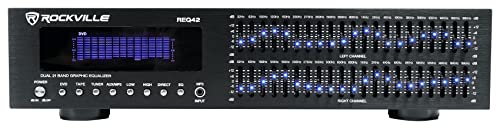
- Two 21-band graphic equalizers
- RCA and 3.5mm source connectivity
- Rack-ready design with VU meters
Best For: RCA-based home studios and mobile DJ rigs
Compact Hi-Fi
Douk Audio T7 7-Band EQ Preamp

- Seven adjustable frequency bands
- XLR and RCA input/output options
- Compact aluminum enclosure
Best For: Compact home stereo systems
Car Audio Tuning
CT Sounds CT-7EQ Parametric Car EQ
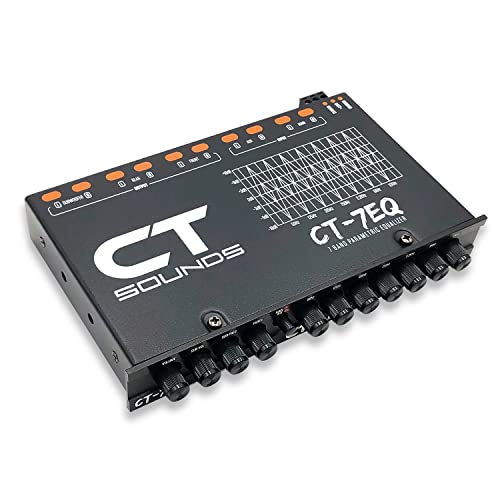
- Seven-band 20Hz–20kHz coverage
- Dedicated bass, mid, treble, and sub-bass controls
- Includes 1/2-DIN mounting hardware
Best For: Custom car audio installations
Best Budget Home EQ
Audiotek AT-EQ500 5-Band Equalizer
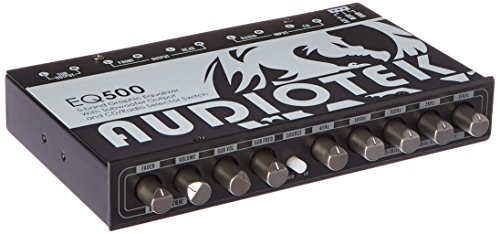
- Five-band ±12dB tone adjustment
- Adjustable low-pass subwoofer output
- RCA source and output connections
Best For: Basic home stereo tuning with subwoofer control
Best Professional-Style EQ
31-Band Digital Equalizer with Spectrum Display

- 31-band DSP control with spectrum display
- Bluetooth, USB, XLR, and TRS connectivity
- Rack-mount design with presets and bypass
Best For: Studios, DJ systems, live setups, and home theater
Best Compact Headphone EQ
7-Band Two-Channel Sound Equalizer

- Seven bands with ±12dB adjustment
- 3.5mm interface and headphone output
- Two-channel aluminum-alloy design
Best For: Headphones, streaming, podcasting, and mobile voice setups
Best Visual Control
31-Band Digital Home Audio Equalizer

- 31-band adjustment with real-time LED spectrum display
- Bluetooth 5.2, USB, XLR, and 1/4-inch TRS connectivity
- 10 presets, bypass, and adjustable bass output
Best For: Detailed home, studio, DJ, and KTV audio setups
Best for Car Audio
Taramps TEQ 7.4 7-Band Equalizer

- Seven bands from 50Hz to 12kHz with ±12dB adjustment
- Two RCA inputs and three outputs for front, rear, and sub
- Compact 12V design with auxiliary gain and fader control
Best For: Multi-channel car audio systems
Best Rack-Mount Precision
15-Band Stereo Graphic Equalizer

- 15 bands per channel with ±12dB adjustment
- Low-cut control and adjustable dedicated bass output
- XLR and 1/4-inch TRS connections in a 1U rack design
Best For: Home audio, DJ, studio, live, and installation systems
Studio Control – dbx 231s 31-Band Equalizer
The dbx 231s is a strong choice among audio equalizers under 500 for users who need detailed, rack-ready frequency control. Its dual 31-band layout provides fine adjustment across 1/3-octave constant-Q bands, while selectable boost/cut ranges and front-panel monitoring support practical live or studio setup work.
Best For: Rack-mounted studio systems, live sound rigs, and users who want highly granular stereo equalization.
Pros:
- Dual 31-band, 1/3-octave constant-Q control
- Switchable 6 dB or 12 dB boost/cut ranges
- TRS and XLR inputs and outputs
- Front-panel bypass and four-segment LED output meters
Cons:
- Rack-oriented 19-inch design may be excessive for compact home systems
- Provides many controls for users seeking simple tone adjustment
Choose the 231s when precision and conventional professional connectivity matter more than minimal size. Its 7.9-pound rack format and extensive band count make it best suited to permanent or semi-permanent audio setups.
Rack Value – Rockville REQ42-B Dual 21-Band EQ
The Rockville REQ42-B offers two 21-band graphic equalizers in a rack-mountable chassis, making it a flexible pick among audio equalizers under 500 for home studios, events, and mobile DJ setups. RCA connectivity, a front 3.5mm input, and visual level displays keep the layout accessible.
Best For: Home audio users, mobile DJs, and event systems built around RCA connections.
Pros:
- Dual 21-band equalizer covering 20Hz–20kHz
- RCA stereo input, record output, and 3.5mm MP3/iPod input
- Removable rack-mount brackets
- Blue sliders, multicolor display, and dual VU meters
Cons:
- RCA-focused connectivity is less suited to balanced professional cabling
- Its 19-inch rack format requires suitable installation space
The REQ42-B is a practical option when you want visible controls and broad consumer-friendly connectivity in one unit. It is especially appealing for setups that use RCA sources and benefit from straightforward front-panel monitoring.
Compact Hi-Fi – Douk Audio T7 7-Band EQ Preamp
The Douk Audio T7 is a compact home-audio preamp for shoppers comparing audio equalizers under 500 without needing a rack-sized component. Its seven fixed frequency bands offer ±6 dB adjustment, while simultaneous XLR and RCA input/output support makes it easy to integrate with varied amplifier systems.
Best For: Home stereo listeners who want compact, balanced and unbalanced EQ connectivity.
Pros:
- Seven bands from 64Hz through 8kHz with ±6 dB adjustment
- Both XLR and RCA inputs and outputs
- Reported signal-to-noise ratio above 104dB and 0.003% distortion
- Small aluminum alloy enclosure
Cons:
- No volume control knob
- Seven bands provide less detailed adjustment than 21- or 31-band designs
The T7 fits systems where compact size and flexible connection options are priorities. Its no-volume-control design keeps operation simple, but buyers should confirm that their amplifier or source provides the volume adjustment they need.
Car Audio Tuning – CT Sounds CT-7EQ Parametric Car EQ
The CT Sounds CT-7EQ is a 1/2-DIN car audio equalizer designed for in-vehicle frequency shaping. For shoppers seeking audio equalizers under 500 for a car system, it provides seven frequency segments across 20Hz–20kHz, separate bass, mid, and treble adjustment, and included mounting hardware.
Best For: Car audio installations needing compact dash-mounted frequency control and sub-bass adjustment.
Pros:
- Seven-band design covering 20Hz–20kHz
- Separate ±10 dB bass, mid, and treble adjustment
- Includes installation brackets and hardware
- 1/2-DIN format with 43Hz and 60Hz sub-bass controls
Cons:
- Designed specifically for car audio rather than home or rack systems
- Band layout is less granular than a full 21- or 31-band graphic EQ
The CT-7EQ makes the most sense when your priority is adding hands-on EQ control to a compatible car installation. Its compact format and included hardware simplify fitting, while the dedicated sub-bass controls target common vehicle-audio tuning needs.
Best Budget Home EQ – Audiotek AT-EQ500 5-Band Equalizer
Audiotek At-eq500 Eq500 5-Band Graphic Equalizer with Subwoofer Output and Cd/Radio Selector Switch
Check Price On AmazonIf you need audio equalizers under 500 for a straightforward stereo setup, the Audiotek AT-EQ500 focuses on essential tone shaping without an overly complex control layout. Its five bands offer ±12dB adjustment, while RCA connectivity and a dedicated subwoofer section support common home audio configurations.
Best For: Home stereo listeners who want basic graphic EQ control, source selection, and adjustable subwoofer output.
Pros:
- Five-band equalization with ±12dB tone adjustment.
- Dedicated subwoofer volume control and selectable low-pass frequency.
- Includes RCA inputs, three stereo RCA outputs, input selection, master volume, and front/rear fader control.
Cons:
- Offers fewer adjustment bands than a professional 31-band equalizer.
- Uses RCA connections rather than the balanced XLR/TRS connections found on some studio units.
The AT-EQ500 is a practical choice when you want hands-on control over broad frequency ranges and bass integration in an RCA-based system. It is less suited to highly precise studio correction.
Best Professional-Style EQ – 31-Band Digital Equalizer with Spectrum Display
Among audio equalizers under 500, this 31-band digital EQ is aimed at users who want detailed frequency control and flexible system integration. It combines a spectrum analyzer display with presets, Bluetooth 5.2, USB playback, noise reduction, and rack-mountable construction.
Best For: Home theaters, DJ setups, KTV systems, studios, and live audio rigs requiring detailed EQ control and multiple connection options.
Pros:
- 31-band DSP equalizer with real-time frequency monitoring and four-color LED display.
- Stores up to 10 custom presets and includes intelligent noise reduction.
- Provides Bluetooth 5.2, USB playback, adjustable 50Hz–250Hz subwoofer output, and a BYPASS switch.
- Supports XLR balanced and 1/4-inch TRS unbalanced input/output connections in a standard 1U rack-mount design.
Cons:
- Its rack-mount format and extensive controls may be more equipment than a simple home stereo needs.
- The supplied notes do not specify included rack hardware or detailed supported USB file formats.
This model stands out for precision and connectivity. The combination of detailed band control, recallable presets, and balanced I/O makes it the most versatile option here for more involved audio systems.
Best Compact Headphone EQ – 7-Band Two-Channel Sound Equalizer
For portable or desktop recording, streaming, and podcasting setups, this compact two-channel unit offers seven-band tone shaping in an aluminum-alloy enclosure. Its 3.5mm input, headphone support, and 5V–12V DC power range make it a focused option among audio equalizers under 500.
Best For: Headphone users, streamers, podcasters, and mobile voice-call setups needing adjustable bass, mids, and treble.
Pros:
- Seven frequency bands from 60Hz to 15kHz with ±12dB adjustment.
- Two-channel design with a 3.5mm input and microphone-compatible headphone output.
- Includes a headphone amplifier section and supports 5V–12V DC power.
- Aluminum-alloy construction offers a compact freestanding format.
Cons:
- It is a small two-channel preamp/equalizer rather than a rack-mount system processor.
- The supplied notes do not identify a battery or power adapter as included.
- Its listed impedance and gain specifications may require matching with the rest of the audio chain.
This equalizer is best viewed as a specialized desktop or headphone tool. It provides more frequency points than a basic tone control, but it is not intended to replace a full home or live-sound rack EQ.
Best Visual Control – 31-Band Digital Home Audio Equalizer
For shoppers comparing audio equalizers under 500, this 31-band digital model stands out for its real-time LED spectrum display and broad connectivity. It combines preset effects, independent bass/mid/treble adjustment, Bluetooth 5.2, USB playback, and rack-mount installation for home audio, studio, DJ, and KTV setups.
Best For: Users who want detailed visual frequency monitoring and flexible home or professional audio integration.
Pros:
- 31-band control with real-time, multicolor LED spectrum indication.
- Includes 10 preset modes, EQ bypass, and independent high, mid, and bass adjustment.
- Supports Bluetooth 5.2, USB playback, XLR balanced, and 1/4-inch TRS connections.
- Includes an adjustable independent bass output and standard rack-mount design.
Cons:
- The corded rack-mount design may be more equipment than a casual listener needs.
- Its broad feature set may require more setup time than a simpler equalizer.
This is a strong choice when hands-on control and visual feedback matter. The combination of 31-band adjustment, noise reduction, and multiple inputs and outputs makes it especially adaptable for more involved audio systems.
Best for Car Audio – Taramps TEQ 7.4 7-Band Equalizer
Among audio equalizers under 500, the Taramps TEQ 7.4 is tailored specifically to 12-volt car audio systems. Its seven adjustable bands, dual RCA inputs, three RCA outputs, auxiliary gain, and fader control provide a compact way to shape front, rear, and subwoofer channels.
Best For: Car-audio users who need compact analog EQ control with dedicated front, rear, and subwoofer outputs.
Pros:
- Seven-band graphic EQ covers frequencies from 50Hz to 12kHz with ±12dB gain adjustment.
- Two RCA stereo inputs and three RCA stereo outputs support flexible system integration.
- Offers front, rear, and subwoofer outputs along with auxiliary gain and fader control.
- Compact 4 x 3 x 1-inch design is made for 12V systems and includes blue lighting.
Cons:
- It is designed for 12V car audio rather than home or studio systems.
- RCA connectivity and analog operation may not suit setups requiring balanced connections or digital inputs.
The TEQ 7.4 is a focused choice for vehicle installations. Its compact format and three-output layout make it practical for tuning a multi-channel car system without adding a larger rack-style processor.
Best Rack-Mount Precision – 15-Band Stereo Graphic Equalizer
For buyers seeking audio equalizers under 500 for more precise stereo shaping, the EQX-215S provides 15 bands per channel with ±12dB control. Its dual-channel layout, low-cut function, bypass switching, bass output, and XLR or 1/4-inch TRS connectivity suit home audio, DJ, live, studio, and installation use.
Best For: Audiophiles and audio professionals who want dual-channel rack-mount control with balanced and unbalanced connections.
Pros:
- Provides dedicated 15-band adjustment per channel with a ±12dB range.
- Low-cut control helps reduce unwanted low-end noise and allows cutoff-frequency adjustment.
- Includes XLR balanced and 1/4-inch TRS unbalanced inputs and outputs.
- Features a 1U rack-mount design, EQ bypass switch, adjustable bass output, and a two-year warranty.
Cons:
- The 1U rack-mount format may be excessive for small or casual listening systems.
- Its 110V corded design limits portability and may require suitable power compatibility.
The EQX-215S offers a practical balance of detailed control and installation flexibility. It is particularly appealing when dual-channel tuning, low-frequency cleanup, and professional-style connections are more important than a compact footprint.
How We Picked the Best Audio Equalizers Under 500
We focused on equalizers priced below $500 that offer practical value for their intended use. Selection criteria included adjustment range, band count, connection options, channel layout, installation format, controls, and compatibility with common audio systems. Because a car audio EQ has different requirements from a rack-mounted studio unit, we considered each product in the context of its likely application rather than treating every model as interchangeable.
We also looked for useful features such as balanced inputs and outputs, RCA connectivity, subwoofer outputs, auxiliary gain, spectrum display, noise reduction, rack-mount construction, and compact installation formats. Buyers should confirm current specifications and dimensions before ordering, particularly for products with similar names or marketplace listings that may vary by revision.
Quick Comparison
| Best For | Recommended Type | Features to Prioritize |
|---|---|---|
| Home stereo | 5- or 7-band EQ | RCA or balanced connections, simple controls |
| Studio or live sound | 31-band rack EQ | Balanced I/O, precise adjustment, reliable chassis |
| DJ and performance systems | 15- or 31-band graphic EQ | Dual-channel operation, rack compatibility, display |
| Car audio | 7-band parametric or graphic EQ | RCA routing, gain, fader, compact installation |
| Streaming or desktop audio | Compact digital EQ | 3.5mm or USB-compatible signal path, accessible controls |
Key Buying Factors for Audio Equalizers Under 500
Graphic Versus Parametric Control
Graphic equalizers use fixed frequency bands and are easy to adjust visually. More bands generally allow finer correction, but they can be unnecessary for basic home listening. Parametric designs provide more control over frequency and, depending on the model, bandwidth or Q; they are better suited to targeted tuning when you know which frequencies need attention.
Connections and Signal Routing
Match the EQ’s inputs and outputs to your equipment. RCA is common in home and car audio, while balanced XLR or TRS connections are preferable for many studio and professional installations because they can reduce noise over longer cable runs. Check whether the unit has the required number of channels, a subwoofer output, auxiliary input, or separate output routing.
Band Count, Headroom, and Noise
More bands do not automatically mean better sound. Look for usable boost and cut ranges, adequate headroom, low added noise, and controls that are easy to read. An EQ should be placed where it will not overload the next component; gain controls and sensible level matching help preserve clarity.
Form Factor and Installation
Rack-mount units suit studios, DJ racks, and permanent systems, while compact models work better beside a desktop setup or inside a vehicle. Verify rack width, depth, power requirements, ventilation, and mounting hardware before purchase.
Who Should Buy Which Audio Equalizers Under 500?
Choose a 31-band rack equalizer if you need detailed control for live sound, recording, DJ use, or room correction. A 15-band model is a practical middle ground for stereo or performance systems. For straightforward home listening, a 5- or 7-band unit can deliver useful tone shaping without a steep learning curve.
Car audio buyers should prioritize models designed for vehicle signal paths, with appropriate RCA inputs and outputs plus gain or fader controls. Desktop, streaming, and compact-system users should favor smaller digital or analog units whose connectors match the source and speakers. If you are unsure, map the complete signal chain first—source, EQ, amplifier, and speakers—then choose the model that supports every connection without adapters or unnecessary conversion.