The right equalizer can make a live mix clearer, more balanced, and easier to control in a changing venue. From compact DJ mixers to multi-band rack units, these picks cover practical options for shaping vocals, instruments, monitors, and mains.
We selected products with useful band control, live-friendly connectivity, feedback-management features, and flexible output options. Use the guide below to match your system, venue, and experience level with the right type of EQ.
Best 10 Audio Equalizers for Live Sound Picks for 2026
Feedback Control Specialist

- 31-band stereo EQ
- FBQ feedback detection
- Pink-noise generator and limiters
Best For: Detailed live-system tuning and feedback control
Portable Mixing Hub
4-Channel Bluetooth Audio Mixer

- USB and Bluetooth input
- +48V phantom power
- Compact live-streaming design
Best For: Portable small-event mixing and content creation
Subwoofer Tuning Rack EQ
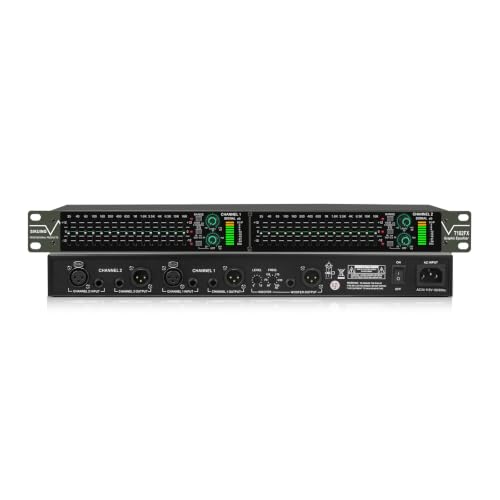
- 15-band dual-channel EQ
- Adjustable low-cut filter
- Dedicated 50–250Hz sub output
Best For: Rack systems with active subwoofer control
Expanded Event Mixer
FULUODE CT-80S 8-Channel Console

- Eight-channel input capacity
- 48V phantom power and reverb
- Bluetooth, USB playback, and recording
Best For: Small events, karaoke, and multi-source live mixing
Balanced Control
EQ-215 Pro Dual 15-Band Equalizer

- Dual 15-band stereo control
- 40Hz low-cut and bypass switches
- XLR/TRS I/O with LED monitoring
Best For: Live PA, DJ, church, and studio setups needing simple analog EQ control
Digital Display Hub
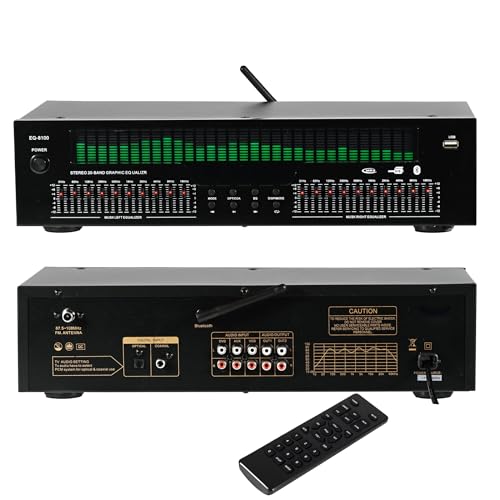
- 20-band EQ with 31-band analyzer
- Optical, coaxial, USB, RCA, and Bluetooth inputs
- Auto-save presets and remote control
Best For: Live and studio users who want visual analysis and digital source flexibility
Fine-Grain Shaping
EQ-231 31-Band Stereo Equalizer

- 31 bands per stereo channel
- Low-cut and bypass switches
- XLR/TRS connectivity with LED ladders
Best For: Live, installed, DJ, and studio systems needing detailed analog frequency control
Flexible Rack Control
EQX-215S 15-Band Stereo Equalizer

- Dual 15-band control with up to ±12 dB adjustment
- Low-cut control plus adjustable bass output
- XLR and 1/4-inch TRS connectivity in a 1U chassis
Best For: Live sound and DJ systems needing flexible stereo routing
Low-Noise Tuning
EQ-215 15-Band Stereo Graphic Equalizer
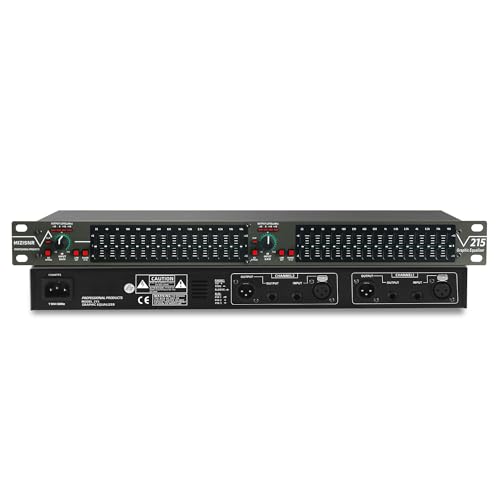
- Dual 15-band graphic EQ with up to ±12 dB range
- Low-cut switch targets rumble, wind noise, and hum
- Bypass switch supports quick signal comparisons
Best For: Straightforward live, studio, and installation EQ
Live Low-End Control
EQX-215 Stereo Graphic Equalizer

- 15 bands per channel for detailed stereo tone shaping
- Low-cut switch helps tighten sub-bass response
- Compact 1U design with balanced and unbalanced I/O
Best For: Live rigs and studios focused on clean, controlled low end
Feedback Control Specialist – FBQ6200HD 31-Band Graphic EQ
The Behringer ULTRAGRAPH PRO FBQ6200HD is a strong choice among audio equalizers for live sound when you need detailed stereo tone shaping and practical feedback control. Its 31-band layout, pink-noise generator, FBQ detection system, and channel limiters support room tuning and safer operation.
Best For: Live sound operators who need extensive EQ control, feedback identification, and overload protection.
Pros:
- 31-band stereo graphic equalization for detailed adjustments.
- FBQ system helps identify critical feedback frequencies.
- Pink-noise generator supports adapting a system to room acoustics.
- Dedicated limiters with gain-reduction meters help protect against overload.
Cons:
- Its rack-style controls and broad feature set may be more than casual users need.
- It requires corded power and dedicated audio-system connections.
Choose this model when feedback management and system tuning matter more than minimal size. The extensive controls make it particularly suited to installed or regularly configured live rigs.
Portable Mixing Hub – 4-Channel Bluetooth Audio Mixer
This compact 4-channel mixer is a practical entry in audio equalizers for live sound setups that also need playback, recording, and microphone connectivity. It combines USB, Bluetooth input, XLR, 6.35mm inputs, monitoring, and +48V phantom power in a backpack-friendly enclosure.
Best For: Small live streams, presentations, karaoke, podcasts, ceremonies, and mobile setups needing flexible source connections.
Pros:
- Compact 7.87-by-6.7-by-1.57-inch design for portable use.
- Supports microphones, guitars, bass, keyboards, USB, and Bluetooth input.
- Built-in USB interface supports PC recording and live streaming.
- +48V phantom power accommodates compatible condenser microphones.
Cons:
- Bluetooth supports input only, not wireless output.
- Four channels provide less expansion than larger live mixers.
This is best viewed as a small control center rather than a dedicated rack equalizer. Its value comes from combining basic live mixing, monitoring, wireless playback, and USB recording in one portable unit.
Subwoofer Tuning Rack EQ – 15-Band Stereo Equalizer
This 15-band stereo unit is a focused option among audio equalizers for live sound, offering dual-channel tone shaping, low-cut filtering, signal metering, and a dedicated adjustable subwoofer output. Its 1U metal chassis is designed for rack installation in live or studio systems.
Best For: Rack-based sound systems that need straightforward stereo EQ, low-frequency cleanup, and separate subwoofer control.
Pros:
- 15 EQ bands cover 25Hz to 16kHz for broad tonal adjustment.
- Adjustable low-cut filter helps reduce hum and muddy low frequencies.
- Dedicated subwoofer output adjusts from 50Hz to 250Hz.
- LED metering and clip indication help monitor signal levels.
Cons:
- Provides fewer bands than a 31-band graphic equalizer.
- Its rack-mounted format is less convenient for highly portable setups.
For systems built around an active subwoofer, the dedicated sub output is a useful advantage. It offers essential live-system controls without the broader complexity of a higher-band-count processor.
Expanded Event Mixer – FULUODE CT-80S 8-Channel Console
The FULUODE CT-80S is an 8-channel mixing console for live sound users who need more input capacity than a compact desktop mixer. It combines 48V phantom power, reverb, MP3/USB playback, Bluetooth 5.0, and USB recording for events, karaoke, studio use, and live music.
Best For: Small bands, karaoke systems, conferences, campus activities, and live events needing multiple wired or wireless sources.
Pros:
- Eight channels provide room for multiple microphones and instruments.
- Includes 48V phantom power for compatible condenser microphones.
- Built-in reverb, MP3/USB playback, Bluetooth 5.0, and USB recording.
- Ultra-thin 1.57-inch design for a relatively streamlined console.
Cons:
- The supplied notes do not specify detailed EQ-band controls for each channel.
- At 3.3kg and 15.75 inches wide, it is less compact than a mini mixer.
- The product is specified for 110V power with an American plug.
This model suits users who need a versatile event mixer more than a dedicated graphic equalizer. Its larger channel count and integrated playback and effects make it useful where several sources must be managed from one board.
Balanced Control – EQ-215 Pro Dual 15-Band Equalizer
For buyers comparing audio equalizers for live sound, the EQ-215 Pro offers practical dual-channel control in a standard 1U rack format. Its 15 bands per channel, low-cut filter, bypass switch, and XLR/TRS connectivity make it suited to shaping a PA, DJ, or studio signal chain.
Best For: Mobile DJs, church sound systems, home theaters, recording setups, and smaller live stages needing straightforward stereo EQ control.
Pros:
- Dual independent 15-band channels for correcting room acoustics and shaping vocals or instruments.
- 40Hz low-cut filter helps reduce floor rumble, wind, and electrical hum.
- XLR and 1/4-inch TRS inputs and outputs support mixers, amplifiers, receivers, and PA systems.
- Switchable ±6dB or ±12dB range, LED monitoring, bypass, and 1U rack mounting add practical flexibility.
Cons:
- Offers 15 bands per channel rather than the finer control of a 31-band equalizer.
- Its analog-focused design may be less suitable for buyers wanting built-in digital playback or wireless features.
The EQ-215 Pro is a sensible choice when reliable, hands-on stereo adjustment matters more than advanced digital connectivity. Its signal monitoring and low-cut filter are particularly useful for basic feedback and noise management in live systems.
Digital Display Hub – EQ8100 20-Band Equalizer
The EQ8100 stands out among audio equalizers for live sound by combining 20-band adjustment with a 31-band spectrum analyzer and multiple digital inputs. It is designed for users who want visual frequency feedback, preset-style flexibility, and connectivity that extends beyond a conventional analog rack EQ.
Best For: Stage systems, recording studios, KTV mixers, home theaters, mobile DJs, and setups that use optical, coaxial, USB, or Bluetooth sources.
Pros:
- Real-time 31-band spectrum analyzer provides visual feedback on frequency levels.
- 20-band EQ with 12 customizable jump modes supports detailed sound shaping and feedback management.
- Optical, coaxial, USB, RCA, and Bluetooth connectivity expands source compatibility.
- Auto-save presets, remote control, oversized display, and a 1U aluminum chassis suit rack or mobile use.
Cons:
- The extensive digital features may be more than needed for a simple analog live-sound signal chain.
- Supplied dimensions are listed as 19 inches on each side, so buyers should verify rack-clearance details before installation.
Choose the EQ8100 if spectrum visualization and varied source connections are priorities. It offers more integrated functionality than a basic graphic EQ, although its feature set may require more setup and familiarity.
Fine-Grain Shaping – EQ-231 31-Band Stereo Equalizer
For demanding audio equalizers for live sound applications, the EQ-231 provides 31 adjustable bands on each stereo channel. Its low-cut filter, selectable gain range, balanced XLR connections, and level-monitoring LEDs give engineers detailed control for live systems, installations, and studio work.
Best For: Live applications, installed audio systems, DJ rigs, and studios where detailed frequency adjustment and noise reduction are important.
Pros:
- 31 bands per channel allow finer frequency shaping than 15-band designs.
- Adjustable ±6dB to ±12dB gain range provides flexible boost and cut control.
- Low-cut switch helps attenuate wind noise, floor rumble, and electrical hum.
- XLR and 1/4-inch inputs and outputs, bypass, and four-segment LED ladders support practical system setup.
Cons:
- The supplied notes do not list digital, USB, Bluetooth, or optical connectivity.
- Its many controls may take longer to configure than a simpler 15-band equalizer.
The EQ-231 is the strongest fit here for users who want granular, hands-on stereo correction. It focuses on core analog EQ duties and useful monitoring features rather than integrated playback or spectrum-display extras.
Flexible Rack Control – EQX-215S 15-Band Stereo Equalizer
For audio equalizers for live sound, the EQX-215S offers dual-channel 15-band control, balanced and unbalanced connectivity, and extra low-end management for tuning a stereo system to its room or performance space.
Best For: Live sound, DJ setups, audio installations, and users who need subwoofer output control.
Pros:
- Provides 15 adjustable bands per channel with a stated range of up to ±12 dB.
- Includes low-cut control and an adjustable bass output frequency.
- Supports XLR balanced and 1/4-inch TRS unbalanced connections.
- Fits a standard 1U rack space and includes a two-year warranty.
Cons:
- Its 1U rack-mount design may be more equipment than a basic home setup needs.
- The notes do not specify digital controls, presets, or automatic feedback suppression.
Choose this model when connection flexibility and dedicated low-frequency routing matter. It is a practical analog-style rack option, though buyers wanting automated live-sound features should look elsewhere.
Low-Noise Tuning – EQ-215 15-Band Stereo Graphic Equalizer
The EQ-215 is a straightforward choice among audio equalizers for live sound, combining dual 15-band graphic adjustment with low-cut filtering and bypass switching in a space-saving 1U rack-mount design.
Best For: Live applications, studio systems, and installations that need basic stereo EQ and low-frequency noise reduction.
Pros:
- Offers 15 bands on each stereo channel with up to ±12 dB of adjustment.
- Low-cut switching is designed to reduce wind noise, floor rumble, and electrical hum.
- Bypass switching makes direct signal comparison and troubleshooting easier.
- Provides XLR balanced and 1/4-inch TRS unbalanced inputs and outputs.
Cons:
- The supplied details do not mention a dedicated subwoofer output.
- No warranty information or included-cable details are provided in the notes.
This is a sensible pick for users who want familiar rack-based controls and a useful low-cut function without adding complexity. Its feature set is focused on core EQ duties rather than advanced system processing.
Live Low-End Control – EQX-215 Stereo Graphic Equalizer
Designed with live use in mind, this EQX-215 gives each stereo channel 15 frequency bands, a low-cut switch, and bypass operation. It is a practical option for shaping audio equalizers for live sound alongside mixers, amplifiers, and subwoofers.
Best For: Live performances, recording studios, and home audio systems needing compact stereo tone shaping.
Pros:
- Provides independent 15-band equalization on both channels.
- Includes low-cut switching for a tighter, cleaner sub-bass response.
- EQ and bypass modes allow quick tuning and direct tonal comparisons.
- Works with XLR balanced and 1/4-inch TRS unbalanced connections.
Cons:
- The supplied notes do not specify a separate adjustable subwoofer output.
- Its 1U rack format requires suitable rack or shelf space.
- The package details do not list included cables or a warranty.
Consider this version if low-end cleanup and simple A/B checking are priorities. It covers the essential controls for compact live or studio rigs, while buyers needing more specialized routing should verify their signal-flow requirements first.
How We Picked the Best Audio Equalizers for Live Sound
We evaluated these Audio Equalizers for Live Sound based on the controls they provide, their likely role in a signal chain, and how easily they can fit into a small or expanded PA system. Key considerations included the number of EQ bands, stereo or dual-channel operation, rack-mount practicality, feedback-control features, subwoofer outputs, connectivity, and ease of use during a performance.
Because this list includes both dedicated equalizers and mixer-style products, shoppers should first identify whether they need tone-shaping hardware, a front-end mixer, or an all-in-one control surface.
Quick Comparison
| Best For | Look For | Recommended Type |
|---|---|---|
| Small DJ or karaoke setups | Simple controls and media inputs | Compact mixer with built-in EQ |
| Live vocals and instruments | Multiple bands and dual-channel control | 15- or 31-band graphic EQ |
| Feedback-prone venues | Fast frequency identification and notch control | EQ with feedback detection or spectrum display |
| Subwoofer-equipped PA systems | Dedicated low-frequency routing | EQ with subwoofer output |
| Installed or touring racks | Balanced connections and rack compatibility | Professional dual-channel rack EQ |
Key Buying Factors for Audio Equalizers for Live Sound
Band Count and Control Range
A 15-band EQ is usually easier to operate quickly and works well for basic system shaping. A 31-band model offers finer control, which can help tune a PA to a difficult room or reduce narrow feedback frequencies. More bands are useful only if you can adjust them confidently without overcorrecting the mix.
Graphic EQ Versus Mixer EQ
Dedicated graphic equalizers sit between source equipment and amplifiers, powered speakers, or system processors. Mixer EQ sections are more convenient when you also need microphone inputs, level controls, Bluetooth, USB playback, or phantom power. Confirm the product’s inputs and outputs before assuming it can replace a standalone EQ.
Feedback Management and Displays
Feedback detection, spectrum analyzers, and visible frequency indicators can speed up troubleshooting. These features are helpful for monitors, vocal microphones, and temporary stages, but they do not replace careful microphone placement, gain staging, and speaker positioning.
Connections and System Compatibility
Check whether the unit uses balanced XLR or TRS connections, RCA inputs, or consumer-style outputs. Match the number of channels to your setup, and verify whether a subwoofer output, bypass switch, or independent left/right adjustment is required.
Who Should Buy Which Audio Equalizers for Live Sound?
Choose a 15-Band Stereo EQ If:
You want straightforward tone shaping for a home system, small PA, DJ rig, or rehearsal space. These models offer a practical balance of control, affordability, and fast operation.
Choose a 31-Band or Spectrum-Display EQ If:
You regularly work in changing venues, manage monitor feedback, or need precise control across vocals, instruments, and mains. The extra visual feedback and frequency resolution are most valuable for experienced operators.
Choose a Mixer-Style Product If:
You need microphone inputs, playback, Bluetooth, USB support, reverb, or phantom power in addition to basic equalization. It is often the better choice for mobile performers and compact event systems.
Before buying, confirm the signal path, connector format, channel count, rack dimensions, and output requirements. A well-matched EQ improves clarity; an incompatible one adds complexity without solving the underlying problem.