The right direct box can make a noticeable difference onstage, converting instrument or line-level sources into balanced signals that run cleanly to a mixing console. The best DI boxes for live performance also help manage hum, gain levels, and difficult cable runs.
This roundup covers dependable passive and active models, dual-channel options, and affordable choices for guitars, basses, keyboards, playback rigs, and other stage sources.
Best 10 Di Boxes for Live Performance Picks for 2026
Reliable Passive Pick

- Passive mono design with custom transformer
- Rugged stainless-steel I-beam construction
- Supports guitars, basses, keyboards, and drum machines
Best For: Durable live or studio instrument connections
Flexible Stage Routing

- Converts 1/4-inch input to balanced XLR
- Needs no batteries or phantom power
- Includes pads, ground lift, and passive thru
Best For: Live rigs needing flexible signal routing
Dual-Channel Utility

- Two passive DI channels in one unit
- No battery required
- Adds attenuation, filtering, phase, and ground-lift controls
Best For: Stereo or multi-source live performance rigs
Phantom-Powered Active Choice
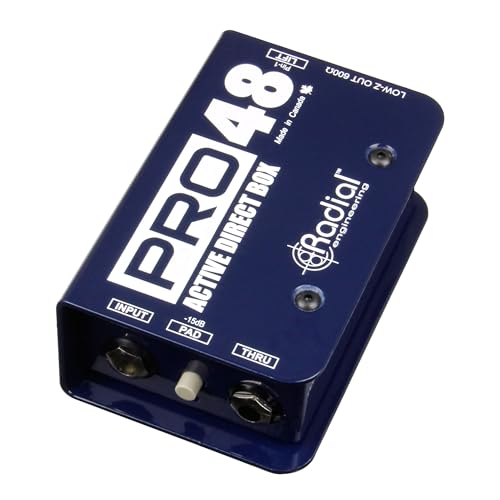
- Active DI for guitar and bass
- Uses 48-volt phantom power
- Includes a -15 dB pad and balanced mono XLR output
Best For: Compact active setups with phantom power
Dual-Channel Flexibility

- Two independent channels for instruments
- Ground switches and -30dB attenuation
- Compact, driver-free live setup
Best For: Bands and multi-instrument live rigs
Active Stereo Routing

- Two balanced XLR outputs
- Mono, stereo, and Link modes
- Phantom or 9V battery powered
Best For: Stereo sources and flexible stage routing
Simple Passive Control

- High-impedance input and 1/4-inch throughput
- Balanced floating XLR output
- Variable attenuation and Lift mode
Best For: Single-instrument passive stage setups
Best Stereo Isolation
Radial ProD2 Passive 2 Channel DI

- Two-channel passive stereo design
- Isolation transformer and ground lift
- 15dB pad for signal-level flexibility
Best For: Stereo keyboards and playback rigs
Best Budget Hum Control
Donner Special-I Passive DI Box

- Balanced XLR conversion from 1/4-inch sources
- Transformer isolation helps reduce hum
- Thru output for simultaneous amp and PA feeds
Best For: Guitar, bass, and keyboard stage setups
Best Versatile Passive Option
Pyle Premium Direct Injection Box

- Handles instruments and other unbalanced sources
- Input attenuator supports signal-level matching
- Compact passive design with hum cancellation
Best For: Mixed instrument and processor setups
Reliable Passive Pick – Radial Pro DI
The Radial Pro DI is a rugged passive option for live performance setups that need to send instrument signals to professional consoles or snake systems. Its transformer-based design and mono XLR connectivity suit acoustic guitars, basses, keyboards, and drum machines.
Best For: Musicians who want a durable, straightforward passive DI box for live or studio use.
Pros:
- Passive mono direct box with a custom transformer
- Rugged stainless-steel I-beam construction
- Works with guitars, basses, keyboards, and drum machines
- Includes a 2-year warranty
Cons:
- Mono operation supports one signal path
- Does not provide wireless communication
- Not waterproof
Choose the Radial Pro DI when physical durability and simple passive operation matter more than extra channel or switching features.
Flexible Stage Routing – Samson MD1 Pro DI
The Samson MD1 Pro is a practical choice among DI boxes for live performance, converting a 1/4-inch unbalanced instrument or line signal into a balanced mic-level XLR output. Its ground lift, switchable pads, and passive thru output make it adaptable to changing stage connections.
Best For: Guitarists, bassists, keyboard players, and live sound users who need flexible routing to a console, interface, amplifier, or pedals.
Pros:
- Outputs a balanced mic-level XLR signal
- Passive operation requires no batteries or phantom power
- Ground lift helps address buzz and hum
- Offers -15 dB and -30 dB pad settings plus a passive thru output
Cons:
- Its 14-gauge steel chassis weighs 1.3 pounds
- Warranty information should be confirmed with the seller or manufacturer
- Primarily designed for wired connections
The MD1 Pro stands out when a live rig needs signal attenuation, ground isolation, and a dry thru feed without adding an active power requirement.
Dual-Channel Utility – ART DualZDirect
The ART DualZDirect provides two passive DI channels in one unit, making it useful for live performance setups with stereo or multiple instrument sources. Its transformer design converts high-impedance inputs to balanced 600-ohm outputs without requiring a battery.
Best For: Performers and engineers who need two passive DI channels with adjustable attenuation and signal-isolation controls.
Pros:
- Provides two channels in a single enclosure
- Fully passive transformer design needs no battery
- Offers 0, -20, and -40 dB input attenuation
- Includes low-pass filter, phase invert, and ground lift switches
Cons:
- Its controls may be more than needed for simple single-channel setups
- The supplied notes do not specify included cables or accessories
For live performance systems that benefit from dual-channel coverage and extensive signal-shaping options, the DualZDirect is a versatile passive solution.
Phantom-Powered Active Choice – Radial Pro48 Active DI
The Radial Pro48 is a compact active DI box for live performance systems using guitar or bass signals. It runs on 48-volt phantom power and includes a -15 dB pad, helping accommodate passive instruments while delivering a balanced mono XLR output.
Best For: Guitarists and bassists with access to 48-volt phantom power who want a compact active direct box.
Pros:
- Active design is powered by 48-volt phantom power
- Includes a -15 dB pad for passive guitars and basses
- Provides balanced mono XLR output
- Steel enclosure weighs about 0.56 kg
Cons:
- Requires a 48-volt phantom-power source
- Designed for mono operation
- Its supplied details list battery power, so power requirements should be checked against the connected system
The Pro48 is a sensible fit for powered stage and console environments, particularly when a compact active DI with a pad is preferable to a passive design.
Dual-Channel Flexibility – StudioMan DI-2 Passive DI Box
For performers comparing DI boxes for live performance, the StudioMan DI-2 is a practical choice when you need to connect two instruments at once. Its passive, dual-channel design includes independent ground switches, attenuation, and balanced outputs for straightforward stage or studio routing.
Best For: Bands, keyboard-and-guitar setups, live streaming, and multi-track recording.
Pros:
- Two independent channels support simultaneous instrument connections.
- Independent ground switches help address ground-loop hum.
- -30dB attenuation accommodates high-output devices and helps prevent clipping.
- Compact chassis and driver-free operation suit quick live setups.
Cons:
- Its 1.32-pound chassis is less lightweight than some compact single-channel options.
- Passive operation may not suit users specifically seeking an active DI design.
The DI-2 stands out for flexible two-channel routing and useful per-channel controls. It is a strong fit when your live rig needs balanced connectivity without adding a complicated setup.
Active Stereo Routing – Behringer Ultra-Di DI20
The Behringer Ultra-Di DI20 is an active option for performers who need two balanced outputs from unbalanced line sources. Among DI boxes for live performance, it offers flexible mono, stereo, and link modes, plus attenuation for connecting powerful outputs.
Best For: Stereo keyboard rigs, amplifiers, and setups requiring flexible two-channel signal splitting.
Pros:
- Converts two unbalanced 1/4-inch inputs to balanced XLR outputs.
- Supports mono, two-channel, stereo, and switchable Link operation.
- Input attenuation supports outputs rated up to 3,000 watts.
- Can run on phantom power or a 9V battery.
Cons:
- Active operation requires phantom power or a 9V battery.
- The supplied notes do not specify detailed frequency-response or distortion figures.
With multiple operating modes and two power options, the DI20 is particularly useful for flexible stage routing. Its attenuation range also makes it suitable for higher-output sources when passive simplicity is not the priority.
Simple Passive Control – Livewire SPDI Direct Box
For musicians seeking uncomplicated DI boxes for live performance, the Livewire SPDI provides a passive signal path with practical connection and grounding controls. It accepts a high-impedance instrument signal, passes through a 1/4-inch output, and sends a balanced, floating XLR signal to the mixer.
Best For: Instrument rigs that need basic passive DI conversion, attenuation, and ground isolation.
Pros:
- High-impedance 1/4-inch input accommodates instrument signals.
- 1/4-inch throughput preserves a connection to an amplifier or other device.
- Balanced, floating XLR output ignores +48V phantom power.
- Variable attenuation provides input flexibility, while Lift mode separates grounds.
Cons:
- It provides one DI channel rather than a dual-channel solution.
- The supplied notes do not specify the available attenuation range.
The SPDI is a focused choice for single-instrument setups that value straightforward controls. Its throughput jack, variable attenuation, and Lift/GND modes cover several common stage-routing needs without adding active power requirements.
Best Stereo Isolation – Radial ProD2 Passive 2 Channel DI
For live performers who need dependable DI boxes for live performance, the Radial ProD2 offers two passive channels in a compact, stainless-steel enclosure. Its isolation transformer, ground-lift switch, and 15dB pad make it practical for managing different signal levels and potential hum on stage.
Best For: Stereo keyboards, playback rigs, and other two-channel live sources.
Pros:
- Two-channel passive stereo DI design
- Isolation transformer helps separate input and output
- Ground-lift switch and 15dB pad support flexible stage setups
- Compact 1.2-pound stainless-steel unit
Cons:
- Passive design may not suit every source or gain requirement
- Provides two channels rather than a larger multi-channel setup
The ProD2 is a focused choice when stereo connectivity and signal isolation matter more than extra features. Its compact build also makes it convenient for portable live rigs.
Best Budget Hum Control – Donner Special-I Passive DI Box
The Donner Special-I is a compact option for musicians comparing DI boxes for live performance on a budget. It converts an unbalanced instrument- or line-level signal to a balanced, low-impedance XLR output, while its transformer isolation and ground-lift switch are designed to help reduce hum and buzz.
Best For: Guitars, basses, keyboards, and stage setups needing a thru connection to an amplifier.
Pros:
- Supports 1/4-inch input and XLR connections
- Transformer isolation helps address ground-loop hum and buzz
- Ground lift and thru output support amp-and-PA configurations
- Compact enclosure with a one-year warranty
Cons:
- Plastic body construction may be less substantial than metal alternatives
- Single-channel design
The Special-I covers the core needs of a straightforward live DI: impedance matching, balanced output, isolation, and an amp thru path. It is especially useful for performers who need simple routing without stereo operation.
Best Versatile Passive Option – Pyle Premium Direct Injection Box
The Pyle Premium Direct Injection Audio Box is a flexible choice for live performers evaluating DI boxes for live performance. Its 1/4-inch connector and impedance transformer are intended for guitars, basses, keyboards, effects processors, and other unbalanced sources feeding a balanced or unbalanced system.
Best For: Mixed live setups using instruments, submixers, effects processors, or consumer audio sources.
Pros:
- Works with guitars, basses, keyboards, and outboard processors
- Input attenuator supports different source levels
- Hum and buzz cancellation for unbalanced connections
- Compact 13.4-ounce design
Cons:
- Single-channel passive DI unit
- Supplied dimensions and connector details indicate a compact, basic design rather than an expanded feature set
The Pyle stands out for source flexibility, particularly when a live rig includes more than standard guitar or bass connections. Its passive format and compact size keep it practical for portable setups.
How We Picked These Di Boxes for Live Performance
We focused on practical stage requirements rather than specifications alone. The selection includes passive and active designs, single- and dual-channel units, models with ground-lift or attenuation controls, and options suited to different budgets. We also considered connection flexibility, power requirements, portability, and whether each unit can handle common live sources such as passive instruments, active basses, keyboards, mixers, and playback devices.
A good direct box should provide a balanced XLR output, dependable signal conversion, useful noise-control features, and a rugged enclosure that can tolerate repeated setup and teardown. Because no single design fits every rig, the roundup includes both simple passive boxes and powered active models.
Quick Comparison
| Type | Best For | Main Advantage | Power |
|---|---|---|---|
| Passive single-channel | Guitars, basses, and general stage use | Simple, durable, and maintenance-free | Usually none |
| Active single-channel | Passive pickups and lower-output sources | Higher input sensitivity and headroom | Battery or phantom power |
| Dual-channel | Keyboards, stereo playback, and two instruments | Handles two signals in one enclosure | Model-dependent |
| Budget DI | Rehearsals, small venues, and backup rigs | Affordable signal balancing | Model-dependent |
Key Buying Factors for Di Boxes for Live Performance
Passive Vs. Active Design
Passive DI boxes typically require no battery or phantom power and are straightforward for strong-output sources. They are often a reliable choice for active basses, keyboards, mixers, and general-purpose stage work. Active models can be better for passive pickups or weaker signals because they generally offer higher input impedance and greater sensitivity, but they require a power source.
Channel Count and Connections
A single-channel unit is enough for most guitars and basses. Choose a dual-channel box for stereo keyboards, electronic instruments, DJ or playback setups, or two simultaneous mono sources. Check that the inputs and outputs match your cables, especially when using 1/4-inch instrument connections alongside XLR console inputs.
Ground Lift and Attenuation
Ground-lift switches can help reduce hum caused by differing electrical grounds, while an input pad is useful when connecting loud sources. These controls are not substitutes for safe electrical practices, but they can make troubleshooting a live rig much easier.
Build Quality and Portability
Look for a sturdy enclosure, clearly labeled controls, secure jacks, and a layout that is easy to operate in low light. Compact designs are convenient, but the box should still be stable enough to stay put during a performance.
Who Should Buy Which Di Boxes for Live Performance?
Choose a passive single-channel model if you want a simple, dependable solution for a guitar, bass, or general stage input. An active DI is the better fit for passive pickups, quieter sources, or rigs where input impedance and gain flexibility matter. Keyboardists and playback performers should prioritize dual-channel operation, while touring musicians may value rugged construction and easy troubleshooting over extra features.
If you are building a backup rig or outfitting a small venue, a budget model with ground lift and attenuation can cover essential balancing duties. For professional touring or frequent live work, spend more on a durable unit with reliable connectors and predictable performance.