DI boxes with speaker simulation let guitarists and bassists send a more finished, cabinet-shaped signal to a mixer, audio interface, or recording system. They can simplify silent practice, direct recording, live sound, and pedalboard setups.
This roundup compares 10 options ranging from compact analog cabinet simulators to IR-based pedals and advanced tone-capture systems, so you can choose the right balance of realism, connectivity, control, and price.
Best 10 Di Boxes with Speaker Simulation Picks for 2026
Flexible Cab Simulation

- 48 speaker-simulation sounds
- Bypassable speaker simulation
- Compact mono DI pedal
Best For: Players needing cabinet sounds plus conventional DI use
Digital IR Versatility

- 32 cabinet simulations
- Third-party IR loading and 9-band EQ
- XLR, USB, and headphone connectivity
Best For: Players wanting customizable digital recording tones
Tone Capture and Reamping

- DI and reamp functions
- Captures amp tone pre-cabinet
- Ground lift and galvanic isolation
Best For: Studios capturing and reamping amplifier tones
Simple Analog Emulation

- Passive analog cabinet emulation
- Compact metal housing
- 6.3 mm and XLR connectivity
Best For: Players wanting uncomplicated analog speaker simulation
Compact DI Choice

- Speaker- and line-level support
- Speaker-emulation controls
- Compact analog DI design
Best For: Players needing flexible speaker simulation and DI connectivity
Budget Amp-Sim Pedal
- Built-in analog cabinet simulation
- Six amp-shaping controls
- Compact aluminum housing
Best For: Direct recording, PA connection, and silent practice
Cab-Sim Bundle

- Five tonal-filter switches
- Pad and ground-loop switches
- Includes right-angle patch cable
Best For: Tube- or solid-state amp users wanting a bundled cab simulator
Most Versatile Bass DI

- Preamp, EQ, DI, and cabinet simulation in one pedal
- Three cabinet choices with selectable speaker colors
- Dual effects loops and parallel signal routing
Best For: Bassists needing extensive direct-tone control
Best Budget Matchbox DI
Mini DI Box with Cabinet Simulator

- Compact metal pedal with cabinet simulation
- Balanced and unbalanced outputs
- -20 dB, 0 dB, and +20 dB gain options
Best For: Players wanting simple direct conversion in a small pedal
Best Compact Feature Set
- Balanced XLR and 1/4-inch outputs
- Adjustable gain from -20 dB to +20 dB
- Cabinet simulation and ground lift switches
Best For: Portable live, studio, and pedalboard setups
Flexible Cab Simulation – GOPEO Cabzeus Mono
For players comparing di boxes with speaker simulation, the GOPEO Cabzeus Mono combines a compact DI box with 12 speaker algorithms, each offering four cabinet or speaker variations. Its speaker simulation can also be bypassed for straightforward DI use.
Best For: Guitarists who want multiple cabinet-style sounds and the option to use the unit as a conventional DI box.
Pros:
- Offers 48 selectable sounds from 12 algorithms and four variations each.
- Speaker simulation can be bypassed.
- Compact pedal-style design with a simple interface.
Cons:
- Mono operation rather than stereo.
- The supplied notes do not specify detailed connection options or onboard editing features.
The Cabzeus Mono is a versatile choice when you want speaker simulation without giving up basic DI functionality. Its broad algorithm library makes it especially useful for exploring different cabinet-style tones.
Digital IR Versatility – M-VAVE IRBOX
The M-VAVE IRBOX is a digital option for shoppers seeking di boxes with speaker simulation, pairing 32 cabinet simulations with third-party IR loading, a nine-band EQ, and multiple monitoring and recording connections.
Best For: Guitarists and bassists who want extensive digital cabinet options, app or computer control, and direct recording connectivity.
Pros:
- Includes 32 amplifier cabinet simulations.
- Supports third-party IR loading and independent nine-band EQ.
- Provides XLR, headphone, USB audio, and external sound-card compatibility.
- Offers 44.1 kHz/24-bit processing and a stated 103 dB signal-to-noise ratio.
Cons:
- Requires a 9V power supply.
- Its digital controls and app/software options may be more involved than a simple analog box.
With its broad connectivity and customization features, the IRBOX is aimed at users who want more than basic cabinet emulation. It is particularly well suited to flexible home recording and tone-shaping setups.
Tone Capture and Reamping – IK Multimedia TONEX Capture
IK Multimedia TONEX Capture all-in-one DI box, reamp box, and Tone Model creation system
Check Price On AmazonThe IK Multimedia TONEX Capture takes a different approach to di boxes with speaker simulation: it is an all-in-one DI, reamp, and tone-model creation system designed to capture amplifier tones before the cabinet without microphones or load boxes.
Best For: Home studios and players who want to capture amp sounds, connect amps or pedals at the correct level, and reamp recordings.
Pros:
- Combines tone modeling and reamplification in one device.
- Captures amp tone pre-cabinet without microphones or load boxes.
- Ground lift and galvanic isolation help address hum and noise.
Cons:
- It is more specialized than a basic speaker-simulation DI box.
- Its supplied compatibility details specifically mention Windows-compatible software.
TONEX Capture is best viewed as a studio workflow tool rather than a simple cabinet-emulation pedal. Its strength is integrating amp capture and reamping while helping maintain appropriate signal levels.
Simple Analog Emulation – Palmer CAB M
The Palmer CAB M is a compact passive guitar speaker simulator for buyers comparing di boxes with speaker simulation and preferring analog cabinet emulation. It uses a metal housing with 6.3 mm connections and XLR output capability.
Best For: Guitarists seeking a straightforward passive speaker-simulation unit for compact pedalboard or studio setups.
Pros:
- Uses passive analog cabinet emulation.
- Compact metal housing is suited to space-conscious setups.
- Provides 6.3 mm jack connections and XLR connectivity.
- Includes a stated five-year warranty.
Cons:
- Does not offer selectable digital cabinet algorithms or IR loading in the supplied notes.
- Its passive design may provide fewer tone-shaping options than digital alternatives.
The CAB M is a sensible pick when simplicity and analog operation matter more than a large preset library. Its compact build and XLR connectivity make it practical for direct guitar signal routing.
Compact DI Choice – Hughes & Kettner Red Box 5
The Hughes & Kettner Red Box 5 is a practical option for players seeking DI boxes with speaker simulation. It accepts speaker- and line-level sources and provides speaker-emulation controls in a compact, analog unit.
Best For: Guitarists who need speaker simulation with speaker- or line-level connectivity.
Pros:
- Supports both speaker-level and line-level inputs and outputs.
- Includes speaker simulation controls and direct-box functionality.
- Compact 5.9 x 3.9 x 2.4-inch design with XLR and 3.5mm connections.
- Covered by a two-year warranty.
Cons:
- Requires a 9-volt corded power source.
- The supplied notes do not specify detailed tone-control options.
The Red Box 5 stands out when flexible input handling and straightforward speaker emulation matter more than extensive pedal-style controls.
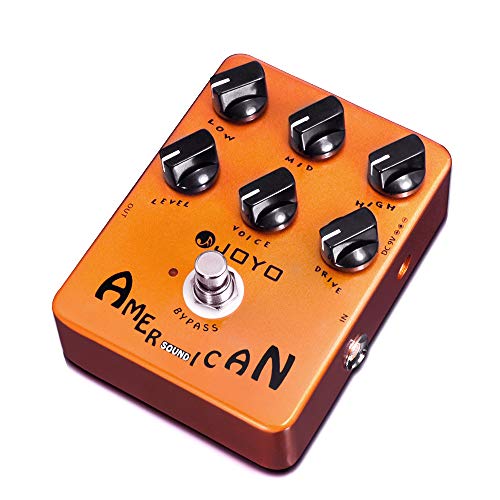
Budget Amp-Sim Pedal – JOYO American Sound
The JOYO American Sound is a pedal-based choice among DI boxes with speaker simulation, combining an American-style tube amp character with built-in cabinet simulation. Its analog design can feed a PA, mixer, or audio interface directly.
Best For: Home recording, silent practice, and players wanting direct American-style amp tones.
Pros:
- Built-in analog cabinet simulation supports direct recording and PA use.
- Six controls provide level, drive, three-band EQ, and voice shaping.
- Rugged aluminum alloy housing is compact and lightweight.
- Offers bypass operation and a one-year manufacturer warranty.
Cons:
- Power supply or battery is not included.
- The supplied notes recommend an isolated, regulated 9V supply to reduce hiss.
This is a versatile, affordable route to direct guitar tones, especially if you want amp-style shaping and cabinet simulation in one stompbox.
Cab-Sim Bundle – Red Box 5 with Patch Cable
Hughes & Kettner Red Box 5 Guitar Cabinet Simulator with 6" Patch Cable R Angle (2-Pieces) Bundle
Check Price On AmazonThis Hughes & Kettner bundle pairs the Red Box 5 guitar cabinet simulator with a 6-inch right-angle patch cable. It suits players comparing DI boxes with speaker simulation who want speaker- and line-level compatibility plus tonal filtering in a ready-to-use package.
Best For: Guitarists using tube or solid-state amps who want a bundled cabinet-simulation setup.
Pros:
- Uses a guitar-cab emulator in a DI-style form factor.
- Five switches provide tonal filters and signal-shaping options.
- Includes pad and ground-loop switches.
- Compatible with speaker- and line-level sources, tube or solid-state amps, and includes a patch cable.
Cons:
- The bundle is larger and heavier than the standalone Red Box 5, at 1.08 pounds.
- The supplied notes do not list detailed connector specifications.
Choose this bundle when the included cable and broader switch-based filtering are useful additions to the Red Box 5 cabinet-simulation format.
Most Versatile Bass DI – BS BOX Analog Bass Preamp
The BS BOX is a full-featured option for players searching for DI boxes with speaker simulation and extensive bass tone shaping. It combines a bass preamp, EQ, cabinet simulation, DI connectivity, parallel routing, and two effects loops in one metal pedal.
Best For: Bassists who want detailed direct tones for live FOH connections or recording.
Pros:
- Combines preamp, cab simulator, EQ, and DI functions.
- Offers three cabinet simulations plus Warm, Bright, and Modern speaker colors.
- Includes gain, level, semi-parametric mids, resonance, and mic-position controls.
- Dual effects loops support separate processing for the preamp and parallel signal.
Cons:
- Its extensive controls may be more than players need from a basic DI.
- Designed around bass-focused tones rather than general-purpose guitar use.
The BS BOX stands out when speaker simulation and deep signal-routing options matter more than minimal setup. Its parallel clean path can help preserve low-end response while the preamp is driven, making it a flexible direct-bass platform.
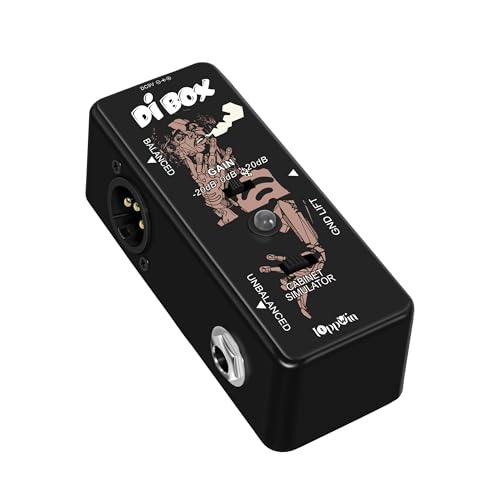
Best Budget Matchbox DI – Mini DI Box with Cabinet Simulator
This compact matchbox-style pedal is a straightforward choice among DI boxes with speaker simulation. It provides balanced and unbalanced outputs, selectable -20 dB, 0 dB, or +20 dB gain, and a cabinet simulator in a small metal enclosure.
Best For: Guitarists and bassists who want a compact direct-signal converter with basic gain matching.
Pros:
- Includes balanced and unbalanced outputs for flexible connections.
- Three-position gain switch supports different instrument and pedal levels.
- True bypass is designed to preserve the signal when disengaged.
- Solid metal shell and status indicator suit portable pedalboard use.
Cons:
- Power adapter is not included.
- Offers less detailed tone shaping than a dedicated preamp-style DI.
Choose this model when size and simple connectivity are priorities. Its gain switch and cabinet-simulation function cover the essentials, though players seeking extensive EQ or routing controls will need a more advanced pedal.
Best Compact Feature Set – IOppWin Matchbox DI Pedal
The IOppWin Matchbox is a compact option for players comparing DI boxes with speaker simulation for live or recording setups. It combines balanced XLR and 1/4-inch outputs with adjustable gain, a cabinet-simulator switch, ground lift, and true bypass.
Best For: Players who need portable connectivity, basic speaker emulation, and hum reduction.
Pros:
- Provides balanced XLR and unbalanced 1/4-inch outputs.
- Adjustable -20 dB to +20 dB gain helps match different devices.
- Ground lift is included for addressing cable-related hum.
- Small metal enclosure and true bypass suit compact pedalboards.
Cons:
- Power adapter is not included.
- Its cabinet simulation is switchable rather than highly adjustable.
This is a practical pick for a small rig that still needs XLR output and useful noise-management features. The gain control adds flexibility, while the cabinet switch provides a simple amp-like option for direct signals.
How We Picked These Di Boxes with Speaker Simulation
We selected products that combine direct-output functionality with speaker, cabinet, amplifier, or impulse-response simulation. The list includes dedicated DI boxes, pedal-format preamps, passive analog simulators, and more advanced digital systems. We considered output connectivity, signal-shaping options, power requirements, portability, ease of use, and suitability for recording or live performance.
Because these products serve different roles, the comparison focuses on practical use rather than treating every model as interchangeable. Some are simple plug-and-play solutions, while others are designed for detailed tone building, reamping, or capturing custom amplifier sounds.
Quick Comparison
| Best For | Look For | Product Types |
|---|---|---|
| Simple direct recording | XLR output, cabinet simulation, low setup complexity | Compact DI pedals and passive boxes |
| Pedalboard rigs | Preamp controls, bypass, 9V operation, rugged housing | Amplifier-simulation pedals |
| Detailed digital tones | IR loading, presets, editing, USB or app support | Digital cabinet simulators |
| Studio reamping and tone capture | Reamp connectivity, modeling workflow, flexible routing | Advanced capture systems |
Key Buying Factors for Di Boxes with Speaker Simulation
Simulation Type
Analog cabinet emulation is usually fast and straightforward, with no software or preset management. Digital IR-based units can offer more realistic or varied cabinet sounds, but they may require additional setup. Amplifier-simulation pedals add gain and EQ, while a dedicated DI may focus mainly on balancing and cabinet shaping.
Connections and Signal Routing
Check whether you need a balanced XLR output, a 1/4-inch output, an input pad, a ground lift, or a dedicated reamp path. A ground lift can help reduce hum, while separate outputs may make it easier to feed both an amplifier and a mixing console. Confirm that the unit accepts your instrument, pedalboard, or amplifier output safely.
Power, Controls, and Portability
Passive units can be convenient for simple setups, while active and digital models may need batteries, a 9V supply, USB power, or a specific adapter. Consider whether you want physical knobs for quick adjustments or app-based editing and presets. Metal housings and compact dimensions are useful for touring and pedalboard mounting.
Recording and Live Compatibility
For recording, prioritize low noise, a dependable balanced output, and a speaker simulation that complements your interface or console. For live use, verify the output level, bypass behavior, and whether the sound remains consistent across different PA systems. If you plan to record without a real cabinet, choose a model that produces a complete, mix-ready signal rather than relying on external software.
Who Should Buy Which Di Boxes with Speaker Simulation?
Choose a compact analog DI or cabinet simulator if you want the quickest path from a pedalboard or amplifier output to an interface or PA. An amplifier-simulation pedal is a better fit when you also need gain, EQ, and a self-contained front end for direct playing.
Choose an IR-capable digital unit if you want multiple cabinet choices, presets, or the ability to shape tones more precisely. Advanced tone-capture systems are best for players and studios that want custom amplifier sounds, reamping capability, and a broader modeling workflow. Before buying, match the unit’s input and output design to your rig, then confirm its power requirements and whether its simulation can be bypassed when you need a dry or external-cabinet signal.