The right channel strip can make voiceover recording sound cleaner, more controlled, and easier to mix. It combines key front-end tools—such as preamp gain, compression, EQ, de-essing, and gating—in one signal path.
These 10 options cover broadcast-style vocal work, home studios, professional rooms, and different budgets. Use the guide below to match features, connectivity, and tonal character to your recording setup.
Best 10 Channel Strip for Voiceover Picks for 2026
Best Value Voice Chain

- Mic preamp with four independent processors
- Dedicated de-esser for reducing sibilance
- Rack-mountable 1U analog design
Best For: Affordable, practical voiceover processing
Best Digital Connectivity
- Tube preamp for warmth and definition
- Compression, expansion, de-essing, and gate
- USB plus multiple digital output formats
Best For: Studios needing flexible digital routing
Best Premium Tone Shaping
- Transformer-gain microphone preamp
- Inductor EQ and diode-bridge compressor
- Sidechain sends and returns with stereo link
Best For: Professional studios pursuing premium analog voice tone
Best Tube-and-EQ Flexibility

- Class A 12AX7 tube preamplifier
- Variable VCA compressor with flexible settings
- Three-band EQ with parametric mid band
Best For: Hands-on voice shaping in project and professional studios
Classic Two-Channel Choice

- Two-channel mic, line, and DI preamp/EQ
- Up to 80 dB of gain
- High-pass filters, inserts, and headphone amp
Best For: Two-channel voiceover front ends needing flexible gain and routing
Compact 500-Series Control
- 500 Series mic pre, EQ, and compressor
- +48V phantom power included
- 75 Hz high-pass filter and Hi-Z input
Best For: Modular voiceover racks seeking simple integrated processing
Tube-Focused Processing
- Tube mic pre, compressor, and EQ
- Switchable optical/tube compression
- Selectable VU metering
Best For: Single-channel voiceover recording with tube coloration
Best USB Value

- One-channel mic/line preamp with USB interface
- Built-in compressor, gate, and de-esser
- Supports Windows, Mac, and up to 192 kHz
Best For: Computer-based voiceover recording with integrated processing
Best Rackmount Flexibility
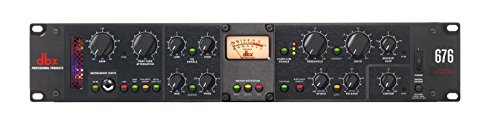
- 250-volt Class-A tube preamp
- Compressor/limiter with side-chain insert
- Three-band parametric EQ and rackmount design
Best For: Hardware-based voiceover processing and tonal control
Best Tube-and-Optical Combo

- Vacuum tube mic, instrument, and line preamp
- Onboard EQ and optical compressor
- Single-channel design with two-year warranty
Best For: Traditional studio voiceover chains with tube coloration
Best Value Voice Chain – dbx 286s
The dbx 286s is a practical channel strip for voiceover work when you want microphone preamplification, dynamics control, de-essing, and tone enhancement in one rack unit. Its compressor, de-esser, enhancer, and expander/gate provide useful tools for bringing speech forward and reducing unwanted noise or sibilance.
Best For: Voiceover creators who want an affordable, straightforward analog processing chain with clear front-panel metering and rack-mount installation.
Pros:
- Combines mic preamp, compressor, de-esser, enhancer, and expander/gate.
- Dedicated de-esser helps reduce harsh high frequencies and sibilance.
- Includes XLR and 1/4-inch inputs, loop-out, insert connectivity, and status LEDs.
- Rack-mountable 1U design with an official manufacturer’s warranty when purchased from an authorized dealer.
Cons:
- Single-channel design limits simultaneous microphone processing.
- Uses wired analog connectivity rather than built-in digital outputs.
- Requires external recording or conversion equipment for computer-based workflows.
Choose the 286s if you want the core processing functions commonly needed for spoken-word recording without a complicated setup. Its combination of compression and de-essing is particularly useful for consistent, intelligible narration.
Best Digital Connectivity – ART VoiceChannel
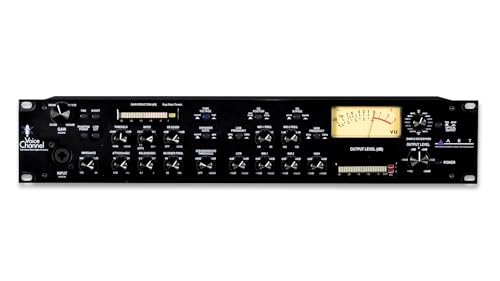
The ART VoiceChannel is a versatile channel strip for voiceover setups that need tube-preamp character and extensive routing options. Along with compression, expansion, de-essing, and gating, it offers USB and several digital output formats for connecting to recording systems and computers.
Best For: Home and project studios that want tube-based preamp warmth plus ADAT, AES/EBU, S/PDIF, TOSLink, or USB connectivity.
Pros:
- Uses an ART Tube Preamp design for warmth and definition.
- Includes compressor, expander, de-esser, and gate processing.
- Supports USB, ADAT, AES/EBU, S/PDIF, and TOSLink digital connections.
- Supports sample rates up to 192 kHz and carries a two-year warranty.
Cons:
- Single-channel format may not suit multi-microphone recording.
- Its broad connectivity may be more than a simple voiceover rig requires.
- The supplied notes do not specify the individual control ranges or metering layout.
The VoiceChannel is a strong fit when digital integration matters as much as processing. It gives voiceover users a fuller connection toolkit than a basic analog strip while retaining dedicated speech-oriented dynamics controls.
Best Premium Tone Shaping – Rupert Neve Shelford Channel
Rupert Neve Designs Shelford Channel Microphone Preamp, Inductor EQ & Diode Bridge Compressor
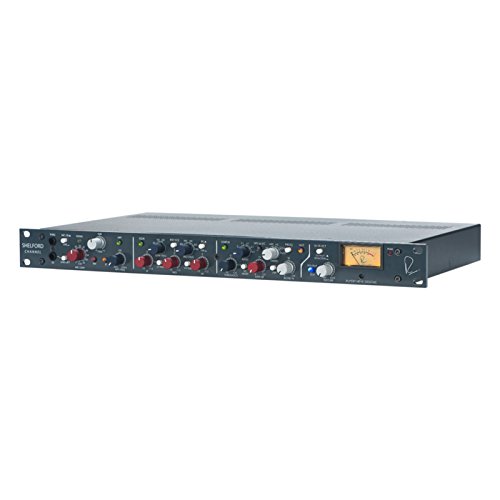
Check Price On AmazonThe Rupert Neve Designs Shelford Channel is a premium channel strip for voiceover engineers who prioritize transformer-based character and detailed analog tone shaping. It combines a transformer-gain microphone preamp with an inductor EQ and diode-bridge compressor in a single mono channel.
Best For: Professional voiceover rooms seeking high-end analog microphone amplification, tonal control, and compression.
Pros:
- Transformer-gain mic preamp and transformer output stage provide a dedicated analog signal path.
- Inductor EQ offers focused tone-shaping capability.
- Diode-bridge compressor provides dedicated dynamics control.
- Includes sidechain stereo-link sends and returns plus a double-voltage power supply.
Cons:
- Mono design processes one channel at a time.
- Premium feature set may be excessive for basic narration recording.
- Analog workflow requires separate digital conversion for computer recording.
The Shelford Channel makes the most sense when the preamp and processing stage is a central part of a high-end recording chain. Its focused EQ and compressor complement a carefully chosen voice microphone and treated recording space.
Best Tube-and-EQ Flexibility – PreSonus StudioChannel
The PreSonus StudioChannel is a flexible channel strip for voiceover users who want tube preamplification, compression, and three-band EQ in one rack unit. Its Class A 12AX7 preamp, variable VCA compressor, and adjustable mid-band EQ provide several ways to shape narration before it reaches the recorder.
Best For: Project and professional studios wanting extensive analog control over microphone tone, dynamics, and frequency balance.
Pros:
- High-voltage Class A 12AX7 vacuum-tube mic and instrument preamplifier.
- Variable VCA compressor includes auto attack/release and soft or hard knee options.
- Three-band EQ includes a parametric mid band plus shelving or peak low and high bands.
- Offers mic, line, and instrument inputs in a rugged 1U rack-mountable chassis.
Cons:
- Analog design does not include built-in digital connectivity in the supplied specifications.
- Single-channel construction is intended for one source at a time.
- Tube-based processing may be more control than a simple plug-in-based workflow needs.
StudioChannel is a compelling option when you want more hands-on shaping than a basic preamp provides. Its combination of tube gain, flexible EQ, and VCA compression can help tailor different voices and microphones within a consistent recording chain.
Classic Two-Channel Choice – Neve 1073DPX
The Neve 1073DPX is a premium two-channel option for anyone comparing a channel strip for voiceover work. It combines microphone, line, and DI preamplification with EQ, up to 80 dB of gain, high-pass filtering, polarity reverse, and rear-panel inserts.
Best For: Voiceover setups that need two channels, substantial preamp gain, and flexible front-end routing.
Pros:
- Two-channel microphone, line, and DI preamp/EQ design
- Up to 80 dB of gain for demanding input sources
- Includes high-pass filters, polarity reverse, and rear-panel inserts
- Built-in headphone amplifier adds monitoring flexibility
Cons:
- Its 26.5-pound weight may make installation and repositioning difficult
- Two-channel capacity may be more than a single-microphone setup requires
The 1073DPX is a feature-rich choice when preamp flexibility and two-channel capability matter more than a compact, minimal setup.
Compact 500-Series Control – SSL SiX Channel Strip
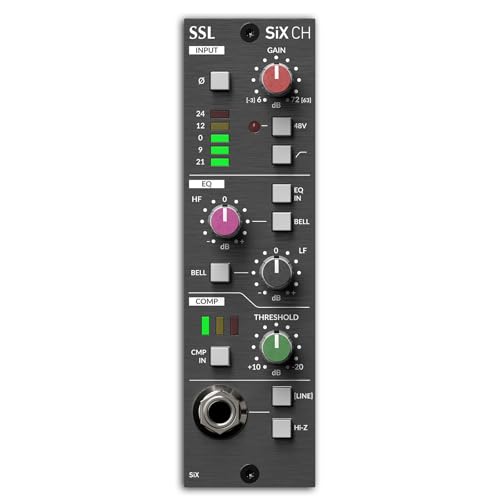
The Solid State Logic SiX Channel Strip is a focused channel strip for voiceover users working in a 500 Series rack. It pairs a mic preamp with +48V phantom power, a high-pass filter, switchable EQ shaping, and a single-knob compressor.
Best For: Rack-based voiceover systems that value a streamlined preamp, EQ, and compression path.
Pros:
- Combines mic preamp, EQ, and compressor in one 500 Series module
- +48V phantom power supports compatible condenser microphones
- Switchable 75 Hz high-pass filter helps manage low-frequency buildup
- Front-panel TRS line input includes a 1MΩ Hi-Z switch
Cons:
- Requires a compatible 500 Series enclosure
- The single-knob compressor offers less parameter control than a multi-control design
The SiX Channel Strip suits a modular studio where fast, practical processing is more important than extensive compressor controls.
Tube-Focused Processing – ART Pro Channel II
ART Pro Channel II Microphone Preamp/Compressor/EQ Professional Tube Based Selectable VU Metering
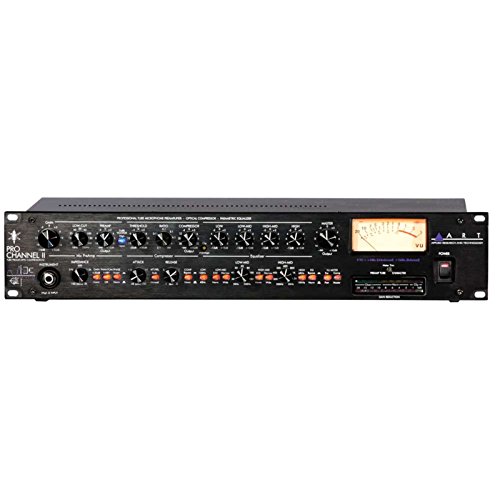
Check Price On AmazonThe ART Pro Channel II is a tube-based channel strip for voiceover recording, combining a tube microphone preamp, switchable optical/tube compression, and tube EQ. Its selectable VU metering can monitor the mic preamp output, compressor output, or main output.
Best For: Voiceover artists who want tube-based coloration with separate preamp, compression, and EQ stages.
Pros:
- Three independent tube-oriented modules in one recording channel
- Switchable optical/tube compressor provides two compression approaches
- Selectable VU metering supports different gain-staging views
- Provides XLR, 1/4-inch TRS, and 1/4-inch TS connectivity
Cons:
- Single-channel design is less suitable for stereo or two-microphone use
- Its 13.4-pound chassis is less portable than a compact desktop unit
The Pro Channel II is a sensible fit when you want an all-in-one vocal front end with tube character and dedicated control over compression and EQ.
Best USB Value – Behringer UV1
The Behringer Ultravoice UV1 is a practical channel strip for voiceover users who want a single-channel microphone preamp with USB connectivity and built-in dynamics and de-essing tools. Its Windows and Mac compatibility and support for sample rates up to 192 kHz make it suitable for straightforward computer-based recording setups.
Best For: Voiceover creators who want a compact, USB-connected one-channel recording solution with compression, gating, and de-essing.
Pros:
- Combines a one-channel mic/line preamp with a USB audio interface.
- Includes compressor, gate, and dedicated de-esser functions.
- Supports Windows 10 and Mac OS X 10.4 or higher.
- Supports sample rates up to 192 kHz.
Cons:
- Provides only one channel.
- Its supplied notes do not specify additional analog EQ controls.
The UV1 stands out when simple computer connectivity and essential voice-processing functions matter more than extensive analog shaping or multichannel expansion.
Best Rackmount Flexibility – dbx 676FX
The dbx DBX676FX is a rackmount channel strip for voiceover setups that need tube-based preamplification, dynamics control, and detailed tonal shaping. It combines a high-voltage Class-A tube preamp with a compressor/limiter, side-chain insert, and three-band parametric EQ with sweepable mids.
Best For: Rack-based studio and live setups that need tube coloration, precise EQ, and integrated compression and limiting.
Pros:
- Uses a 250-volt high-voltage Class-A tube preamp for adjustable tonal character.
- Includes compressor/limiter and a side-chain insert.
- Offers three-band parametric EQ with sweepable midrange.
- Provides XLR and 1/4-inch connectivity and is rack mountable in a 2U chassis.
Cons:
- At 13 pounds and 2U, it is less compact than a desktop voiceover interface.
- Its supplied notes do not mention USB connectivity.
The 676FX is the more hardware-focused choice for users who want hands-on control over preamp tone, dynamics, and equalization in a rack system.
Best Tube-and-Optical Combo – Universal Audio LA-610 Mk II
The Universal Audio LA-610 Mk II is a single-channel tube channel strip for voiceover users seeking a dedicated microphone or instrument preamp with EQ and optical compression. Its XLR input and tube-based design suit recording chains built around traditional studio hardware.
Best For: Voiceover recording setups that prioritize a dedicated tube preamp, onboard EQ, and optical compression.
Pros:
- Combines a vacuum tube microphone, instrument, and line preamp with EQ.
- Includes an optical compressor for integrated dynamics control.
- Provides a dedicated single-channel signal path.
- Includes a two-year warranty according to the supplied notes.
Cons:
- It is limited to one channel.
- The supplied notes specify XLR audio input but do not list USB connectivity.
- At 15.7 pounds, it is relatively substantial for a single-channel unit.
The LA-610 Mk II is a focused choice for users who want tube preamplification, EQ, and optical compression in one dedicated channel strip rather than an all-in-one USB interface.
How We Picked the Best Channel Strip for Voiceover
We compared these channel strips by focusing on the features that matter most for spoken-word recording: preamp quality, noise performance, compression control, de-essing or high-frequency shaping, EQ flexibility, monitoring options, and connection types. We also considered whether each unit is better suited to a clean, transparent sound or a warmer tube- and transformer-influenced character.
Because voiceover workflows vary, this list includes single-channel and dual-channel designs, 500 Series modules, rackmount units, and models with USB or digital connectivity. A strong choice should provide useful control without forcing you to over-process the signal before editing.
Quick Comparison
- Best for affordable vocal processing: dbx DBX286S and Behringer UV1.
- Best for tube warmth: ART VoiceChannel, ART Pro Channel II, dbx DBX676FX, and Universal Audio LA-610 Mk II.
- Best for premium studio tone: Rupert Neve Designs Shelford Channel and Neve 1073DPX.
- Best for compact modular setups: Solid State Logic SiX Channel 500 Series.
- Best for a straightforward tube channel strip: PreSonus StudioChannel.
Key Buying Factors for a Channel Strip for Voiceover
Preamp Character and Gain
Choose a transparent preamp if you want the microphone and room to sound natural. Transformer or tube designs can add thickness and harmonic color, which may flatter a thin voice but can become excessive with a bright microphone.
Compression and Dynamics Control
Look for an adjustable compressor with useful attack, release, ratio, and threshold controls. A voiceover compressor should smooth level changes without making breaths, room noise, or plosives more obvious. An expander or gate can help in a noisy room, but it requires careful setup.
De-Essing and EQ
A dedicated de-esser is valuable for controlling sharp S sounds before they reach the recorder. Parametric or sweepable EQ gives you more control over muddiness and presence than fixed tone controls, while a simple high-pass filter can reduce rumble and handling noise.
Connectivity and Workflow
Check whether you need XLR and line inputs, insert points, digital outputs, USB recording, or 500 Series compatibility. A USB model may simplify a small home setup, while a rack or modular unit can integrate more easily with an existing interface and patchbay.
Who Should Buy Which Channel Strip for Voiceover?
Choose the dbx DBX286S or Behringer UV1 if you want an accessible Channel Strip for Voiceover with practical vocal processing and a modest setup cost. The UV1 is especially convenient when USB connectivity is important.
Choose an ART or dbx tube model if you want a warmer, more colored presentation and prefer having preamp, compression, and EQ in one rack unit. These are useful for singers and voice actors who benefit from added body.
Choose the Shelford Channel, Neve 1073DPX, or Universal Audio LA-610 Mk II if premium analog tone, robust controls, and long-term studio use matter more than price or compactness.
Choose the SSL SiX Channel for a 500 Series system, or the PreSonus StudioChannel for a simpler tube-based front end. Before buying, confirm that your microphone, interface, room, and gain-staging needs match the unit’s inputs, outputs, and processing style.