Finding the best vocal processor with phantom power depends on more than vocal effects. You also need to match microphone type, connection requirements, live or studio workflow, and the amount of control you want while performing.
This roundup covers dedicated vocal pedals, multi-effects processors, microphone preamps, and compact mixers. Some products provide phantom power directly, while others are better paired with a phantom-power mixer or preamp.
Best 10 Vocal Processor with Phantom Power Picks for 2026
Best All-in-One Value
AVE-100 Vocal Effects Processor

- 48V phantom power for condenser microphones
- Pitch correction, harmony, reverb, delay, and looping
- Key detection and anti-feedback for live use
Best For: Singers and performers wanting a compact, feature-rich vocal processor
Best for Auto-Tune Control
HeadRush VX5 Vocal Effects Pedal

- Antares Auto-Tune with Retune Speed and Humanize controls
- Switchable +48V phantom power and XLR mic preamp
- Footswitches, presets, harmony, and USB audio/MIDI
Best For: Live vocalists who want hands-free Auto-Tune and preset control
Best Mixer-Based Option
W IN-MIX 6-Channel Audio Mixer
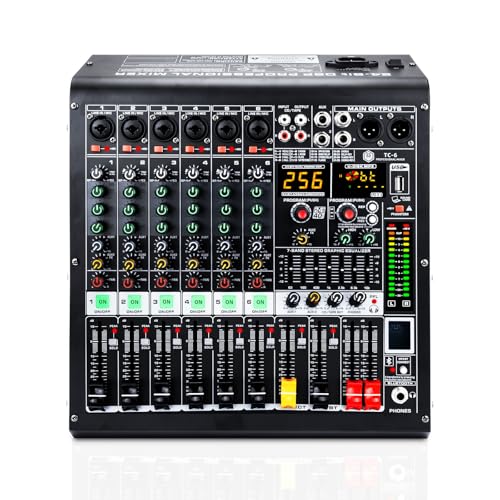
- 48V phantom power for condenser microphones
- 256 DSP effects with six input channels
- Bluetooth, USB playback, and direct USB recording
Best For: Podcasts, karaoke, small venues, and multi-source audio setups
Best Portable Vocal Toolbox

- Automatic pitch correction, harmony, and doubling
- Broad effects library with reverb, delay, and creative sounds
- Portable battery-powered design for stage or livestreaming
Best For: Singers seeking portable vocal effects for performance and recording
Clean-Gain Vocal Front End

- Up to 75 dB of clean gain
- 48V phantom power for condenser mics
- Balanced XLR and dual 3.5mm outputs
Best For: Vocal recording that needs substantial, low-noise microphone gain
Creative Vocal Effects

- 16 effects and three-part harmonies
- 48V phantom power for condenser mics
- USB audio and battery-powered operation
Best For: Live performance, streaming, and effect-rich vocal recording
All-in-One Vocal Mixing

- Four channels with 48V phantom power
- Bluetooth, USB, MP3, and flash playback
- Three-band EQ and 16-bit DSP processing
Best For: Small live, karaoke, DJ, and streaming audio setups
Flexible Vocal Doubling
FLAMMA FV02 Vocal Doubling Processor

- 48V phantom power support
- Vocal doubling, chorus, and reverb
- Separate or mixed signal output modes
Best For: Singers and guitarists seeking fuller live vocals
Harmony-Focused Vocal Processing
Zoom V3 Vocal Processor Bundle

- 16 voice effects with 48V phantom power
- Adds up to two voices for harmonies
- Includes cables and 9V power supply
Best For: Performers wanting broad vocal effects and harmonies
Pitch-Correction Vocal Pedal
FLAMMA FV01 Pitch Correction Processor

- Pitch correction with 48V phantom power
- Delay, reverb, and three tone modes
- Supports microphone and guitar signals
Best For: Singers needing pitch correction for live or recorded vocals
Best All-in-One Value – AVE-100 Vocal Effects Processor
If you want a compact vocal processor with phantom power, the AVE-100 combines pitch correction, harmony, reverb, delay, looping, and anti-feedback tools in one unit. Its KeyLearn function can detect the key of backing tracks to help guide harmony and pitch effects.
Best For: Singers, live performers, karaoke users, streamers, and home recordists who want versatile vocal effects in a compact processor.
Pros:
- Supports 48V phantom power for condenser microphones.
- Includes pitch correction, harmony, reverb, delay, and looping.
- Key detection and anti-feedback features support live use.
- Offers microphone, instrument, headphone, speaker, and USB-C connectivity.
Cons:
- Its controls and feature set may require setup time for new users.
- It is battery powered, so extended use may require attention to power management.
The AVE-100 is a practical choice when you want many singer-focused functions without adding separate effects units. It is especially appealing for performers who need harmony, looping, and phantom-powered microphone support in one portable device.
Best for Auto-Tune Control – HeadRush VX5 Vocal Effects Pedal
The HeadRush VX5 is a vocal processor with phantom power aimed at performers who want hands-free control and recognizable Auto-Tune effects. Dedicated Retune Speed and Humanize controls let you move from subtle correction to a harder electronic sound without a computer.
Best For: Live singers, vocalists using guitar or keyboard accompaniment, and producers who want presets, footswitch control, and real-time pitch effects.
Pros:
- Uses an Antares algorithm with dedicated Retune Speed and Humanize controls.
- Provides switchable +48V phantom power and a premium XLR microphone preamp.
- Includes harmony, compression, reverb, delay, chorus, and other effects.
- Stores up to 250 presets and supports hands-free preset changes.
Cons:
- At 1.2 kg, it is heavier than some compact vocal processors.
- Its broader preset and routing system may be more than casual users need.
With its footswitches, color display, Talk Mode, A/B Mode, and USB audio and MIDI functions, the VX5 is built around live workflow. It is a strong fit when precise Auto-Tune adjustment and stage-ready control matter more than minimal size.
Best Mixer-Based Option – W IN-MIX 6-Channel Audio Mixer
For setups that need more than a dedicated vocal pedal, the W IN-MIX is a six-channel mixer and vocal processor with phantom power. It combines 48V support for condenser microphones with 256 DSP effects, Bluetooth playback, USB MP3 functions, and direct USB recording.
Best For: Podcasters, karaoke hosts, small venues, home studios, streamers, and users mixing microphones with instruments or backing tracks.
Pros:
- Provides dedicated 48V phantom power for condenser microphones.
- Offers 256 DSP effects, including reverb, delay, and chorus.
- Supports six channels with XLR and 1/4-inch inputs.
- Includes Bluetooth 5.0, USB playback and recording, and channel EQ.
Cons:
- Its tabletop mixer format is less portable than a compact vocal pedal.
- It requires corded electric power.
- The supplied notes do not specify a detailed individual effects list beyond the stated DSP examples.
The W IN-MIX makes sense when vocal processing is only part of the job. Its channel count, EQ, monitoring, effects, and playback features provide a more complete control center for small production and performance setups.
Best Portable Vocal Toolbox – BOSS VE-22 Vocal Performer
The BOSS VE-22 is a portable vocal effects unit for singers who want pitch correction, harmony, doubling, and creative processing in a compact format. It is worth considering alongside a vocal processor with phantom power, although the supplied product information does not specify a phantom-power feature.
Best For: Singers who need a portable effects toolbox for practice, recording, stage performance, or online livestreaming.
Pros:
- Includes compressor, EQ, delay, echo, reverb, and specialty effects.
- Provides automatic pitch correction plus real-time harmony and doubling.
- Supports creative sounds such as lo-fi, distortion, radio, and ring modulation.
- Includes four AA batteries and offers USB-C connectivity.
Cons:
- The supplied notes do not list 48V phantom power.
- Its signal format is listed as analog, which may not suit every digital recording workflow.
The VE-22 is a strong choice for singers prioritizing portability and a broad selection of BOSS vocal effects. If condenser-microphone compatibility through phantom power is essential, verify the connection requirements before choosing it.
Clean-Gain Vocal Front End – JCANOL MIC-1 Preamp
If you need a vocal processor with phantom power focused on clean gain, the JCANOL MIC-1 is a practical choice for pairing microphones with recording or portable audio setups. It provides up to 75 dB of gain, 48V phantom power, and multiple output formats, including balanced XLR and 3.5mm connections.
Best For: Vocal recording with dynamic or condenser microphones, especially low-output dynamic models that need substantial clean gain.
Pros:
- Up to +75 dB of gain with a stated -120 dB EIN noise performance.
- Supports condenser microphones with 48V phantom power.
- Offers balanced XLR plus independent 3.5mm mic and line outputs.
- Includes a 1 MΩ high-impedance instrument input for DI applications.
Cons:
- The two input ports cannot operate simultaneously.
- It is a preamp rather than a full vocal-effects processor with harmonies or pitch effects.
The MIC-1 makes the most sense when clean microphone gain and flexible connectivity matter more than onboard creative processing. Its compact metal design and three-year warranty add practical appeal for home and portable recording.
Creative Vocal Effects – Zoom V3 Vocal Processor
The Zoom V3 is a vocal processor with phantom power designed for singers, streamers, and live performers who want real-time effects. It combines 16 vocal effects, three-part harmonies, pitch correction, and dedicated reverb, delay, and compression controls in a portable unit.
Best For: Live vocals, streaming, and home recording where real-time harmonies and creative vocal effects are central to the setup.
Pros:
- Provides 16 vocal effects and up to three-part harmonies.
- Built-in enhancer optimizes the microphone input signal.
- Supports condenser microphones with 48V phantom power.
- Records up to 32-bit/44.1kHz over USB and can run on four AA batteries.
Cons:
- USB recording is limited to a 44.1kHz maximum sample rate.
- Battery operation is rated for up to 3.5 hours, so extended use may require a power solution.
- Its single-channel design is focused on vocal processing rather than multichannel mixing.
Choose the V3 when performance features matter more than broad mixing capability. Its phantom power, hands-on effects, USB audio, and battery operation make it particularly adaptable for mobile content creation and live use.
All-in-One Vocal Mixing – Pyle PMXU43BT.5 Mixer
The Pyle PMXU43BT.5 is a vocal processor with phantom power in a broader four-channel mixer format. It combines microphone and stereo line inputs with 48V phantom power, three-band EQ, USB and MP3 playback, Bluetooth streaming, and a 16-bit DSP processor for live or studio-style setups.
Best For: Small live rigs, karaoke, DJ sessions, and streaming setups that need microphone mixing alongside music playback and wireless audio.
Pros:
- Four-channel layout with XLR and unbalanced 1/4-inch microphone or line inputs.
- Includes switchable +48V phantom power and three-band EQ on all channels.
- Supports Bluetooth, USB, flash-drive, MP3, and computer playback or recording.
- Provides XLR and 1/4-inch main outputs plus headphone and send/return connections.
Cons:
- The listed DSP processing is 16-bit rather than a higher-resolution format.
- It is a mixer with vocal-processing features, not a dedicated harmony or pitch-correction processor.
- The product notes do not specify a warranty.
The PMXU43BT.5 is a sensible fit when microphone processing is only part of the job. Its input flexibility, phantom power, playback options, and rugged steel chassis make it more useful for compact event and performance systems than for effect-focused vocal production.
Flexible Vocal Doubling – FLAMMA FV02 Vocal Doubling Processor
If you want a vocal processor with phantom power for adding thickness and ambience, the FLAMMA FV02 focuses on vocal doubling, chorus, and reverb. It supports 48V phantom power and also accepts a guitar input, making it a practical choice for singers who perform with guitar.
Best For: Vocalists and guitarists who want doubling, reverb, and selectable vocal voicings in a compact pedal.
Pros:
- Supports 48V phantom power for compatible microphones.
- Provides vocal doubling, chorus, and built-in reverb effects.
- Offers WARM, BRIGHT, and NORMAL EQ modes.
- Supports mixed or separate guitar and microphone outputs.
Cons:
- Its effects focus is narrower than a processor offering a larger range of voice effects.
- Requires a 9V, 500mA power source.
The FV02 is a focused option for performers who value vocal thickness and simple tone shaping, especially when guitar and microphone signals need to work together.
Harmony-Focused Vocal Processing – Zoom V3 Vocal Processor Bundle
The Zoom V3 is a versatile vocal processor with phantom power, combining an XLR microphone input with compression, reverb, delay, enhancement, and voice effects. This bundle also includes a long XLR cable, instrument cable, 9V power supply, and cleaning cloth.
Best For: Singers who want multiple vocal effects and up to two added voices for three-part harmonies.
Pros:
- Includes an XLR microphone input with 48V phantom power.
- Provides 16 voice effects plus compression, reverb, delay, and enhance functions.
- Can add up to two voices for three-part harmonies.
- Bundle includes cables, a 9V power supply, and a cloth.
Cons:
- The supplied details do not specify the exact individual voice effects.
- The processor is listed as battery powered, so power planning may matter for mobile use.
With its broad effect selection and harmony capability, the V3 is the strongest fit here for performers who want more vocal variety than basic doubling or correction.
Pitch-Correction Vocal Pedal – FLAMMA FV01 Pitch Correction Processor
The FLAMMA FV01 is a compact vocal processor with phantom power designed around pitch correction and live vocal effects. It can serve as a microphone amplifier or stompbox, with delay, reverb, three vocal tone modes, and support for condenser microphones through optional 48V phantom power.
Best For: Singers who prioritize pitch correction and want straightforward effects for live singing, streaming, or recording.
Pros:
- Offers optional 48V phantom power for condenser microphones.
- Combines pitch correction with vocal effects and tone shaping.
- Includes WARM, BRIGHT, and NORMAL modes.
- Supports mixed or separate microphone and guitar outputs.
Cons:
- Its primary focus is pitch correction rather than a large multi-effect collection.
- Requires a 9V, 500mA power source.
The FV01 makes sense when pitch correction is the priority and you still want useful delay, reverb, and tone controls in a pedal-sized format.
How We Picked the Best Vocal Processor with Phantom Power
We selected products across the main categories buyers consider when shopping for a Vocal Processor with Phantom Power: dedicated vocal-effects pedals, harmonizers, streaming processors, microphone preamps, and compact mixers. We prioritized useful vocal tools such as pitch correction, harmony, doubling, reverb, delay, looping, anti-feedback, and hands-on control.
Because phantom power is not included on every vocal-effects pedal, we also considered compatibility with condenser microphones and external 48V sources. A processor can still be a strong choice if it works reliably with a suitable mixer or preamp in the signal chain.
Quick Comparison
| Best For | Recommended Type | Look For |
|---|---|---|
| Live singers | Vocal-effects pedal | Footswitches, feedback control, durable connections |
| Streaming and content creation | Desktop vocal processor | Simple routing, USB support, real-time effects |
| Condenser microphones | Mixer or microphone preamp | Reliable 48V phantom power and clean gain |
| Harmony performances | Harmonizer | Key detection, harmony control, pitch correction |
| Small recording setups | USB mixer or preamp | Low noise, computer connectivity, flexible inputs |
Key Buying Factors for a Vocal Processor with Phantom Power
Phantom-Power Compatibility
Confirm whether the unit supplies 48V phantom power itself. Many vocal pedals are designed for dynamic microphones or require an external mixer, preamp, or inline phantom-power supply for condenser microphones. Never assume a microphone input automatically provides phantom power.
Effects and Control
Choose effects based on your performance style. Pitch correction suits singers who want subtle tuning or an obvious Auto-Tune sound; harmony and doubling add depth; reverb and delay help create space. Footswitches are especially valuable for live transitions, while knobs and preset controls matter for streaming and recording.
Signal Quality and Gain
Look for clean preamp gain, low noise, and enough headroom for your microphone. A high-gain preamp can help quieter dynamic microphones, but excessive gain may increase hiss. Check whether the processor offers balanced XLR connections and outputs that fit your mixer, interface, or powered speaker.
Connectivity and Workflow
USB, Bluetooth, auxiliary inputs, looping, and instrument inputs can make a unit more flexible, but they may add complexity. Decide whether you need a compact pedal for stage use, a desktop device for streaming, or a mixer that can handle several microphones and playback sources.
Who Should Buy Which Vocal Processor with Phantom Power?
Live vocalists should favor a dedicated pedal or multi-effects processor with sturdy foot controls, fast access to presets, and feedback-management features. Singers using condenser microphones should choose a model with built-in 48V power or budget for a compatible mixer or preamp.
Streamers and home creators will generally benefit from a simple processor with USB connectivity and easy real-time monitoring. Bands, karaoke hosts, and small venues may prefer a compact mixer because it combines phantom power, multiple inputs, playback, and overall level control. If you mainly need clean microphone gain rather than creative effects, a dedicated preamp is the more focused choice.