DJ controllers with standalone mode give you the freedom to perform without carrying a laptop, while still offering the hands-on workflow DJs expect from modern performance gear.
We selected 10 standout systems for different needs, including club-style all-in-ones, portable controllers, motorized platters, streaming support, and beginner-friendly options.
Best 10 Dj Controllers with Standalone Mode Picks for 2026
Best All-Rounder
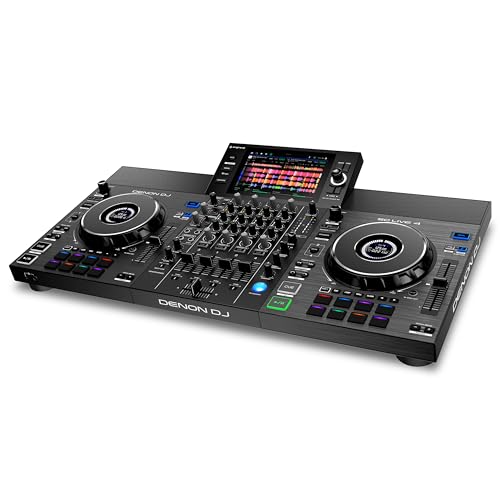
- Four-channel standalone Engine DJ operation
- Built-in speakers and wireless streaming
- Serato DJ Pro and VirtualDJ compatibility
Best For: Flexible home, mobile, streaming, and club DJs
Best Club-Style Workflow

- Standalone USB playback for rekordbox sets
- 10.1-inch touchscreen with CDJ-style layout
- Beat FX, Sound Color FX, and 16 pads
Best For: Club-focused practice and small-venue performance
Best Portable Pick
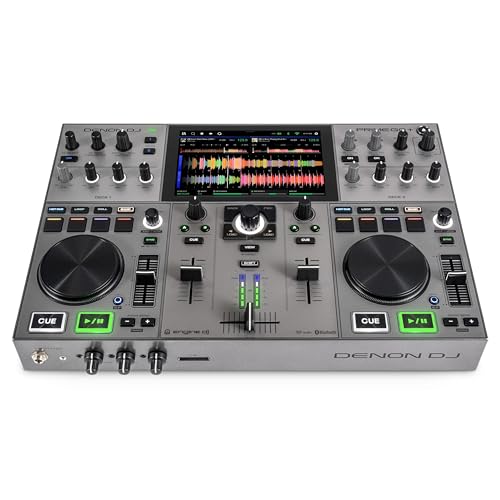
- Battery-powered Engine DJ standalone operation
- Wi-Fi streaming and SD/USB media support
- Compact 8.11-pound design with pro outputs
Best For: Traveling DJs and off-grid pop-up performances
Best Hybrid Setup

- Four-channel standalone mixer for phono and line sources
- Dual USB interfaces for two-device handoffs
- Jog displays, FX paddles, and eight performance modes
Best For: Digital-and-analog hybrid DJ setups
Premium Standalone Pick

- Four-channel computerless Engine DJ performance
- Streaming, Stems, sampler, and extensive FX
- Zone output and professional venue connectivity
Best For: Mobile and event DJs needing a full-featured four-channel system
Hybrid Performance Value

- Two-channel control for up to four Serato decks
- Built-in TR drum machine and 16-step sequencer
- Standalone mixer with phono and line inputs
Best For: Serato performers who want drum-machine features and external-source mixing
Motorized Standalone Choice
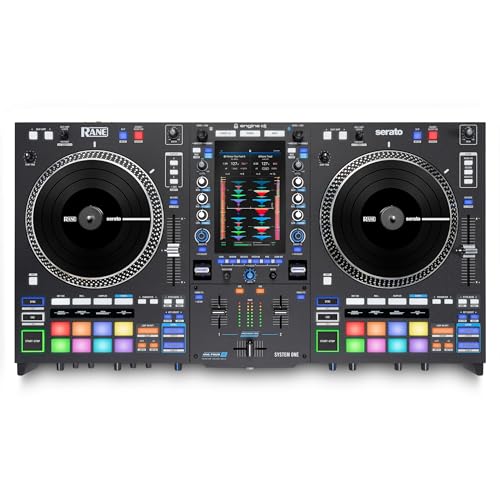
- Motorized 7.2-inch platters for turntable-style control
- Engine DJ standalone, Serato, streaming, and Stems support
- Touchscreen, extensive FX, and professional I/O
Best For: Scratch and open-format DJs wanting motorized standalone performance
Versatile USB Performer

- USB standalone playback plus VirtualDJ control
- Touch jog wheels and dual high-contrast screens
- Lightweight design with XLR and RCA outputs
Best For: Mobile DJs wanting flexible USB and software operation
All-in-One Streaming System
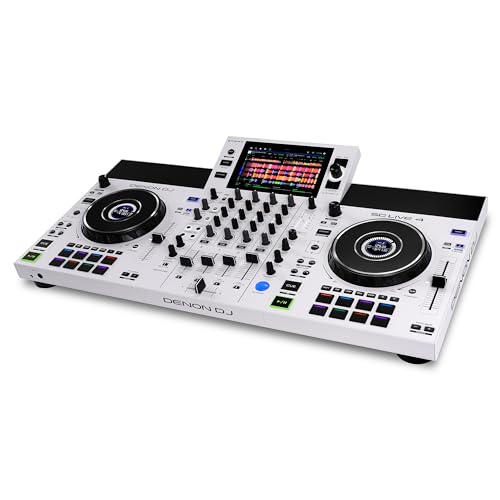
- Four-channel standalone operation with Engine DJ OS
- Wi-Fi streaming, Bluetooth, SD, and USB support
- Seven-inch screen, stems, and built-in speakers
Best For: Laptop-free performers and streaming-focused DJs
Vinyl-Style Training Deck

- Two motorized platters with removable replica records
- Long 3.9-inch tempo faders for precise control
- Portable design with handles and retractable feet
Best For: Vinyl-minded DJs using Serato DJ Lite or DJUCED
Best All-Rounder – Denon DJ SC LIVE 4
The Denon DJ SC LIVE 4 is a versatile choice among dj controllers with standalone mode, combining laptop-free Engine DJ performance with four-deck control, wireless streaming, and built-in speakers. Its 7-inch touchscreen, SD card slot, and two USB inputs support flexible track access for home, mobile, streaming, and club use.
Best For: DJs who want a feature-rich standalone controller with streaming access, built-in speakers, and broad connectivity.
Pros:
- Runs laptop-free with Engine DJ OS and supports SD and USB media.
- Streams from services including Amazon Music Unlimited, Apple Music, TIDAL, and SoundCloud Go+.
- Offers four channels, Serato DJ Pro hardware integration, and VirtualDJ compatibility.
- Includes built-in speakers plus XLR main, booth, RCA, and microphone connections.
Cons:
- At 28.3 inches wide and 13.6 pounds, it is less portable than compact controllers.
- Its corded-electric power design is not suited to battery-powered performance.
The SC LIVE 4 stands out when you want standalone flexibility without giving up streaming, software integration, or professional outputs. It is especially practical for DJs moving between practice sessions, mobile gigs, and more involved setups.
Best Club-Style Workflow – Pioneer DJ XDJ-RX3
The Pioneer DJ XDJ-RX3 is a strong pick among dj controllers with standalone mode for DJs who prefer a familiar club-style layout. It plays prepared rekordbox sets directly from USB drives and adds a 10.1-inch touchscreen, CDJ-inspired controls, performance pads, and onboard effects.
Best For: DJs preparing for club environments, home practice, mobile work, or small-venue performances.
Pros:
- Runs USB-based rekordbox sets without requiring a laptop.
- 10.1-inch touchscreen and CDJ-style layout support an easy transition to booth equipment.
- Includes Beat FX, Sound Color FX, and 16 performance pads.
- Supports rekordbox Performance mode hardware unlock and Serato DJ Pro computer control.
Cons:
- It is a sizable 21-pound unit, making frequent transport less convenient.
- Standalone operation is centered on prepared USB sets rather than built-in streaming features.
The XDJ-RX3 focuses on a straightforward, professional workflow rather than maximum portability. Its touchscreen and club-oriented control layout make it a practical bridge between home practice and performance on larger booth-style systems.
Best Portable Pick – Denon DJ PRIME GO+
The Denon DJ PRIME GO+ is one of the most portable dj controllers with standalone mode, offering Engine DJ operation, built-in Wi-Fi streaming, and battery-powered performance in an 8.11-pound chassis. It also supports SD cards, USB media, onboard effects, touch controls, and standalone stems prepared with Engine DJ Desktop.
Best For: DJs who need laptop-free performance and streaming capability while traveling or working away from mains power.
Pros:
- Battery-powered standalone operation with included lithium-ion batteries.
- Wi-Fi access to more than 100 million tracks through supported streaming services.
- Compact 16.2-by-10.8-inch design weighs just 8.11 pounds.
- Provides extensive effects, Bluetooth I/O, SD and USB media support, and professional outputs.
Cons:
- Standalone stems require tracks or playlists to be pre-rendered with Engine DJ Desktop.
- Its compact format provides less physical space than larger four-channel systems.
The PRIME GO+ is the clearest choice here for portability. Its battery, streaming support, and professional connections make it well suited to pop-up sets, travel, and performances where carrying a full-size controller is impractical.
Best Hybrid Setup – Reloop Mixon 8 Pro
The Reloop Mixon 8 Pro suits DJs seeking a hybrid option among dj controllers with standalone mode. Its built-in standalone mixer accepts turntable or media-player connections, while dual USB audio interfaces support two laptops or an iPad for flexible digital setups and DJ handoffs.
Best For: DJs who mix digital and analog sources or need flexible multi-device performance workflows.
Pros:
- Four-channel standalone mixer supports two phono and four line inputs.
- Dual USB audio interface enables two-laptop handoffs and iPad connectivity.
- Jog-wheel displays show track information, playhead position, and timing.
- Provides four FX paddles, channel EQ and filters, and eight color-coded performance modes.
Cons:
- Its standalone function is primarily a mixer for connected sources, not a full self-contained media player.
- At 12.9 pounds, it is less travel-friendly than the PRIME GO+.
The Mixon 8 Pro is best understood as a flexible hybrid control hub. It offers the strongest connection options in this group for combining turntables, media players, laptops, and an iPad, though it is less suited to completely laptop-free library playback.
Premium Standalone Pick – Denon DJ PRIME 4+
The Denon DJ PRIME 4+ is a strong choice for DJs seeking dj controllers with standalone mode and extensive connectivity. Its four-channel Engine DJ workflow supports USB, SATA, SD, streaming services, Dropbox, and standalone Stems, so you can perform without a computer while still having room for advanced mixing and venue-focused output options.
Best For: Mobile DJs, open-format performers, and event setups requiring four channels, streaming access, microphone control, and zone output.
Pros:
- Four-channel standalone operation with USB, SATA, SD, streaming, and Dropbox support.
- 10.1-inch adjustable touchscreen and larger jog-wheel surface provide practical visual and tactile control.
- Standalone Stems, a 16-slot Drop Sampler, extensive FX, and dedicated Zone output support creative live sets.
- Professional I/O includes multiple line/phono inputs, microphone inputs, XLR main, booth, and zone outputs.
Cons:
- Its large feature set and 28.68-inch width may be more than compact home setups need.
- Standalone Stems require pre-rendering tracks or playlists with Engine DJ Desktop.
The PRIME 4+ stands out when standalone flexibility and venue-ready routing matter most. It is especially well suited to DJs who want a computerless workflow without giving up streaming, four-deck control, microphones, or advanced performance tools.
Hybrid Performance Value – Roland DJ-505
The Roland DJ-505 is a practical option for DJs who want standalone mixer functionality alongside computer-based Serato performance. It offers two-channel hardware with four-deck control, responsive platters, performance pads, built-in TR drum sounds, and phono/line inputs for connecting external players or turntables.
Best For: Serato DJs, scratch-focused performers, and users who want drum-machine creativity plus a mixer that can operate with external sources.
Pros:
- Controls up to four Serato decks from a two-channel layout.
- Large low-latency platters and dedicated pads support scratching, cues, rolls, slicing, samples, and sequencing.
- Built-in TR-909, TR-808, TR-707, and TR-606 sounds add editable drum-machine performance options.
- Standalone mixer functionality includes line/phono inputs, balanced XLR output, booth output, and separate headphone connections.
Cons:
- It is not a fully computerless library-and-deck standalone system; standalone use is described for its mixer functionality.
- The two-channel layout may feel limiting for users who want four independent physical channels.
- Its listed model year is 2017, so it may lack newer standalone features found on current systems.
The DJ-505 is best viewed as a Serato controller with useful external-input flexibility rather than a modern all-in-one standalone player. Choose it if hands-on performance pads, classic Roland drum sounds, and DVS-ready mixer functionality are more important than built-in computerless browsing.
Motorized Standalone Choice – RANE SYSTEM ONE
The RANE SYSTEM ONE targets DJs who want dj controllers with standalone mode and a turntable-like feel. Its motorized 7.2-inch aluminum platters run on Engine DJ OS for laptop-free mixing, while OmniSource playback, streaming support, Serato integration, Stems, and a vertical touchscreen create a flexible performance workflow.
Best For: Open-format and scratch DJs who prioritize motorized platters, standalone Stems, broad media support, and high-touch performance control.
Pros:
- Motorized aluminum platters provide a turntable-style feel in a standalone Engine DJ system.
- Supports USB, SD, an internal drive slot, streaming services, Serato DJ Pro, and djay PRO.
- Standalone Stems include onboard rendering, Stem FX, dedicated vocal and instrumental controls, and Stem pad modes.
- Offers extensive FX, a MAG FOUR crossfader, touchscreen browsing, professional outputs, and SoundSwitch lighting support.
Cons:
- At 29.4 pounds, it is a substantial system for DJs who need maximum portability.
- The motorized platter and extensive performance feature set may be excessive for straightforward mixing.
- The supplied specifications do not list a dedicated zone output or phono inputs.
The SYSTEM ONE is a specialized choice for performers who want standalone convenience without giving up the physical response of motorized decks. Its combination of Engine DJ, Serato compatibility, Stems, and OmniSource playback makes it particularly compelling for scratch and open-format workflows.
Versatile USB Performer – Compact Standalone GMX
For shoppers comparing dj controllers with standalone mode, the Gemini GMX offers a compact two-channel setup that can play from USB drives or control DJ software. Its screens, touch-sensitive jog wheels, and multiple outputs make it a flexible choice for home practice, mobile gigs, and smaller venue setups.
Best For: DJs who want USB playback, software control, and a lightweight controller in one unit.
Pros:
- Supports standalone playback from USB drives as well as VirtualDJ control.
- Touch-sensitive jog wheels, hot cues, auto loop, and filter effects support creative mixing.
- Dual screens display waveforms and track information.
- Includes MIDI mapping, XLR and RCA outputs, and a 24-bit audio interface.
Cons:
- It is limited to two channels.
- The unit requires corded power.
- Its compact design may offer fewer controls than larger four-deck systems.
The GMX is a practical hybrid for DJs who want laptop-free USB playback without giving up software integration. Its modest size and broad connectivity are particularly useful for portable setups.
All-in-One Streaming System – Denon DJ SC LIVE 4 White
The Denon DJ SC LIVE 4 White is a feature-rich option among dj controllers with standalone mode, combining a four-channel mixer, Engine DJ OS, a touchscreen, streaming connectivity, and onboard speakers. It is designed for DJs who want to perform, practice, or stream without relying on a laptop.
Best For: DJs seeking a four-deck standalone controller with streaming, stems, and built-in monitoring.
Pros:
- Runs laptop-free with Engine DJ OS and supports tracks from SD and USB storage.
- Built-in Wi-Fi enables access to supported streaming services, including TIDAL and Apple Music.
- Seven-inch touchscreen, onboard stems, and four-channel mixing support advanced sets.
- Built-in speakers allow practice and track preview without external speakers.
Cons:
- At 13.6 pounds, it is heavier than compact two-deck controllers.
- Its 28.3-inch width requires more setup space.
- Some software features and streaming access depend on compatible services or platforms.
The SC LIVE 4 is the most self-contained choice in this group. Its four-deck layout, wireless features, speakers, and screen make it well suited to DJs who prioritize standalone convenience and broad performance capabilities.
Vinyl-Style Training Deck – Hercules DJControl Inpulse T7
The Hercules DJControl Inpulse T7 takes a different approach to dj controllers with standalone mode: it focuses on hands-on, vinyl-style control rather than laptop-free playback. Its motorized platters, removable records, and long tempo faders are aimed at DJs who want to practice turntable techniques with Serato DJ Lite or DJUCED.
Best For: Beginners and vinyl-minded DJs who want motorized platters and tactile tempo control.
Pros:
- Two motorized platters provide a vinyl-inspired performance feel.
- Removable replica records, felt slipmats, and platters support hands-on practice.
- 3.9-inch tempo faders offer resolution comparable to real vinyl DJ turntables.
- Retractable feet, side handles, and an 11-pound weight improve portability.
Cons:
- It is designed for use with a laptop or PC rather than standalone USB playback.
- It is a two-deck controller.
- Software support listed in the supplied details is limited to Serato DJ Lite and DJUCED.
The T7 is best viewed as a tactile training and performance controller, not a traditional standalone system. Choose it when motorized platters and vinyl technique matter more than laptop-free operation.
How We Picked the Best Dj Controllers with Standalone Mode
We compared these systems by looking at their standalone capabilities, deck count, screen quality, media support, software flexibility, portability, connectivity, and performance controls. We also considered how well each controller fits its intended audience, from home users and mobile DJs to club performers and experienced professionals.
A true standalone setup should let you prepare and play music directly from supported USB drives, internal storage, or network and streaming services without requiring a computer for core mixing functions. Features such as touchscreens, onboard effects, performance pads, stem separation, and independent zone outputs can further improve a controller’s usefulness, but they should match your workflow rather than simply increase the feature list.
Quick Comparison
The Denon DJ PRIME 4+ is the most feature-rich option for four-deck performance, while the Pioneer DJ XDJ-RX3 is a strong choice for DJs who prefer a familiar club-style layout. Denon’s SC LIVE 4 offers a versatile balance of standalone performance, streaming, and entertainment features, and the PRIME GO+ is particularly appealing when portability matters.
For software-focused users, the Reloop Mixon 8 Pro and Roland DJ-505 offer broad controller functionality, although their standalone capabilities differ from dedicated all-in-one systems. The RANE SYSTEM ONE stands out for motorized performance, while the Gemini GMX and Hercules DJControl Inpulse T7 provide more accessible routes into hands-on DJing.
Key Buying Factors for Dj Controllers with Standalone Mode
Standalone Media and Music Access
Check which file formats, USB devices, streaming platforms, and cloud services the controller supports. Confirm whether your preferred music library can be analyzed and accessed without a laptop, and look for multiple USB ports if you plan to hand off between DJs.
Deck Layout and Performance Controls
Two-deck systems are typically easier to transport and learn, while four-deck controllers provide more room for layering tracks, samples, acapellas, and stems. Motorized platters, dedicated effects, performance pads, and touchscreen controls can make a major difference for scratch, open-format, and remix-oriented workflows.
Connections, Sound, and Event Use
For home practice, a standard master output may be sufficient. Mobile and professional DJs should also check for booth outputs, balanced connections, microphone inputs, auxiliary inputs, zone outputs, and independent volume controls. Built-in Wi-Fi, lighting control, and battery power may also matter depending on where you perform.
Size and Setup
Measure your available space and consider the controller’s weight before buying. Larger all-in-one systems offer more direct control, but compact models are easier to carry, store, and set up at smaller events.
Who Should Buy Which Dj Controllers with Standalone Mode?
Choose a full-size four-channel system if you perform regularly, mix multiple sources, or want a setup that resembles professional club equipment. Pick a compact standalone controller if you travel frequently or need fast setup for mobile gigs. DJs who prioritize tactile scratching should consider motorized jog wheels, while streamers and open-format performers may benefit most from touchscreen browsing, streaming integration, and stem controls.
Beginners should prioritize an intuitive layout, included software, clear visual feedback, and room to grow. Before purchasing, verify firmware support, music-service compatibility, and the manufacturer’s current feature requirements so the controller remains useful as your library and performance needs develop.