The best wireless microphones for singers combine clear vocal reproduction, dependable signal strength, comfortable handling, and enough battery life for the entire performance. The right choice depends on whether you sing at home, perform with a portable speaker, host karaoke, or need a more flexible stage setup.
We’ve gathered 10 wireless systems spanning plug-and-play 2.4GHz models, versatile UHF designs, dual-microphone kits, and long-range options. Use the guide below to compare the features that matter most before choosing a system.
Best 10 Wireless Microphones for Singers Picks for 2026
PartyBox Performance Pick

- Clear cardioid vocal pickup with pop filtering
- Up to 20 hours of rechargeable playtime
- Compatible with all JBL PartyBox speakers
Best For: JBL PartyBox karaoke and party performances
Feature-Packed Party Pair
ECHOMUSSY RGB Wireless Microphones
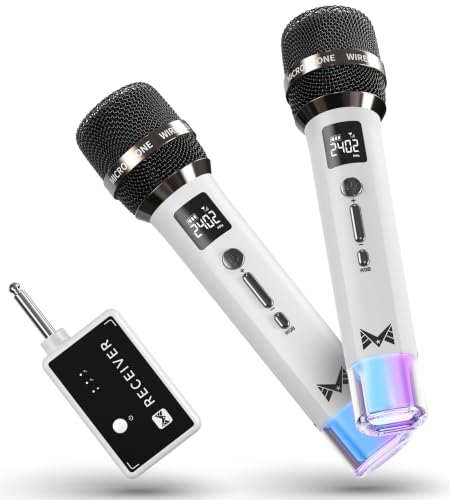
- Up to 200 feet of open-area wireless range
- Up to 40 hours of stated battery life
- RGB lighting and on-mic volume controls
Best For: Karaoke parties and presentations with compatible mic inputs
Best Overall
Dual UHF Auto-Scan Handheld System

- Auto Scan and 200 selectable UHF frequencies
- 290–328-foot stated line-of-sight range
- Cardioid, metal handheld microphones with mute controls
Best For: Karaoke, weddings, churches, and DJ performances
Best Tunable Value
Dual UHF Tunable Frequency System

- 30 tunable UHF frequency groups
- Automatic pairing and frequency hopping
- Dual XLR and mixed 1/4-inch outputs
Best For: Karaoke, live singing, churches, and smaller events
Reliable Range Pick
TONOR TW360 Wireless Microphone System

- 200-foot UHF operating range
- Cardioid pickup helps reduce background noise
- 4x10 adjustable channels for flexible setups
Best For: Karaoke, churches, weddings, and presentations
Simple Dual-Mic Pick
JBL Wireless Two Microphone System
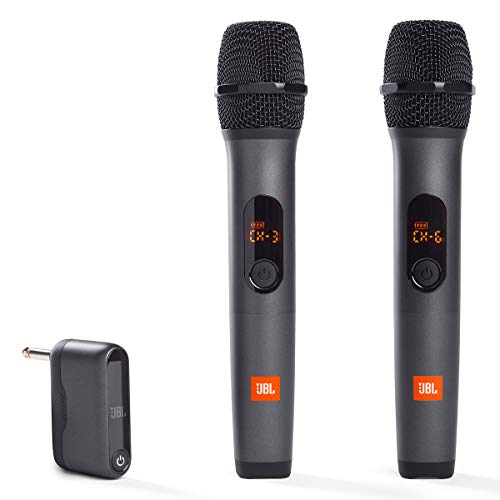
- Includes two microphones and a dual-channel receiver
- Plug-and-play setup for quick use
- Designed for compatible JBL PartyBox speakers
Best For: Duets, karaoke, and JBL PartyBox owners
Multi-Mic Performance Pick

- Includes four handheld microphones
- 200-foot coverage with frequency hopping
- 24-bit/48kHz audio and broad cable compatibility
Best For: Groups, events, churches, DJs, and larger karaoke setups
PartyBox Performance Pick – JBL PartyBox Wireless Mic
For singers who already use a JBL PartyBox, these wireless microphones offer a straightforward way to add clear vocals without extra setup. The cardioid pickup, pop filter, and shock mount help keep singing sound focused and reduce handling and breathing noise.
Best For: JBL PartyBox owners who want a rechargeable two-microphone setup for karaoke, parties, and mobile performances.
Pros:
- Cardioid pickup delivers warm, clear, crisp vocals.
- Rechargeable batteries provide up to 20 hours of playtime, or up to 12 hours with the wireless dongle.
- Stable 2.4GHz connection reaches up to 30 meters with the dongle.
- Works with all JBL PartyBox speakers and can charge while in use.
Cons:
- Designed for JBL PartyBox speakers rather than general-purpose audio systems.
- The longer 20-hour runtime does not apply when using the digital wireless dongle.
This is a convenient choice when compatibility with a PartyBox matters most. Its rechargeable design and vocal-focused noise controls make it especially practical for extended singing sessions.
Flexible Karaoke Value – FIFINE K036 Dual Wireless System
The FIFINE K036 is a practical option for singers seeking wireless microphones for singing with separate controls for two performers. Its UHF connection, included cables, adjustable echo, and extra microphone input make it adaptable for karaoke, parties, school events, and church use.
Best For: Home karaoke and small events using a speaker, amplifier, or soundbar with a microphone or RCA input.
Pros:
- UHF wireless operation offers an operating range of up to 80 feet.
- Separate volume controls support two simultaneous vocalists.
- Adjustable echo can be mixed with music without a separate mixer.
- Includes 1/4-inch, 3.5mm, and 3.5mm-to-RCA cables.
Cons:
- No Bluetooth connectivity.
- Requires a compatible microphone or RCA input; smart TVs may need a digital-to-analog converter.
- Uses four AA batteries rather than rechargeable microphone batteries.
This system emphasizes connection flexibility and easy karaoke operation rather than Bluetooth convenience. Check your speaker or soundbar inputs before buying, then use the included cables to match the setup.
Feature-Packed Party Pair – ECHOMUSSY RGB Wireless Microphones
These ECHOMUSSY wireless microphones for singers combine cardioid vocal pickup with DSP noise reduction, on-mic volume controls, and colorful RGB lighting. The plug-and-play receiver pairs with both microphones automatically, making the set suited to karaoke, speeches, presentations, and family parties.
Best For: Singers and hosts who want long battery life, independent microphone controls, and visual lighting effects for compatible PA or karaoke equipment.
Pros:
- Dedicated one-to-one chips support simultaneous use of both microphones.
- Offers up to 200 feet of open-area 2.4GHz range.
- Built-in rechargeable batteries provide up to 40 hours of battery life.
- RGB modes, battery displays, and on-mic volume controls add convenience.
Cons:
- Not compatible with phones, tablets, laptops, TVs, Bluetooth-only speakers, or headphone/AUX ports.
- Requires a compatible 3.5mm or 6.35mm microphone input.
- Some listed specifications describe AA batteries, while the product notes also specify built-in rechargeable batteries; verify the included configuration.
This is an appealing all-around party set if your equipment has the required microphone input. Its long stated runtime and independent controls are useful for duets, while the RGB lighting is a bonus for casual entertainment.
Durable UHF Choice – TONOR TW-820 Wireless Microphones
The TONOR TW-820 is built for singers who want sturdy wireless microphones for singing in karaoke, party, church, wedding, or DJ settings. Its all-metal handheld microphones, cardioid dynamic capsules, adjustable UHF frequencies, and automatic matching provide a durable and flexible two-mic setup.
Best For: Performers and event hosts using an amplifier, mixer, PA speaker, or karaoke system with a 6.35mm or XLR microphone connection.
Pros:
- Cardioid dynamic capsules help produce clear vocals and reduce background noise and howling.
- Each microphone offers 15 adjustable UHF frequencies, with up to 60 meters of open-space range.
- All-metal microphone construction is designed to resist impact and corrosion.
- Receiver provides separate volume controls for the two microphones.
Cons:
- Requires two AA batteries per microphone, and batteries are not included.
- Does not connect directly to a TV or AV receiver without a microphone input.
- Only a 6.35mm audio cable is included; XLR connection requires appropriate equipment or cabling.
The TW-820 is a strong fit when durability and frequency flexibility are priorities. Before ordering, confirm that your audio system has a compatible 6.35mm or XLR microphone input.
Best Overall – Dual UHF Auto-Scan Handheld System
For singers who need dependable wireless microphones for singers in venues with potential interference, the Phenyx Pro PTU-71-2H combines automatic frequency scanning, dual-channel operation, and a long line-of-sight range. Its cardioid handheld microphones are tuned for balanced vocals and include mute controls for convenient performance management.
Best For: Karaoke, weddings, churches, DJ events, and singers using a PA system or mixer.
Pros:
- Auto Scan helps find lower-interference frequencies, with 200 selectable UHF frequencies and a frequency-lock function.
- Offers a stated 290–328-foot line-of-sight operating range and quick IR synchronization.
- Cardioid microphones, tuned EQ, metal construction, and replaceable microphone heads support clear, durable performance.
- Includes two handheld microphones, receiver, cable, adapter, antennas, and AA batteries.
Cons:
- Uses disposable AA batteries rather than a rechargeable system.
- Its UHF frequency ranges may require attention to local frequency requirements.
The PTU-71-2H is a strong all-purpose choice when frequency flexibility and extended range matter. It is especially practical for two-singer setups that need straightforward controls and rugged hardware.
Best Long-Range Pick – 500ft 2.4G Wireless Mic Set
These wireless microphones for singers are designed for performers who want broad movement without giving up simple setup. The dual 2.4G system claims a 500-foot range, uses automatic pairing, and adds noise reduction, independent channel volume controls, and power-off memory for repeat events.
Best For: Large weddings, church services, outdoor events, karaoke, DJ use, and presentations.
Pros:
- Provides a stated 500-foot operating range with 2.4G wireless transmission.
- Dynamic cardioid microphones and a noise-reduction chip aim to reduce background and handling noise.
- Automatic pairing and power-off memory simplify setup and preserve volume and channel settings.
- Supports PA systems, amplifiers, mixers, and karaoke machines through 6.35mm or XLR connections.
Cons:
- The supplied notes describe the microphones as rechargeable while also listing two AAA batteries, so battery details should be verified before purchase.
- Unlike a UHF tunable system, it does not list selectable frequency groups.
This set stands out for venues where performers need substantial roaming range and quick operation. Independent volume controls are useful for balancing two singers, while the automatic pairing keeps setup uncomplicated.
Best Tunable Value – Dual UHF Tunable Frequency System
The Phenyx Pro PTU-52-2H is a practical option for singers who want wireless microphones for singers with adjustable UHF frequencies and a sturdy metal build. Its frequency-hopping design pairs the microphones and receiver quickly, while cardioid capsules are intended to deliver clean sound with reduced feedback and hiss.
Best For: Karaoke, live singing, church services, weddings, meetings, and smaller outdoor events.
Pros:
- Provides 30 tunable frequency groups in the 500MHz band and supports up to three units simultaneously.
- Offers automatic pairing, frequency hopping, and frequency selection for flexible setup.
- Includes two XLR outputs plus a mixed 1/4-inch output for mixers, speakers, and amplifiers.
- Metal receiver and microphones, anti-rolling rings, windscreens, cables, antennas, and AA batteries are included.
Cons:
- Its stated 200-foot open-space range is shorter than the longer-range systems in this roundup.
- The notes specify up to three units simultaneously, which may limit larger multi-microphone setups.
Choose the PTU-52-2H when tunability and solid construction are more important than maximum distance. It offers useful connection flexibility for singers moving between karaoke machines, PA systems, and mixers.
Reliable Range Pick – TONOR TW360 Wireless Microphone System
For singers who need room to move, the TONOR TW360 is a practical choice among wireless microphones for singers. Its UHF connection reaches up to 200 feet, while the cardioid dynamic microphones help focus on the main sound source and reduce background noise. The receiver also supports adjustable frequencies for more flexible setups.
Best For: Karaoke, church gatherings, weddings, presentations, and other indoor or outdoor events requiring extended range.
Pros:
- Up to 200 feet of wireless operating range.
- Cardioid pickup pattern helps reduce background noise.
- Supports 4×10 adjustable channels, with up to 40 simultaneous connections.
- Works with mixers, karaoke machines, amplifiers, and powered speakers through the included 1/4-inch cable.
Cons:
- AA batteries are required and not included.
- The system uses a 1/4-inch connection rather than a stated XLR output.
The TONOR stands out for singers who value coverage and frequency flexibility. It is especially useful for larger karaoke or event spaces, provided your audio equipment has a compatible microphone input.
Simple Dual-Mic Pick – JBL Wireless Two Microphone System
The JBL Wireless Two Microphone System is a straightforward option among wireless microphones for singers who want two vocalists on one setup. Its dual-channel UHF receiver mixes both microphones through a compatible speaker, and the plug-and-play design makes setup quick for karaoke or casual performances.
Best For: Duets, karaoke, and JBL PartyBox owners who want a simple two-microphone solution.
Pros:
- Includes two wireless microphones and a dual-channel receiver.
- Designed for clear vocal reproduction with JBL Original Pro Sound systems.
- Plug-and-play setup requires turning on the receiver and microphones.
- Microphones use replaceable AA batteries.
Cons:
- Compatibility is focused on listed JBL PartyBox models.
- The supplied notes do not specify a wireless operating range.
- It provides two channels rather than a larger multi-microphone configuration.
This JBL system is most compelling when convenience and brand compatibility matter more than extensive frequency control. Confirm that your speaker is one of the listed compatible JBL PartyBox models before buying.
Multi-Mic Performance Pick – MELONARE 4-Mic UHF System
For groups and larger events, the MELONARE system is a versatile choice among wireless microphones for singers. It includes four handheld transmitters, 200 feet of UHF coverage, 24-bit/48kHz audio, and frequency groups that support multiple systems. The included cables and adapters also make it easier to connect with varied audio equipment.
Best For: Group singing, DJ events, weddings, churches, small theaters, and larger karaoke setups.
Pros:
- Includes four handheld microphones with color-coded controls.
- Offers up to 200 feet of coverage and frequency hopping for clearer transmission.
- 24-bit/48kHz sampling and cardioid pickup support detailed vocal sound.
- Includes 1/4-inch, 6.35mm-to-3.5mm, and power cables, plus eight AA batteries.
Cons:
- The four-microphone design may be more equipment than a solo singer needs.
- The supplied notes do not specify an XLR cable or individual microphone outputs.
The MELONARE is the strongest fit here for ensembles and event hosts who need several microphones at once. Its included accessories and multi-system frequency support add practical flexibility, though solo performers may prefer a smaller kit.
How We Picked the Best Wireless Microphones for Singers
We focused on the features that have the greatest effect on live singing: vocal clarity, wireless stability, usable range, battery endurance, microphone handling, receiver compatibility, and setup simplicity. We also considered whether each system is better suited to solo singers, duets, karaoke, presentations, parties, or more demanding performance environments.
Because wireless specifications can vary by venue and surrounding interference, advertised range and battery figures should be treated as best-case estimates. A clear line of sight, fresh batteries, and compatible audio equipment all help performance.
Quick Comparison
| System type | Best for | What to prioritize |
|---|---|---|
| 2.4GHz wireless | Home use, parties, portable speakers | Simple pairing, low interference, speaker compatibility |
| UHF dual-channel | Duets, karaoke, small events | Frequency selection, receiver controls, range |
| Long-range cordless systems | Large rooms and active performers | Signal stability, line of sight, battery capacity |
| Multi-frequency UHF | Events requiring flexibility | Selectable channels and interference management |
Key Buying Factors for Wireless Microphones for Singers
Sound and Microphone Design
Dynamic handheld microphones are generally practical for live singing because they tolerate louder stages and reduce some background noise. Look for a system described as clear and balanced rather than relying only on maximum volume claims. A comfortable handle and accessible controls also matter during longer sets.
Signal Type, Range, and Interference
2.4GHz systems are often easy to pair and convenient for consumer audio gear. UHF systems may offer more channel flexibility, especially when several wireless devices are operating nearby. Do not choose solely by the advertised range: walls, people, venue layout, and other radio equipment can reduce real-world performance.
Battery Life and Charging
Rechargeable microphones can reduce the cost and hassle of disposable batteries, while replaceable batteries may be easier to swap during an event. Check whether the receiver also needs separate power, how charging is handled, and whether the stated runtime covers your typical performance length.
Receiver and Equipment Compatibility
Confirm the receiver’s output connection and make sure it works with your mixer, amplifier, karaoke machine, powered speaker, or party speaker. Some microphone systems are designed for particular speaker families, while others use more standard audio connections.
One or Two Microphones
Dual-microphone kits are useful for duets, karaoke, announcements, and backup coverage, but they may cost more and require more receiver space. A single microphone is usually the simpler choice for solo singers and smaller setups.
Who Should Buy Which Wireless Microphones for Singers?
- For home karaoke and parties: Choose a simple 2.4GHz or easy-pairing system with rechargeable microphones and speaker compatibility.
- For duets: Select a dual-channel system with two handheld microphones and independent volume control if available.
- For small venues: A UHF system with selectable frequencies and dependable range offers more flexibility around other wireless equipment.
- For energetic performers: Prioritize stable transmission, strong battery life, comfortable handling, and a receiver that remains reliable across the performance area.
- For occasional presenters or hosts: Favor fast setup, clear speech reproduction, straightforward controls, and minimal charging complexity.
Before buying, verify connector compatibility, local wireless-frequency requirements, included charging accessories, and return coverage. Those details can matter as much as the microphone’s headline range or runtime.