Great monitors only sound great in the right room. If your space adds bass buildup, reflections, or uneven imaging, studio monitors with room correction can help you hear a more reliable mix.
This roundup focuses on compact to full-size picks that pair strong monitoring performance with easier calibration, so you can spend less time fighting your room and more time making decisions you trust.
Best 10 Studio Monitors with Room Correction Picks for 2026
Compact ARC-Calibrated Pair

- Built-in ARC room correction
- 36 Hz to 32 kHz frequency range
- ARC X speaker emulation support
Best For: Compact mixing and critical listening setups
Wall-Friendly Reference Monitor

- Portless design for wall-near placement
- Low-directivity tweeter for flexible listening
- Flax cone for controlled bass and detail
Best For: Small studios with placement constraints
Precision ARC Monitor

- Includes ARC mic for built-in calibration
- Linear phase and time coherence design
- ARC X emulates 20+ playback systems
Best For: Professional calibration and mix translation
DSP Nearfield Reference

- DSP engine for monitored control
- 4-inch compact nearfield design
- MMD waveguide supports focused listening
Best For: Compact professional and project studios
Compact Room-Tuned Pick
Edifier MR5 2.0 Studio Monitor Bookshelf Speakers

- 3-way active design with detailed driver layout
- Rear knobs and app presets for room tuning
- XLR, TRS, RCA, AUX, and Bluetooth 6.0 inputs
Best For: Near-field desks and small studios needing flexible tuning
Mixing Benchmark
Yamaha HS7 7-Inch Powered Studio Monitor Pair

- Bi-amplified 7-inch powered monitor pair
- Balanced XLR and TRS inputs for studio gear
- 43Hz to 30kHz response for critical listening
Best For: Mixing and recording in treated rooms
Wide-Dispersion Reference
Focal Alpha-Twin-EVO Active 2.5-Channel Studio Monitor
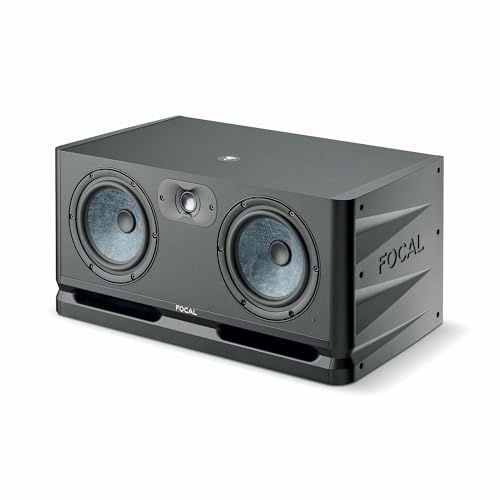
- Wide dispersion for consistent room coverage
- Slatefiber cone aims for neutrality and low distortion
- XLR, TRS, and RCA connectivity for studio setups
Best For: Producers wanting neutral sound and broad dispersion
Room-Correction Focused Pick
KRK RP7G5 7-inch tuned studio monitor
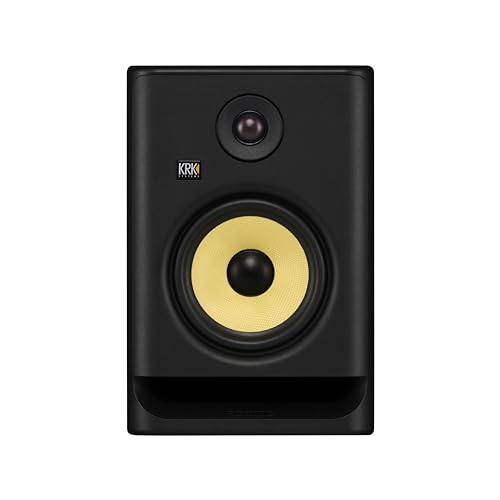
- 25 EQ combinations for boundary and tuning adjustment
- 7-inch woven Kevlar woofer for accurate low end
- XLR and 1/4-inch TRS combo input
Best For: Home/project studios needing flexible room-aware tuning
Desktop Tuning Choice
ADAM Audio D3V compact USB-C monitors
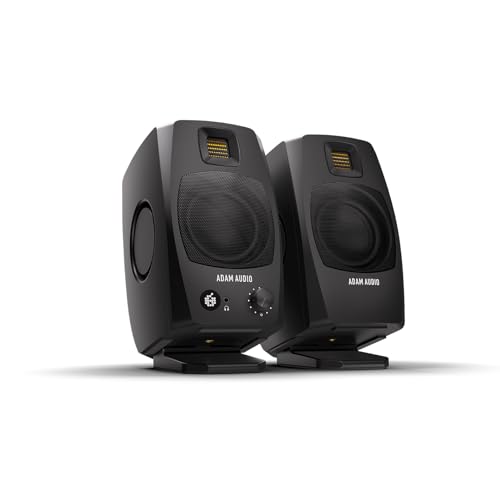
- DSP switches help handle common placement issues
- USB-C direct connection for modern desktop setups
- 15° angled stands included for better aiming
Best For: Compact desks, creators, and small-room nearfield use
Studio Room Control Classic
Yamaha HS8 8-inch monitors with room control

- ROOM CONTROL and HIGH TRIM for manual tuning
- 8-inch bi-amped design for clear, accurate playback
- Balanced XLR and TRS input support
Best For: Producers wanting proven monitors with simple room tuning
Compact ARC-Calibrated Pair – iLoud MTM MKII
If you want studio monitors with room correction for a small workspace, the iLoud MTM MKII pair is built to make calibration easy while keeping the sound precise. It combines a compact footprint with built-in ARC room correction, linear-phase behavior, and a wide frequency range, so you can get a more reliable reference without a large setup.
Best For: Mixing, critical listening, and compact studios that need built-in room calibration.
Pros:
- Built-in ARC room correction helps optimize playback for different rooms and speaker placements.
- Ultra-flat 36 Hz to 32 kHz response supports detailed bass, mids, and highs.
- Time alignment and linear phase design help reduce phase distortion and ear fatigue.
- ARC X software can emulate other monitors and reference systems for mix checks.
Cons:
- ARC mic is sold separately according to the product notes.
- Small 3.5-inch class design may not suit users wanting a larger monitor format.
- Built for nearfield use, so it is more of a precision tool than a room-filling speaker.
The iLoud MTM MKII stands out if correction and accuracy matter more than sheer size. For a compact studio that needs dependable monitoring and useful translation tools, it offers a very practical balance of calibration, detail, and flexibility.
Wall-Friendly Reference Monitor – Focal Shape 50
The Focal Shape 50 is a practical pick if you need studio monitors with room correction-style flexibility in a challenging space, especially near a wall. Its portless design, low-directivity tweeter, and adjustable settings are aimed at helping the monitor integrate more easily into different rooms and small home studios.
Best For: Small home studios and wall-near placements where flexible integration matters.
Pros:
- Designed without a port, so it can be placed near a wall more easily.
- Low-directivity tweeter supports a flexible listening position.
- Multiple settings help with integration and accurate control.
- Flax sandwich cone aims for controlled bass and detailed mids.
Cons:
- Does not include built-in DSP room correction.
- No bundled calibration microphone or software mentioned in the notes.
- Sold as a single speaker, so a stereo pair requires two units.
The Shape 50 is less about automated correction and more about smart acoustic design. If your room setup benefits from wall-friendly placement and an adaptable nearfield monitor, it offers a thoughtful, studio-focused approach.
Precision ARC Monitor – iLoud Precision 5 MKII
The iLoud Precision 5 MKII is a strong fit if you want studio monitors with room correction and a more reference-grade workflow. It combines linear phase coherence, a flat response, built-in ARC calibration with the included mic, and ARC X software for profile control and monitor emulation.
Best For: Professional mixing, mastering, and immersive audio setups that need calibrated accuracy.
Pros:
- Built-in ARC room correction includes the microphone for automatic calibration.
- Linear phase and time coherence support very precise monitoring.
- 46 Hz to 30 kHz response with extended low-end coverage.
- ARC X software can emulate over 20 studio monitors and playback systems.
Cons:
- Single-monitor listing, so a stereo pair means buying more than one unit.
- Uses XLR connectivity, which may be less convenient for casual desktop setups.
- Advanced feature set is geared more toward production than simple listening.
This monitor is clearly aimed at serious studio work, where calibration and translation matter. If you want a compact nearfield speaker with advanced correction and virtual monitoring tools, it is one of the most capable options here.
DSP Nearfield Reference – Neumann KH 80 DSP
The Neumann KH 80 DSP is a compact reference monitor for buyers looking for studio monitors with room correction features in a smaller nearfield format. Its DSP engine and MMD waveguide are designed for professional monitoring environments, giving you a controlled and precise listening tool for studios where accuracy matters.
Best For: Nearfield reference monitoring, project studios, and compact professional setups.
Pros:
- DSP engine adds digital control for professional monitoring use.
- Mathematically modeled dispersion waveguide supports focused nearfield listening.
- Compact 4-inch design suits desks, small studios, and multi-channel systems.
- Works in a wide range of professional and home studio environments.
Cons:
- No explicit room-correction microphone or calibration system is listed in the notes.
- 25-watt maximum output is modest compared with larger powered monitors.
- Sold as a single speaker, so stereo monitoring requires two units.
The KH 80 DSP is a precision-first monitor rather than a feature-packed correction system. For users who want a compact Neumann reference speaker with DSP control and a disciplined nearfield sound, it makes a lot of sense.
Compact Room-Tuned Pick – Edifier MR5 2.0 Studio Monitor Bookshelf Speakers
If you want studio monitors with room correction in a compact desktop-friendly format, the Edifier MR5 is built to make placement easier. Its rear tuning knobs and EDIFIER ConneX app controls let you adjust high and low frequencies, apply low cut-off, and use acoustic space presets to better match your room.
Best For: Near-field listening, desktop setups, and small studios that need flexible room compensation without a separate calibration system.
Pros:
- 3-way active design with 5-inch woofer, 3.75-inch mid driver, and 1-inch silk dome tweeter for detailed monitoring
- Room acoustic tuning via physical rear knobs or the EDIFIER ConneX app
- Multiple inputs including XLR, TRS, RCA, AUX, plus Bluetooth 6.0 with multi-point support
- 110W RMS output and MDF cabinets for strong, controlled near-field performance
Cons:
- Room compensation is based on tuning controls and app presets, not automated measurement-based correction
- Best suited to near-field or mid-sized rooms rather than larger monitoring spaces
The MR5 stands out if you want an easy-to-tune monitor that can adapt to a desk or room without much fuss. It offers useful correction-style controls, broad connectivity, and enough power to serve as a practical all-around studio speaker.
Mixing Benchmark – Yamaha HS7 7-Inch Powered Studio Monitor Pair
The Yamaha HS7 is a straightforward choice if you want studio monitors with room correction-style benefits from careful placement and honest response rather than built-in processing. Its 43Hz to 30kHz range, bi-amp design, and balanced XLR/TRS inputs make it a dependable pair for critical mixing work.
Best For: Mixing and studio recording when you want an accurate, no-frills monitor pair with balanced connectivity.
Pros:
- 7-inch powered monitor pair with bi-amplified 60W LF and 35W HF design
- Balanced XLR and TRS inputs accept both balanced and unbalanced signals
- Wide 43Hz to 30kHz frequency response for detailed monitoring
- Built for studio recording and mixing with a proven monitor-style voicing
Cons:
- No built-in room correction or app-based tuning features
- Larger footprint may be less convenient for small desks
The HS7 is best viewed as an accuracy-first monitor pair rather than a feature-heavy speaker. If your room is already treated or you are willing to position carefully, it delivers the kind of direct monitoring many mixers prefer.
Wide-Dispersion Reference – Focal Alpha-Twin-EVO Active 2.5-Channel Studio Monitor
For studio monitors with room correction in the sense of consistent off-axis sound across the room, the Focal Alpha-Twin-EVO focuses on wide dispersion and tonal balance. Its 2.5-channel active design is meant to keep the sound stable at low and high volumes, which helps in real-world rooms where listening position can vary.
Best For: Producers and creators who want a powerful monitor with wide dispersion and neutral voicing for a studio setup.
Pros:
- Wide dispersion helps maintain the same sound throughout the room
- Slatefiber cone is designed for sound neutrality and low distortion
- Identical tonal balance at both low and high volume
- Multiple connection options including XLR, TRS, and RCA
Cons:
- Does not include automated room correction software or measurement-based calibration
- Single-monitor listing may require checking quantity carefully for a stereo pair setup
The Alpha-Twin-EVO is a strong fit if you value dispersion and tonal consistency more than extra DSP features. It is a polished monitor for studio use where the goal is reliable translation and a balanced sound field.
Room-Correction Focused Pick – KRK RP7G5 7-inch tuned studio monitor
If you want studio monitors with room correction options built in, the KRK RP7G5 is aimed squarely at taming a real room instead of just sounding good on paper. Its 25 boundary and tuning EQ combinations give you useful ways to reduce issues caused by wall placement and room reflections, while the 7-inch woofer and low-diffraction baffle are built for accurate low-end response and cleaner imaging.
Best For: Home and project studios that need flexible tuning to fit the room.
Pros:
- 25 boundary and tuning EQ combinations help address placement and acoustical issues.
- 7-inch woven Kevlar aramid fiber woofer supports tight low and low-mid performance.
- Low diffraction baffle design is intended to reduce distortion and improve stereo imaging.
- XLR and 1/4-inch TRS combo input offers broad compatibility with audio gear.
Cons:
- Room tuning is switch-based rather than automatic room measurement.
- The larger 7-inch footprint takes more desk or stand space.
- Designed for wired use only, with no wireless connectivity.
Overall, the RP7G5 is a strong fit if you need a practical, adjustable monitor rather than a plug-and-play solution. It gives you enough tuning flexibility to adapt to your space while still focusing on accurate monitoring for music production, editing, and sound design.
Desktop Tuning Choice – ADAM Audio D3V compact USB-C monitors
The ADAM Audio D3V is a compact option for buyers looking at studio monitors with room correction features in a desktop setup. Its DSP-powered switches are designed to address common acoustical issues from speaker placement, and the included angled stands help aim the speakers toward your ears for a more controlled listening position. With USB-C connectivity, it also fits neatly into modern computer-based workflows.
Best For: Desktop producers and creators who need compact monitors with simple placement tuning.
Pros:
- DSP-powered switches help address common acoustical issues from placement.
- Detachable stands angle the monitors 15° toward the listener.
- USB-C connection makes direct hookup to computers and mobile devices easy.
- Compact active design suits desks, mic stands, and small workspaces.
Cons:
- 3.5-inch woofers are small compared with larger nearfield monitors.
- Room correction is based on DSP switches, not automatic measurement.
- Best suited to desktop use rather than larger studio rooms.
For a compact monitor that still offers some placement-aware tuning, the D3V is a smart desktop choice. It combines ADAM Audio’s ribbon tweeter approach with practical controls for small-room and near-field listening.
Studio Room Control Classic – Yamaha HS8 8-inch monitors with room control
The Yamaha HS8 is a familiar choice for anyone comparing studio monitors with room correction tools for a more controlled mix position. Its ROOM CONTROL and HIGH TRIM adjustments let you fine-tune the response for your space, while the 8-inch design and bi-amp system are built for clear, accurate monitoring across a wide frequency range. The balanced XLR and TRS support also makes integration straightforward in most studio setups.
Best For: Engineers and producers who want simple manual room tuning in a proven nearfield monitor.
Pros:
- ROOM CONTROL and HIGH TRIM adjustments help tailor sound to the room.
- Bi-amp system is designed for clarity and accurate reproduction.
- 8-inch woofer supports deep bass and full-range monitoring.
- XLR and TRS connectivity fits common studio interfaces and gear.
Cons:
- Room correction is manual rather than automatic.
- Larger cabinets require more space in the room or on stands.
- Wired connectivity only, with no wireless features.
If you want a straightforward monitor with room-aware controls and a long track record in studios, the HS8 remains an easy recommendation. It focuses on practical tuning and accurate playback rather than extra features.
How We Picked These Studio Monitors with Room Correction
We prioritized monitors that combine accurate driver design, practical power output, and room optimization features that matter in real studios. That includes built-in DSP, calibration software support, flexible placement options, and designs suited to nearfield listening.
We also weighed use case: desktop producers, small untreated rooms, mix suites, and users who want a cleaner upgrade path from basic powered speakers. The goal was to highlight options that improve consistency without adding unnecessary complexity.
Quick Comparison
Use the smallest, most flexible models for tight desktop setups or secondary listening spaces. Step up to 5-inch and 7-inch options when you need more low-end reach, higher headroom, or a broader sweet spot. If your room is untreated or irregular, calibration features can matter as much as driver size.
Key Buying Factors for Studio Monitors with Room Correction
Correction Method
Some monitors include built-in correction, while others rely on external software or calibration systems. Built-in DSP is convenient, but software-based systems may offer more control over measurement and target curves.
Room Size and Listening Distance
Compact monitors work best on desks or in small rooms at shorter distances. Larger woofers can deliver more bass and output, but they need more space to perform well and may be harder to tame without proper treatment.
Low-End Accuracy
Room correction can improve bass balance, but it cannot fully replace good placement and acoustic treatment. Look for monitors with controlled low end and enough extension for your genre and workflow.
Connectivity and Workflow
Balanced inputs, onboard DSP, and easy level controls make setup simpler. If you switch between interfaces, controllers, or desktop sources, flexibility matters.
Translation and Reliability
The best Studio Monitors with Room Correction help mixes hold up across headphones, cars, and consumer speakers. Accuracy, not hype, should be the deciding factor.
Who Should Buy Which Studio Monitors with Room Correction?
Choose compact corrected monitors if you produce in a small or shared room and need better imaging without overwhelming the desk. Go with 5-inch models if you want a balanced middle ground for writing, editing, and mixing. Pick 7-inch or larger monitors if you have the room, need stronger low-end output, or work on bass-heavy material.
If your space is untreated, correction features are especially valuable. If your room is already well controlled, you may value monitor character and voicing more than aggressive DSP. Either way, the best choice is the one that gives you consistent results in your actual room.