Choosing powered studio monitors can make a bigger difference to your mixes than almost any other studio upgrade. The right pair gives you a clearer, more honest picture of your sound.
Below, we focus on options that balance accuracy, size, features, and value so you can pick the best fit for your room and workflow.
Best 10 Powered Studio Monitors Picks for 2026
Compact Desktop Pick

- 4.5-inch two-way powered pair
- Room control and high trim
- XLR/TRS, RCA, and stereo mini inputs
Best For: Small desks and home studios
Mixing Sweet Spot

- 5-inch two-way powered monitors
- Wide sweet spot with Image Control Waveguide
- Boundary EQ and HF Trim for room tuning
Best For: Music production and podcasting
Neutral Reference Choice

- 5-inch bi-amplified near-field pair
- Neutral sound with no added coloration
- XLR and TRS balanced/unbalanced inputs
Best For: Accurate studio monitoring
Budget-Friendly Near-Field
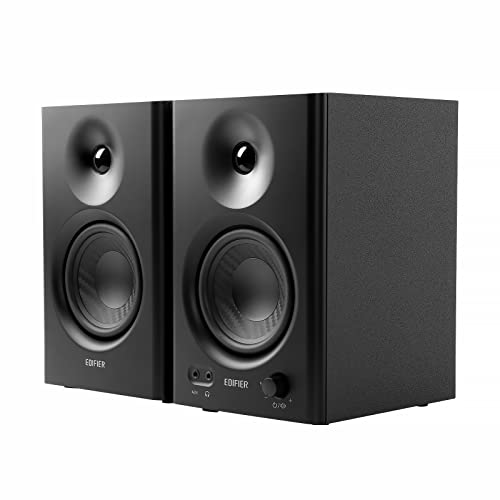
- 4-inch near-field powered speaker pair
- Almost flat tuning for creators
- TRS, RCA, AUX, and headphone output
Best For: Affordable desktop studio setups
Classic Room-Filling Pick
KRK Classic 7 Powered Two-Way Studio Monitor

- 73-watt self-powered 7-inch design
- Front-firing port helps with wall placement
- Low/high level controls for room tuning
Best For: mixing-focused studios that need a larger powered monitor
Desktop Detail-Focused Choice
ADAM Audio D3V Active Desktop Studio Monitor Speakers
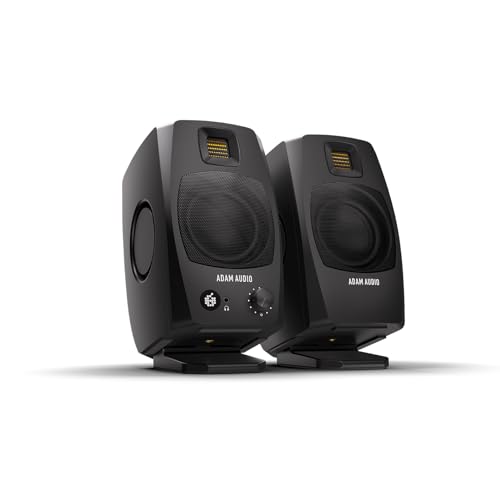
- USB-C ready fully active desktop monitor pair
- D-ART tweeter for precise, unfatiguing highs
- Passive radiators extend bass down to 45 Hz
Best For: desk setups, songwriting, and compact nearfield monitoring
Accuracy-First Bundle
Yamaha HS5 W 5-Inch Powered Studio Monitor Bundle

- Two powered 5-inch monitors for stereo use
- Flat, accurate nearfield reference tuning
- XLR wired connectivity for studio setups
Best For: buyers seeking an accurate two-monitor reference pair
Best with Extra Features
PreSonus Eris 3.5 Powered Studio Monitors

- 50W built-in amplification
- High/low tuning controls
- TRS, RCA, and front aux inputs
Best For: Home studios, gaming, and desktop listening
Hi-Res All-Rounder
Edifier MR3 Powered Studio Monitor

- Hi-Res Audio certified
- TRS, RCA, AUX, and Bluetooth
- App EQ plus listening modes
Best For: Creators who want flexible connectivity and tuning
Feature-Packed Budget Choice
Ortizan C7 Powered Studio Monitors

- Bluetooth 5.3 and USB DAC
- TRS, RCA, AUX, and headphone out
- 3.5-inch carbon fiber drivers
Best For: Small setups that need many input options
Compact Desktop Pick – Yamaha HS4 Pair
If you want powered studio monitors for a tight desk setup, the Yamaha HS4 pair keeps things simple and practical. With 4.5-inch woofers, room control and high trim, and multiple inputs including XLR/TRS, RCA, and stereo mini, they are built for everyday music production and video editing on a compact workspace.
Best For: Small desks, home studios, and creators who need a straightforward, compact monitor pair.
Pros:
- Compact 4.5-inch two-way design fits smaller workstations.
- Room control and high trim help tailor the sound to your space.
- Flexible XLR/TRS, RCA, and stereo mini connectivity.
- Includes speaker cable, stereo mini-RCA cable, and anti-slip pads.
Cons:
- Lower maximum output than larger studio monitor pairs.
- Best suited to near-field listening rather than bigger rooms.
The HS4 pair is a sensible choice if you value a clean setup and easy connectivity over sheer output. For desktop-focused work, it offers the essentials without taking up much space.
Mixing Sweet Spot – JBL 305P MkII Pair
The JBL 305P MkII is a strong option if you want powered studio monitors with a wider listening area and room-friendly tuning tools. The 5-inch two-way design, Image Control Waveguide, and Boundary EQ/HF Trim make it a practical fit for music production, podcasting, and other detailed listening tasks.
Best For: Producers and podcasters who want a responsive 5-inch monitor pair with flexible room tuning.
Pros:
- Patented Image Control Waveguide provides a wide sweet spot.
- Dual 41-watt Class-D amplifiers support strong, clear output.
- Boundary EQ and HF Trim help adapt to different rooms.
- XLR/TRS inputs and a rugged MDF enclosure add versatility.
Cons:
- Larger than ultra-compact desktop monitors.
- Designed for studio reference use, so it is less about boosted sound.
For buyers who need a reliable near-field reference, the 305P MkII checks the key boxes. Its tuning features and wide sweet spot make it especially useful when your room is not acoustically perfect.
Neutral Reference Choice – Yamaha HS5 Pair
The Yamaha HS5 pair is aimed at users who want powered studio monitors that emphasize sonic purity rather than added color. With a 5-inch cone woofer, 1-inch dome tweeter, and XLR/TRS inputs, it is a straightforward near-field option for music production and studio monitoring.
Best For: Mixers and producers who want a clear, uncolored reference sound in a compact pair.
Pros:
- Bi-amplified 2-way design with 45W LF and 25W HF power.
- 5-inch woofer and 1-inch dome tweeter for near-field monitoring.
- Neutral tuning focused on sonic purity.
- XLR and TRS inputs accept balanced or unbalanced signals.
Cons:
- Not designed for high-output room-filling playback.
- Best used where accurate listening is more important than extra bass.
The HS5 remains a classic choice when you want a monitor that shows the mix clearly. Its design is practical, direct, and built around accuracy for studio work.
Budget-Friendly Near-Field – Edifier MR4
The Edifier MR4 is a practical entry point into powered studio monitors, especially if you want a near-flat response for basic production work and daily listening. Its 4-inch woofer, 1-inch silk dome tweeter, and flexible front and rear connections make it easy to integrate into a small creative setup.
Best For: New creators and PC users who want an affordable monitor with flexible inputs and simple controls.
Pros:
- Professionally tuned for an almost flat studio-monitor curve.
- 1-inch silk dome tweeter and 4-inch composite woofer.
- TRS, RCA, AUX, and front headphone output for flexible hookup.
- Dual mode design supports monitor use or casual music listening.
Cons:
- Smaller 4-inch woofer limits low-end scale versus larger monitors.
- Designed for near-field use, not bigger-room playback.
If you need a simple pair of powered studio monitors for a desk, the MR4 offers a lot of utility for the money. It balances studio-minded features with user-friendly controls and broad connectivity.
Classic Room-Filling Pick – KRK Classic 7 Powered Two-Way Studio Monitor
If you want powered studio monitors with a bigger nearfield footprint, the KRK Classic 7 is built for straightforward recording and mixing. Its self-powered design uses matched bi-amped class A/B amplification, while the 7-inch woofer and front-firing port help deliver a full-range response with more placement flexibility than many rear-ported designs.
Best For: Producers and home studios that want a larger 7-inch powered monitor for mixing and placement near walls.
Pros:
- 73-watt self-powered design with matched amplifiers and low-distortion bi-amped operation
- Front-firing port makes room placement easier, including setups closer to a wall
- Low- and high-frequency level controls help tailor the response to the room
- Includes RCA, 1/4-inch TRS, and analog XLR connectivity for flexible wired setups
Cons:
- Larger cabinet may be less convenient for very small desks
- Wired-only design means no wireless input options
Overall, the Classic 7 is a practical choice if you want powered studio monitors with more size, flexibility, and room-shaping control than compact desktop models. It focuses on mixing-friendly functionality rather than extra features.
Desktop Detail-Focused Choice – ADAM Audio D3V Active Desktop Studio Monitor Speakers
The ADAM Audio D3V is a compact option for powered studio monitors when desk space is tight but you still want serious monitoring detail. This fully active pair connects directly to computers and mobile devices via USB-C, and its 3.5-inch woofers, passive radiators, and D-ART tweeter are designed for clear low-end extension and precise high frequencies.
Best For: Songwriters, producers, and desktop users who want compact powered studio monitors with USB-C convenience.
Pros:
- Fully active desktop pair with direct USB-C connectivity
- D-ART tweeter is designed for precise, unfatiguing high-frequency reproduction
- Dual-sided passive radiators help extend bass response down to 45 Hz
- Includes angled monitor stands plus 3/8-inch mic stand mounting threads
Cons:
- Small 3.5-inch woofers are better for nearfield use than larger-room monitoring
- One speaker houses the backplate controls, so placement setup matters
For a desk-based setup, the D3V stands out by combining compact size with practical tuning features and modern connectivity. It is a strong fit when you want powered studio monitors that are easy to place and quick to hook up.
Accuracy-First Bundle – Yamaha HS5 W 5-Inch Powered Studio Monitor Bundle
The Yamaha HS5 W bundle is a classic accuracy-first option for powered studio monitors, especially if your priority is getting a concise sound image and flat response for mixing decisions. This two-pack is built around Yamaha’s nearfield reference approach, so it focuses on transparency rather than hyped bass or flashy extras.
Best For: Mix engineers and studio buyers who want a trusted two-monitor powered reference setup with a flat, accurate presentation.
Pros:
- Includes two powered 5-inch monitors for a matched stereo setup
- Nearfield reference design emphasizes accuracy and flat response
- Well-known Yamaha studio monitor lineage built around mixing reliability
- XLR connectivity suits straightforward wired studio integration
Cons:
- 5-inch size is less suited to those wanting bigger low-end output
- Bundled pair increases footprint compared with a single monitor purchase
If you want powered studio monitors that prioritize honest playback over added color, the HS5 W remains a dependable studio staple. It is especially appealing for users who value accuracy in a compact nearfield format.
Best with Extra Features – PreSonus Eris 3.5 Powered Studio Monitors
If you want powered studio monitors that fit easily on a desk but still aim for true studio-style clarity, the PreSonus Eris 3.5 is a practical starting point. This stereo pair offers 50 watts of built-in amplification, balanced TRS, RCA, and front aux connectivity, plus tuning controls to help adapt the sound to your room.
Best For: Home studio beginners, desktop creators, and anyone who needs compact monitors for music, gaming, or everyday listening.
Pros:
- 50 watts of built-in amplification for clear, distortion-free playback
- 3.5-inch woven-composite woofers and 1-inch silk-dome tweeters for balanced sound
- High- and low-frequency controls help tailor the output to your space
- Front headphone jack and multiple inputs make desk setup simple
Cons:
- Smaller 3.5-inch drivers are better suited to near-field listening than big-room bass
- No explicit app-based EQ or advanced DSP features
Overall, this is a straightforward powered monitor pair for users who want dependable desk-friendly sound and flexible wired connections without a complicated setup.
Hi-Res All-Rounder – Edifier MR3 Powered Studio Monitor
The Edifier MR3 is a good fit if you want powered studio monitors with a flatter response and a broader feature set for everyday work. It is Hi-Res Audio certified, includes balanced TRS, RCA, AUX, Bluetooth with multi-point support, and adds Music, Monitor, and Custom modes for more control.
Best For: Creators, editors, and listeners who want flexible connectivity and app-based tuning in a compact monitor.
Pros:
- Hi-Res Audio certification with a flat response from 52Hz to 40kHz
- Balanced TRS, RCA, AUX, headphone output, and Bluetooth multi-point
- Music, Monitor, and Custom modes with EDIFIER ConneX app EQ control
- MDF cabinet design helps reduce distortion during playback
Cons:
- Single-speaker listing means you need to confirm pair pricing and package details
- 18W x 2 RMS output is more modest than some larger monitor systems
For buyers who want a powered monitor that mixes studio-oriented tuning with modern convenience, the MR3 offers a balanced feature set in a compact footprint.
Feature-Packed Budget Choice – Ortizan C7 Powered Studio Monitors
The Ortizan C7 is aimed at buyers who want powered studio monitors with lots of connection options in a small setup. It combines Bluetooth 5.3, RCA, 3.5mm AUX, USB with a built-in 24-bit DAC, and a 6.35mm TRS balanced input for compact music production or casual media use.
Best For: Users who need an affordable monitor pair for gaming, media, or small creative setups with both wired and wireless inputs.
Pros:
- Bluetooth 5.3 plus RCA, AUX, USB, and TRS connectivity
- Built-in 24-bit DAC for direct digital audio over USB
- 3.5-inch carbon fiber drivers and 0.75-inch silk dome tweeters
- Front headphone output supports easy monitoring changes
Cons:
- Specific tuning and performance are presented more as general flat-response claims than detailed measurements
- Designed around compact drivers, so low-end output will be limited versus larger monitors
In practice, this is the most connectivity-heavy option here, making it appealing if you want powered monitors that can handle a mix of devices without extra adapters.
How We Picked These Powered Studio Monitors
We looked for Powered Studio Monitors that make sense for real-world setups: home studios, desktop production, podcasting, and casual content creation. Priority went to models with solid reputation, sensible driver sizes, useful connectivity, and performance that matches their price class.
We also considered room size, near-field listening, and how easy each model is to integrate with an interface, mixer, or computer. That means this list favors practical choices, not just spec-sheet wins.
Quick Comparison: What Matters Most
For small desks and tight rooms, compact monitors are usually the easiest to place and control. Larger drivers can produce more low end and output, but they also need more space and better room treatment to sound their best.
If you want a simple shortcut, think in terms of use case: 3.5-inch to 4-inch models for ultra-compact setups, 5-inch models for balanced all-around use, and 7-inch options for users who want more bass extension and headroom.
Key Buying Factors for Powered Studio Monitors
Driver Size and Room Size
Smaller drivers are often best for near-field listening on a desk, while 5-inch monitors are a popular sweet spot for most bedroom studios. If your room is larger or better treated, 7-inch monitors can offer fuller low-end response.
Tonal Accuracy
For mixing, you want monitors that reveal problems instead of flattering your tracks. Look for a neutral or controlled response rather than boosted bass or overly bright treble.
Inputs and Connectivity
Check whether you need balanced inputs such as TRS or XLR, especially if you are connecting to an audio interface. Some Powered Studio Monitors also add Bluetooth or other convenience features, which can be useful for casual playback but should not be your only connection option.
Placement and Room Interaction
Even the best speakers will struggle if they are crammed into corners or pushed against walls. Make sure you have enough desk depth, isolation pads if needed, and room to angle the speakers toward your listening position.
Who Should Buy Which Powered Studio Monitors?
If you are building a small home studio, compact models are usually the most practical starting point. If you mix music regularly and want a more trustworthy reference, a 5-inch pair is often the best all-around choice. Creators who want stronger low-end performance or more listening distance may prefer a 7-inch model.
For buyers focused on desktop convenience, Bluetooth, or casual monitoring, smaller lifestyle-friendly options can be attractive. For serious mixing, prioritize accuracy, balanced inputs, and a design that fits your room over extra features you may rarely use.