Choosing between today’s 3D printers is easier when you know what matters most: reliability, print speed, setup time, and support for the materials you actually plan to use.
This roundup focuses on practical picks for beginners, hobbyists, and makers who want better results with less trial and error.
Best 10 3d Printers Picks for 2026
Speed-Focused Enclosed CoreXY

- Up to 500mm/s speed with 20,000 mm/s² acceleration
- Fully enclosed body helps with advanced filaments
- Auto bed leveling and 15-minute setup simplify use
Best For: Fast enclosed printing with optional multi-color capability
Auto-Calibrating Beginner Pick

- Full-auto calibration handles setup automatically
- 10,000 mm/s² acceleration for fast printing
- AMS lite supports multi-color printing
Best For: Beginners wanting quiet, low-hassle printing
Multi-Color Speed Builder

- Prints up to 4 colors simultaneously
- CoreXY system reaches 600mm/s with 20,000mm/s² acceleration
- 1-click auto leveling and nozzle options add flexibility
Best For: Fast multi-color printing with efficient controls
Multicolor speed-focused pick
Anycubic Kobra X 4-Color 600mm/s Printer

- Native 4-color printing with expansion up to 19 colors
- Up to 600mm/s speed with vibration compensation
- LeviQ 3.0 auto leveling and AI monitoring features
Best For: Buyers who want a fast multicolor printer with easy setup and expansion room
Enclosed multicolor combo choice
Bambu Lab P1S Combo 16-Color Printer
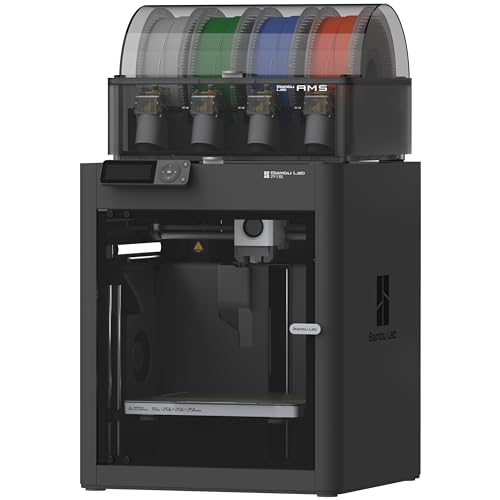
- Up to 16 colors with AMS support
- 500mm/s speed and 20000 mm/s² acceleration
- Fully enclosed body with automatic bed leveling
Best For: Makers who want an enclosed, fast printer with multi-color support
Quiet plug-and-play multicolor pick
Creality K2 Combo 16-Color Printer

- Up to 16 colors with 4 CFS units
- 95% pre-assembled for plug-and-play setup
- Silent mode plus AI camera and smart leveling
Best For: Users who want a quiet, mostly assembled multicolor printer with monitoring
Speed-First Multi-Color Pick

- Prints up to 600 mm/s with sharp, consistent layers
- AMS 2 Pro enables multi-color/multi-material printing
- Quick 15-minute setup with auto calibration and AI detection
Best For: Users who want fast printing and easy multi-color capability
Fast Auto-Leveling Value Pick

- One-click auto leveling simplifies first layers
- Up to 600 mm/s travel speed with CoreXY design
- Fast nozzle swaps and remote app monitoring
Best For: Beginners and speed-focused users who want a simple setup
Toolchanger Multi-Material Pick

- Four-toolhead system with 5-second tool changes
- Designed for less waste and faster multi-color printing
- Supports rigid, flexible, and soluble-support materials
Best For: Advanced users who want efficient multi-material printing
Speed-Focused Enclosed CoreXY – Bambu Lab P1S 3D Printer
If you want a fast, enclosure-ready option in 3d printers, the Bambu Lab P1S is built for users who care about speed and smoother prints with more demanding materials. It combines high acceleration, automatic bed leveling, and a fully enclosed body to help streamline the printing process from setup to finished part.
Best For: Makers who want fast, enclosed printing with easy setup and optional multi-color capability.
Pros:
- Up to 500mm/s printing speed and 20,000 mm/s² acceleration for rapid jobs
- Fully enclosed design supports advanced filaments better than open-frame machines
- Automatic bed leveling helps simplify first-layer setup
- Ready to use in about 15 minutes for a quick start
Cons:
- Multi-color printing requires a Bambu Lab AMS connection
- Carbon/glass fiber reinforced polymer is not recommended
- Higher-performance materials are supported, but some are only listed as capable
The P1S is a strong fit if you want a high-speed 3d printer that reduces setup hassle while still leaving room for more advanced filament choices. It stands out most when enclosure support and quick turnaround matter.
Quiet Direct-Drive Starter – ELEGOO Neptune 3 Pro
The ELEGOO Neptune 3 Pro is a practical pick for 3d printers buyers who want a reliable, easy-start machine for everyday projects. Its direct drive extruder, auto bed leveling, and quiet operation make it a straightforward option for users who value consistency over flashy extras.
Best For: Everyday printing with quiet operation and dependable first-layer setup.
Pros:
- 36-point auto bed leveling helps improve first-layer success
- Direct drive extruder supports PLA, TPU, PETG, and ABS
- Silent stepper motors keep noise down to as low as 47dB
- Power-loss resume and filament runout detection add convenience
Cons:
- Build volume is standard rather than oversized
- Speed-focused shoppers may prefer a more aggressive CoreXY machine
- Best suited to practical printing rather than advanced multi-color workflows
This model makes sense if you want a dependable workhorse that gets you printing quickly and keeps maintenance concerns lower. It is especially appealing for users who value stable, quiet operation in a straightforward package.
Auto-Calibrating Beginner Pick – Bambu Lab A1 3D Printer
The Bambu Lab A1 is designed for people who want 3d printers that are easy to live with from the start, especially beginners and kids. It focuses on automatic calibration, quiet operation, and fast printing with optional multi-color support through AMS lite.
Best For: Beginners who want a simple, quiet printer with automatic calibration.
Pros:
- Full-auto calibration handles Z-offset, bed leveling, and more automatically
- High acceleration up to 10,000 mm/s² supports fast prints
- AMS lite enables multi-color printing when added separately or in the Combo
- 1-clip quick swap nozzle makes maintenance easier
Cons:
- Multi-color printing requires AMS lite
- Not as enclosed as a fully enclosed printer for advanced materials
- Designed more for ease of use than extreme material versatility
The A1 is a sensible choice when the goal is to reduce setup friction and keep printing approachable. It balances speed, quiet performance, and automation in a way that should suit first-time users especially well.
Multi-Color Speed Builder – FLASHFORGE AD5X 3D Printer
The FLASHFORGE AD5X is aimed at buyers comparing 3d printers who want speed, multi-color output, and a compact CoreXY setup. With 1-click auto leveling, a 300°C direct-drive extruder, and remote monitoring support, it is positioned for efficient printing without giving up flexibility.
Best For: Fast multi-color printing with easy leveling and flexible nozzle options.
Pros:
- Supports up to 4 colors simultaneously for vivid prints
- CoreXY design reaches up to 600mm/s with 20,000mm/s² acceleration
- 1-click auto leveling simplifies setup
- Multiple nozzle sizes give more control over detail or speed
Cons:
- Build volume is 220x220x220mm, which is compact for larger projects
- Multi-color capability may not be necessary for simple single-color work
- Some features depend on choosing the right nozzle or using app-based controls
The AD5X is a good fit if you want a speed-oriented printer that still offers creative flexibility. Its combination of high-speed CoreXY motion and multi-color support makes it especially appealing for users who print often and want efficient results.
Multicolor speed-focused pick – Anycubic Kobra X 4-Color 600mm/s Printer
For buyers comparing 3d printers that can handle color, speed, and easier setup, the Anycubic Kobra X stands out with native 4-color printing and expansion up to 19 colors with 4 ACE 2 Pro units. It also aims to cut wasted time and filament with a streamlined material path, while the 600mm/s max speed and auto leveling make it more appealing for fast-moving home and maker workflows.
Best For: Users who want a fast multicolor printer with built-in convenience and room to expand color capabilities.
Pros:
- Native 4-color printing, expandable up to 19 colors with 4 ACE 2 Pro units
- Claims 81.25% less filament and machine travel path to reduce purge waste
- Up to 600mm/s max speed with vibration compensation and hardened steel nozzle
- LeviQ 3.0 auto bed leveling uses a 49-point calibration for easier first layers
Cons:
- Filament is not included
- ACE 2 Pro and ACE Pro are incompatible
- Expansion to 19 colors requires additional ACE 2 Pro units
This is a strong fit if you want multicolor capability without giving up speed-oriented features. It blends convenience tools like app control and AI monitoring with a large 260mm cubic build volume, making it a practical choice for home users, schools, and makerspaces.
Enclosed multicolor combo choice – Bambu Lab P1S Combo 16-Color Printer
If you’re shopping 3d printers for fast, reliable multi-material work, the Bambu Lab P1S Combo is built around speed, enclosure, and AMS-based color printing. It supports up to 16 colors when paired with the AMS, reaches 500mm/s with very high acceleration, and keeps setup simple with a design that claims a 15-minute start.
Best For: Makers who want an enclosed, high-speed printer with multi-color capability and simple setup.
Pros:
- Up to 16 colors with Bambu Lab AMS
- 500mm/s speed and 20000 mm/s² acceleration for fast prints
- Fully enclosed design improves print performance for advanced filaments
- Automatic bed leveling and quick 15-minute setup
Cons:
- AMS is required for multi-color printing
- Carbon/glass fiber reinforced polymer is not recommended
- Heavier than some compact printers at 47.5 pounds
The P1S Combo makes sense if enclosure and speed matter as much as color. Its supported filament list is broad for common materials like PLA, PETG, TPU, PVA, PET, ABS, and ASA, so it fits well in a serious hobby shop or small production setup.
Quiet plug-and-play multicolor pick – Creality K2 Combo 16-Color Printer
Among current 3d printers, the Creality K2 Combo is aimed at users who want multicolor printing with less hassle out of the box. It supports up to 16 colors with 4 CFS units, offers a 260 × 260 × 260 mm build volume, and pairs its 600mm/s speed claims with smart leveling and AI monitoring for a more hands-off experience.
Best For: Buyers who want a quiet, mostly assembled multicolor printer with smart monitoring.
Pros:
- Up to 16 colors using 4 CFS units
- 95% pre-assembled for a plug-and-play start
- 600mm/s printing speed with silent mode for quieter operation
- Smart auto leveling and AI camera for failure monitoring
Cons:
- K2 Combo includes one CFS unit, so more colors need additional hardware
- Build volume is solid but not oversized at 260 × 260 × 260 mm
- Advanced material support is narrower than some competitors
This model is a good fit if you value convenience and quieter operation over maximum flexibility. The direct drive extruder, sturdy frame, and target-area leveling add to its appeal for users who want dependable everyday printing with less babysitting.
Speed-First Multi-Color Pick – Bambu Lab P2S Combo
For buyers comparing 3d printers that balance speed, accuracy, and convenience, the Bambu Lab P2S Combo is built to feel streamlined from the start. It prints up to 600 mm/s, uses active flowrate compensation for cleaner layers, and includes the AMS 2 Pro for multi-color or multi-material printing with filament drying built in.
Best For: Makers who want fast, accurate printing plus easy multi-color workflows.
Pros:
- Up to 600 mm/s printing with precision-focused flowrate compensation
- Quick setup in about 15 minutes with automatic calibration and AI failure detection
- AMS 2 Pro supports multi-color/multi-material printing and dries filament up to 65°C
- Adaptive airflow helps with both crisp overhangs and higher-temperature materials
Cons:
- The printer itself does not support multi-color printing without the Combo setup
- At 46.3 pounds, it is a relatively heavy desktop machine
This is a strong pick if you want a fast, polished 3d printers option with a workflow that reduces setup friction. The combo package adds the color and material flexibility many hobbyists want without forcing a complicated process.
Fast Auto-Leveling Value Pick – FLASHFORGE Adventurer 5M
If you want one of the more straightforward 3d printers for quick jobs and rapid prototyping, the FLASHFORGE Adventurer 5M leans hard into speed and simplicity. It offers one-click automatic bed leveling, a CoreXY structure, and speeds up to 600 mm/s, while the detachable nozzle and fast warm-up help keep the workflow moving.
Best For: Beginners and makers who want fast printing with minimal manual tuning.
Pros:
- One-click automatic bed leveling for easier first-layer setup
- CoreXY design with up to 600 mm/s travel speed and high acceleration
- Quick 3-second nozzle changes and 35-second warm-up to 200°C
- Remote monitoring through the Flash Studio app
Cons:
- Build volume is limited to 220 x 220 x 220 mm
- Primarily optimized for speed-focused everyday printing rather than large-format jobs
The Adventurer 5M is a practical choice if you care more about getting prints started quickly than fiddling with manual calibration. Its combination of auto leveling, fast motion, and app control makes it easy to fit into a busy printing routine.
Toolchanger Multi-Material Pick – Snapmaker U1
Among 3d printers focused on advanced color and material workflows, the Snapmaker U1 stands out for its four-toolhead system and 5-second tool changer. Instead of purging filament between colors, it swaps preloaded toolheads, which is designed to cut waste and make multi-color or multi-material prints much more efficient.
Best For: Users who need true multi-material printing with less waste and faster color changes.
Pros:
- Four independent toolheads enable true multi-color and multi-material printing
- 5-second tool changing helps reduce downtime versus traditional filament swapping
- Claims up to 5X less waste and up to 5X faster multi-color printing
- Supports a wide range of materials, including PLA, TPU, PETG, ABS, ASA, PA, and PC
Cons:
- It is a larger, heavier machine at 59 pounds
- More advanced than a basic single-material printer, so casual users may not need all its capabilities
This is a compelling option if you want a more advanced 3d printers setup for functional parts, soluble supports, and complex color work. The toolchanger approach is aimed at makers who value productivity and material flexibility over a simpler single-extruder experience.
How We Picked the Best 3d Printers
We prioritized machines that balance real-world usability with strong performance. That means dependable first-layer success, sensible setup, stable motion systems, and features that reduce calibration headaches. We also weighed build volume, enclosure options, multi-color capability, and whether the printer is likely to fit a beginner’s learning curve or an experienced maker’s workflow.
Quick Comparison of 3d Printers
In a broad lineup like this, the fastest models are not always the easiest to live with, and the most beginner-friendly models are not always the best fit for multi-material work. CoreXY systems and enclosed printers tend to suit speed, higher-temperature materials, and cleaner output, while compact bedslinger-style printers often deliver a better value for straightforward PLA and PETG printing. Multi-color systems add convenience, but they also increase cost, complexity, and maintenance.
Key Buying Factors for 3d Printers
Ease of Setup
If you want to print quickly with minimal tinkering, look for auto bed leveling, pre-assembled frames, and guided first-run calibration. These features matter more than raw spec sheets for most buyers.
Print Speed and Stability
High advertised speeds are useful only if the frame, motion system, and cooling can keep quality consistent. For many users, a slightly slower but more stable printer produces better results.
Multi-Color and Multi-Material Support
Systems with AMS-style add-ons or native color switching are appealing for figurines, prototypes, and display pieces. Just keep in mind that purge waste, extra setup, and higher costs are part of the tradeoff.
Material Compatibility
Not all 3d Printers handle advanced filaments equally well. If you plan to print ABS, ASA, nylon, or carbon-filled materials, enclosure design, nozzle temperature, and bed heat become far more important than beginner-friendly extras.
Build Volume and Footprint
Pick a build area that matches your projects, but don’t ignore the printer’s physical size. A compact machine may be easier to place at home, while a larger one may need more room for ventilation and access.
Who Should Buy Which 3d Printers?
Beginners and families should lean toward simple, ready-to-run models with strong auto-calibration. Makers who want cleaner, faster output may prefer enclosed or CoreXY designs. If your goal is colorful models or print farms, multi-color systems are worth considering, but only if you are comfortable managing added complexity. For budget-conscious buyers, the best value often comes from a dependable single-color machine that prints well out of the box and leaves room to upgrade later.