Need a printer that can handle bigger parts without constant splitting, gluing, or reprints? The best large format 3D printers make it easier to produce functional prototypes, cosplay pieces, props, and production-ready parts with fewer compromises.
In this roundup, we focus on models that combine generous build volume, practical automation, and strong real-world speed so you can choose a machine that fits your space, budget, and workflow.
Best 10 Large Format 3d Printers Picks for 2026
Large-Format Speed King
Sovol SV08 Max CoreXY 3D Printer
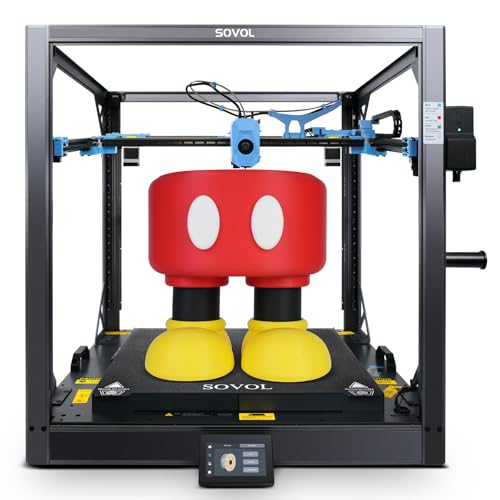
- 500 × 500 × 500mm build volume
- Up to 700mm/s with CoreXY motion
- 300°C hotend plus camera monitoring
Best For: Makers needing huge prints and fast throughput
Multi-Color Large Build

- 350 × 350 × 350mm build volume
- Included CFS supports up to 16 colors
- 600mm/s speed with dual AI cameras
Best For: Creators wanting large prints with automatic multi-color capability
Compact High-Speed Starter

- 500mm/s print speed
- Enclosed body with auto bed leveling
- Up to 16 colors with AMS
Best For: Users wanting a compact, fast enclosed FDM printer
Ultra-Large Build & Print-Farm Speed
Creality Ender 5 Max 3D Printer

- 400×400×400 mm build volume for oversized prints
- Up to 700 mm/s with CoreXY motion system
- WLAN multi-printer control for farm workflows
Best For: Oversized prototypes and production-focused print farms
Fast Multi-Color CoreXY
FLASHFORGE AD5X 4-Color Printer

- 4-color printing with Intelligent Filament System
- Up to 600 mm/s with CoreXY structure
- Compact, space-saving design
Best For: Multicolor prototypes and compact high-speed printing
High-Temp Large-Volume Workhorse
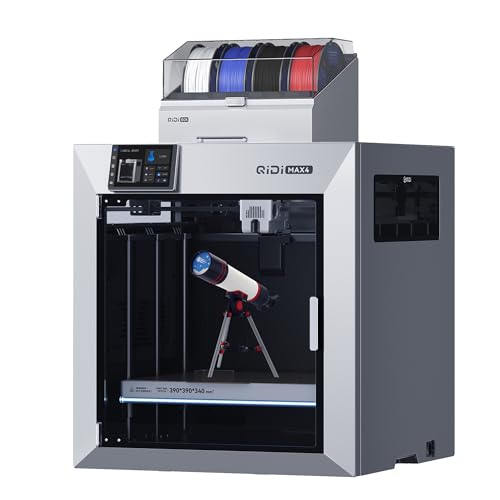
- 390×390×340 mm build volume for large parts
- 65℃ heated chamber for tougher materials
- AI camera monitoring for print protection
Best For: Industrial prototypes and high-temperature material printing
Compact Speed-First Multicolor Pick
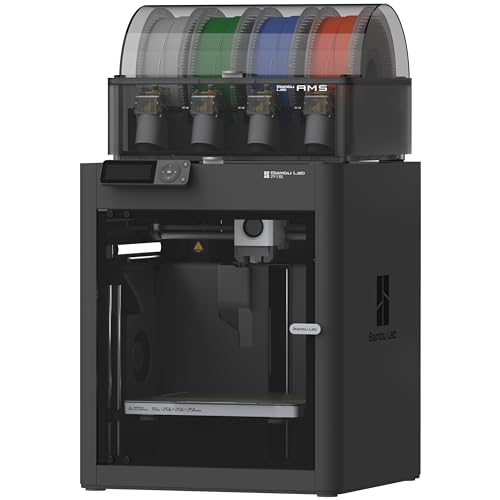
- Up to 16 colors with AMS support
- 500mm/s printing and fast acceleration
- Enclosed body with auto bed leveling
Best For: Users who want a fast enclosed printer with multicolor support
Balanced Large-Volume Multicolor Pick

- 260 × 260 × 260 mm build volume
- Up to 16 colors with 4 × CFS support
- 600mm/s speed with AI camera and auto leveling
Best For: Users who want a roomy, automated multicolor printer
Flagship Large-Format Multicolor Pick

- 350 × 350 × 350 mm build volume
- Up to 16 colors with new CFS system
- 600mm/s speed with dual AI cameras
Best For: Users who need the largest build volume and advanced automation
Large-Format Speed King – Sovol SV08 Max CoreXY 3D Printer
If you want one of the more ambitious large format 3d printers for oversized parts, the Sovol SV08 Max is built for exactly that job. Its 500 × 500 × 500mm build area, CoreXY motion system, and 700mm/s top speed aim to cut wait times without giving up the workspace needed for full-scale prototypes, industrial parts, and big props.
Best For: Makers who need a huge build volume and high-speed performance for large functional prints or oversized projects.
Pros:
- Very large 500 × 500 × 500mm print volume for big, one-piece builds.
- Up to 700mm/s speed with 40,000 mm/s² acceleration for faster turnaround.
- CoreXY design helps reduce vibration and supports smoother high-speed printing.
- Includes eddy current bed scanning, HD camera monitoring, and support for high-temp materials up to 300°C.
Cons:
- The large footprint will take significant desk or floor space.
- Heated chamber support is reserved for a future module sold separately.
- Only standard 0.4mm nozzles are included; other sizes are optional extras.
Overall, the SV08 Max is a strong pick if build size is the priority and you still want fast motion, automation, and material flexibility. It suits users who need a serious large-format machine rather than a compact all-rounder.
Multi-Color Large Build – Creality K2 Plus Combo
The Creality K2 Plus Combo is one of the more versatile large format 3d printers for users who want size and color in the same machine. With a 350 × 350 × 350mm build area, 600mm/s print speed, and the included CFS for multi-color printing, it targets creators who need big prints with more visual impact.
Best For: Users who want a roomy build volume and built-in multi-color capability for detailed presentation pieces or multi-part jobs.
Pros:
- 350 × 350 × 350mm build space handles large models or multiple parts.
- Included CFS supports automatic switching across four filament slots and up to 16-color blending.
- High-speed printing reaches 600mm/s with 30,000mm/s² acceleration.
- Dual AI cameras and 18 sensors add monitoring and fault detection.
Cons:
- Filaments are not included with the combo.
- The 103.4-pound weight makes it a substantial machine to place and move.
- Multi-color printing adds system complexity compared with a basic single-filament setup.
In practice, this combo is best when you want a large build area plus the convenience of automatic multi-color printing. It is a strong fit for users who value automation and presentation-ready output as much as print size.
Large Resin Detail Leader – ELEGOO Jupiter 2 Resin 3D Printer
For buyers looking at large format 3d printers in resin form, the ELEGOO Jupiter 2 focuses on size, detail, and process control. Its 302.4 × 161.98 × 300mm build volume, 16K resolution, and smart resin handling features make it suited to large display pieces and batches of smaller high-detail prints.
Best For: Resin users who want a very large build volume with high-resolution detail and automated workflow features.
Pros:
- Large 302.4 × 161.98 × 300mm build volume supports big models or multiple parts.
- 16K resolution with 20 × 26 μm XY resolution for fine detail.
- Auto leveling, tank heating, and auto resin feeding simplify setup and printing.
- Built-in camera, Wi-Fi cluster management, and safety sensors add convenience and oversight.
Cons:
- It is a resin printer, so it is not the right choice for FDM materials or workflows.
- The machine is large and will need adequate space for resin handling and maintenance.
- Advanced features may be more than casual users need for simple prints.
The Jupiter 2 stands out when large resin capacity and surface detail both matter. It is a practical pick for users who want a spacious MSLA printer with a lot of automation built in.
Compact High-Speed Starter – Bambu Lab P1S 3D Printer
The Bambu Lab P1S is not a large-format machine, but it is a fast and easy FDM option for buyers who want speed and enclosure benefits in a smaller package. With 500mm/s printing, automatic bed leveling, and support for multi-color printing through AMS, it makes sense for users who care more about reliable output than maximum build size.
Best For: Users who want a compact enclosed printer with fast operation and straightforward setup.
Pros:
- 500mm/s speed and 20,000mm/s² acceleration for quick printing.
- Fully enclosed design helps with advanced filament performance.
- Automatic bed leveling supports easier setup and consistent results.
- Can support up to 16 colors when paired with Bambu Lab AMS.
Cons:
- Build volume is much smaller than true large format 3d printers.
- Multi-color printing requires connecting Bambu Lab AMS.
- Carbon/glass fiber reinforced polymers are not recommended.
The P1S is a good practical choice if you want speed and convenience in a compact printer, but it is not aimed at oversized parts. Buyers who need maximum build volume should look elsewhere.
Ultra-Large Build & Print-Farm Speed – Creality Ender 5 Max 3D Printer
If you’re comparing large format 3d printers for oversized parts or high-throughput jobs, the Creality Ender 5 Max stands out for its 400×400×400 mm build volume and up to 700 mm/s printing speed. It is aimed at users who want to produce bigger models without splitting them, while also keeping pace with print-farm workflows.
Best For: Oversized prototypes, batch production, and multi-printer setups that need fast, organized output.
Pros:
- Extra-large 400×400×400 mm build volume supports bigger models and batch printing.
- CoreXY system and high-torque motors are built for up to 700 mm/s speed.
- WLAN multi-printer control and grouped management suit print farms.
- 64-point auto leveling and auto Z-offset simplify first-layer setup.
Cons:
- Its size and 68.9 lb weight make it less portable than smaller desktop printers.
- Designed for production-focused use, so it may be more machine than casual hobbyists need.
The Ender 5 Max is a strong pick if you want a large-format machine that balances build size, speed, and workflow tools. Its emphasis on stability, automation, and farm control makes it especially practical for demanding production environments.
Fast Multi-Color CoreXY – FLASHFORGE AD5X 4-Color Printer
For buyers focused on large format 3d printers? this model is actually better described as a speed-first multi-material machine rather than a large-volume one. The FLASHFORGE AD5X centers on 4-color printing, CoreXY rigidity, and fast output up to 600 mm/s, making it a smart choice when color variety and efficient printing matter more than sheer build size.
Best For: Multicolor prototypes, mixed-material projects, and compact setups that need fast, reliable output.
Pros:
- 4-color printing with Intelligent Filament System for multi-material jobs.
- Up to 600 mm/s speed and 20,000 mm/s² acceleration.
- Full auto leveling helps keep first layers consistent.
- Compact, space-saving design with side-by-side filament placement.
Cons:
- It does not offer a large build volume like true large-format printers.
- Best suited to color and material workflows rather than oversized parts.
The AD5X is a strong productivity booster if your priority is fast multicolor printing in a compact footprint. It is less about scale and more about delivering efficient, consistent output with fewer setup headaches.
High-Temp Large-Volume Workhorse – QIDI Max4 Combo 3D Printer
If you need large format 3d printers for industrial-style parts, the QIDI Max4 Combo is built around a 390×390×340 mm build area, fast motion control, and a heated chamber for demanding materials. It is designed for users who want a roomy printer that can handle both large parts and tougher filament types in one machine.
Best For: Large technical parts, industrial prototypes, and high-temperature materials.
Pros:
- 390×390×340 mm build volume supports large parts and complex molds.
- 65℃ active heated chamber helps with high-temperature materials.
- Up to 800 mm/s speed with closed-loop X/Y motors and strong Z-axis hardware.
- AI camera monitoring can detect print failures and pause automatically.
Cons:
- Heavy at 120 pounds, so it is not easy to move around.
- Some multi-color functionality depends on the separately sold QIDI BOX.
The Max4 Combo is the most industrial-leaning option here, especially if material performance matters as much as size. Its heated chamber and abrasive-material support make it a practical choice for advanced users and professional workflows.
Compact Speed-First Multicolor Pick – Bambu Lab P1S Combo
If you want a fast, user-friendly option among large format 3d printers, the Bambu Lab P1S Combo is built around speed, enclosure, and multicolor capability rather than maximum build size. It prints up to 500mm/s with 20000 mm/s² acceleration, includes automatic bed leveling, and ships with AMS support for up to 16 colors when connected.
Best For: Makers who want a compact, enclosed, high-speed printer with multicolor printing for creative projects.
Pros:
- Up to 16-color/multi-material printing with AMS support
- 500mm/s speed and 20000 mm/s² acceleration for fast turnaround
- Fully enclosed design helps with advanced filament printing
- Automatic bed leveling and 15-minute setup simplify day one use
Cons:
- Build size is not the largest in this roundup
- AMS is required for multicolor printing
- Carbon/glass fiber reinforced polymers are not recommended
As a practical buy, this model makes sense if you value speed, enclosure, and easy setup more than sheer volume. It is a strong all-around choice for users who want consistent results and multicolor output in a relatively compact footprint.
Balanced Large-Volume Multicolor Pick – Creality K2 Combo
For buyers comparing large format 3d printers, the Creality K2 Combo aims for a balanced mix of build volume, multicolor output, and convenience. It offers a 260 × 260 × 260 mm build area, 600mm/s printing speed, 4 × CFS support for up to 16 colors, and smart auto leveling with an AI camera for monitoring.
Best For: Users who want a roomy, plug-and-play printer with multicolor capability and automated print oversight.
Pros:
- Up to 16 colors with support for 4 × CFS
- 260 × 260 × 260 mm build volume covers many common projects
- 600mm/s speed and quiet mode for faster, calmer printing
- Smart auto leveling and AI camera add convenience and monitoring
Cons:
- Build volume is smaller than the largest machines here
- K2 Combo includes one CFS unit, not four
- Multicolor use depends on adding the required CFS hardware
This is a sensible pick if you want a large-enough work area without stepping up to a much bigger footprint. It blends speed, automation, and multicolor support in a package that should fit a wide range of everyday printing needs.
Flagship Large-Format Multicolor Pick – Creality K2 Plus Combo
If your shortlist of large format 3d printers includes bigger builds and more advanced automation, the Creality K2 Plus Combo is the most expansive option here. It offers a 350 × 350 × 350 mm build volume, 600mm/s printing, 30000 mm/s² acceleration, dual AI cameras, and support for up to 16 colors with the new CFS system.
Best For: Users who need a truly large build volume with high-speed printing and advanced automation.
Pros:
- Large 350 × 350 × 350 mm build volume for bigger models or batch runs
- Up to 16-color printing with automatic filament selection and relay
- 600mm/s speed with 30000 mm/s² acceleration for large-format output
- Dual AI cameras and 18 sensors support monitoring and automation
Cons:
- Likely the biggest footprint in this group
- Advanced feature set may be more than casual users need
- Best results rely on its more complex automation ecosystem
This model stands out when build size is the top priority and you still want strong speed and automation. It is the most capable fit for larger parts, batch printing, and users who want a flagship-style machine with broad material support.
How We Picked These Large Format 3d Printers
We prioritized build size first, then looked at print speed, motion stability, leveling automation, chamber control, and multi-material capability where it adds real value. We also weighed setup complexity, ecosystem support, and whether the machine is better suited to hobby use, design work, or higher-output printing.
Because Large Format 3d Printers vary widely in tech and intent, we included both FDM and resin models to cover users who need big functional parts as well as those chasing large, highly detailed models.
Quick Comparison
If you want the simplest path to big functional prints, a ready-to-use enclosed FDM machine with auto-leveling is the safest bet. If you need color or material changes, look for an AMS or CFS-style system. If your priority is surface detail and miniature-to-mid-size resin output, a large MSLA printer makes more sense than a filament machine.
Key Buying Factors for Large Format 3d Printers
Build Volume Vs. Usable Volume
Published build dimensions matter, but so does how much of that space is realistically printable with your chosen material. Beds that stay flat, chambers that hold temperature, and rigid frames all help preserve quality at larger sizes.
Speed and Stability
Higher headline speeds are useful only when the motion system, extrusion path, and cooling can keep up. For large parts, consistent layer quality is usually more important than chasing the fastest number on the box.
Enclosure and Temperature Control
An enclosed or heated chamber is especially important for ABS, ASA, nylon, and other engineering materials. Better thermal control reduces warping and improves layer adhesion on tall or wide prints.
Automation and Workflow
Auto-leveling, camera monitoring, smart filament handling, and auto-calibration can save a lot of time on big builds, where failed first layers or mid-print issues are expensive. If you print often, convenience features are worth paying for.
Material and Multi-Color Support
Multi-material systems are ideal for prototypes, presentation parts, and color-coded models, but they add cost and complexity. If you mainly print structural parts, a simpler single-material setup may be the better long-term choice.
Who Should Buy Which Large Format 3d Printers?
Choose a fast enclosed FDM printer if you want dependable large-format output for parts, prototypes, and functional models. Pick a multi-color system if presentation quality, branding, or multi-part consolidation matters more than simplicity. Go with a large resin machine if you need exceptional detail and smoother surfaces at a bigger scale. For most buyers, the best choice is the model that matches your material needs and typical print size, not just the largest advertised build volume.