If you’re serious about gaming or streaming in 2026, you’ll want to guarantee you have the best tools at your disposal. High-quality capture cards can make all the difference in achieving ultra-smooth gameplay and stunning visuals. From the Elgato 4K S to the Razer Ripsaw HD, there are several options worth considering. Let’s explore which capture cards stand out and why they’re essential for your setup.
Elgato 4K S External Capture Card for PS5, Xbox, Switch, PC, Mac

If you’re a gamer looking to capture stunning gameplay in 4K at 120Hz, the Elgato 4K S External Capture Card is an excellent choice. Compatible with PS5, Xbox Series X/S, Switch, PC, and Mac, it allows you to record in resolutions like 4K60 and 1080p240. With near-zero latency and VRR passthrough, your gameplay remains ultra-smooth. The card supports HDR10 on Windows, enhancing your visuals even further. Plus, it comes with all necessary cables and has a compact design, making it easy to set up. Enjoy high-quality streaming without compromising performance, making your gaming moments truly enthralling.
Best For: Gamers who want to capture and stream high-quality gameplay in 4K with minimal latency.
Pros:
- High-Resolution Capture: Supports capture resolutions up to 4K60, ensuring stunning video quality.
- Low Latency: Near-zero latency and VRR passthrough provide a seamless gaming experience.
- Versatile Compatibility: Works with multiple platforms including PS5, Xbox Series X/S, Switch, PC, and Mac.
Cons:
- Limited HDR Support: HDR10 capture is only available on Windows systems.
- System Requirements: Requires relatively powerful hardware, which may not be suitable for all users.
- Weight: Some users may find it slightly heavier compared to other portable capture cards.
Elgato 4K Pro Internal Capture Card for Streaming & Recording

The Elgato 4K Pro Internal Capture Card is ideal for streamers and gamers who demand high performance and low latency. With HDMI 8K60 passthrough and 4K60 HDR10 capture, it guarantees stunning visuals on platforms like YouTube and Twitch. You’ll enjoy ultra-low latency while gaming on PS5 Pro, Xbox Series S, or Nintendo Switch 2. This card supports single and dual PC setups and integrates seamlessly with popular streaming software like OBS and Streamlabs. Plus, you can record high frame rates up to 240fps in 1080p, making it a top choice for anyone looking to elevate their streaming experience.
Best For: Streamers and gamers seeking high-performance, low-latency capture solutions for immersive gameplay and stunning visuals.
Pros:
- High-resolution capture: Supports 4K60 HDR10 capture and 8K60 passthrough for unparalleled video quality.
- Ultra-low latency: Ensures synchronized broadcast and gameplay, enhancing the streaming experience.
- Versatile compatibility: Works seamlessly with multiple platforms and popular streaming software, accommodating both single and dual PC setups.
Cons:
- System requirements: Requires a relatively powerful PC setup, which may exclude some casual users.
- Limited input options: Only supports unencrypted HDMI input, potentially restricting certain devices.
- Weight and size: Being a physical card, installation may be cumbersome for users unfamiliar with PC hardware.
Elgato HD60 X Game Capture Card
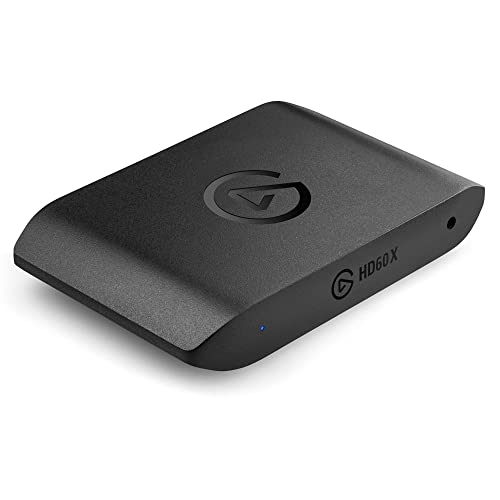
For gamers seeking to elevate their streaming experience, the Elgato HD60 X Game Capture Card stands out with its ability to capture and stream gameplay in stunning 4K30 HDR10 quality. It’s compatible with a variety of consoles and devices, including PS5, Xbox Series X, and Nintendo Switch 2. With options for 1080p60 HDR10 and 1440p120, you get exceptional video quality. Its ultra-low latency passthrough guarantees seamless audio/video syncing. Plus, it works with popular platforms like Twitch and YouTube without any watermarks or subscriptions. With a two-year warranty, you can stream confidently, knowing you’ve got reliable support.
Best For: Gamers and streamers looking for high-quality gameplay capture and streaming capabilities across multiple platforms.
Pros:
- Exceptional video quality with support for up to 4K30 HDR10 and various resolutions.
- Ultra-low latency passthrough ensures seamless audio and video syncing during live streams.
- No watermarks or subscription fees, allowing for a clean streaming experience on popular platforms.
Cons:
- Requires specific hardware and software specifications, which may limit compatibility for some users.
- Limited to HDMI input, which may not suit all gaming setups or preferences.
- Weight and size may be a consideration for portability, as it’s not the most compact option available.
Acer USB 3.0 Video Capture Card for Streaming

Streamers and content creators seeking high-quality video capture without the hassle will find the Acer USB 3.0 Video Capture Card an ideal choice. This HDMI capture card supports 4K input and outputs at 1080P@60Hz, ensuring vibrant visuals thanks to its YUY2 color technology. It’s compatible with PS5, Xbox, and even DSLR cameras, making it versatile for any setup. The plug-and-play functionality eliminates complicated installations, while the mic-in feature allows for real-time commentary. Lightweight and portable, it’s perfect for outdoor streams. With a solid 4.3-star rating, it’s a reliable option for anyone serious about streaming.
Best For: Streamers and content creators looking for a versatile and high-quality video capture solution.
Pros:
- High-quality video output with minimal latency, perfect for gaming and content creation.
- Plug-and-play functionality for easy setup without the need for additional drivers.
- Lightweight and portable design, making it ideal for outdoor streaming or on-the-go recordings.
Cons:
- Limited to 1080P output, which may not meet the needs of those seeking 4K streaming capabilities.
- Potential compatibility issues with certain older devices or software.
- Reliance on USB 3.0 ports, which may not be available on all laptops or older PCs.
Elgato Cam Link 4K – External Capture Card for DSLR & Camcorder

Looking to elevate your streaming or video conferencing game? The Elgato Cam Link 4K is your go-to external capture card. It transforms your DSLR, mirrorless cameras, and even iPhones into stunning webcams. With support for 4K up to 60 fps and 1080p at 60 fps, your video quality will impress. This compact card is compatible with PC, Mac, and iPad, plus it works seamlessly with OBS, Zoom, and Discord. Enjoy ultra-low latency for perfectly synced audio and video. Plug it in, and you’re set—no extra software needed. With a 4.6-star rating from thousands, it’s a top choice for creators.
Best For: Streamers, content creators, and professionals looking to enhance their video quality using high-end cameras.
Pros:
- High-Quality Streaming: Supports resolutions up to 4K at 60 fps for stunning video clarity.
- Easy Setup: Plug and play functionality means no additional software is required for operation.
- Ultra-Low Latency: Ensures video and audio are perfectly synced for a professional streaming experience.
Cons:
- Limited to Compatible Cameras: Requires a compatible DSLR or camcorder for optimal performance.
- No Built-in Recording: Functions solely as a capture card, without on-device recording capabilities.
- Short Cable Length: The 30 cm cable may limit placement flexibility for some setups.
ASUS TUF Gaming Video Capture Card (CU4K30)

Gamers seeking high-quality livestream visuals will find the ASUS TUF Gaming Video Capture Card (CU4K30) an excellent choice. It supports 4K HDR passthrough at 60 Hz and captures video up to 4K at 30 Hz, perfect for your PS5, Xbox, or Nintendo Switch. With near-zero latency and certified for OBS Studio, you’ll enjoy seamless streaming at 30 fps in 4K, 60 fps in 2K, and 120 fps in Full HD. Its durable alloy design guarantees longevity, and the Plug & Play UVC connection makes setup a breeze. Plus, it comes with a 1-year warranty for peace of mind.
Best For: Gamers looking for high-quality livestreaming capabilities with support for 4K resolution and low latency performance.
Pros:
- Supports 4K HDR passthrough at 60 Hz and captures video at 30 Hz for stunning visual quality.
- Near-zero latency ensures real-time streaming, ideal for competitive gaming.
- Durable alloy construction for enhanced longevity and a compact design for easy setup.
Cons:
- Limited to capturing 4K at 30 fps, which may not meet the needs of those seeking higher frame rates in 4K.
- Requires a USB 3.2 Type-C port, which may not be available on older devices.
- The 1-year warranty may be shorter compared to some competing products.
AVerMedia 4K60 Capture Card (GC553G2)

The AVerMedia 4K60 Capture Card (GC553G2) stands out as an excellent choice for console enthusiasts seeking high-quality game capture and streaming. With support for PS5, Xbox, and Switch, it captures stunning 4K at 60fps. You’ll appreciate its low latency, ensuring minimal delay during gameplay, and the 4K144 HDR/VRR pass-through keeps your visuals smooth and sharp. Plus, with live party chat support, you can easily manage game and chat audio. The customizable RGB lighting adds a personal touch, and it’s compatible with major streaming platforms like Twitch and YouTube. Overall, it’s a powerful tool for gamers and streamers alike.
Best For: Gamers and streamers seeking high-quality 4K game capture with low latency for a seamless streaming experience.
Pros:
- 4K144 HDR/VRR pass-through ensures smooth visuals during gameplay.
- Live party chat support allows for easy management of game and chat audio.
- Customizable RGB lighting adds a personal touch to your streaming setup.
Cons:
- Limited to Windows operating systems (Windows 10 x64 / 11 x64 or later).
- Relatively lightweight may raise concerns about durability during transport.
- Requires HDMI interface, which may necessitate additional cables or adapters for some setups.
Portta DX20R HDMI Video Capture Card

If you’re seeking a reliable solution for high-quality streaming and recording, the Portta DX20R HDMI Video Capture Card stands out with its ability to handle impressive resolutions. You can stream and record in 4K@60Hz, 2K@144Hz, and 1080p@240Hz, ensuring ultra-smooth visuals. Its ultra-low latency and passthrough capabilities make it perfect for fast-paced gaming. The smart display keeps you informed on real-time parameters, while the PORTTA CapHub Utility allows you to customize settings effortlessly. Plus, with plug-and-play compatibility across major operating systems, there’s no hassle with driver installations. Enjoy a seamless experience with this highly-rated capture card.
Best For: Those looking for a high-performance video capture solution for gaming, streaming, and recording in stunning resolutions.
Pros:
- Supports multiple resolutions including 4K@60Hz and 1080p@240Hz for ultra-smooth visuals.
- Plug-and-play compatibility with Windows, macOS, and Linux, eliminating the need for driver installation.
- Equipped with advanced features like ultra-low latency and High Dynamic Range (HDR) technology.
Cons:
- Limited to USB 3.0 interface, which may not be compatible with older USB versions.
- Some users may find the PORTTA CapHub Utility software complex to navigate initially.
- Warranty period of 2 years may be shorter compared to other capture cards on the market.
Acer 4K HDMI to USB 3.0 Capture Card for Streaming

For anyone looking to elevate their streaming experience, the Acer 4K HDMI to USB 3.0 Capture Card stands out with its ability to deliver stunning 4K video at 30FPS. With support for 1080P at 60FPS, it’s perfect for gaming, live streaming, and video recording. The high-speed USB 3.0 interface guarantees smooth footage, eliminating motion blur and stuttering. Its plug-and-play design means you won’t need extra drivers, and the 2-in-1 USB-A & Type-C interface enhances compatibility. Plus, it’s lightweight and portable, making it easy to take anywhere. Enjoy gaming on your PS4, Switch, or any compatible device effortlessly!
Best For: Streamers and gamers looking for a high-quality capture card to enhance their streaming experience with 4K video support.
Pros:
- Supports up to 4K at 30FPS for high-resolution video capture.
- Plug-and-play design allows for easy setup without the need for additional drivers.
- Wide compatibility with various devices and popular streaming software.
Cons:
- One-way transmission only, limiting use to HDMI to USB.
- Maximum 4K input at 30FPS may not meet the needs of all users looking for higher frame rates.
- Restocking fees may apply for returns on misrepresented products.
Razer Ripsaw HD – Capture Card for Streaming

Offering seamless streaming capabilities, the Razer Ripsaw HD capture card is an excellent choice for gamers and content creators looking to elevate their broadcasts. With video capture at Full HD 1080p and 60 FPS, you’ll experience powerful performance. The 4K 60 FPS pass-through guarantees smooth gameplay, while full audio mixing capabilities simplify audio control. Connectivity is hassle-free with HDMI 2.0 and USB 3.0, providing zero latency output. Plus, the easy setup using a 3.5 mm audio cable makes it perfect for quick installations. Just remember, it’s compatible with Windows, but not with Mac systems.
Best For: Streamers and content creators looking for high-quality video capture with seamless audio management.
Pros:
- Full HD Video Capture: Delivers 1080p at 60 FPS for superior streaming quality.
- 4K Pass-Through: Allows for smooth gameplay while streaming without lag.
- Easy Setup: Quick installation with a 3.5 mm audio cable and no software required.
Cons:
- Windows Only: Not compatible with Mac operating systems.
- Limited Warranty Information: Specific warranty details must be requested, which may be inconvenient.
- Average Customer Rating: Rated 4.0 out of 5 stars, indicating mixed user experiences.
Factors to Consider When Choosing a 4K 120HZ Capture Card
When choosing a 4K 120Hz capture card, you’ll want to take into account several key factors. Think about compatibility with your devices, the capture resolution options available, and how latency might affect your performance. Don’t forget to check passthrough capabilities and software compatibility to guarantee everything runs smoothly.
Compatibility With Devices
Choosing the right 4K 120Hz capture card hinges on verifying compatibility with your devices. First, check that the capture card supports the specific gaming consoles you plan to use, like the PS5, Xbox Series X/S, or Nintendo Switch. Next, verify its compatibility with your operating system, as some cards require Windows, macOS, or specific iPadOS versions. It’s essential to confirm the input and output specifications, such as HDMI versions, to match your devices for peak performance. Additionally, verify the capture card can handle 4K at 120Hz for high-quality streaming. Finally, look for extra features like low-latency passthrough and audio management to enhance compatibility with various streaming software and applications.
Capture Resolution Options
While selecting a 4K 120Hz capture card, you should carefully consider the capture resolution options available. Capture cards typically offer various settings, like 4K at 60 frames per second (fps), 1440p at 120 fps, and 1080p at 240 fps. Higher resolutions, like 4K60, deliver sharper and more detailed video quality, which is perfect for professional streaming. Additionally, many capture cards allow passthrough resolutions, ensuring high-quality output to your monitor while capturing gameplay at different settings. Your choice of capture resolution directly impacts compatibility with consoles and PCs, influencing overall performance and streaming quality. It’s essential to evaluate both capture and passthrough resolutions for seamless integration with your setup and ideal viewing experiences.
Latency Performance Metrics
Latency performance metrics play an essential role in guaranteeing your audio and video stay in sync during streaming or recording sessions. Ultra-low latency, defined as under 100 milliseconds, is vital for competitive gaming and live interactions. When choosing a capture card, pay attention to how latency is measured—from the moment the video signal inputs until it appears on your display. High-quality capture cards can achieve as low as 20 milliseconds, dramatically reducing lag and enhancing your experience. Factors like connection type (USB 3.0 vs. USB 2.0), the resolution being captured, and your hardware’s processing capabilities all influence latency performance. Prioritizing these metrics guarantees a smoother gaming and streaming experience, keeping you in the action without delays.
Passthrough Capabilities
When it comes to selecting a 4K 120Hz capture card, passthrough capabilities are a key factor to take into account. You want a card that can transmit video signals from your source device to your display without any noticeable delay or degradation in quality. Look for 4K passthrough support to maintain high-resolution gameplay visuals while recording or streaming. High refresh rates like 120Hz are essential for competitive gaming, ensuring smooth visuals and responsive gameplay. Many modern cards also offer Variable Refresh Rate (VRR) passthrough technology, which synchronizes frame rates for an even smoother experience. Finally, check the HDMI version supported by the capture card; HDMI 2.1 is typically required for ideal 4K 120Hz passthrough performance.
Software Compatibility
Choosing a 4K 120Hz capture card requires careful consideration of software compatibility, as it greatly impacts your streaming experience. Make certain the card works with popular software like OBS, Streamlabs, and Twitch Studio, as well as video conferencing tools such as Zoom and Teams. It’s also essential to check support for multiple operating systems, including Windows and macOS, guaranteeing you can use it across different devices. Look for compatibility with the latest streaming technologies like HDR and VRR to enhance video quality. Additionally, verify the capture card meets the resolution and frame rate requirements of your preferred applications. Finally, confirm that it integrates smoothly with any additional hardware, like microphones or webcams, for a seamless setup.
Installation Process
Installing a 4K 120Hz capture card involves several key steps that guarantee you get the most out of your gaming or streaming setup. First, verify your PC or console meets the minimum system requirements, including a USB 3.0 port and compatible HDMI interfaces. Next, follow the manufacturer’s instructions to connect the capture card, typically by plugging the HDMI output from your console into the card and connecting it to your PC via USB. Install any necessary drivers or software for proper functionality. After that, configure the capture settings in your streaming software, adjusting for 4K at 120Hz. Finally, test the setup by capturing a short video to verify everything works smoothly and adjust any audio and video settings as needed.
Portability and Design
Portability and design play essential roles in selecting a 4K 120Hz capture card, especially for gamers and streamers on the move. You’ll want a lightweight and compact model, typically weighing between 20 to 110 grams, making it easy to carry in your bag or backpack. Look for a plug-and-play design that lets you set up quickly without dealing with complicated installations. Most portable capture cards measure around 3.18 x 0.47 x 1.22 inches to 2.7 x 7.3 x 6.3 inches, ensuring they fit seamlessly into your travel gear. Durable constructions, like alloy outer shells, help withstand the wear and tear of travel, while USB 3.0 Type-C connectivity offers compatibility with various devices for flexible streaming setups.
Warranty and Support
When you’re investing in a 4K 120Hz capture card, warranty and support can greatly impact your overall experience. Check the manufacturer’s warranty length, typically ranging from 1 to 2 years, as it protects you against defects. A solid return policy is also vital; many brands allow refunds within 30 days for items that arrive damaged or aren’t functioning. Be cautious, though—some companies impose restocking fees for returns due to misuse or misrepresentation. Reliable customer support is essential for resolving technical issues, and brands with dedicated channels can make a difference. Finally, reviewing customer feedback can help you gauge the reliability of warranty claims and the effectiveness of support services for the capture card you’re considering.