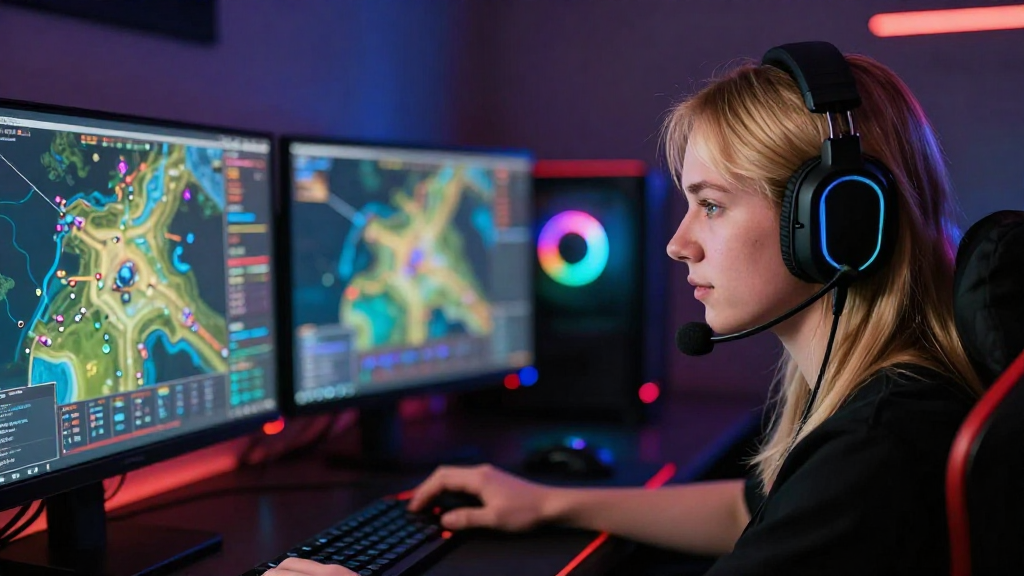
Understanding how gamers build mental models is essential for exploring the cognitive processes involved in gaming.
The ability to construct and apply mental models allows players to excel in their preferred games, strategize effectively, and make informed decisions.
What Are Mental Models?
Before delving into how gamers build mental models, it’s important to clarify what mental models are.
Mental models are internal representations of the external world.
They help individuals understand, predict, and interpret their surroundings.
In gaming, mental models are critical as they assist players in:
- Recognizing Patterns: Identifying recurring themes or strategies.
- Making Predictions: Anticipating an opponent’s next move or the outcome of a certain action.
- Solving Problems: Navigating complex challenges or obstacles within a game.
How Do Gamers Build Mental Models?
Now that we’ve established the foundation, let’s explore how gamers build mental models.
There are several stages and techniques that gamers use to create effective mental models.
1. Experience and Familiarity
Experience plays a vital role in shaping mental models.
The more time players invest in a game, the more they become familiar with its mechanics.
This process involves:
- Learning Game Mechanics: Understanding the rules, controls, and unique features.
- Exploring the Game World: Familiarizing oneself with maps, characters, and objectives.
As players gain experience, they begin to form connections that lead to stronger mental models.
2. Observational Learning
Another crucial aspect of how gamers build mental models is observational learning.
This can occur through:
- Watching Others Play: Viewing gameplay videos or streams can provide insights into strategies and tactics.
- Learning from Mistakes: Analyzing failures in both personal gameplay and that of others teaches valuable lessons.
By observing skilled players, gamers can adopt new strategies and incorporate them into their own mental frameworks.
3. Decomposing Mechanics
Gamers also build mental models by breaking down complex mechanics into simpler components.
This involves:
- Understanding Core Functions: Identifying vital elements that drive game mechanics and outcomes.
- Analyzing Interactions: Examining how different actions or strategies interact with one another.
This decomposition allows players to grasp complicated systems more effectively.
4. Utilizing Analogies
Gamers often use analogies from real life or from other games to construct mental models.
For instance:
- Translating Skills: A player may relate shooting mechanics to ‘aiming a bow’ to improve their shooting accuracy.
- Game Comparisons: Using familiar games to relate new experiences helps in quickly adapting to new environments.
Such analogies enrich a player’s repertoire and clarify their understanding.
5. Continuous Feedback and Adaptation
A continuously evolving approach is integral to how gamers build mental models.
Gamers rely on feedback loops:
- Immediate Feedback: Noticing the results of their actions in real-time encourages players to adjust strategies.
- Performance Reviews: Reflecting on past games allows players to refine their tactics and strengthen their mental models.
This ongoing refinement ensures that mental models remain relevant to in-game changes.
6. Collaboration and Social Interaction
Working with other players enhances mental models significantly.
Being part of a team enables gamers to:
- Share Strategies: Collaborating often results in sharing tips and tricks that can alter a player’s approach.
- Discuss Theories: Talking through gameplay strategies with peers can lead to new discoveries and insights.
Social interaction fosters a valuable environment for model building.
How Does Game Genre Influence Mental Model Building?
Different game genres influence how gamers build mental models due to their inherent mechanics and styles.
1. Strategy Games
In strategy games, players often build intricate mental models focused on:
- Resource Management: Keeping track of resources is vital to success.
- Long-term Planning: Anticipating opponent moves involves strategizing several steps ahead.
2. Action Games
In fast-paced action games, mental models are developed through:
- Quick Decision-Making: Players need to make split-second choices based on immediate feedback.
- Reflexes: Reaction time is critical; thus, building mental models may focus on spatial awareness and quick judgments.
3. Role-playing Games (RPGs)
RPGs allow for deep storytelling, where players build mental models based on:
- Character Development: Understanding how choices affect character progression.
- World Exploration: Gaining knowledge about the game world enhances immersion and strategy.
Can Gamers Improve Their Mental Models?
Absolutely! Gamers can take proactive steps to enhance their mental model-building process, including:
- Playing Diverse Games: Exploring different genres challenges cognitive flexibility.
- Setting Goals: Focused objectives lead to more systematic learning and model building.
- Engaging with Communities: Joining forums or discussion groups to share insights enhances understanding.
By adopting these strategies, gamers can cultivate more robust mental frameworks that benefit their gameplay.
Conclusion: Why Understanding Mental Models Matters
In summary, understanding how gamers build mental models sheds light on the remarkable cognitive processes that occur during gameplay.
Mental models are not just about winning games; they are essential for problem-solving, prediction, and strategy formulation.
As players invest time and effort into crafting their mental models, they uncover deeper levels of enjoyment and mastery within the gaming universe.
By incorporating techniques such as observational learning, decomposition of mechanics, and collaboration, gamers can continue to refine their understanding, ensuring they remain competitive and engaged.
Embracing the complexities of game mechanics and interactions leads to an enriched gaming experience, unlocking new possibilities and strategies in any gaming endeavor.