Choosing among fiber optic testers for computer repair can be difficult because compact meters, visual fault locators, network testers, and OTDRs serve very different troubleshooting needs. The best option depends on whether you need basic light-level checks, connector testing, cable tracing, or full link diagnostics.
These 10 picks cover portable all-in-one tools and more advanced testers, helping technicians match useful features, wavelength support, range, interfaces, and portability to the jobs they handle most often.
Best 10 Fiber Optic Testers for Computer Repair Picks for 2026
All-in-One Field Meter
Portable OPM-VFL-1 Fiber Tester

- OPM, VFL, and RJ45 testing in one unit
- Eight wavelengths; -70 to +6 dBm range
- FC/SC/ST interface with calibration support
Best For: Portable general-purpose fiber and RJ45 troubleshooting
Fault-Finding Kit

- Locates breaks, bends, cracks, and bad connections
- Supports ST, SC, FC, and LC setups with adapters
- Includes five adapters and three patch cords
Best For: Field fault location and patch-panel troubleshooting
Network Diagnostic Tester
NOYAFA NF-8518 Fiber and LAN Tester

- Combines OPM, VFL, PoE, continuity, and cable tests
- Measures six wavelengths from 850 to 1625 nm
- Tests network cable lengths up to 200 meters
Best For: Mixed fiber, Ethernet, and PoE troubleshooting
High-Range Pocket Meter

- Covers ten standard wavelengths
- Adds 10 mW VFL, RJ45 test, and LED light
- Stores up to 500 readings; includes FC-LC adapter
Best For: Portable, record-friendly fiber diagnostics
Best All-in-One Pick
Rechargeable 4-in-1 Fiber Tester
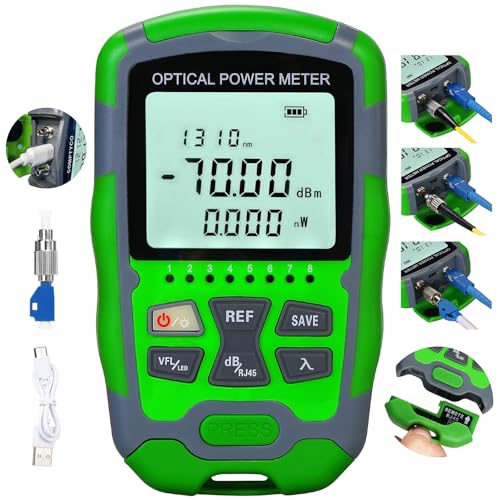
- Combines OPM, VFL, RJ45 testing, and flashlight
- Supports 10 wavelengths from 850–1650nm
- Stores up to 500 readings
Best For: Portable fiber and Ethernet troubleshooting
Best Advanced Diagnostic Unit

- Adds OTDR event mapping at 1310/1550nm
- Tests fiber, RJ45 cabling, IP cameras, and PoE
- Includes OPM, VFL, loss testing, and network tools
Best For: Professional fiber and network infrastructure diagnostics
Best Compact Field Option
4-in-1 Fiber Optic Cable Tester

- Combines optical power, VFL, RJ45, and flashlight tools
- Supports 10 wavelengths and -70 to +10dBm
- Stores 500 records with dual mW/dBm display
Best For: Portable routine fiber and cable troubleshooting
Best Basic Fault Locator

- Visible glow helps locate fiber breaks and bends
- Supports LC, FC, SC, and ST interfaces
- Rugged aluminum and stainless-steel construction
Best For: Basic fiber tracing, continuity checks, and fault finding
Best Compact Power Meter
Mini 4-in-1 Optical Power Meter

- Combines power meter, VFL, and network testing
- Measures -70 dBm to +6 dBm
- Compact 200 g battery-powered design
Best For: Portable fiber and network diagnostics
Best Multifunction Tester
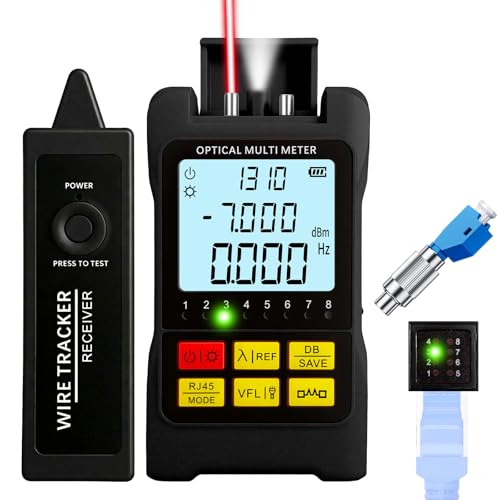
- Combines fiber, RJ45, cable-finder, and flashlight functions
- Supports 10 wavelengths and -70 to +10 dBm
- Stores up to 500 readings for field documentation
Best For: Mixed fiber and Ethernet troubleshooting
All-in-One Field Meter – Portable OPM-VFL-1 Fiber Tester
For technicians comparing fiber optic testers for computer repair, this portable meter combines optical power measurement, a visual fault locator, and RJ45 testing in one compact tool. It supports eight wavelengths, a broad -70 dBm to +6 dBm test range, and FC/SC/ST interfaces for routine troubleshooting.
Best For: Computer repair technicians who need one lightweight tester for fiber signal checks, visible fault tracing, and RJ45 testing.
Pros:
- Combines OPM, VFL, and RJ45 functions.
- Measures eight standard wavelengths from 850 nm to 1650 nm.
- Supports FC/SC/ST interfaces, backlight selection, wavelength memory, and user calibration.
- Displays linear mW and dBm readings simultaneously.
Cons:
- Two AA batteries are required but not included.
- Optical power range tops out at +6 dBm.
This is a practical general-purpose choice when portability and multiple basic testing functions matter more than specialized network diagnostics.
Fault-Finding Kit – Fiber Optic Troubleshoot Kit
Among fiber optic testers for computer repair, this kit focuses on locating physical fiber problems rather than measuring optical power. Its visual fault locator can identify breaks, poor connections, bends, and cracks, while the included adapters and patch cords help test cables at distribution panels.
Best For: Repair work centered on locating fiber breaks and connection faults across ST, SC, FC, and LC setups.
Pros:
- Detects and locates breaks, bends, cracks, and poor connections.
- Works with ST, SC, and FC interfaces; LC testing is supported through the included adapter.
- Includes five adapters and three short patch cords.
- Compact and lightweight for field testing.
Cons:
- Two AA batteries are not included.
- It is a visual fault locator kit rather than an optical power meter.
The included accessories make this a useful choice for hands-on fault isolation, especially when access to patch panels makes direct cable removal inconvenient.
Network Diagnostic Tester – NOYAFA NF-8518 Fiber and LAN Tester
The NOYAFA NF-8518 is suited to technicians who want fiber optic testers for computer repair alongside broader Ethernet diagnostics. It combines an optical power meter and visual fault locator with cable continuity, scanning, length, port flashing, and PoE testing functions.
Best For: IT professionals and network engineers handling both fiber troubleshooting and copper-network maintenance.
Pros:
- Offers nine core network-testing functions, including cable length and PoE tests.
- Optical power measurements cover 850, 1300, 1310, 1490, 1550, and 1625 nm.
- Power detection range extends from -70 dBm to +10 dBm.
- VFL helps locate breaks, bends, cracks, and poor connections.
Cons:
- FC/SC/ST connectors require separate purchase.
- The supplied notes do not specify the included battery configuration.
This is the most versatile option in the group for mixed network work, but budget separately for the fiber connectors needed for optical testing.
High-Range Pocket Meter – M70-10 OPM & VFL Tester
For portable fiber optic testers for computer repair, the M70-10 offers optical power measurement, a 10 mW visual fault locator, RJ45 sequence testing, and LED lighting in a pocket-friendly format. It covers ten standard wavelengths and stores up to 500 measurement records.
Best For: Mobile repair technicians who value broad wavelength coverage, data storage, and a compact multi-function tester.
Pros:
- Measures ten wavelengths from 850 nm through 1650 nm.
- Provides OPM, 10 mW VFL, RJ45 testing, and LED lighting.
- Offers less than ±0.2 dB measurement error according to the supplied notes.
- Stores up to 500 readings and includes an FC-LC adapter.
Cons:
- Uses two AAA batteries, which are not included.
- The included adapter is specified as FC-LC; broader connector compatibility is not stated.
Its expanded wavelength support and record storage make it particularly appealing for technicians who need repeatable field measurements in a small package.
Best All-in-One Pick – Rechargeable 4-in-1 Fiber Tester
For technicians comparing fiber optic testers for computer repair, this rechargeable handheld combines optical power testing, visual fault locating, RJ45 cable checks, and a flashlight in one portable tool. Its broad wavelength support, USB-C charging, and onboard storage make it practical for everyday field diagnostics.
Best For: Computer repair technicians and network installers who need fiber and Ethernet testing in a compact, rechargeable device.
Pros:
- Combines an optical power meter, VFL, RJ45 tester, and LED flashlight.
- Supports 850–1650nm wavelengths and -70 to +10dBm measurements.
- Stores up to 500 readings and includes REF testing and manual calibration.
- Works with FC, SC, ST, and LC interfaces using the included adapter.
Cons:
- Its feature set is focused on handheld checks rather than full OTDR trace analysis.
- The RJ45 tester is designed for continuity and wiring checks, not advanced network analysis.
This is a strong general-purpose choice when portability and convenience matter more than advanced fiber characterization. The rechargeable battery and data storage add useful value for repeated service calls.
Best Advanced Diagnostic Unit – WANLUTECH MT-5500 OTDR Tester
Among fiber optic testers for computer repair, the WANLUTECH MT-5500 is the most comprehensive option for technicians who need link-level diagnostics alongside network testing. It adds OTDR event mapping, optical power and loss testing, IP-camera support, cable TDR functions, and network tools to a touchscreen handheld platform.
Best For: Professional installers and repair teams handling singlemode fiber links, IP cameras, PoE equipment, and structured cabling.
Pros:
- Provides 1310/1550nm OTDR testing with 28/26dB dynamic range and event mapping.
- Includes OPM, VFL, light source, and optical loss testing functions.
- Tests up to 4K 12MP IP cameras and provides RJ45 TDR and cable tracing.
- Offers PoE output up to 30W, Wi-Fi analysis, and multiple network diagnostics.
Cons:
- Its larger feature set and 5.4-inch touchscreen may be more than needed for basic repairs.
- The listed 1310/1550nm model does not support testing live fiber.
- It requires a 12V DC power input rather than being described as USB-C rechargeable.
This model is best suited to advanced field work where fiber, copper, IP cameras, and network infrastructure overlap. Buyers should specifically account for the live-fiber limitation before choosing it for service workflows.
Best Compact Field Option – 4-in-1 Fiber Optic Cable Tester
This 4-in-1 model is a practical choice for computer repair technicians who want essential fiber and copper checks without carrying several separate instruments. It combines an optical power meter, 15km visual fault locator, RJ45 tester, and LED flashlight in a lightweight body.
Best For: Portable troubleshooting of fiber attenuation, visible fiber faults, and Ethernet cable wiring in server rooms, offices, and field locations.
Pros:
- Combines optical power, VFL, RJ45, and flashlight functions.
- Supports 10 wavelengths and a -70 to +10dBm measurement range.
- Stores up to 500 records and displays readings in both mW and dBm.
- Includes SC/FC/ST compatibility and an FC-to-LC adapter.
Cons:
- It is a multifunction handheld tester rather than an OTDR with event-curve analysis.
- The supplied details do not specify USB-C charging or a rechargeable battery.
Choose this unit when a compact toolkit with broad connector and wavelength coverage is more important than advanced trace testing. Its memory, adjustable backlight, and rugged portable design support routine service work.
Best Basic Fault Locator – Moocci Visual Fault Locator
For straightforward fiber optic testers for computer repair, the Moocci Visual Fault Locator focuses on tracing fibers, checking continuity, and locating breaks. Its bright fault glow can help identify breakpoints, poor connections, bends, and cracks during practical repair work.
Best For: Technicians who need a simple visual fault locator for LC, FC, SC, and ST fiber identification and continuity checks.
Pros:
- Helps reveal breaks, bends, cracks, and poor connections with a visible glow.
- Supports ST, SC, FC, and LC interfaces through its universal connector design.
- Uses two AA batteries and includes low-battery warning and constant output power.
- Stainless-steel head and aluminum body provide a crash- and dust-resistant design.
Cons:
- Primarily provides visual fault location rather than detailed optical power measurements.
- Its listed functions may be more limited than those of multi-function testers.
This is a practical choice when your repair workflow centers on finding fiber faults quickly. Choose a different model if you also need extensive power measurement or network-cable testing.
Best Compact Power Meter – Mini 4-in-1 Optical Power Meter
This compact option broadens the role of fiber optic testers for computer repair by combining optical power measurement with a visual fault locator and network cable testing. Its small 200 g design is suited to technicians who want several basic diagnostic functions in a portable tool.
Best For: Computer and network repair work requiring optical power readings, visual fault location, and cable testing in a compact package.
Pros:
- Measures optical power from -70 dBm to +6 dBm.
- Supports calibration wavelengths from 850 nm through 1650 nm, including common fiber wavelengths.
- Combines an optical power meter, 650 nm visual fault locator, and network cable test functions.
- Works with SC, FC, and ST connectors, with an SC-to-LC adapter required for LC use.
Cons:
- LC testing requires the specified SC male-to-LC female connector arrangement.
- The listed power range is narrower than some higher-range multifunction testers.
With both dBm and milliwatt measurement options, this tester is more versatile than a basic visual locator while remaining easy to carry. It is a sensible fit for routine diagnostic work where portability matters.
Best Multifunction Tester – Portable 5-in-1 Fiber Tester
For broader fiber optic testers for computer repair, this 5-in-1 model combines optical power measurement, visual fault locating, cable finding, RJ45 testing, and an LED flashlight. It is designed for technicians who want one portable instrument for fiber and copper network troubleshooting.
Best For: Field technicians, data-center staff, and ISP or telecom workers handling mixed fiber and RJ45 diagnostic tasks.
Pros:
- Combines five functions in one compact tester, including RJ45 testing and cable finding.
- Measures 10 listed wavelengths from 850 nm to 1650 nm with a -70 dBm to +10 dBm range.
- Displays both mW and dBm readings and claims deviation of no more than ±0.2 dB.
- Offers adjustable backlight, automatic shutdown, user calibration, and storage for up to 500 records.
Cons:
- The extensive feature set may be unnecessary for simple visual fault tracing.
- Its listed universal interfaces are FC, SC, and ST; LC use relies on the included adapter.
This is the most comprehensive choice of the three for mixed network repair. Its data storage and wide wavelength coverage are especially useful when inspections need to be documented or repeated in the field.
How We Picked the Best Fiber Optic Testers for Computer Repair
We prioritized tools that combine practical diagnostics with straightforward operation. The selection includes optical power meters for measuring signal strength, visual fault locators for finding breaks and sharp bends, and combination units with RJ45 testing for mixed copper-and-fiber environments. We also considered supported connectors, wavelength coverage, measurement range, rechargeable operation, display usability, and portability.
Advanced OTDR models were included for technicians who need event mapping and distance-to-fault analysis, while simpler testers remain represented for routine installation checks and computer repair work. Product descriptions and stated specifications should still be verified before purchase, especially for calibration requirements and included adapters.
Quick Comparison
| Tester type | Best for | Typical strengths |
|---|---|---|
| Optical power meter and VFL | Everyday troubleshooting | Signal checks, visible fault tracing, portable operation |
| 4-in-1 or 5-in-1 tester | Mixed service calls | Fiber testing plus RJ45, cable finder, or connector support |
| OTDR tester | Long links and complex faults | Distance analysis, event maps, and broader diagnostics |
| Mini tester | Basic field checks | Compact size and simple controls |
Key Buying Factors for Fiber Optic Testers for Computer Repair
Measurement Range and Wavelengths
Check the optical power range and supported wavelengths before buying. A wider range is useful when testing links with weak signals, while common 850, 1300, 1310, and 1550 nm support can improve compatibility across network equipment and fiber types.
Fault-Finding Functions
A VFL helps identify visible breaks, poor bends, and incorrect routing over short distances. For longer runs or hidden events, an OTDR provides more useful distance and reflection information, but it costs more and requires greater technical familiarity.
Connector and Adapter Compatibility
Confirm that the tester supports the connectors used in your work, such as SC, FC, ST, or LC. Included FC-to-LC adapters can reduce accessory costs, but adapters should be clean and properly seated for dependable readings.
Portability and Power
Rechargeable batteries, a clear display, protective design, and easy controls matter for field repairs. If the tool will stay in a bench kit, a larger screen or expanded function set may be more valuable than the smallest possible body.
Who Should Buy Which Fiber Optic Testers for Computer Repair?
Choose a basic optical power meter with VFL if you mainly verify signal presence, trace short cables, and diagnose common connection problems. A 4-in-1 or 5-in-1 model is a better fit for repair technicians handling both fiber and RJ45 cabling during the same visit.
Choose an OTDR when you maintain longer installations, need event maps, or regularly locate faults beyond the reach of a simple VFL. For occasional troubleshooting, a compact mini tester can provide essential checks without the cost or complexity of an advanced platform. Whichever model you choose, pair it with clean connectors, suitable reference cords, and a regular calibration routine.