The best fiber optic testers help installers, network technicians, and field engineers verify signal strength, locate faults, and troubleshoot fiber links without carrying unnecessary equipment.
This roundup compares 10 options, from compact visual fault locators and optical power meters to multifunction OTDR platforms, so you can match the tester to your network, budget, and workflow.
Best 10 Fiber Optic Testers Picks for 2026
Best All-in-One Pick
Portable OPM-VFL-1 Fiber Tester

- Combines OPM, VFL, and RJ45 testing
- Supports eight standard wavelengths
- FC/SC/ST universal interface
Best For: Technicians needing several basic testing functions in one portable tool
Best Fault-Finding Kit

- Locates breaks, bends, and poor connections
- Includes five adapters and three patch cords
- Works with single-mode and multimode cables
Best For: Field troubleshooting with multiple connector types
Best for Long-Distance Analysis
Mini-Pro OTDR Multi-Function Tester

- OTDR testing from 5 m to 60 km
- Includes OPM, OLS, VFL, and RJ45 tools
- Stores results internally or on TF card
Best For: Professional FTTx and access-network testing
Best for Quick Signal Detection

- Detects 850–1625 nm optical signals
- Non-contact testing for ports and patch cords
- Light and sound indicate signal presence
Best For: Fast, simple signal checks in the field
Best Complete Kit
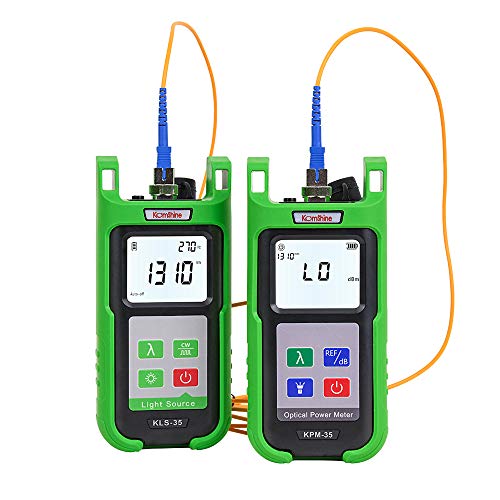
- Power meter plus light source
- Seven calibrated meter wavelengths
- Self-calibration and rugged housing
Best For: Fiber installers needing a coordinated two-piece test kit
Best Pocket Tester

- Tests 10 standard wavelengths
- Includes OPM, VFL, RJ45 test, and LED
- Stores up to 500 readings
Best For: Portable field troubleshooting across fiber and network cabling
Best Rechargeable Multitester
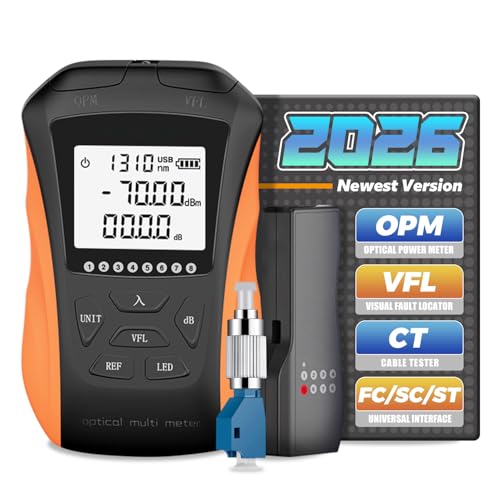
- Combines OPM, VFL, and LAN testing
- Supports FC, SC, and ST interfaces
- USB-charged 1100mAh battery
Best For: Technicians testing fiber and LAN cables on service calls
All-in-One OTDR Platform

- 1310/1550nm OTDR with 28/26dB dynamic range
- Includes OPM, VFL, OLS, event map, and cable tools
- Adds IP camera, PoE, Wi-Fi, and network testing
Best For: Technicians needing comprehensive fiber and network diagnostics
Complete FTTH Testing Kit
Komshine KLT-12E Fiber Toolkit
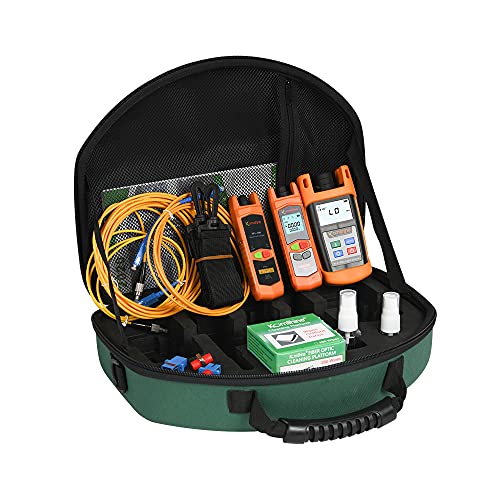
- Includes OPM, 1310/1550nm OLS, and VFL
- Power meter range is -70 to +10dB
- Adds cleaning platform, couplers, and jump cable
Best For: FTTH installation, loss testing, and fiber-end cleaning
Portable Fault-Finding Tool

- Locates breaks, bends, cracks, and poor connections
- Compatible with ST, SC, FC, and LC interfaces
- Compact aluminum body uses two AA batteries
Best For: Fiber tracing, continuity checks, and quick fault location
Best All-in-One Pick – Portable OPM-VFL-1 Fiber Tester
This versatile option stands out among fiber optic testers by combining an optical power meter, visual fault locator, and RJ45 tester in one portable unit. It supports eight standard wavelengths, measures from -70 dBm to +6 dBm, and works with FC, SC, and ST interfaces.
Best For: Technicians who want one compact tool for power measurements, basic fault tracing, and RJ45 checks.
Pros:
- Combines OPM, VFL, and RJ45 testing functions.
- Supports 850–1650 nm testing across eight standard wavelengths.
- Displays linear mW and nonlinear dBm readings simultaneously.
- Includes backlight, wavelength memory, automatic shutdown, and user calibration.
Cons:
- Two AA batteries are required but not included.
- Its feature set may be more than needed for simple visual fault checks.
With its broad wavelength support and integrated functions, the OPM-VFL-1 is a practical general-purpose choice when portability matters more than specialized OTDR analysis.
Best Fault-Finding Kit – Fiber Optic Troubleshoot Kit
This visual fault locator kit is a straightforward choice among fiber optic testers for locating breaks, poor connections, bends, and cracks. Its 2.5 mm universal connector supports ST, SC, and FC interfaces, while the included adapters and patch cords help test cables at distribution panels.
Best For: Field technicians who need a portable VFL kit with adapters and patch cords for hands-on troubleshooting.
Pros:
- Detects and locates common fiber faults, including breaks and bends.
- Includes five adapters and three short patch cords.
- Supports single-mode and multimode cables.
- Compact and lightweight for field testing.
Cons:
- Two AA batteries are not included.
- It is focused on visual fault location rather than optical power measurement or OTDR analysis.
The included connection accessories make this kit especially useful when cables remain connected to a distribution panel and cannot easily be removed for testing.
Best for Long-Distance Analysis – Mini-Pro OTDR Multi-Function Tester
For advanced fiber optic testers, the Mini-Pro combines OTDR testing with optical power, light-source, VFL, cable-length, cable-tracking, and RJ45 sequencing functions. It tests at 1310 and 1550 nm over a stated 5 m to 60 km range, with 24/22 dB dynamic range.
Best For: Professional users evaluating FTTx and access networks, locating breakpoints, measuring cable length, and assessing relative optical loss.
Pros:
- Provides OTDR testing over a 5 m to 60 km range.
- Combines several fiber and network testing tools in one device.
- Includes event-map capability, a 3.5-inch color display, and internal storage.
- Supports Micro USB data transfer, TF-card storage, and analysis software.
Cons:
- The product notes recommend professional experience before purchase.
- It cannot test splitters with its stated dynamic range.
- At approximately 1 kg, it is less lightweight than basic handheld testers.
This is the most capable and specialized option in the group, but its OTDR functions and software workflow make it better suited to trained users than occasional home testing.
Best for Quick Signal Detection – Fluke FiberLert-125
The Fluke FiberLert-125 simplifies fiber optic testers into a quick signal-presence check. It detects optical power in single-mode and multimode fiber from 850 to 1625 nm, using light and sound rather than requiring setup or result interpretation.
Best For: Technicians who need a compact, non-contact detector for ports and patch cords.
Pros:
- Detects signals across near-infrared wavelengths from 850 to 1625 nm.
- Uses light and sound indicators without requiring setup or interpretation.
- Non-contact detection helps reduce the risk of fiber damage.
- Includes two AAA batteries and a two-year warranty.
Cons:
- It indicates signal presence rather than providing detailed OTDR or power-loss analysis.
- Its five-minute automatic shutoff may interrupt extended checks.
Choose the FiberLert-125 when speed and simplicity are priorities. Its tiny, lightweight design makes it convenient for confirming whether a fiber carries an optical signal.
Best Complete Kit – Komshine KPM-35 + KLS-35-MS
For technicians who need a coordinated set of fiber optic testers, this Komshine package combines an optical power meter with a singlemode/multimode light source. It covers seven calibrated meter wavelengths and four light-source wavelengths for FTTH and general fiber testing.
Best For: Fiber installers and technicians who want both a power meter and compatible light source in one kit.
Pros:
- Includes both the KPM-35 power meter and KLS-35-MS light source.
- Supports seven meter wavelengths from 850nm through 1625nm.
- Features self-calibration, backlighting, automatic shutdown, and a 2m drop-resistant silicone jacket.
- Light source includes a 2.5mm universal interface with FC and SC adapter support.
Cons:
- It is a two-piece kit, so it is less compact than an all-in-one tester.
- The light source uses a typical -5dB output, which may not suit every test setup.
This is the most complete option of the three for users who need to measure optical power and inject test light across both singlemode and multimode networks.
Best Pocket Tester – M70-10 OPM & VFL
This compact fiber optic tester combines optical power measurement with a 10mW visual fault locator, RJ45 wiring tests, and an LED light. Its broad wavelength coverage, data storage, and pocket-friendly design make it practical for field troubleshooting.
Best For: Field technicians who want several basic network and fiber functions in one portable unit.
Pros:
- Measures 10 standard wavelengths from 850nm to 1650nm.
- Combines OPM, 10mW VFL, RJ45 network testing, and LED lighting.
- Offers an advertised measurement error below ±0.2dB.
- Stores up to 500 readings and supports user calibration.
Cons:
- Two AAA batteries are required and are not included.
- The package contains a single multifunction meter rather than a separate light source.
Choose this model when portability and built-in troubleshooting tools matter more than having a dedicated optical light-source unit.
Best Rechargeable Multitester – Y8 Optical Power Meter
The Y8 is a versatile choice among fiber optic testers, combining optical power measurement, a visual fault locator, LAN cable testing, and an LED flashlight. Its rechargeable 1100mAh battery and support for FC, SC, and ST interfaces suit technicians testing fiber and copper cabling on site.
Best For: Installers who need rechargeable fiber and LAN cable testing in one handheld device.
Pros:
- Combines OPM, VFL, cable continuity testing, and LED lighting.
- Supports seven fiber modes or wavelengths across SM and MM testing, with a -70dBm to +10dBm range.
- Works with FC, SC, and ST universal interfaces.
- Uses a USB-charged 1100mAh Li-ion battery and displays battery status on the LCD.
Cons:
- It does not include a separate fiber light source for paired insertion-loss testing.
- Its feature set may be more than needed for users who only measure optical power.
This model is a strong fit for service calls that involve both optical fiber and LAN cabling, especially when USB charging is preferable to replaceable batteries.
All-in-One OTDR Platform – MT-5500 Fiber Tester
For technicians who need more than basic fiber checks, the WANLUTECH MT-5500 is a versatile choice among fiber optic testers. It combines 1310/1550nm OTDR testing with power measurement, a light source, VFL, event mapping, cable testing, network diagnostics, and IP camera tools in one touchscreen unit.
Best For: Fiber installation and maintenance technicians who also work with IP cameras and network cabling.
Pros:
- Offers OTDR testing at 1310/1550nm with 28/26dB dynamic range.
- Includes OPM, VFL, light source, optical loss testing, and event mapping.
- Adds RJ45 TDR, cable tracing, PoE output, Wi-Fi analysis, and IP camera testing.
- Features a 5.4-inch touchscreen and gigabit Ethernet port.
Cons:
- This model does not support testing live fiber.
- Its many functions may be more than needed for simple fiber troubleshooting.
The MT-5500 is a strong multifunction option when carrying separate fiber, cable, and network testers would be inconvenient. Its broad feature set is most valuable for field professionals who can use the added diagnostics.
Complete FTTH Testing Kit – Komshine KLT-12E Fiber Toolkit
The Komshine KLT-12E is a practical kit for fiber installation, inspection, cleaning, and loss testing. Rather than combining everything into one electronic tester, it provides dedicated tools including an optical power meter, 1310/1550nm light source, VFL, cleaning platform, couplers, and a jump cable.
Best For: FTTH installers and maintenance crews who want a portable fiber loss-testing and cleaning toolkit.
Pros:
- Combines an OPM, optical light source, and visual fault locator.
- The power meter measures from -70 to +10dB and supports seven wavelengths.
- Includes a 1310/1550nm singlemode light source and 1m jump cable.
- Comes with a cleaning platform and paper for more than 200 cleanings.
Cons:
- It is a toolkit of separate instruments rather than a touchscreen OTDR.
- The supplied light source is specified for singlemode 1310/1550nm testing.
For routine FTTH work, the KLT-12E emphasizes the core tasks technicians perform repeatedly: checking power, measuring loss, locating faults, and cleaning fiber ends. Its shock-resistant portable case also suits field deployment.
Portable Fault-Finding Tool – Moocci Visual Fault Locator
The Moocci Visual Fault Locator is a focused option among fiber optic testers for tracing fibers and finding visible fault points. It uses a bright output to help identify breaks, poor connections, bends, and cracks, while its 2.5mm universal connector accommodates common ST, SC, FC, and LC interfaces.
Best For: Field technicians who need a compact tool for fiber routing, continuity checks, and locating breaks.
Pros:
- Helps identify breakpoints, bends, cracks, and poor connections.
- Supports ST, SC, FC, and LC fiber interfaces through its universal connector.
- Uses two AA batteries and includes low-battery warning functionality.
- Aluminum construction and a stainless steel head help protect against dust and impacts.
Cons:
- It is a visual fault locator rather than a full OTDR or optical power meter.
- It provides a narrower testing scope than multifunction fiber kits.
The Moocci is best viewed as a straightforward fault-location companion. Its durable body, broad connector compatibility, and long-distance detection make it useful when the immediate goal is tracing or pinpointing a visible fiber fault.
How We Picked These Fiber Optic Testers
We selected products representing the main testing approaches used in fiber installation and maintenance: optical power measurement, visual fault location, light-source testing, cable identification, and OTDR analysis. We also considered wavelength support, connector compatibility, testing range, portability, included adapters, battery and charging features, display usability, and the type of work each tester is best suited to.
Because a basic power meter and a full OTDR solve different problems, the right choice depends more on your workflow than on the number of features. A compact tester may be ideal for quick checks, while a multifunction or OTDR unit can reduce the need to carry several tools.
Quick Comparison
- Power meters: Best for measuring received optical power and checking link loss when paired with a suitable light source.
- Visual fault locators: Best for quickly finding breaks, sharp bends, poor splices, and incorrectly connected fibers.
- Multifunction testers: Combine features such as OPM, VFL, RJ45 testing, and sometimes OLS functions in one portable device.
- OTDR testers: Best for locating events along a fiber run, estimating distance to faults, and documenting longer links.
- FTTH kits: Useful for installers who need a coordinated set of loss-testing and network tools rather than one standalone meter.
Key Buying Factors for Fiber Optic Testers
Test Type and Range
Choose the instrument based on the measurements you actually need. An OPM can confirm signal levels, but it generally cannot show the exact location of a break. An OTDR provides event distance and trace information, but it is usually more expensive and requires more setup knowledge. For fast visual checks, a VFL is often the simplest option.
Wavelength and Fiber Compatibility
Check that the supported wavelengths match your equipment and application. Common testing wavelengths include 850, 1310, 1490, 1550, and 1625nm. Also verify whether the unit supports single-mode, multimode, or both. FC, SC, ST, and LC compatibility matters if your installations use mixed connector types.
Accuracy, Dynamic Range, and Usability
For routine maintenance, readable results and consistent operation may matter more than advanced specifications. OTDR buyers should compare dynamic range, dead zones, event-map features, trace storage, and screen visibility. Field technicians should also consider battery life, USB charging, protective construction, and whether adapters or carrying cases are included.
Who Should Buy Which Fiber Optic Testers?
Choose a basic optical power meter if you mainly verify signal levels, test patch cords, or commission straightforward links. Choose a VFL if your priority is quickly identifying visible breaks, bends, or fiber routing mistakes.
Choose a multifunction tester if you want one compact tool for occasional power, fault-location, and copper-network checks. These models are especially practical for technicians working across fiber and RJ45 installations.
Choose an OTDR if you maintain long runs, need fault-distance information, or must produce more detailed test results. For FTTH contractors and installation teams, a complete loss-testing kit may be more convenient than assembling compatible tools individually.