The right DMX controller can help a band turn a basic lighting rig into a coordinated part of the live show. The best choice depends on fixture count, programming needs, portability, and whether you prefer physical faders or app-based control.
We compared 10 options ranging from straightforward 192-channel consoles to more advanced software and wireless systems, focusing on usability, flexibility, and value for working musicians.
Best 10 Dmx Controllers for Bands Picks for 2026
Flexible Scene Control
CO-Z 192 DMX Stage Light Controller

- Controls up to 12 fixtures
- Stores up to 240 scenes
- Voice control and hands-on faders
Best For: Amateur bands and small event lighting rigs
Music-Synced Performance
SoundSwitch Control One DMX Lighting Controller

- Two DMX universes
- Live audio BPM detection
- Tactile controls for live effects
Best For: Bands using software-driven, music-responsive light shows
Proven Scene Programming
CHAUVET DJ Obey 70 DMX Controller

- 384 DMX channels
- 240 scenes in 30 banks
- Six programmable chases
Best For: Bands needing rack-mount scene and chase control
384-Channel Value Console
DMX512 DJ 384CH Stage Lighting Console

- 384 DMX channels
- 30 banks of eight scenes
- LED gooseneck work light
Best For: Bands seeking extensive programmed scene capacity
Feature-Rich Control

- Controls up to 12 fixtures and 192 DMX channels.
- Stores 240 scenes across banks and chase sets.
- Includes fog, strobe, MIDI, and reversible-slider controls.
Best For: Bands with complex, multi-fixture lighting rigs
Hands-On Value

- Controls 12 fixtures with up to 16 channels each.
- Programs up to 240 scenes with adjustable transitions.
- Adds 3-pin DMX output and voice-control operation.
Best For: Bands wanting an accessible physical lighting console
App-Based Flexibility

- Provides 256-channel tablet-based DMX control.
- Supports Wi-Fi and USB with a 15,000-plus fixture library.
- Includes presets, automatic effects, and truss-mount brackets.
Best For: Bands seeking compact, tablet-driven lighting control
Band-Ready Control
192-Channel DMX Light Controller

- Controls 12 fixtures with up to 16 channels each
- Stores 240 scenarios and six programmable chases
- Offers microphone, MIDI, tap, and automatic modes
Best For: Bands and DJs needing music-synchronized lighting control
Beginner-Friendly Pick
192-Channel DMX Stage Controller
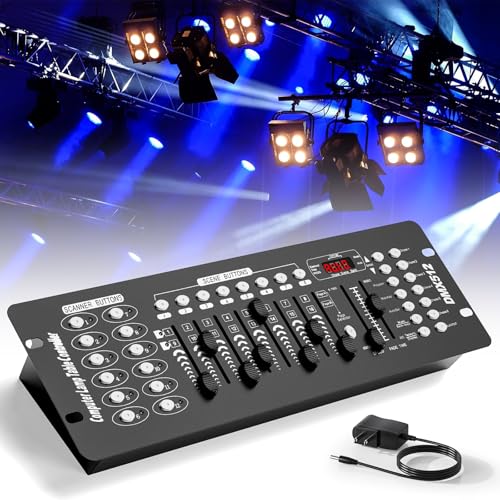
- Controls up to 12 fixtures with 16 channels each
- Includes eight sliders and automatic speed/fade controls
- Offers 240 scenarios and six programmable chases
Best For: Beginners and small bands building programmed light shows
Programmable Performance Option
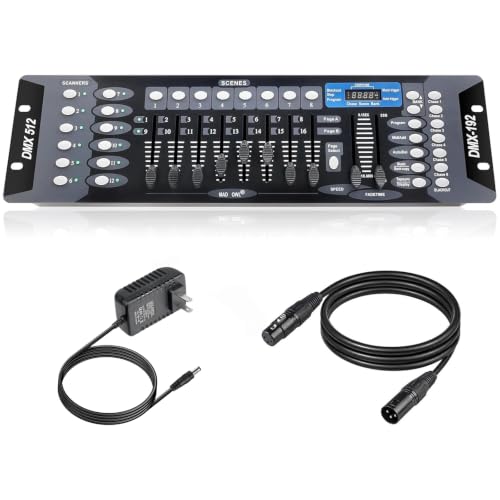
- Controls up to 12 fixtures with up to 16 channels each
- Stores 23 banks and supports 240-step scenes
- Includes faders, buttons, and a 6.6-foot DMX cable
Best For: Performance venues and bands programming custom light sequences
Flexible Scene Control – CO-Z 192 DMX Stage Light Controller
For bands seeking approachable dmx controllers for bands, the CO-Z 192 offers hands-on control for up to 12 intelligent lights, with 192 channel groups and room for up to 240 scenes. Its layout is aimed at users who want to program and recall lighting looks without an especially complex workflow.
Best For: Amateur bands, DJs, churches, weddings, and small event setups using multiple fixtures and scene presets.
Pros:
- Controls up to 12 fixtures with up to 16 channels each.
- Stores up to 240 scenes for more involved show programming.
- Includes voice control, precision control sticks, and a three-pin cable connection.
Cons:
- Its plastic construction may feel less substantial than metal consoles.
- Manual programming may require a learning period for first-time users.
The CO-Z is a practical choice when a band wants dedicated physical controls, flexible scene storage, and support for common stage fixtures such as pars, strobes, fog machines, and moving lights.
Music-Synced Performance – SoundSwitch Control One DMX Lighting Controller
The SoundSwitch Control One stands out among dmx controllers for bands when lighting needs to follow music or be adjusted live. It provides tactile controls for intensity and effects while supporting live audio BPM detection from a band, DAW, DJ software, USB, or microphone input.
Best For: Performing bands and hybrid DJ setups that want software-assisted, music-responsive lighting control.
Pros:
- Supports two DMX universes with inputs, outputs, and a thru option.
- Live Audio BPM detection can sync lighting with external music sources.
- Touch strip, encoders, and RGB performance pads enable live adjustments.
Cons:
- Many features depend on SoundSwitch software and compatible hardware.
- A computer is required for PRO DJ LINK Bridge use with compatible AlphaTheta equipment.
This is the most performance-oriented option in the group for bands that want responsive, software-linked lighting rather than a traditional standalone scene console.
Proven Scene Programming – CHAUVET DJ Obey 70 DMX Controller
The CHAUVET DJ Obey 70 is a straightforward choice among dmx controllers for bands that need extensive scene and chase programming. It controls up to 12 intelligent lights across 384 DMX channels and provides dedicated storage for scenes, banks, and chases.
Best For: Bands and venues that want a rack-mountable controller for programmed lighting sequences and multiple fixtures.
Pros:
- Controls up to 12 intelligent lights with up to 32 channels each.
- Offers 30 banks of eight scenes, for up to 240 scenes total.
- Provides six chases and programmable fade and speed times.
Cons:
- It is a larger, heavier console at 6.9 pounds.
- Its traditional programming layout may be less immediate than software-linked systems.
With 384 channels and substantial scene capacity, the Obey 70 fits bands that prefer repeatable programmed looks and a conventional rack-mount control surface.
384-Channel Value Console – DMX512 DJ 384CH Stage Lighting Console
This 384-channel console gives bands a conventional option among dmx controllers for bands for programming live-lighting scenes. It provides 30 banks of eight programmable scenes, a compact structure, and an LED gooseneck light for operating the console in darker show environments.
Best For: Bands and small venues wanting broad channel capacity and programmable scene banks in a straightforward console.
Pros:
- Provides 384 DMX channels for detailed fixture control.
- Includes 30 banks with eight programmable scenes each.
- Supports 110–240Vac power and includes an LED gooseneck light.
Cons:
- The supplied notes do not specify the maximum number of fixtures supported.
- Its compact console format still measures roughly 20.71 inches wide.
The DMX512 DJ Controller is worth considering when channel count and scene-bank capacity matter, especially for users who want a traditional editing console rather than a computer-based lighting workflow.
Feature-Rich Control – CHAUVET DJ Obey 40
For bands comparing DMX controllers for bands, the CHAUVET DJ Obey 40 is suited to setups that need substantial fixture control and organized scene playback. It controls up to 12 fixtures with up to 16 channels each, while its banks, chases, fog control, strobe control, and MIDI compatibility support more involved performances.
Best For: Bands running multiple intelligent lights and needing extensive programmed looks.
Pros:
- Controls up to 192 DMX channels across as many as 12 fixtures.
- Stores up to 240 scenes in 30 banks with 8 scenes each.
- Offers six chase sets, plus fog, strobe, and MIDI control.
- Reversible sliders provide flexible operator control.
Cons:
- Its extensive programming capacity may be more than a simple lighting rig requires.
- At 6.7 pounds, it is less lightweight than a compact interface-style controller.
The Obey 40 makes the most sense when your band’s lighting system is growing beyond basic scene changes. Its large storage capacity and dedicated effect controls give operators room to build repeatable, dynamic show cues.
Hands-On Value – 192-Channel DMX512 Console
This 192-channel DMX512 console is a practical option for bands seeking straightforward, hands-on control over stage lighting. It supports up to 12 fixtures with 16 channels each, includes a 3-pin DMX output, and adds voice control for changing lighting effects.
Best For: Amateur users and small performance setups that want physical controls with flexible scene programming.
Pros:
- Controls up to 12 intelligent lights and up to 240 scenes.
- Supports scene steps with adjustable pause and fade times.
- Includes a professional 3-pin XLR DMX512 output.
- Voice control and clearly organized control sections can simplify operation.
Cons:
- The plastic construction may feel less substantial than a metal console.
- Its corded design does not provide the portability of a wireless controller.
- Voice control may be unnecessary for operators who prefer manual control.
With physical sliders, scene controls, and adjustable transition timing, this console offers a familiar workflow for bands building programmed lighting cues. It is especially appealing when ease of operation matters more than app-based control.
App-Based Flexibility – ADJ MyDMX Go
For bands looking for portable DMX controllers for bands, the ADJ MyDMX Go combines tablet-based operation with wireless connectivity. Its 256-channel app supports Wi-Fi and USB connections, a large fixture library, automatic effects, and preset-based control without requiring traditional programming.
Best For: Bands that prefer tablet control, quick setup, and compact wireless integration.
Pros:
- Provides 256-channel control through an iPad or Android tablet.
- Works with a fixture library of more than 15,000 models.
- Offers 50 user presets and 21 automatic effects.
- Compact, lightweight design includes O-Clamp brackets for truss mounting.
Cons:
- Operation depends on a compatible iPad or Android tablet.
- App-based control may not suit performers who prefer dedicated physical faders.
- The supplied notes describe connections through 3-pin XLR, USB, and Wi-Fi rather than a fully cable-free fixture setup.
MyDMX Go is a strong fit for bands that value quick deployment and visual control over traditional console programming. Its fixture library and preset effects can help create varied looks while keeping the hardware footprint small.
Band-Ready Control – 192-Channel DMX Light Controller
For bands seeking practical dmx controllers for bands, this 192-channel console offers straightforward control for up to 12 lighting fixtures, with sound-responsive and MIDI beat activation options that can help coordinate lighting with live music.
Best For: Bands, DJs, bars, clubs, weddings, and house parties needing programmable scenes and music-synchronized operation.
Pros:
- Controls up to 16 channels across 12 smart lights.
- Provides 240 scenarios, six chases, and simultaneous chase operation.
- Includes microphone, MIDI beat activation, tap synchronization, and automatic operation.
- Supports compatible stage lights through a 3-pin DMX cable.
Cons:
- The control capacity is limited to 192 channels and 12 fixtures.
- It requires corded power and compatible 3-pin DMX connections.
Its combination of programmable scenes and built-in beat-synchronization features makes it a flexible choice for small to medium live setups where the lighting operator wants both manual and automatic control.
Beginner-Friendly Pick – 192-Channel DMX Stage Controller
This 192-channel console is one of the more approachable dmx controllers for bands, with clearly separated control areas, eight sliders, programmable scenes, and automatic speed and fade controls for small shows and gatherings.
Best For: Beginners, small bands, parties, concerts, festivals, and users who want a simple control layout with broad fixture compatibility.
Pros:
- Controls up to 12 devices with 16 channels each.
- Supports 240 scenarios, 23 banks of programmable scenes, and six chases.
- Includes eight sliders for manual channel control plus automatic speed and fade operation.
- Works with compatible 3-pin equipment such as moving heads, fog machines, PAR lights, and wall washers.
Cons:
- Its fixture capacity is limited to 12 devices and 192 total channels.
- The listed warranty information is inconsistent, mentioning both 360-day repair service and a 90-day manufacturer warranty.
The layout and operating modes suit newcomers, while the scene and chase capacity gives a small live rig room to build more varied lighting sequences.
Programmable Performance Option – DMX512 Lighting Console
For bands that want hands-on programming, this 192-channel DMX512 board combines faders and buttons with 240-step scene capacity, six programmable chases, and a supplied 6.6-foot DMX cable.
Best For: Bands, clubs, stages, and performance venues that need custom lighting sequences and real-time adjustments.
Pros:
- Controls up to 12 fixtures with 16 channels or fewer per fixture.
- Stores 23 banks of eight programmable scenes.
- Supports 240-step scenes across six programmable chases.
- Includes a 6.6-foot DMX cable and hands-on faders and buttons.
Cons:
- It is limited to 192 total channels and 12 lighting fixtures.
- The console is relatively large, measuring 22.44 inches long by 7.28 inches wide by 4.72 inches high.
This model emphasizes manual access and custom programming, making it a sensible fit when a band or lighting operator wants to adjust scenes live rather than rely only on automatic effects.
How We Picked the Best Dmx Controllers for Bands
We evaluated these Dmx Controllers for Bands based on the features that matter during rehearsals, performances, and setup. Key considerations included channel and fixture capacity, scene and chase programming, hands-on control, compatibility with common DMX512 lighting fixtures, portability, and learning curve.
We also considered the needs of different band setups. A small group with a few LED pars may benefit from a simple console, while a touring act or production-oriented band may need app control, wireless connectivity, or more sophisticated show programming. Because product specifications and included accessories can vary, verify the current listing before buying.
Quick Comparison
| Controller Type | Best For | Main Advantage |
|---|---|---|
| 192-channel console | Small rigs and basic shows | Simple, affordable hands-on control |
| 384-channel console | Larger fixture collections | More programming capacity |
| 70- or 40-channel console | Compact setups | Lower complexity and easier learning |
| Computer or app-based system | Detailed programming and wireless operation | Flexible control and show management |
Key Buying Factors for Dmx Controllers for Bands
Channel and Fixture Capacity
Check both the total DMX channels and the number of fixtures the controller can address. A moving head may use many more channels than a basic RGB fixture, so leave room for future expansion instead of matching today’s rig exactly.
Programming and Live Operation
Look for programmable scenes, banks, chases, and adjustable fade times if you want repeatable song cues. Physical faders and dedicated buttons are useful for quick changes onstage, while software can provide deeper editing and visual organization.
Compatibility and Connections
Confirm that the controller supports DMX512 and has the appropriate output connection for your lighting equipment. For wireless systems, check transmitter compatibility, range, power requirements, and whether a receiver is needed at each fixture or DMX chain.
Portability and Reliability
A compact console may be ideal for rehearsals and club dates, but touring users should also consider construction, power arrangements, cable storage, and backup plans. Keep DMX cables properly terminated and avoid relying on an unfamiliar control system immediately before a show.
Who Should Buy Which Dmx Controllers for Bands?
Small Bands and First-Time Users
Choose a straightforward 192-channel or lower-capacity console if your rig uses a few LED pars, wash lights, or effects. These controllers are generally easier to learn and offer direct access without requiring a computer.
Bands with Larger or Expanding Rigs
A 384-channel model or a higher-capacity system makes more sense when you use multiple fixture types, moving lights, or several independent zones. Extra capacity can prevent an expensive replacement as the show grows.
Touring and Production-Focused Acts
Consider an app- or computer-based controller when detailed cue editing, wireless operation, saved show files, and flexible remote control are priorities. This approach can be powerful, but plan for device compatibility, power, and a backup workflow.
Best Practical Approach
For most bands, prioritize dependable DMX output, enough capacity for planned expansion, and controls the lighting operator can use confidently in real time. The most advanced controller is not necessarily the best choice if it slows down setup or complicates live performance.