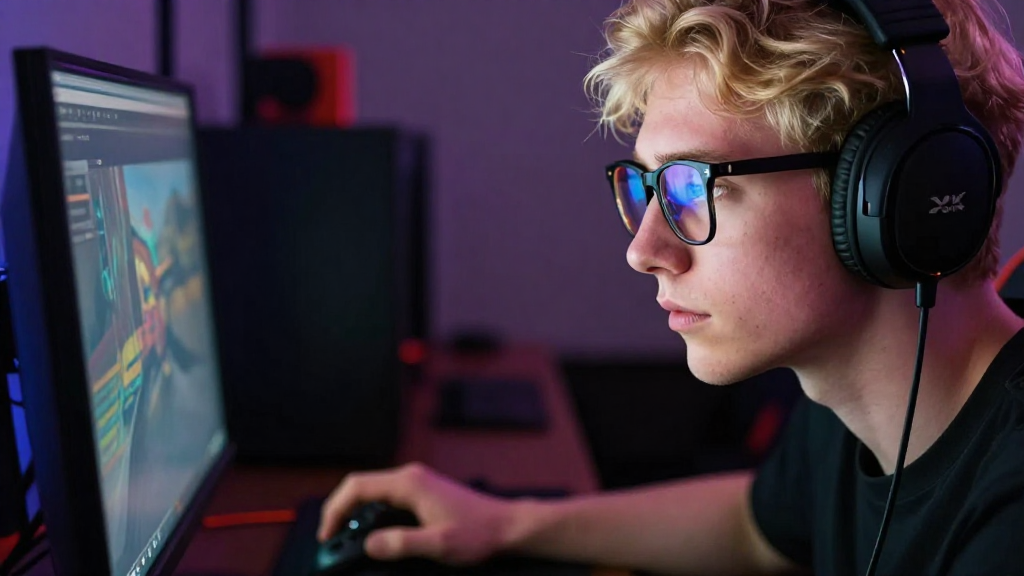
In recent years, the debate surrounding gaming and visual accuracy has gained traction among gamers, researchers, and health professionals alike.
Many studies suggest that engaging in video games can enhance certain visual capabilities.
But how exactly does gaming impact visual accuracy?
How Does Gaming Affect Our Visual Skills?
Gaming and visual accuracy are closely intertwined as video games often demand sharp focus, quick reflexes, and acute spatial awareness.
Numerous research projects and experiments have pointed out several key aspects in which video gaming can improve visual skills:
-
Increased Peripheral Awareness:
Gamers tend to have superior peripheral vision compared to non-gamers, enabling them to better track moving objects in their environment. -
Enhanced Depth Perception:
Video games often place players in three-dimensional worlds, rewarding those who can accurately judge distances and spatial relationships. -
Faster Reaction Times:
The immersive nature of video games can result in quicker decision-making abilities, benefitting a player’s overall visual processing speed.
These enhancements are particularly impressive when considering that many traditional practices aimed at improving visual accuracy take significantly longer to yield similar results.
Can Gamers See Better Than Non-Gamers?
The discussion of whether gamers can actually see better than non-gamers directly ties into the concept of gaming and visual accuracy.
Studies have shown that gamers often perform better in tasks that require visual discrimination and contrast sensitivity.
These tasks include distinguishing between similar colors or shapes under varying light conditions.
Moreover, the type of games played can influence these abilities:
-
Action Games:
Fast-paced shooters like “Call of Duty” or “Counter-Strike” train players to notice subtle visual changes quickly. -
Puzzle Games:
Titles such as “Tetris” or “Portal” challenge players to engage with complex visual patterns and spatial reasoning skills.
The combination of these gameplay experiences can sharpen visual cognition, categorizing gamers as potentially more visually accurate.
Do Certain Genres Improve Visual Accuracy More Than Others?
It’s important to ask whether specific genres foster greater enhancements in gaming and visual accuracy.
Several gaming genres have been found to impact visual skills differently:
-
First-Person Shooters (FPS):
FPS games often require rapid eye movements and a keen sense of situational awareness. Studies have shown that playing these games can improve players’ ability to process fast-paced visual cues. -
Real-Time Strategy (RTS):
RTS games, which require players to make decisions based on multiple visual elements, can improve multitasking abilities while enhancing visual processing speed. -
Simulation Games:
Games like “Flight Simulator” and “The Sims” allow players to practice controlling and navigating complex environments, leading to improved navigational skills and visual accuracy.
What Does the Research Say?
A number of scientific studies have explored the link between gaming and visual accuracy:
-
University of Toronto Study (2014):
Researchers found that action video game players could track multiple moving objects more effectively than non-gamers. -
California State University Study (2013):
The research indicated that players of FPS games demonstrate better motion sensitivity, especially under dynamic conditions. -
Psychological Science Study (2016):
This study showed that gamers excel in visual attention tasks and have a superior ability to pick out relevant visual information.
These studies paint a compelling picture of how gaming can equip individuals with impressive visual accuracy.
How Much Gaming is Needed for Improvement?
The question arises, how much gaming is necessary to effectively improve visual accuracy?
While there’s no one-size-fits-all answer, research suggests that even moderate gaming can yield benefits.
Typically, a few hours a week dedicated to action-oriented games can enhance visual skills.
However, it’s essential to balance gaming with other lifestyle factors to promote overall well-being:
-
Regular Breaks:
Taking breaks helps to reduce eye strain and fatigue. -
Physical Activity:
Engaging in physical exercise complements cognitive improvement gained from gaming. -
Diverse Gameplay:
Trying out various genres can lead to a more well-rounded skillset.
Are There Risks of Gaming on Visual Health?
As promising as the effects of gaming and visual accuracy may be, there are potential risks involved.
Excessive gaming can lead to various visual issues, including:
-
Eye Strain:
Prolonged screen time without breaks can cause discomfort. -
Dry Eyes:
Focusing on screens can reduce blinking, leading to dryness and irritation. -
Increased Blue Light Exposure:
Continuous exposure to screens risks disrupting sleep patterns.
To minimize these risks, players should adopt healthy gaming habits:
- Use blue light filters on devices.
- Set reminders to take breaks.
- Ensure proper lighting in the gaming area.
Conclusion: Is Gaming Worth It for Visual Accuracy?
The relationship between gaming and visual accuracy is a fascinating topic that continues to evolve.
Research indicates that engaging in certain video games can significantly enhance visual skills such as depth perception, peripheral awareness, and multitasking abilities.
With proper balance, moderation, and protective measures, the positive impacts of gaming can contribute to improved visual capabilities without compromising health.
In a world where visual processing plays a crucial role in daily life, developing these skills through gaming could be more than just entertainment; it could enhance one’s overall quality of life.
So, the next time you pick up that controller, remember:
Your gaming habits might just be sharpening your vision!