Reliable power is easy to overlook until a voltage problem, accidental switch-off, or unruly shutdown interrupts a performance. The right stage power conditioner can organize rack power, add protection, and make startup and shutdown more consistent.
This roundup compares 10 options for touring rigs, venues, DJs, studios, and installed systems, including sequencers, portable units, voltage displays, and higher-capacity rack models.
Best 10 Stage Power Conditioners for Live Sound Picks for 2026
Zone-Controlled Protection
Monoprice Stage Right 15A Sequencer
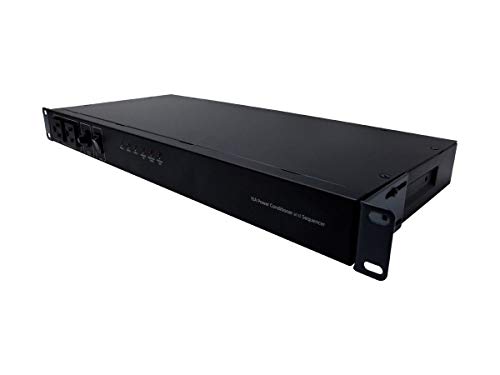
- Eight outlets with three sequencing zones
- 15A, 120V surge-protected design
- 1U rack-mount metal enclosure
Best For: Rack setups needing organized power sequencing
Heavy-Duty Filtering

- Nine outlets for pro-audio equipment
- Noise filtering and surge protection
- Stainless-steel enclosure with USB port
Best For: Larger pro-audio rigs needing robust power distribution
Audio-Focused Filtering

- PG-90 filtering technology
- Eight rear and one front outlet
- Front USB port and rackmount design
Best For: Rack systems needing filtering and front-panel access
Expanded Outlet Capacity

- Eleven outlets for connected equipment
- Noise filtering and surge protection
- Stainless-steel construction
Best For: Live sound rigs needing maximum outlet capacity
Best Rack-Mount Power Sequencer

- 10 outlets with 8 sequenced and 2 always-on connections
- 1U rack-mount design with LCD voltage readout
- 2000W capacity, USB charging, and surge protection
Best For: Rack-mounted live sound and studio systems needing centralized power control
Best Portable Audio Filter

- Six-outlet portable surge protector for audio gear
- Audio filtration and 540-joule surge protection
- Includes a flexible 9-foot power cable
Best For: Portable professional audio setups and compact live rigs
Best High-Capacity Sequencer

- Eight sequenced and two always-on outlets
- Individual switches, indicators, and LCD display
- Up to 15 amps with spike and EMI/RFI protection
Best For: Demanding rack-mounted live sound and studio systems
Flexible Sequencing

- Sequential startup and shutdown
- Eight independently switched rear outlets
- 110V–240V monitoring with 3000W capacity
Best For: Stage and DJ rigs needing controlled power management
Studio-Friendly Control

- Compact 1U rack-mount design
- Eight rear and two always-on front sockets
- LCD voltage monitoring with surge protection
Best For: Compact studio, DJ, and stage racks
Remote-Ready Protection
20A Rack-Mount Power Sequencer

- Eight independently controlled sequenced outlets
- Bypass mode and external remote switch
- LCD monitoring with 10 total outlets
Best For: Installed audio racks needing remote power control
Zone-Controlled Protection – Monoprice Stage Right 15A Sequencer
For stage power conditioners for live sound, the Monoprice Stage Right combines surge protection with sequencing in a 1U rack-mount design. It provides eight outlets, three zones, and a 15-amp capacity for compatible audio and electronic equipment.
Best For: Rack-based setups needing multiple outlet zones and power sequencing.
Pros:
- Eight outlets support amplifiers, speakers, and other electronic devices.
- Three zones provide organized power sequencing.
- Metal enclosure and 15-amp capacity suit rack installations.
- Uses a standard North American Type B three-pin plug.
Cons:
- Designed for 120-volt Type B power connections.
- Its feature set may be more than needed for simple outlet expansion.
The combination of sequencing, surge protection, and rack mounting makes this a practical choice when a live sound system benefits from structured power control.
Heavy-Duty Filtering – Radial Power-2
The Radial Power-2 is a stainless-steel power conditioner for live sound and other pro-audio equipment. Its nine outlets, noise filtering, surge protection, LED illumination, and 15-amp rating make it suited to larger rack or equipment setups.
Best For: Pro-audio systems needing nine outlets, filtering, and a durable enclosure.
Pros:
- Nine outlets provide extensive connection capacity.
- Includes noise filtering and surge protection.
- LED illumination can aid visibility in equipment environments.
- Includes one USB port and a two-year warranty.
Cons:
- Limited to 120-volt Type B power connections.
- At 12.4 pounds, it is relatively heavy to transport.
With its high outlet count and stainless-steel construction, the Power-2 is a strong fit for performers and technicians who want filtering and protection in one substantial unit.
Audio-Focused Filtering – Black Lion Audio PG-X
The Black Lion Audio PG-X is a rackmount option among stage power conditioners for live sound, with PG-90 filtering technology and a mix of front- and rear-panel connections. Its Panasonic and Wima capacitors, nine total outlets, and front USB port support organized rack power management.
Best For: Rack systems that prioritize audio-focused filtering and convenient front-panel access.
Pros:
- PG-90 filtering technology is designed for power conditioning.
- Eight rear outlets and one front outlet accommodate connected equipment.
- Front-panel USB port adds convenient access.
- Stainless-steel enclosure and rackmount form factor suit installed systems.
Cons:
- The supplied notes do not specify voltage, amperage, or surge-protection details.
- Rackmount construction may be less convenient for portable setups.
The PG-X stands out for its filtering-focused design and accessible outlet layout, making it worth considering when front-panel convenience matters in a rack system.
Expanded Outlet Capacity – Radial Power-1
The Radial Power-1 offers expanded outlet capacity for stage power conditioners for live sound, with 11 outlets in a stainless-steel build. Its noise filtering and surge protection help organize and protect compatible equipment in a rack-oriented setup.
Best For: Live sound systems that need many outlets in a durable power-distribution unit.
Pros:
- Eleven outlets support multiple connected devices.
- Noise filtering helps address unwanted power-related interference.
- Surge protection adds another layer of equipment protection.
- Stainless-steel construction is suited to demanding equipment environments.
Cons:
- The supplied notes do not list voltage, amperage, or USB connectivity.
- Its larger outlet count may be unnecessary for compact rigs.
The Power-1 is a straightforward choice when outlet quantity is the priority and the system benefits from filtering and surge protection in a stainless-steel enclosure.
Best Rack-Mount Power Sequencer – Pyle PCO875
For stage power conditioners for live sound setups that need centralized control, the Pyle PCO875 combines 10 outlets, sequencing, surge protection, and a front-panel voltage readout in a compact 1U rack unit. Its 2,000-watt capacity and USB charging port make it practical for smaller audio, studio, and home-theater rigs.
Best For: Rack-mounted live sound or studio systems needing multiple outlets and sequenced power control.
Pros:
- Provides eight rear outlets plus two always-on front outlets.
- Offers a 1U rack-mount design with a digital LCD display.
- Includes spike, surge, overload, and noise-interference protection.
- Adds a USB port for external device charging.
Cons:
- Its 2,000-watt rating may be limiting for larger power-hungry rigs.
- The unit weighs about 6 pounds, adding some rack weight.
The PCO875 is a feature-rich choice when you want sequencing and basic power protection without taking more than one rack space. The two always-on outlets are useful for equipment that should remain powered separately from the sequenced connections.
Best Portable Audio Filter – Black Lion Audio PG-P
The Black Lion Audio PG-P is a portable option for stage power conditioners for live sound, offering six outlets, audio filtration, surge protection, and a long 9-foot power cable. Its compact design suits musicians and audio professionals who need straightforward protection without rack-mount hardware.
Best For: Portable professional audio setups and smaller live rigs that need filtered, surge-protected power.
Pros:
- Provides six outlets for professional audio equipment.
- Includes audio filtration to help address unwanted power noise.
- Uses a 9-foot power cable for flexible placement.
- Offers 540 joules of surge protection and a 2-year warranty.
Cons:
- It has fewer outlets than the rack-mount alternatives.
- It does not provide sequencing or a voltage display.
The PG-P focuses on portability and audio-specific filtration rather than advanced rack control. It is a sensible fit for compact rigs, though larger stage systems may need more outlets or dedicated sequencing.
Best High-Capacity Sequencer – Sound Town STPS-1028
For stage power conditioners for live sound systems that need organized startup and shutdown, the Sound Town STPS-1028 supplies eight sequenced outlets and two always-on outlets in a 1U rack-mount chassis. It also adds individual outlet switches, an LCD display, EMI/RFI filtering, and up to 15 amps of power.
Best For: Live rigs, studios, and home theaters that need outlet-by-outlet sequencing and higher available current.
Pros:
- Provides eight sequenced outlets and two always-on outlets.
- Individual switches and indicators make outlet status easy to monitor.
- Includes spike protection and EMI/RFI filtering.
- Offers up to 15 amps with a front LCD readout.
Cons:
- At about 8.53 pounds, it is heavier than some compact conditioners.
- The larger package may be less convenient for minimal portable setups.
The STPS-1028 is built for organized rack power management, especially where sequenced activation and individual outlet control matter. Its 15-amp capacity and filtering make it a strong candidate for more demanding live or studio systems.
Flexible Sequencing – 10-Outlet Power Sequencer
For stage power conditioners for live sound, this FMUSER rack unit emphasizes controlled startup and flexible outlet management. Its sequenced power-up and power-down process is designed to reduce startup noise and help limit stress on amplifiers and speakers.
Best For: Live sound, DJ, stage, laboratory, and home theater setups that need sequential power control and voltage monitoring.
Pros:
- Sequences equipment startup and shutdown to help reduce noise impact.
- Eight rear outlets have independent power switches for flexible control.
- Voltage display monitors input from a stated 110V–240V range.
- Supports up to 3000W total output power according to the supplied specifications.
Cons:
- The supplied notes do not specify individual outlet wattage limits.
- Its universal outlet configuration may require checking compatibility with your devices and region.
This is a practical choice when sequencing and individually controlled rear outlets matter more than advanced connectivity. Verify your local power and plug requirements before installation.
Studio-Friendly Control – 2000W Rack Power Sequencer
This rack-mounted option is worth considering among stage power conditioners for live sound when you want a compact 1U format with voltage monitoring. It combines eight rear sockets with two always-on front sockets, plus USB and international power interfaces for compatible accessories.
Best For: Home theaters, music production studios, DJ systems, and compact stage racks needing multiple connection points.
Pros:
- Provides 10 sockets: eight on the rear and two always-on outlets on the front.
- Large LCD screen provides real-time voltage monitoring.
- 1U rack-mount housing helps conserve rack space.
- Includes stated surge, overload, and noise-protection features.
Cons:
- The listed maximum power is 2000W, lower than some larger-capacity conditioners.
- The supplied notes do not clearly describe independent switching for each rear outlet.
- International and USB interfaces should be checked for compatibility with your equipment.
Its compact 1U design and always-on front outlets make it convenient for smaller racks. Choose it when socket access and monitoring are priorities, while keeping the 2000W rating in mind.
Remote-Ready Protection – 20A Rack-Mount Power Sequencer
For stage power conditioners for live sound, this MICNAUX rack unit adds several control options to a 10-outlet design. It combines eight sequenced rear outlets, two always-on front outlets, an LCD voltage display, bypass mode, and an external dry-contact switch.
Best For: Audio racks and installations that benefit from remote control, outlet-level management, and 20A-rated power handling.
Pros:
- Eight rear outlets have independent switches and front-panel indicators.
- Two always-on front outlets provide convenient power access.
- Supports stated 110–230V compatibility with real-time LCD voltage monitoring.
- Offers bypass mode and an external dry-contact remote switch.
Cons:
- Maximum output is listed as 2000W, so total system load must be considered.
- The supplied specifications also list 110V input and output, so international use should be verified carefully.
- Remote switching requires compatible external control hardware.
This model stands out for installations where remote operation and bypass access are useful. Its metal rack-mount enclosure and 20A specification suit demanding setups, provided the voltage and load requirements match your system.
How We Picked the Best Stage Power Conditioners for Live Sound
We focused on features that matter in real audio setups: outlet count, rack compatibility, sequencing, independent controls, voltage monitoring, rated capacity, portability, and practical protection features. We also considered whether a unit suits compact rigs, larger racks, installed systems, or mobile production work.
Because specifications and electrical requirements vary, confirm the manufacturer’s current ratings and your venue’s power standards before connecting amplifiers, powered speakers, or other high-draw equipment.
Quick Comparison
- Best for organized rack startup: Choose a sequencer with timed zones or independently controlled outlets.
- Best for monitoring: Look for a front-panel voltage display or other clear status indicators.
- Best for compact rigs: A shorter rack unit or portable conditioner can simplify small live setups.
- Best for demanding systems: Prioritize appropriate amperage, outlet spacing, and a capacity suitable for the connected load.
- Best for flexible control: Models with multiple independently switched outlets can isolate equipment and simplify troubleshooting.
Key Buying Factors for Stage Power Conditioners for Live Sound
Capacity and Electrical Compatibility
Check the unit’s amperage, wattage, voltage, plug type, and outlet configuration against the equipment you plan to connect. Avoid treating a power conditioner as a substitute for a properly sized circuit. Amplifiers and powered speakers can create substantial demand, especially during startup.
Sequencing and Shutdown Control
Sequencing turns equipment on or off in a controlled order, which can reduce thumps and make a rack easier to operate. Multiple zones are useful when mixers, processors, amplifiers, and accessories need different delays. Independent switches are convenient, but they also require disciplined operation.
Protection and Monitoring
Look for clearly stated surge protection, filtering, circuit-breaker, and overvoltage or undervoltage features rather than assuming every rack conditioner provides the same safeguards. A voltage display is useful for spotting unstable incoming power, but it does not replace a qualified electrical inspection.
Rack Fit and Day-To-Day Usability
Confirm rack height, depth, front and rear outlet access, cable clearance, and the position of switches. Front-facing controls are convenient in a portable rack, while rear outlets can keep a permanently installed system tidy.
Who Should Buy Which Stage Power Conditioners for Live Sound?
Touring musicians and mobile DJs should favor durable, easy-to-read units with convenient outlet access and useful sequencing. Live-sound engineers may prefer multiple zones, independent controls, and capacity suited to a complete rack. Small venues and houses of worship can benefit from voltage monitoring and straightforward startup procedures. Home studios and fixed installations should prioritize quiet operation, clean cable management, and a rack format that matches the existing equipment.
For any of these applications, choose based on your actual connected load and workflow—not simply the number of outlets. A well-matched conditioner makes power management more predictable without encouraging unsafe daisy-chaining or overloading.