Ambient light can wash out a projector’s image, reducing contrast and making dark scenes look gray. The right screen can preserve more depth and color without requiring a completely dark room.
We selected 10 projector screens with ambient light rejection for different setups, including ultra-short-throw models, standard-throw screens, fixed frames, motorized floor-rising designs, and portable outdoor options.
Best 10 Projector Screens with Ambient Light Rejection Picks for 2026
Top Motorized UST Pick
IN&VI 150-Inch CLR ALR Motorized Screen
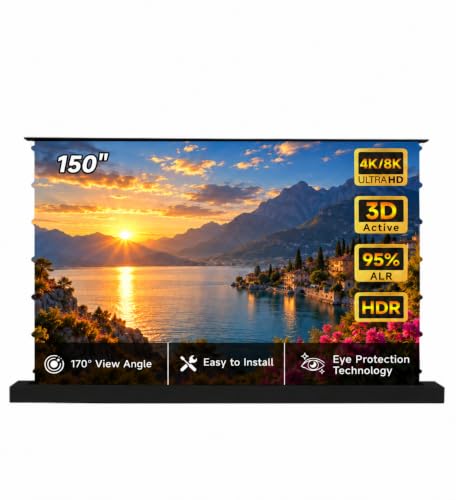
- 95% overhead ambient-light rejection
- Floor-rising motorized design
- Made for UST projectors and 4K/8K signals
Best For: Large UST home theaters and rental-friendly setups
Bright DIY Screen Choice
SilverMagic 100-Inch Gray ALR Material

- Up to 2.6x center-seat gain
- 30% ambient-light suppression
- Trim-to-fit wall or frame installation
Best For: Custom standard-throw projector installations
Portable Value Option
GAINVANE 100-Inch Portable ALR Screen

- Portable 100-inch 16:9 format
- 160° viewing angle
- Works indoors, outdoors, and with a separate tripod
Best For: Traveling movie nights and flexible presentations
Fixed-Frame UST Pick
NothingProjector 120-Inch PET Crystal ALR Screen

- 85% ambient-ceiling-light rejection
- 160° viewing angle for UST setups
- Flat, wrinkle-free fixed-frame design
Best For: Permanent UST theaters in bright living rooms
Best for Easy Setup
100-inch ALR Floor-Rising Screen

- Claims up to 95% ambient light rejection
- USB synchronization automates screen movement
- Supports 4K/8K and active 3D projection
Best For: UST projector owners wanting a large retractable screen
Best Portable Option

- Claims over 90% ambient light rejection
- Tripod or wall mounting supports flexible use
- Includes carry bag and adjustable-height stand
Best For: Indoor and outdoor movie nights or portable presentations
Best Fixed-Frame Choice
120-inch Standard-Throw ALR Screen

- Designed for standard-, medium-, and long-throw projectors
- Claims up to 70% ambient light rejection
- Tensioned aluminum frame promotes a flat surface
Best For: Permanent large-screen theaters using standard-throw projectors
Bright-Room Cinema Pick
Valerion 100-Inch Fresnel ALR Screen
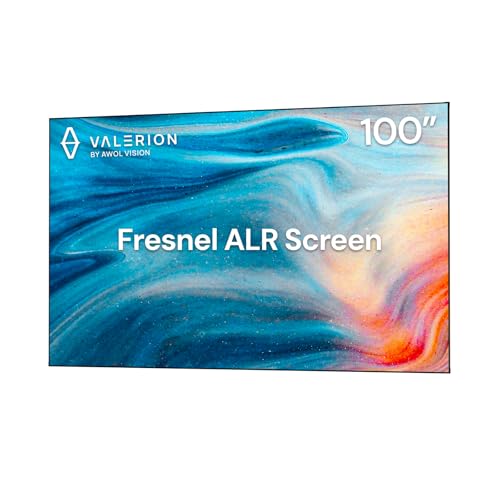
- Up to 85% overhead and side-light rejection
- 1.8 gain for brighter projection
- Designed for long-throw projectors
Best For: Daytime home cinema with a long-throw projector
UST Convenience Pick

- 95% ambient ceiling-light rejection claim
- Floor-rising design needs no wall mounting
- Remote and app-controlled adjustable height
Best For: Large UST setups needing retractable convenience
Top Motorized UST Pick – IN&VI 150-Inch CLR ALR Motorized Screen
For viewers seeking projector screens with ambient light rejection for an ultra-short-throw setup, this IN&VI floor-rising model combines a large 150-inch image with a CBSP prism surface rated to reject 95% of overhead ambient light. Its 0.6 gain finish is designed for contrast and comfortable extended viewing.
Best For: UST laser TV owners who want a large, motorized screen without drilling into a wall.
Pros:
- 95% overhead ambient-light rejection helps limit a hazy, washed-out image.
- Designed specifically for ultra-short-throw projectors, with a 170° viewing angle.
- Floor-rising motorized design supports remote, voice, and compatible projector-linked control.
- Supports 4K/8K UHD signals and active 3D.
Cons:
- The 150-inch size requires substantial floor and viewing space.
- Its 0.6 gain may not be the best fit when maximum brightness is the priority.
- It is intended for floor mounting rather than conventional wall installation.
This is the most feature-rich option here for a dedicated or rental-friendly UST theater. The combination of strong overhead-light rejection, large size, and automated storage makes it appealing when convenience matters as much as image contrast.
Bright DIY Screen Choice – SilverMagic 100-Inch Gray ALR Material
This SilverMagic material is a practical choice among projector screens with ambient light rejection when you need a brighter image from a standard-throw projector. Its gray surface is rated for up to 2.6x center-seat gain and 30% ambient-light suppression, while the material can be trimmed for a custom wall or frame installation.
Best For: Standard-throw projector users building a budget-conscious, custom-size wall or fixed-frame screen.
Pros:
- Provides up to 2.6x gain from center seating for a brighter image.
- Helps improve contrast and color saturation in rooms with some ambient light.
- Wall-safe tape installation is designed to take about 10 minutes.
- Can be trimmed to fit a particular wall or frame.
Cons:
- It is not intended for ultra-short-throw projectors.
- The 30° viewing angle is narrower than the wider-angle options in this roundup.
- It is a manual material rather than a motorized screen.
Choose this screen material when brightness and customization are more important than a wide seating layout. It offers a flexible DIY route, but compatibility with a standard-throw projector is essential.
Portable Value Option – GAINVANE 100-Inch Portable ALR Screen
For flexible indoor and outdoor viewing, this 100-inch GAINVANE model is one of the more portable projector screens with ambient light rejection. Its 16:9 surface is designed to reduce the effect of surrounding light while supporting front projection, and it can be hung with hooks or rope or used with a separate tripod.
Best For: Movie nights, presentations, and travelers who need a screen that can move between rooms or locations.
Pros:
- Portable 100-inch, 16:9 format suits home theater and presentation use.
- Designed to improve perceived color and clarity in brighter rooms.
- Offers multiple setup methods, including wall hooks, rope, or a separate tripod.
- Wide 160° viewing angle accommodates larger groups.
Cons:
- The tripod is not included and must be supplied separately.
- Its 90-day warranty is shorter than the one-year warranties listed for several alternatives.
- Manual hanging requires setup each time it is used.
This is a sensible pick when portability outweighs the convenience of a fixed or motorized installation. Its broad viewing angle and flexible mounting options make it useful for shared viewing, offices, and occasional outdoor events.
Fixed-Frame UST Pick – NothingProjector 120-Inch PET Crystal ALR Screen
This NothingProjector fixed-frame screen is designed for ultra-short-throw projectors in rooms where daylight or ceiling light can reduce contrast. Its PET Crystal surface is rated to reject up to 85% of ambient light, while the layered construction supports 4K UHD and 3D viewing across a 160° angle.
Best For: UST home theaters and bright living rooms where a flat, permanent wall-mounted screen is preferred.
Pros:
- Rejects up to 85% of ambient ceiling light.
- Made for UST projectors with a wide 160° viewing angle.
- Fixed-frame design and PET Crystal material are intended to stay flat and wrinkle-free.
- Supports 4K/8K UHD and active 3D content.
Cons:
- Wall mounting is less flexible than a portable or floor-rising design.
- The 120-inch screen needs adequate wall space.
- It is a manual fixed-frame screen without motorized retraction.
Consider this model when you want a clean, permanent UST installation with strong light rejection and a broad seating area. Its slim fixed-frame format favors a dedicated wall location over temporary or rental setups.
Best for Easy Setup – 100-inch ALR Floor-Rising Screen
If you need projector screens with ambient light rejection for a bright living room or dedicated theater, this 100-inch floor-rising model combines a high claimed rejection rate with motorized convenience. Its ALR surface is designed for UST projectors and supports 4K/8K content, while USB synchronization can automate raising and lowering the screen with compatible projectors.
Best For: UST projector owners who want a large, retractable screen with automated operation and strong ambient-light performance.
Pros:
- Claims up to 95% ambient light rejection for improved contrast and color in brighter spaces.
- Supports 4K and 8K content, active 3D, and a 170-degree stated viewing angle.
- USB-triggered synchronization can raise and retract the screen with projector power.
- Includes a three-year warranty and US-based customer support.
Cons:
- Its floor-rising design requires clear floor space and storage clearance.
- The supplied specifications list both a 170-degree and 160-degree viewing angle.
- Designed around UST use, so it may not be the right fit for every projector setup.
Choose this model when convenience and a retractable installation matter as much as ALR performance. Its large image area and synchronization feature make it particularly practical for a living-room theater, provided the floor-mounted case fits your layout.
Best Portable Option – 80-inch ALR Screen with Stand
For flexible indoor and outdoor viewing, this portable 80-inch screen pairs a tripod stand with an ALR gray surface. It claims over 90% ambient light rejection and uses a black backing to limit light transmission, while the included carry bag and roughly 10-pound listed weight make it easier to move between rooms or take outside.
Best For: Movie nights, camping, presentations, and other setups where quick assembly and portability are priorities.
Pros:
- Claims over 90% ambient light rejection with a 1.5 gain surface.
- Offers tripod or wall-mounted installation and a setup time of about two minutes.
- Adjustable height ranges from 45 to 89 inches for different viewing positions.
- Includes a carrying bag and support for indoor or outdoor use.
Cons:
- The 80-inch image area is smaller than the other screens in this roundup.
- A tripod setup needs adequate floor space and may be less permanent than a fixed frame.
- The manufacturer notes that indoor spaces should be wider than 70 inches and taller than 89 inches.
This is the practical choice for users who do not want a permanent installation. The combination of claimed ALR performance, adjustable height, and portable support makes it versatile, though a fixed or motorized screen may be preferable for a dedicated theater.
Best Fixed-Frame Choice – 120-inch Standard-Throw ALR Screen
This 120-inch fixed-frame model is designed for standard-throw, medium-throw, and long-throw projectors rather than UST units. Its gray nano-silver surface claims up to 70% ambient light rejection, while the tensioned aluminum frame is intended to keep the projection surface smooth for home theaters, living rooms, offices, and larger presentation spaces.
Best For: Standard-throw projector owners seeking a large, permanently wall-mounted screen with a flat, wrinkle-resistant surface.
Pros:
- Claims up to 70% ambient light rejection for brighter, higher-contrast images than a white screen.
- Supports 4K, 8K, and active 3D projection with 0.8 gain and a 160-degree viewing angle.
- Dual-tension construction is designed to maintain a smooth, wrinkle-free surface.
- Aluminum frame and black velvet border help absorb overshoot and improve the theater-style presentation.
Cons:
- Not compatible with ultra-short-throw projectors.
- The 120-inch frame requires substantial wall space, and two-person installation is recommended.
- The manufacturer advises using a higher-lumen projector for this screen.
Consider this screen when image flatness and a permanent theater installation outweigh portability. Verify your projector’s throw type and brightness first; this model is specifically positioned for standard-throw systems, not UST setups.
Portable Outdoor Pick – 80-Inch Foldable ALR Screen
If you need projector screens with ambient light rejection for flexible indoor and outdoor viewing, this 80-inch foldable model emphasizes portability and broad compatibility. Its optical coating is designed to improve contrast and color in brighter spaces while supporting short-throw and ultra-short-throw projectors.
Best For: Portable movie nights, sports viewing, gaming, presentations, and buyers who need an indoor/outdoor screen.
Pros:
- Six-layer PET optical coating supports 4K-level clarity and a 160-degree viewing angle.
- Designed to reduce the effects of ambient light, including natural light.
- Foldable, wall-mountable design is easy to store, transport, and install.
- Stain-resistant surface can be wiped clean with a microfiber cloth.
Cons:
- The listed warranty is limited to 30 days.
- At 80 inches, it provides less image area than the larger options in this roundup.
This is a practical choice when versatility matters more than a permanent installation. The wide viewing angle and portable design make it particularly appealing for multipurpose spaces and outdoor setups.
Bright-Room Cinema Pick – Valerion 100-Inch Fresnel ALR Screen
For buyers comparing projector screens with ambient light rejection for a dedicated cinema or bright living room, this 100-inch Fresnel screen is built specifically for long-throw projectors. Its 8-layer structure is rated to reject up to 85% of overhead and side ambient light, with a 1.8 gain intended to preserve brightness.
Best For: Long-throw home theater projectors, daytime viewing, and large-screen bright-room setups.
Pros:
- Fresnel ALR design targets overhead and side lighting, with up to 85% rejection.
- 1.8 gain helps deliver brighter visuals, while the 90-degree viewing angle supports multiple seats.
- Supports 4K and 8K projection and includes a scratch-resistant, easy-to-clean surface.
- Rollable construction supports transport and DIY installation.
Cons:
- It is not compatible with ultra-short-throw projectors.
- The 90-degree viewing angle is narrower than some competing screens.
- Its 33-pound weight may make installation less convenient than lighter portable screens.
This model makes the most sense when you have a long-throw projector and want a larger, brighter image in a room that is not fully dark. Confirm projector compatibility before buying, since UST units are excluded.
UST Convenience Pick – 120-Inch Motorized ALR Screen
This motorized floor-rising screen is a strong option for shoppers seeking projector screens with ambient light rejection for an ultra-short-throw setup. Its ST Carbon Black surface is designed for bright-room use and 4K UHD detail, while wireless controls and automatic operation reduce day-to-day setup work.
Best For: Ultra-short-throw projectors, large living rooms or basements, and users who want retractable, remote-controlled operation.
Pros:
- Designed for UST projection and listed with 95% ambient ceiling-light rejection.
- 120-inch floor-rising format offers a large 16:9 viewing area without wall mounting.
- Remote and app controls support adjustable height and automatic operation.
- Micro-perforated surface is intended to preserve sound transmission for immersive audio.
Cons:
- The floor-mounted design requires adequate floor space and storage clearance.
- Its automatic features may be more than needed for a simple fixed installation.
Choose this screen when convenience and UST compatibility are priorities. The retractable floor-rising design suits rooms where drilling is undesirable, while the wide 170-degree viewing angle accommodates broad seating.
How We Picked the Best Projector Screens with Ambient Light Rejection
We compared the selected screens by projector compatibility, ambient-light performance, image format, gain, installation style, portability, and intended viewing environment. Special attention went to whether each screen is designed for ultra-short-throw (UST) or standard-throw projection, since the wrong optical surface can create hotspots, uneven brightness, or poor viewing angles.
We also considered practical details such as screen size, motorized operation, frame construction, crease resistance, floor-rising stability, and suitability for indoor or outdoor use. Specifications such as advertised light-rejection percentages and gain ratings are manufacturer claims, so real-world results will vary with room lighting, projector brightness, placement, and wall color.
Quick Comparison
| Screen type | Best for | Main advantage | Potential trade-off |
|---|---|---|---|
| UST ALR | Laser TV-style setups | Rejects overhead and side light when paired correctly | Requires precise projector alignment |
| Standard-throw ALR | Traditional ceiling or rear-room projectors | Works with common long-throw placement | Not suitable for most UST projectors |
| Fixed frame | Dedicated media rooms | Flat, consistently tensioned viewing surface | Permanent installation |
| Motorized or floor rising | Multipurpose rooms | Screen can be hidden when not in use | Needs power and clearance |
| Portable | Outdoor movies and temporary setups | Easy to move and store | Usually less rigid than fixed frames |
Key Buying Factors for Projector Screens with Ambient Light Rejection
Match the Screen to Your Projector
Check whether the screen is made for UST or standard-throw projection before buying. UST screens use specialized directional surfaces, while standard-throw ALR material is intended for light arriving from a more conventional angle.
Consider Room Lighting and Viewing Position
ALR screens are most useful when light comes from predictable directions, such as ceiling fixtures or nearby windows. Compare the screen’s viewing angle with your seating layout. Highly directional surfaces may look brightest straight on but lose brightness or color consistency from the sides.
Balance Gain, Brightness, and Contrast
Higher gain can make an image appear brighter, but it may narrow viewing angles or increase hotspot risk. A bright projector may benefit from a moderate-gain screen that prioritizes contrast and uniformity, while a lower-lumen projector may need more light-efficient material.
Choose the Right Installation Style
Fixed-frame screens generally provide the flattest surface. Motorized and floor-rising models are better for rooms that serve multiple purposes, but measure the housing, floor area, outlet location, and available ceiling or wall clearance. Portable screens should have a stable stand or anchoring method, especially outdoors.
Verify Size and Aspect Ratio
A 16:9 screen suits most movies, streaming content, and home theater projectors. Measure the viewing distance and wall width before selecting a 100-, 120-, or 150-inch model. Larger is not always better if the projector lacks the brightness or throw distance to fill it evenly.
Who Should Buy Which Projector Screens with Ambient Light Rejection?
Choose a UST ALR screen if your projector sits close to the wall and you want a television-like setup in a bright room. Standard-throw ALR material is the better fit for ceiling-mounted or rear-room projectors. Pick a fixed-frame model for a dedicated theater where image uniformity matters most.
For shared living spaces, motorized or floor-rising screens offer a cleaner setup when the screen needs to disappear after viewing. Portable models make the most sense for occasional movie nights, travel, patios, or backyards, provided you can control wind and ambient lighting.