The best portable DACs with balanced output can deliver cleaner conversion, more power, and greater flexibility than a standard phone or laptop headphone jack. The right model depends on whether you prioritize pocket size, Bluetooth, output power, battery life, or precise control.
Our selection spans compact USB-C dongles, Bluetooth DAC amplifiers, and feature-rich portable units with both 3.5mm and 4.4mm connections. Use the guide below to match the specifications that matter most to your headphones and listening setup.
Best 10 Portable Dacs with Balanced Output Picks for 2026
Best Value Dongle

- 4.4mm balanced and 3.5mm outputs
- PCM 32-bit/384kHz and DSD256 support
- 60-step physical volume control
Best For: Compact wired listening from phones, tablets, and computers
Best Wireless Power

- Bluetooth 5.4 with LDAC and aptX Lossless
- 4.4mm balanced output with THX amplification
- Up to 650mW in desktop mode
Best For: Wireless and USB listening with demanding headphones
Best Tube Sound
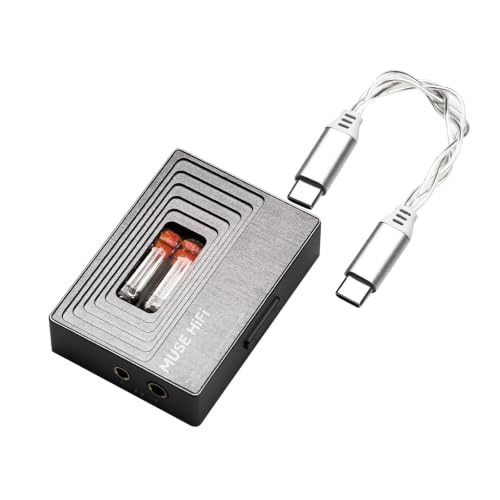
- JAN6418 vacuum-tube amplification
- 480mW 4.4mm balanced output
- PCM 384kHz and DSD256 support
Best For: Warm, characterful listening with IEMs and headphones
Best Feature-Rich Portable
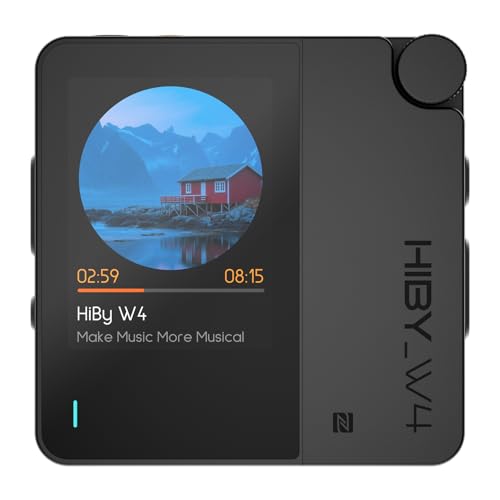
- Bluetooth 5.4 with LDAC and aptX Lossless
- 2-inch touchscreen with EQ and filters
- 4.4mm balanced output up to 475mW
Best For: Everyday wireless listening with extensive onboard controls
Best All-Rounder

- 3.5mm and 4.4mm balanced outputs
- Three gain levels and hardware volume buttons
- PCM 384kHz and native DSD256 support
Best For: Flexible phone, tablet, and computer listening
Best for DSP Customization

- Interactive app-based parametric DSP
- Dual CS43198 DAC architecture
- 100-level volume control with 4Vrms output
Best For: Listeners who want detailed EQ and system tuning
Best for High-Resolution Power
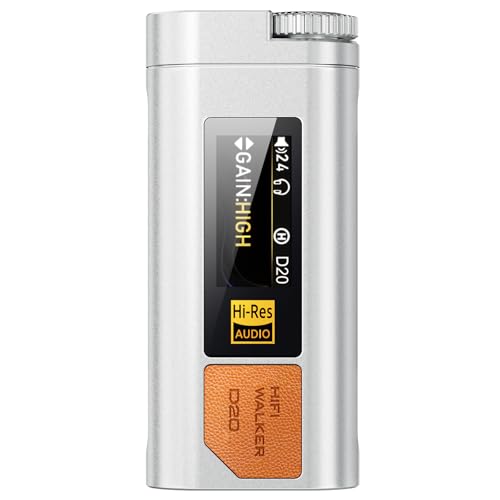
- PCM 768kHz and native DSD512 support
- Up to 280mW through the 4.4mm output
- OLED display with ALPS control knob
Best For: High-resolution listening and portable monitoring
High-Power Pick

- Up to 522mW balanced output at 32 ohms
- PCM 384kHz/32-bit and DSD256 support
- 18g body with OLED display and hardware controls
Best For: Listeners who prioritize powerful balanced drive in a pocket-sized DAC
Feature-Rich Choice
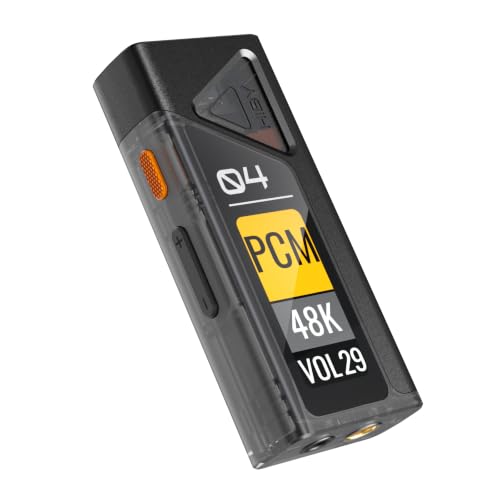
- Dual CS43131 DACs with DSD512 support
- 4.4mm balanced and 3.5mm outputs
- OLED display, hardware volume, and parametric EQ
Best For: Users who want balanced listening with app-based sound customization
Everyday Versatility
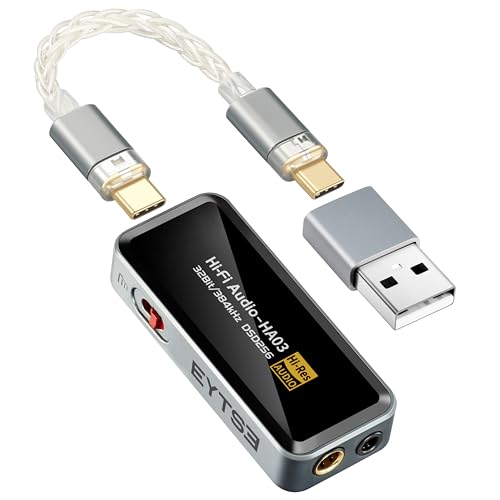
- 4.4mm balanced and 3.5mm outputs
- Dual CS43131 decoding up to DSD256
- Gain switch and physical playback controls
Best For: Mobile listeners who want flexible controls and easy device compatibility
Best Value Dongle – Fosi Audio DS2
The Fosi Audio DS2 is a straightforward choice for listeners seeking portable dacs with balanced output in a compact USB-C dongle. Its 4.4mm balanced connection, dual CS43131 DACs, high-resolution decoding, and physical volume controls make it practical for phones, tablets, and computers.
Best For: Buyers who want a small, wired DAC/amp with both 3.5mm and 4.4mm outputs and broad device compatibility.
Pros:
- Supports PCM up to 32-bit/384kHz and DSD256.
- Offers 4.4mm balanced and 3.5mm single-ended connections.
- Includes independent 60-step volume controls with memory.
- Compact CNC-machined metal housing and a 24-month warranty.
Cons:
- Requires a wired USB-C connection rather than Bluetooth.
- Its 4.4mm balanced output is most useful with compatible headphones or IEM cables.
The DS2 focuses on useful essentials instead of adding wireless features. With up to 170mW per channel at 32 ohms and support for phones, tablets, Macs, and PCs, it is a sensible everyday option for portable balanced listening.
Best Wireless Power – FiiO BTR17
The FiiO BTR17 combines Bluetooth convenience with a 4.4mm balanced output, making it a versatile pick among portable dacs with balanced output. It can work as a Bluetooth DAC/amp, USB sound card, or smartphone tail DAC, while its desktop mode provides up to 650mW of output power.
Best For: Listeners who want one portable device for wireless playback, USB use, and higher-power balanced headphone amplification.
Pros:
- Supports Bluetooth 5.4, LDAC, and aptX Lossless.
- Uses dual ES9069Q DACs and THX AAA 78+ amplification.
- Provides 3.5mm unbalanced and 4.4mm balanced outputs.
- Offers 10-band PEQ and PC, Bluetooth, and phone modes.
Cons:
- Its many modes and adjustment options may be more than casual listeners need.
- Maximum 650mW output depends on desktop mode and dedicated power input.
The BTR17 is the most flexible option here for users who move between wireless and wired sources. Its codec support, EQ controls, and high output ceiling make it especially appealing for demanding headphones and varied listening setups.
Best Tube Sound – MUSEHiFi M3 Ultra
The MUSEHiFi M3 Ultra takes a different approach to portable dacs with balanced output by pairing an ES9028Q2M DAC with a genuine JAN6418 vacuum tube. Its 4.4mm balanced output, tube amplification, and claimed 480mW output make it a distinctive choice for listeners who prefer a warmer presentation.
Best For: Music lovers who want portable balanced output with tube character for IEMs and headphones.
Pros:
- Uses a JAN6418 military-grade vacuum tube for richer harmonics and smoother mids.
- Delivers 480mW through 4.4mm balanced output and 460mW through 3.5mm.
- Supports PCM up to 32-bit/384kHz and DSD256.
- Includes triple noise reduction to help address tube microphonics.
Cons:
- Wired operation does not provide Bluetooth flexibility.
- Tube-based circuitry may appeal less to listeners seeking a strictly neutral presentation.
The M3 Ultra stands out for combining a portable form with tube amplification rather than following a conventional solid-state design. Its balanced output and low claimed THD+N give it useful technical capability while preserving its warmer, more characterful focus.
Best Feature-Rich Portable – HiBy W4
The HiBy W4 is a feature-rich option for shoppers comparing portable dacs with balanced output. Along with 3.5mm and 4.4mm outputs, it offers Bluetooth 5.4, NFC pairing, a touchscreen, EQ presets, and USB DAC operation for phones, computers, tablets, and digital audio players.
Best For: Users who want a portable Bluetooth DAC/amp with a screen, onboard controls, wireless codecs, and balanced headphone support.
Pros:
- Supports LDAC, aptX Lossless, aptX HD, and Snapdragon Sound.
- Includes dual CS43198 DACs and up to 475mW of output power.
- Provides both 3.5mm single-ended and 4.4mm balanced outputs.
- Offers a 2-inch touchscreen, EQ presets, filters, and three gain levels.
Cons:
- The touchscreen and extensive controls add complexity compared with a basic dongle.
- Some advanced functions may require navigating multiple settings.
The W4 is a strong choice when a portable DAC needs to do more than convert USB audio. Its wireless connectivity, display, clip, charging modes, and balanced output make it suited to daily carry and varied listening environments.
Best All-Rounder – TempoTec Sonata BHD
If you want portable DACs with balanced output without giving up everyday flexibility, the TempoTec Sonata BHD is a practical option. It combines 3.5mm single-ended and 4.4mm balanced ports, three gain levels, hardware volume buttons, and plug-and-play support for phones and computers.
Best For: Listeners who use both IEMs and headphones across Android, iOS, Mac, and Windows devices.
Pros:
- Offers both 3.5mm and 4.4mm balanced outputs.
- Three gain settings help accommodate sensitive IEMs and more demanding headphones.
- Physical volume buttons allow independent, precise adjustment.
- Supports PCM up to 32-bit/384kHz and native DSD256.
Cons:
- Windows compatibility is specified for Windows 10 version 1703 and later.
- Power output figures are not provided in the supplied specifications.
The Sonata BHD stands out as a compact, versatile choice for users who need balanced connectivity and simple controls rather than a display or extensive customization.
Best for DSP Customization – MOONDROP Dawn PRO 2
The MOONDROP Dawn PRO 2 is a strong fit for buyers seeking portable DACs with balanced output and software-based sound shaping. Its dual CS43198 DACs, 100-level volume control, and interactive DSP allow more detailed system tuning than a basic plug-and-play dongle.
Best For: Audiophiles who want adjustable EQ and a compact amplifier with both 3.5mm and 4.4mm outputs.
Pros:
- Interactive DSP supports adjustable filter, frequency, gain, and Q settings through the MOONDROP app.
- Uses dual Cirrus Logic CS43198 DAC chips and three independent LDO power chips.
- Provides 4Vrms output voltage and 124 + 124mW output.
- 100-level independent DAC volume control enables fine adjustments.
Cons:
- DSP customization depends on the MOONDROP app.
- The supplied notes do not specify operating-system compatibility.
Choose the Dawn PRO 2 if app-based tuning is a priority. Its aluminum housing and venting also support heat management, while the balanced-ready design targets users who want a more configurable portable setup.
Best for High-Resolution Power – HIFI WALKER D20 DAC512
For shoppers comparing portable DACs with balanced output, the HIFI WALKER D20 DAC512 emphasizes high-resolution support and stronger balanced output. It pairs an ES9038Q2M DAC with a CT7601PR USB chipset, adds an OLED display and ALPS knob, and supports PCM 768kHz and native DSD512.
Best For: Audiophiles and creators who want a display-equipped USB DAC for headphones, monitoring, or high-resolution playback.
Pros:
- Supports PCM up to 32-bit/768kHz and native DSD512.
- 4.4mm balanced output delivers up to 280mW, while 3.5mm output delivers up to 70mW.
- OLED display and ALPS knob provide convenient control and menu navigation.
- CNC aluminum construction and low-jitter FPGA clocking target portable high-fidelity use.
Cons:
- Its 0.13 kg weight is higher than many minimalist dongle-style DACs.
- The supplied notes do not provide detailed battery or standalone power specifications.
The D20 DAC512 is the most feature-focused option here for users who value very high format support, visible controls, and additional balanced-output power in a compact aluminum chassis.
High-Power Pick – Joliker V6633
For listeners seeking portable DACs with balanced output, the Joliker V6633 stands out for its high claimed power, compact size, and useful OLED display. Its 4.4mm balanced connection is rated up to 522mW at 32 ohms, while a 3.5mm output supports broader compatibility.
Best For: Users who want a particularly powerful pocket DAC for demanding headphones and IEMs.
Pros:
- 4.4mm balanced output rated up to 522mW at 32 ohms.
- Supports PCM 384kHz/32-bit and DSD256 playback.
- 18g design includes an OLED display and independent hardware volume buttons.
- Works with iPhone 15/16, Android, Windows, and Mac devices.
Cons:
- Its 4.4mm balanced output is the main attraction, so users with only 3.5mm cables will not access the highest rated output.
- The supplied notes do not specify battery capacity or runtime.
The V6633 is a strong choice when output power matters most. It combines a notably high balanced-output rating with a small form factor, display, and straightforward USB-C compatibility.
Feature-Rich Choice – HiBy Music FC4
The HiBy Music FC4 is one of the more feature-rich portable DACs with balanced output. Along with 4.4mm and 3.5mm connections, it adds dual DAC chips, a color OLED display, hardware volume memory, and app-based EQ customization.
Best For: Listeners who want balanced output plus extensive playback controls and sound customization.
Pros:
- Dual CS43131 DACs support DSD512, PCM 768kHz/32-bit, and MQA 8X.
- 4.4mm balanced output is rated up to 151mW at 32 ohms.
- HiByMusic app offers presets and parametric EQ adjustment.
- Compatible with iOS, Android, Windows, macOS, PS5, and Switch.
Cons:
- The balanced output rating is lower than the Joliker V6633’s supplied rating.
- Its additional app and EQ features may be unnecessary for listeners seeking a simple dongle.
The FC4 is a versatile option for buyers who value control as much as connectivity. Its display, 30-step hardware volume adjustment, and PEQ support make it especially adaptable across headphones, IEMs, and source devices.
Everyday Versatility – EYTSE HA03
The EYTSE HA03 focuses on practical portability, offering both balanced and single-ended outputs in an 18g aluminum-and-glass body. For shoppers comparing portable DACs with balanced output, its physical gain switch is useful for moving between sensitive IEMs and more power-hungry earphones.
Best For: Everyday mobile listening where gain control, physical buttons, and broad USB-C compatibility are priorities.
Pros:
- Includes 4.4mm balanced and 3.5mm single-ended outputs.
- Dual CS43131 decoding supports up to 32-bit/384kHz and DSD256.
- Physical gain switch helps tailor output for sensitive IEMs or demanding planar earphones.
- 18g aluminum body includes playback and volume buttons, plus USB-C and USB-A adapters.
Cons:
- The supplied notes do not provide a specific balanced-output power rating.
- It is USB powered, so it draws power from the connected source.
The HA03 is a sensible convenience-first choice. Its gain control, onboard buttons, included adapters, and compact construction make it well suited to daily use across phones, computers, and tablets.
How We Picked the Best Portable Dacs with Balanced Output
We focused on portable models that include a 4.4mm balanced output alongside, or instead of, a 3.5mm connection. We compared their connection options, advertised decoding support, output power, control features, compatibility, and portability. The list includes simple USB dongles for phones and computers as well as Bluetooth-capable DAC amps for wireless convenience.
Specifications such as DSD and PCM support are useful indicators of format compatibility, but they do not guarantee better sound by themselves. Practical factors—including noise with sensitive IEMs, gain adjustment, battery behavior, and connector quality—often matter more in daily use.
Quick Comparison
| Type | Best For | What to Look For |
|---|---|---|
| Basic USB-C dongle | Affordable phone or laptop upgrades | Low noise, volume controls, device compatibility |
| Balanced USB DAC amp | Wired IEMs and headphones | Output power, gain levels, 4.4mm durability |
| Bluetooth DAC amp | Wireless listening and mobile convenience | Bluetooth codecs, battery life, onboard controls |
| Feature-rich portable unit | Enthusiasts and multiple headphones | EQ, screen, app support, outputs, and amplification |
Key Buying Factors for Portable Dacs with Balanced Output
Balanced Output and Power
A 4.4mm balanced output can provide more available power and better channel separation, but your headphones must use a compatible balanced cable. Do not connect a single-ended cable with an adapter that ties channels together. Check the manufacturer’s power rating at your headphone’s impedance, not only the maximum headline figure.
USB, Bluetooth, and Device Support
USB-C models are usually the simplest choice for Android phones, tablets, Macs, PCs, and newer iPhones, though some phones may require OTG settings or an adapter. Bluetooth models add convenience and can support codecs such as LDAC or aptX Lossless, but codec availability depends on both the source and receiver.
Noise, Gain, and Controls
Sensitive IEMs benefit from a quiet amplifier and adjustable gain. Physical volume buttons are useful with phones, while a screen, EQ, or app can make a larger Bluetooth unit easier to customize. Consider whether the DAC draws power from the source or has its own battery.
Size and Everyday Durability
Small dongles are easiest to carry but may offer fewer controls and less power. Larger units can provide stronger amplification, Bluetooth, displays, or longer battery life. Also check cable strain relief, connector placement, heat, and whether the 4.4mm jack feels secure in a pocket or bag.
Who Should Buy Which Portable Dacs with Balanced Output?
Choose a compact USB-C dongle if you want an inexpensive, wired upgrade for IEMs or efficient headphones. Pick a balanced DAC amp with gain control if you use harder-to-drive headphones or want the extra headroom of a 4.4mm connection. A Bluetooth model is better for listeners who want to keep their phone in a pocket while controlling playback wirelessly. Choose a screen- or EQ-equipped unit if you regularly switch headphones and want more tuning and playback control.
Before buying, confirm your source connector, headphone cable termination, required power, and preferred codec. Those checks will narrow the field more reliably than chasing the highest sample-rate or DSD specification.