The right gear can make a backyard expedition, day hike, or scout-style outing more engaging without weighing kids down. These 10 picks cover clothing, packs, navigation tools, and ready-to-go explorer kits.
Start with your child’s age and the activities they’ll actually do. A comfortable vest or simple kit may suit a younger explorer better than specialized equipment; older kids may get more use from a compass or hiking pants.
Best 10 Kids Scout Style Gear Picks for 2026
Skill-Building Kit
ZLemma Kids Outdoor Explorer Kit

- Beginner knife with locking mechanism
- Compass, whistle, and fire starter included
- Waterproof pouch and two carabiners
Best For: Supervised outdoor-skill practice
Convertible Trail Wear
Zoofly Kids Cargo Hiking Pants

- Zip-off legs convert to shorts
- UPF 50, quick-drying fabric
- Four secure pockets
Best For: Variable-weather hikes and camp days
Observation Starter Set

- 30mm kids binoculars and lensatic compass
- Whistle with built-in thermometer
- Flashlight requires two AA batteries
Best For: Nature observation and beginner navigation
Gear-Carrying Daypack

- Approximately 20-liter capacity
- Multiple pockets and front MOLLE webbing
- Padded back and adjustable straps
Best For: Organizing supplies for school and day trips
Portable Nature Kit

- Six tools including a backpack
- Hand-crank flashlight
- Binoculars are not water-resistant
Best For: Ages 4–8 exploring backyards and trails
Convertible Trail Pants
Kids Zip-Off Cargo Hiking Pants

- Zip off legs to make shorts
- Lightweight UPF 50 fabric
- Water-repellent, not guaranteed waterproof
Best For: Big kids hiking in variable temperatures
Team Adventure Set
Box O' Mart Explorer Kit with Walkie-Talkies

- Two kid-sized walkie-talkies
- Binoculars and nature tools included
- AAA batteries not included
Best For: Ages 4+ exploring with a partner
Map Skills Pick
Advanced Scout Orienteering Compass

- 360-degree rotating bezel
- Magnifier and 1:24,000 ruler scale
- Compact baseplate with lanyard
Best For: Learning map-reading and bearings
Dress-Up Explorer Pick
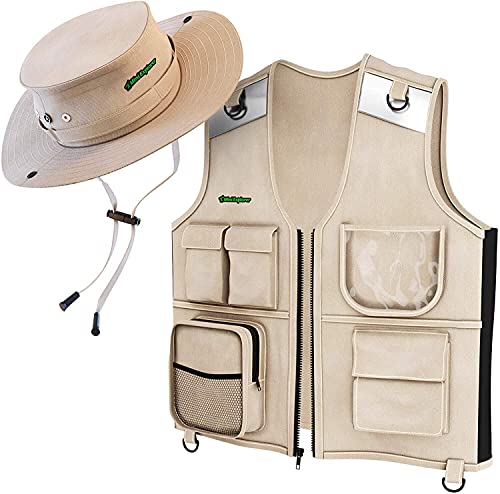
- Vest and hat for ages 3–6
- Multiple pockets and four rings
- Front and back reflective strips
Best For: Backyard explorer dress-up
Two-Compass Pick
Waterproof Mini Orienteering Compasses

- Two compasses listed
- 360-degree dial and magnifier
- Described as waterproof
Best For: Sharing basic navigation gear
Skill-Building Kit – ZLemma Kids Outdoor Explorer Kit
For kids scout style gear that introduces hands-on outdoor skills, this kit pairs a beginner pocket knife with a compass, whistle, ferro-rod fire starter, survival card, and carrying accessories. It is aimed at young explorers ages 7–12.
Best For: Supervised introductions to camping tools and basic outdoor skills.
Pros:
- Rounded knife blade, ergonomic wooden handle, and locking mechanism.
- Includes a whistle, compass, fire starter, survival card, and paracord lanyard.
- Waterproof pouch and two carabiners make the kit easy to carry.
Cons:
- Knife and fire starter require close adult supervision.
- More gear to manage than a simple exploration toy.
This is the most tool-focused option here. Choose it when practicing skills matters more than packing light, and set clear rules for using the blade and fire starter.
Convertible Trail Wear – Zoofly Kids Cargo Hiking Pants
These convertible pants cover the clothing side of kids scout style gear: zip-off legs switch between pants and shorts, while lightweight, quick-drying fabric is listed as water-resistant and UPF 50. Four secure pockets give kids room for small trail essentials.
Best For: Hikes and camp days with changing temperatures.
Pros:
- Zip-off legs offer pants and shorts in one garment.
- Elastic waistband and drawstring allow an adjustable fit.
- Two zippered and two hook-and-loop pockets help secure small items.
- Machine-washable, stretchable polyester-spandex fabric.
Cons:
- Water-resistant fabric is not the same as waterproof rain gear.
- Check the listed waist and inseam measurements before ordering.
The practical draw is versatility rather than specialized protection. They make sense for active days when pocket storage and a quick switch to shorts are useful.
Observation Starter Set – Carson AdventurePak
The Carson AdventurePak keeps kids scout style gear focused on observing and navigating: it bundles 30mm kids binoculars, a lensatic compass, a flashlight, and a signal whistle with a built-in thermometer. A pouch and strap are included for carrying the set.
Best For: Kids who want a starter set for looking, navigating, and signaling outdoors.
Pros:
- Combines binoculars, compass, flashlight, and whistle in one set.
- Lensatic compass supports hand-bearing triangulation.
- Includes a pouch case and strap.
Cons:
- Flashlight needs two AA batteries, which are not included.
- No knife or fire starter if hands-on survival tools are the goal.
This is a straightforward pick for nature walks and beginner navigation activities. Add batteries before heading out so the flashlight is ready to use.
Gear-Carrying Daypack – Kids Tactical MOLLE Backpack
For carrying kids scout style gear rather than supplying the tools themselves, this approximately 20-liter backpack offers a main compartment, exterior zippered pockets, side bottle pockets, and front MOLLE webbing. Its padded back and adjustable, breathable shoulder straps are designed for everyday outings.
Best For: Organizing school supplies and lightweight gear for day trips.
Pros:
- Multiple compartments and bottle pockets separate essentials.
- Front MOLLE webbing allows compatible add-ons.
- Reinforced stitching and water-resistant construction suit light rain.
- Includes two patches and a carabiner.
Cons:
- Water-resistant construction is not a promise of waterproof storage.
- Hand washing is specified for care.
This is the storage choice in the lineup. Its organization is useful for school or outings, though the pack does not replace the exploration tools you may want to carry inside.
Portable Nature Kit – ESSENSON Kids Explorer Kit
For kids scout style gear focused on observing nature, this ESSENSON kit puts binoculars, a magnifying glass, compass, whistle, and hand-crank flashlight in a lightweight backpack. It gives young explorers several ways to investigate a backyard or family hike.
Best For: Kids ages 4–8 who want a portable set of basic exploration tools.
Pros:
- Includes six exploration essentials, including the carrying backpack.
- Hand-crank flashlight does not depend on replacement batteries.
- Compact, lightweight tools suit backyard and hiking activities.
Cons:
- Binoculars are listed as not water-resistant.
- Plastic construction may not suit rough handling.
Choose this set for hands-on nature play rather than wet-weather adventures; its appeal is the variety of tools in one easy-to-carry kit.
Convertible Trail Pants – Kids Zip-Off Cargo Hiking Pants
Clothing is a practical part of kids scout style gear, and these cargo pants offer zip-off legs for changing between pants and shorts. Their lightweight nylon-spandex fabric is described as quick-drying, with UPF 50 sun protection for outdoor activities.
Best For: Big kids who need versatile pants for hikes, camping, and changing temperatures.
Pros:
- Zip-off legs provide a shorts option without packing a second pair.
- UPF 50 fabric adds sun protection when worn as pants.
- Machine-washable, quick-drying fabric is convenient for active days.
Cons:
- Zip-off legs add a step when switching between pants and shorts.
- Water-repellent fabric should not be treated as a guarantee of waterproof protection.
These are a useful pick when flexibility matters more than specialized rain gear; check the listed sizing before ordering for a growing child.
Team Adventure Set – Box O' Mart Explorer Kit with Walkie-Talkies
For kids scout style gear that supports group play, this outdoor set pairs two kid-sized walkie-talkies with binoculars and nature-observation tools. A camo cap and drawstring backpack round out the kit for backyard games or camping trips.
Best For: Kids ages 4 and up who want to explore and communicate with a partner.
Pros:
- Two walkie-talkies let children practice communicating during team games.
- Includes 4x30mm binoculars, a magnifying glass, and compass tools.
- Drawstring backpack helps keep the gear together.
Cons:
- Each walkie-talkie requires four AAA batteries, which are not included.
- The walkie-talkies are listed as not water-resistant.
This set stands out for two-person play, though buyers should budget for batteries and keep the radios out of wet conditions.
Map Skills Pick – Advanced Scout Orienteering Compass
For kids scout style gear that teaches hands-on navigation, this baseplate compass offers more map-reading features than a simple direction finder. It has a rotating 360-degree bezel, a magnifier and a 1:24,000 ruler scale.
Best For: Kids learning to read maps with adult guidance, plus hikers who want a compact compass.
Pros:
- Liquid-filled capsule lets the magnetic needle move freely.
- Magnifier and ruler scale help with map work.
- Compact 4-by-2.4-inch baseplate includes a lanyard.
Cons:
- Manual navigation features take practice to use.
- Plastic construction may not suit shoppers seeking a metal compass.
This is the strongest fit of the three for practicing bearings and plotting routes, provided someone is ready to teach the basics.
If kids scout style gear means dressing for backyard adventures, this vest-and-hat set gives ages 3–6 places to carry small finds and accessories. It works as outdoor playwear or an explorer costume.
Best For: Children ages 3–6 who enjoy pretend expeditions and collecting things outdoors.
Pros:
- Vest has cargo, clear, zipper and mesh pockets, plus four rings.
- Reflective strips appear on the front and back.
- Includes a hat with an adjustable neck string.
Cons:
- Includes only the vest and hat, not exploration tools.
- Sized for ages 3–6, so it is not intended for older kids.
Choose this for imaginative play and storage rather than navigation instruction; the pockets are its main practical advantage.
For kids scout style gear shared between two young explorers, this listing specifies two compact compasses. Each is described with a floating 360-degree dial, magnifier and map-reading scale.
Best For: Families or small groups wanting two portable compasses for introductory outdoor navigation.
Pros:
- Listing specifies two compasses.
- Magnifier, directional arrow and orienting lines support map use.
- Acrylic construction is described as waterproof and fall-resistant.
Cons:
- The stated “1:360” map scale is unclear; verify it before relying on scale measurements.
- The notes do not specify separate accessories for each compass.
The two-count package makes this a convenient sharing option. For precise route plotting, check the scale markings on the actual compasses first.
How We Picked This Kids Scout Style Gear
We focused on gear that serves a clear purpose on outdoor outings: clothing for comfort, packs for carrying essentials, compasses for learning navigation, and kits for hands-on exploration. The selection spans younger children and older kids developing more independent skills. Because product names alone cannot establish build quality or safety, check current specifications, age guidance, and buyer feedback before purchasing.
Quick Comparison: Which Type Fits Your Plans?
For backyard play or a first nature walk, explorer kits and a vest-and-hat set offer an easy starting point. A binocular-and-compass bundle gives curious kids several activities in one package. For regular hikes, prioritize well-fitting cargo or convertible pants and a backpack sized for the child. A standalone compass makes more sense when you plan to teach map-reading; choose one with markings your child can actually read.
Adventure sets with walkie-talkies can make group play more interactive, but check the stated operating range and battery requirements. A survival kit that includes a pocket knife calls for a different level of supervision than a toy-focused kit.
Key Buying Factors for Kids Scout Style Gear
Age, Safety, and Supervision
Follow each manufacturer’s age recommendation, especially for small accessories, batteries, and sharp tools. A knife’s safety lock does not make it suitable for unsupervised use. Review local rules and any scout-group policies before bringing blades or fire starters to an activity. If your child is not ready for those tools, choose a kit without them.
Fit and Carrying Comfort
Check garment size charts and look for room to move, bend, and layer. Convertible pants should be comfortable in both configurations, with zippers that do not rub. For backpacks, compare dimensions and strap adjustment rather than relying on a “kids” label; a loaded pack should remain manageable for the child.
Useful Features Over Extras
Choose tools that match the outing. A basic compass is more valuable when paired with a map and an adult-led lesson. Binoculars should be easy for small hands to hold and adjust. For electronics, confirm battery type and pack spares if needed. Water resistance, visibility, and secure places to store small items may matter more on a trail than a long accessory list.
Who Should Buy Which Kids Scout Style Gear?
For ages 3–6, consider the vest-and-hat costume for imaginative outdoor play, following its stated age range. For ages 4–8, an explorer kit can introduce observation without requiring specialized skills. For a child learning directions, choose a readable orienteering compass and practice together in a familiar area. For frequent hikes, start with comfortable pants and an appropriately sized pack, then add tools your child knows how to use. Reserve knife- or fire-starting gear for children who are ready for direct adult instruction and supervision.