Moisture-sensitive filament can cause popping, stringing, weak layers, and inconsistent extrusion. A compact filament dryer helps restore and maintain material quality without taking over your workbench.
We compared 10 current dryers across heating performance, spool capacity, temperature control, storage design, and everyday usability so you can choose the right fit for your printer setup.
Best 10 Compact Filament Dryers Picks for 2026
Best High-Heat Pick

- Heats to 65°C within 15 minutes
- Adjustable 45–65°C and 0–24-hour timer
- Fits one 1 kg spool and common filament types
Best For: Fast, single-spool drying with broad material support
Best Large-Screen Option

- Reaches up to 70°C
- Supports 0–99-hour drying times
- Fits 1.75, 2.85, and 3.00 mm filament
Best For: Flexible drying settings and convenient touch controls
Best Two-Spool Capacity
Comgrow SH01 Filament Dryer Box

- Holds two 1 kg spools
- Monitors temperature and humidity in real time
- Maximum temperature is 50°C
Best For: Dry storage and feeding for two standard spools
Best Quiet Dryer

- Rated below 10 dB during operation
- Adjustable 35–55°C temperature range
- Supports 1–99-hour drying times
Best For: Quiet, single-spool drying during printing
Dual-Spool Fast Dryer
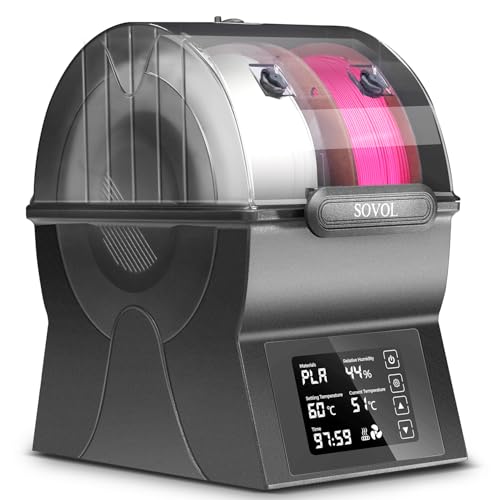
- Dries two 1 kg spools at once
- 150W PTC heater with 40–70°C control
- Nine one-key filament presets
Best For: Multi-spool printing and faster routine drying
Feature-Rich Dual Dryer
Creality Space Pi Filament Dryer Plus
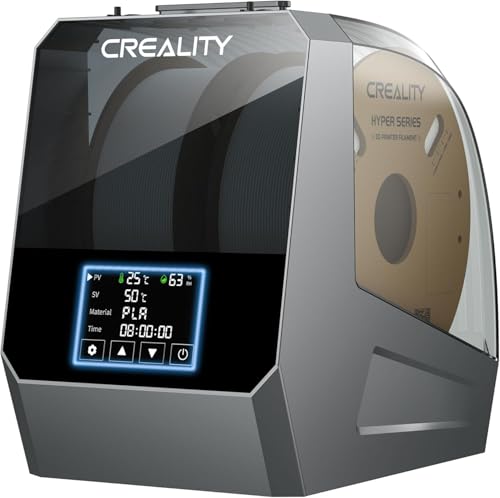
- Two 1 kg spools with four filament holes
- 160W double 360° PTC heating
- 12 presets and a 4-inch touch screen
Best For: Broad filament compatibility and detailed controls
Simple Sealed Storage

- Holds two narrow or one wide spool
- Real-time temperature and humidity display
- Sealed storage with built-in fan
Best For: Basic filament drying and moisture-protected storage
Best Integrated Moisture Control

- Dries, stores, and prints without breaking the seal
- Supports common filament types and three filament sizes
- Adds airflow, hygrometer monitoring, and desiccant support
Best For: Makers wanting an all-in-one dry-store-print workflow
Best for High-Volume Drying

- Holds four 1kg or two 2kg spools
- Uses dual 200W chambers with temperatures up to 85°C
- Provides sealed storage and separate temperature control
Best For: Users managing multiple spools or larger filament batches
Best for Multi-Printer Workflows
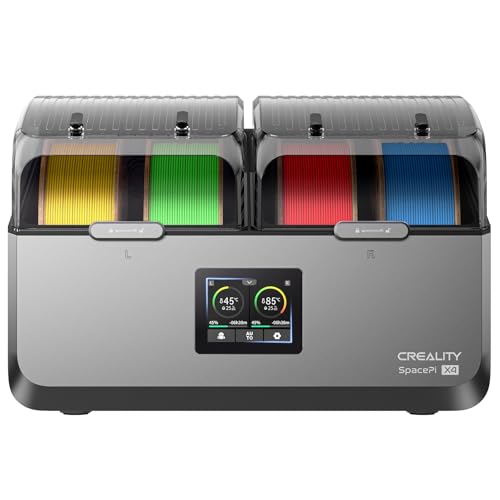
- Dries and prints with four spools simultaneously
- Offers eight filament holes and PTFE tubing
- Reaches 85°C with dual independent heating chambers
Best For: Multi-printer setups using several filament types
Best High-Heat Pick – Creality Space Pi SE
For shoppers seeking compact filament dryers with quick, controlled heating, the Creality Space Pi SE offers a focused single-spool design with adjustable settings and real-time monitoring. Its PTC heating system reaches 65°C within 15 minutes, while insulation and 360-degree air circulation help distribute heat throughout the chamber.
Best For: Users who want fast drying for one 1 kg spool and support for a broad range of common filament materials.
Pros:
- Heats to 65°C within 15 minutes with PTC heating.
- Adjustable temperature from 45°C to 65°C and drying time from 0 to 24 hours.
- Supports 1.75 mm and 2.85 mm filament, including PLA, PETG, ABS, ASA, TPU, and nylon.
- Displays humidity and drying time with a screen and control knob.
Cons:
- Designed for one 1 kg spool rather than multiple rolls.
- Its 65°C maximum may be limiting for materials requiring higher drying temperatures.
The Space Pi SE is a practical compact filament dryer when quick warm-up, broad compatibility, and straightforward controls matter most. After drying, the manufacturer recommends storing filament in a vacuum bag to help maintain dryness.
Best Large-Screen Option – SUNLU Filament Dryer S2
The SUNLU S2 is one of the more versatile compact filament dryers for users who want a wide temperature range and a simple touch interface. It can dry filament while printing, and its internal spindle continuously rotates the spool for more even exposure to heat.
Best For: Makers who value broad spool compatibility, a large touch screen, and extended timer options.
Pros:
- Adjustable temperature from 35°C to 70°C.
- Supports drying times from 0 to 99 hours.
- Fits 1.75 mm, 2.85 mm, and 3.00 mm filament.
- Translucent lid lets users check the spool without opening the dryer.
Cons:
- The listed capacity is larger than some compact single-spool dryers, so it may take more workspace.
- At 1.51 kg, it is heavier than the Creality model in this comparison.
Choose the S2 if flexible settings and convenient monitoring are higher priorities than the smallest possible footprint. Its ability to act as a spool holder during printing also suits humid environments where filament needs ongoing protection.
Best Two-Spool Capacity – Comgrow SH01 Filament Dryer Box
The Comgrow SH01 stands out among compact filament dryers for its ability to hold two 1 kg spools. It combines sealed storage, drying during printing, and temperature and humidity monitoring, making it useful when you want to protect multiple rolls in one enclosure.
Best For: Users who need two-spool storage and do not require drying temperatures above 50°C.
Pros:
- Stores two 1 kg spools in its stated interior volume.
- Works with 1.75 mm and 2.85 mm filament.
- Includes real-time temperature and humidity monitoring.
- Sealed outlet uses a silicone cable sheath and Teflon tube for feeding during printing.
Cons:
- Maximum temperature is 50°C, lower than the other dryers listed here.
- Drying time settings are limited to 6 or 12 hours.
- The sealing hole must be opened during drying and closed for storage.
The SH01 is a strong capacity-focused choice for standard PLA, PETG, and ABS workflows. Its lower temperature ceiling and limited timer options make it less flexible, but the two-spool design can reduce the need for separate storage boxes.
Best Quiet Dryer – SUNLU Filament Dryer S1 Plus
For shoppers comparing compact filament dryers for a quieter workspace, the SUNLU S1 Plus combines drying during printing with a low-noise design. Its adjustable controls cover common filament needs, while two internal rollers allow the spool to feed as it dries.
Best For: Home, office, or bedroom setups where quiet operation and simple single-spool drying are important.
Pros:
- Operates at less than 10 dB according to the supplied specifications.
- Adjustable temperature range of 35°C to 55°C.
- Supports drying times from 1 to 99 hours.
- Compatible with 1.75 mm, 2.85 mm, and 3.00 mm filament.
Cons:
- Its 55°C maximum is lower than the Creality and SUNLU S2 models.
- The listed spool capacity is limited to 210 mm by 85 mm in height.
The S1 Plus is a sensible compact filament dryer for common materials and noise-sensitive environments. It offers useful timing flexibility and in-use feeding, though users working with materials that need higher temperatures should consider a hotter model.
Dual-Spool Fast Dryer – Sovol SH02 Filament Dryer
For makers comparing compact filament dryers, the Sovol SH02 stands out by drying two 1 kg spools at once while retaining a relatively tidy footprint. Its 150W PTC heater, circulating fan, sealed design, and preset material modes make it a practical option for regular multi-material printing.
Best For: Users who want dual-spool drying, faster warm-up, and simple presets for common filament types.
Pros:
- Dries two 1 kg rolls simultaneously and includes two filament holes for flexible printer placement.
- 150W PTC heating reaches 50°C in about seven minutes and supports 40–70°C adjustment.
- Preset modes cover nine filament types, including PLA, TPU, PETG, ABS, PA, and PP.
- Improved sealing helps protect filament from moisture and dirt even when powered off.
Cons:
- Desiccant bags are not included.
- The unit is listed as compatible with 1.75 mm and 2.85 mm filament, but the supplied notes do not specify spool-width limits.
The SH02 is a strong all-around pick when two active printers or larger filament workloads make single-spool drying inconvenient. Its safety cutoff and fan alarm add useful protection for routine operation.
Feature-Rich Dual Dryer – Creality Space Pi Filament Dryer Plus
Among compact filament dryers, the Creality Space Pi Plus is aimed at users who want broad material support and a more informative interface. It combines dual-spool capacity with double 360° PTC hot-air heating, four filament holes, and a 4-inch touch screen.
Best For: Users drying two spools while working with standard, composite, or higher-performance filaments.
Pros:
- Holds two 1 kg rolls and provides four filament holes with two PTFE pipes for up to two printers.
- 160W double PTC heating circulates hot air 360° for more uniform drying.
- One-key settings support 12 filament types, with manual adjustment from 45–70°C.
- 4-inch LCD touch screen displays drying conditions and supports Celsius/Fahrenheit switching.
Cons:
- The supplied listing describes the product as a two-pack in its details, so package contents should be verified before ordering.
- Its feature-rich design may be more than needed for users drying only one common filament type.
The Space Pi Plus is the most versatile choice of these three for material variety and interface controls. Choose it when presets for composite filaments and a touch display matter as much as compact dual-spool operation.
Simple Sealed Storage – Sovol SH01 Filament Dryer
The Sovol SH01 is a straightforward option for shoppers seeking compact filament dryers with storage capability. It uses a built-in fan for more even heating, displays temperature and humidity in real time, and can hold two narrower spools or one wider spool.
Best For: Users who want an uncomplicated dryer with real-time monitoring and power-off filament storage.
Pros:
- Stores two spools under 70 mm wide or one spool under 150 mm wide.
- Real-time temperature and humidity display helps monitor the drying environment.
- Silicone and PTFE sealing protect filament during unpowered storage, with space for four desiccant bags.
- Built-in fan supports more even heating during drying.
Cons:
- Temperature settings are limited to 40°C, 45°C, and 50°C, with six- to 12-hour timing.
- The supplied notes say to open the PTFE seals during heating so moisture can escape.
- In rooms below 16°C, the box may not reach 50°C.
The SH01 is a sensible value-oriented choice for common filament maintenance, especially when sealed storage and humidity monitoring are priorities. Its lower temperature range makes it less flexible than newer models for demanding materials.
Best Integrated Moisture Control – Polymaker PolyDryer
For users seeking compact filament dryers that also simplify storage, the Polymaker PolyDryer combines heated drying, sealed storage, and direct printing in one connected setup. Its airflow system and built-in hygrometer help maintain more consistent filament conditions while reducing exposure to ambient moisture.
Best For: Everyday makers who want one compact system for drying, storing, monitoring, and feeding filament.
Pros:
- Supports drying, sealed storage, and printing without breaking the seal.
- Works with PA Nylon, PLA, PVB, PETG, ABS, ASA, and TPU.
- Accepts 1.75mm, 2.85mm, and 3.00mm filament sizes.
- Uses 360° airflow, heat control, sealing, and desiccant support.
Cons:
- Its 1kg capacity is less suitable for multi-spool drying.
- The integrated storage-box design may be more than users who only need basic drying require.
The PolyDryer is a versatile choice when moisture management needs to continue after the heating cycle. It is especially practical for users who value a tidy dry-store-print workflow over high-volume batch drying.
Best for High-Volume Drying – Creality Space Pi X4
Among compact filament dryers, the Creality Space Pi X4 is designed for users who need more spool capacity without giving up active moisture control. Its dual 200W heating chambers can hold four standard 1kg spools or two 2kg spools, while the sealed enclosure supports storage during printing pauses.
Best For: High-volume users drying or storing several spools at once.
Pros:
- Holds four standard 1kg spools or two large 2kg spools.
- Dual independent chambers reach up to 85°C.
- Supports materials including PLA, PETG, TPU, ABS, PET, PC, ASA, PA, and PAHT.
- Illuminated viewing and a silicone-sealed enclosure help limit moisture exposure.
Cons:
- Its 18 x 14.5 x 13-inch package dimensions require more space than single-spool dryers.
- Its 2.64-pound listed weight and larger capacity may be excessive for occasional users.
The Space Pi X4 stands out when capacity and faster batch drying matter more than the smallest footprint. Independent chambers also make it useful for managing different filament types at separate temperature settings.
Best for Multi-Printer Workflows – Creality Space Pi X4 DB-05
The Creality Space Pi X4 DB-05 is one of the more capable compact filament dryers for multi-spool printing setups. It can dry and feed four spools at once, with eight filament holes and PTFE tubing, while its independently controlled chambers allow two filament types to be dried at different temperatures.
Best For: Multi-printer users who need simultaneous four-spool drying and feeding.
Pros:
- Supports drying and printing with four spools at the same time.
- Eight filament holes and PTFE tubing support multi-printer use.
- Dual 200W PTC heaters reach up to 85°C for engineering filaments.
- Single-chamber operation can save up to 40% energy according to the supplied product notes.
Cons:
- Plastic trays from other brands must be heat resistant.
- Its four-spool design may be unnecessary for single-printer users.
- Independent chamber operation adds more setup complexity than a basic dryer.
The DB-05 is best viewed as a workflow-focused dryer rather than a minimal single-spool appliance. Its combination of four-spool feeding, dual temperature control, and energy-saving modes suits users running several printers or engineering materials.
How We Picked the Best Compact Filament Dryers
We focused on dryers that balance moisture control with a manageable footprint. The selection includes single-spool units for smaller workspaces, larger models for multi-color or multi-material printing, and storage-focused designs for keeping filament protected after drying.
Our comparison considers maximum temperature, heating method, sensor and control features, spool compatibility, chamber layout, drying capacity, and whether filament can feed directly from the box. We also looked for practical differences between basic dryers and higher-capacity models rather than treating every unit as interchangeable.
Quick Comparison
| Best For | What to Look For |
|---|---|
| Small workspaces | Single-spool design, compact dimensions, and simple controls |
| Everyday PLA and PETG | Stable low-to-mid temperature settings and even heating |
| Nylon and other hygroscopic materials | Higher maximum temperature, accurate sensing, and longer timed cycles |
| Multi-material printing | Two or more spool positions and independent or well-distributed heating |
| Drying plus storage | Sealed construction, feed-through ports, and space for active spools |
Key Buying Factors for Compact Filament Dryers
Temperature Range and Accuracy
PLA, PETG, TPU, nylon, and polycarbonate do not all need the same treatment. Choose a dryer with temperature presets or adjustable control suited to the materials you use. A higher maximum temperature is useful for demanding filaments, but consistent regulation matters more than the headline number.
Capacity and Spool Compatibility
Check whether the chamber accepts standard 1 kg spools, wider reels, or multiple rolls. A single-spool dryer is easier to place near a printer, while dual- and four-spool models make sense for busy setups. Confirm that the included rollers and lid clearance match your filament brands.
Airflow, Heating, and Controls
PTC heating, circulating airflow, a visible display, adjustable timers, and humidity or temperature sensors can improve repeatability. Direct feeding is another useful feature because it lets filament move from the dryer to the printer with fewer opportunities to reabsorb moisture.
Storage and Noise
If the unit will remain beside your printer, consider sealing quality, cable routing, footprint, and operating noise. A dryer that also works as a storage box can be more useful than a faster model that requires unloading after every cycle.
Who Should Buy Which Compact Filament Dryers?
Choose a single-spool model if you have limited desk space or mainly print PLA and PETG. A dual-spool dryer is a better middle ground for frequent printing, especially when you switch materials or run more than one printer. Four-spool designs suit production users who need several rolls ready at once, provided the larger footprint fits your workspace.
For nylon, PA, and other moisture-sensitive materials, prioritize higher-temperature capability, reliable sensing, and a well-sealed chamber. If your main concern is keeping filament ready between jobs, choose a storage-oriented dryer with feed-through access rather than focusing only on maximum heat. Finally, match the dryer’s controls and capacity to your actual routine: the best Compact Filament Dryers are the ones you will use consistently.