A compact 3D printer enclosure can make desktop printing cleaner, quieter, and easier to manage. The right model also helps contain dust and fumes while giving your printer a more stable operating environment.
We compared these 10 enclosures for printer fit, ventilation options, lighting, materials, access, and everyday practicality, with options for popular Creality, Bambu Lab, Prusa, filament, and resin setups.
Best 10 Compact 3d Printer Enclosures Picks for 2026
Best Overall Value
Creality Fireproof 3D Printer Enclosure

- Flame-resistance testing noted
- Folding, portable tent design
- Supports steadier high-temperature printing
Best For: Creality Ender owners seeking portable temperature control
Best DIY Cabinet Kit
DELACK IKEA LACK Enclosure Kit

- Plexiglass panels and LED included
- Ventilation and HEPA-ready design
- Printed parts are not included
Best For: DIY builders using an IKEA LACK workstation
Best Spacious Tent
VEVOR LED 3D Printer Enclosure

- Roomy 21.6 × 25.6 × 29.5-inch size
- Built-in LED lighting and viewing window
- Optional ventilation-fan support
Best For: Users needing a roomy fabric enclosure with lighting
Best for Resin Ventilation
Multifunctional Filtered Printer Tent

- Adjustable-speed fan and three-layer filter
- UV-blocking viewing window
- Designed for many LCD resin printers
Best For: Resin-printing setups prioritizing airflow and filtration
Best Dedicated Fit
YOOPAI A1 Mini Enclosure with LED

- Purpose-built for Bambu Lab A1 Mini setups
- LED lighting and clear window support easy monitoring
- Helps contain dust, odors, and printing noise
Best For: A1 Mini owners wanting a compact, dedicated enclosure
Best Ventilated Option
VEVOR 3D Printer Tent with LED
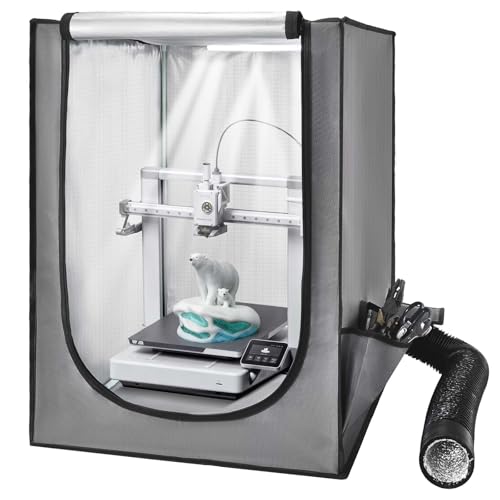
- Fits many small FDM and LCD resin printers
- Includes a ventilation system for smoke and dust
- LED and clear window simplify print monitoring
Best For: Users needing broad compatibility and built-in ventilation
Best All-Around Coverage
LED Constant-Temperature Enclosure

- Built-in LED lighting for easier monitoring
- Helps stabilize temperature and limit dust
- Quick installation with a spacious interior
Best For: FDM users seeking balanced protection and visibility
Best for Resin Workstations

- Fits a resin printer and curing machine
- Carbon filter helps reduce resin odor
- Fans and pipes support exhaust airflow
Best For: Resin users building a two-device printing station
Best Ventilated Acrylic Option

- Built-in ventilation helps expel smoke and dust
- Three acrylic panels offer clear visibility
- LED lighting and temperature control support monitoring
Best For: FDM users wanting ventilation and transparent viewing
Best Overall Value – Creality Fireproof 3D Printer Enclosure
For shoppers comparing compact 3d printer enclosures, this folding tent offers a practical balance of printer coverage, temperature control, and portability. Its 480 × 600 × 720 mm interior is designed for several Creality, Anycubic, and ELEGOO models, but measure your printer before ordering.
Best For: Creality Ender owners who want a portable enclosure for more stable high-temperature printing.
Pros:
- Flame-resistance testing is noted, with flame-retardant exterior and aluminum-film interior materials.
- Helps maintain a steadier printing environment and may support bed adhesion with high-temperature filaments.
- Folding design, observation panels, tool pockets, and a lightweight 3.5-pound construction support convenient use.
Cons:
- Compatibility depends on the printer’s complete dimensions and should be verified before purchase.
- The tent-style structure may provide less rigidity than a hard cabinet.
This is a sensible entry-level choice when portability and broad compatibility matter more than a permanent cabinet installation.
Best DIY Cabinet Kit – DELACK IKEA LACK Enclosure Kit
This DELACK kit is a strong option for compact 3d printer enclosures if you already use, or plan to build around, an IKEA LACK table. It combines plexiglass panels, an LED light, and hardware in a modular format, while printed connectors and accessories must be made separately.
Best For: DIY builders using Bambu Lab A1 Mini, Prusa printers, or an IKEA LACK workstation.
Pros:
- Compact 550 × 486 × 450 mm format is designed to sit flush with an IKEA LACK table.
- Includes an LED strip and 5V adapter for viewing prints without opening the enclosure.
- Supports optional 120 mm fans, HEPA filtration, external venting, and more than 20 downloadable accessories.
Cons:
- It is a kit only; printed parts are not included and must be customized or printed separately.
- Its design is tied to the IKEA LACK table enclosure setup.
Choose this kit when customization and integrated lighting matter more than a ready-to-use enclosure. The modular design also leaves room for future camera, cable, and ventilation upgrades.
Best Spacious Tent – VEVOR LED 3D Printer Enclosure
Among compact 3d printer enclosures, the VEVOR tent provides a relatively roomy 21.6 × 25.6 × 29.5-inch interior while retaining a lightweight 3.53-pound design. It is intended for multiple Creality, Anycubic, and ELEGOO printers, so confirm your model’s dimensions before buying.
Best For: Users who want a roomy fabric enclosure with built-in lighting, dust protection, and noise reduction.
Pros:
- Constant-temperature enclosure can help reduce warping, cracking, clogging, and jamming.
- Flame-retardant, dustproof construction helps shield the printer and work area.
- Transparent viewing window and LED lighting make print monitoring easier, including in low light.
Cons:
- Ventilation fans and components are optional and not included.
- The larger footprint may be less suitable for very small desks.
This VEVOR model is a practical pick when you need more interior room than a basic Ender-sized tent and want visibility and lighting built in.
Best for Resin Ventilation – Multifunctional Filtered Printer Tent
For resin users comparing compact 3d printer enclosures, this model focuses on ventilation and filtration rather than simple dust coverage. It includes an adjustable-speed 12V fan system with a three-layer filter and a UV-blocking window, and it is intended for many small LCD and resin printers.
Best For: Resin-printing setups using printers such as the Anycubic Photon Mono, ELEGOO Saturn or Mars, and Creality Halot series.
Pros:
- Includes adjustable-speed ventilation with a three-layer filter for particles and gases.
- UV-blocking viewing window lets users monitor resin prints while helping limit UV exposure.
- Updated stainless-steel pipe frame is described as lightweight and durable, with a larger viewing window.
Cons:
- The enclosure is not water resistant.
- A plastic adapter must be printed to replace the steel fan bracket; the required file is downloaded separately.
- Printer compatibility varies, so the full printer dimensions must be checked.
This is the most specialized option in the group for resin workflows, especially when adjustable airflow and included filtration are higher priorities than general-purpose printer coverage.
Best Dedicated Fit – YOOPAI A1 Mini Enclosure with LED
For Bambu Lab A1 Mini owners seeking compact 3d printer enclosures, the YOOPAI provides a dedicated cover that helps stabilize the printing environment while keeping the desktop setup organized. Its clear window and built-in LED make monitoring easier without opening the enclosure.
Best For: Bambu Lab A1 Mini and A1 Mini Combo users who want a purpose-built enclosure; AMS Lite must remain outside.
Pros:
- Designed specifically for the A1 Mini and A1 Mini Combo
- Built-in LED and large clear viewing window improve visibility
- Helps contain dust, particles, odors, and printing noise
- Reserved vent opening supports optional external exhaust expansion
Cons:
- Limited to A1 Mini-sized setups
- External exhaust kit is sold separately
- AMS Lite must remain outside the enclosure
With its compact 470 x 550 x 550 mm footprint and printer-specific fit, this is a practical choice when convenience and organization matter more than broad compatibility.
Best Ventilated Option – VEVOR 3D Printer Tent with LED
The VEVOR tent is one of the more versatile compact 3d printer enclosures in this group, accommodating many small FDM and LCD resin printers. Its ventilation system, enclosed structure, and transparent window support cleaner operation and convenient print monitoring.
Best For: Users with small FDM or LCD resin printers, including compatible Photon Mono and Mars 3 setups, who want built-in ventilation.
Pros:
- Broad compatibility with small FDM and LCD resin printers
- Ventilation system helps expel smoke and dust
- Flame-retardant, dust-resistant enclosed construction
- LED lighting and transparent window aid low-light monitoring
Cons:
- Its 21.65 x 25.59 x 29.53-inch size requires careful space planning
- Printer dimensions should be measured before ordering
- Broad compatibility does not guarantee fit for every printer
The VEVOR stands out when ventilation and compatibility are priorities, though its relatively large tent dimensions make measuring both the printer and available workspace essential.
Best for Ender-Style Printers – YOOPAI Enclosure with Ventilation
For users comparing compact 3d printer enclosures for Ender-style machines, this YOOPAI model combines ventilation, LED lighting, and temperature and humidity monitoring. Its enclosed six-sided design also helps isolate operating noise and protect the printer from dust and accidental contact.
Best For: Owners of compatible Creality Ender, Neptune, AnkerMake, and Anycubic printers that fit within the stated dimensions.
Pros:
- Includes ventilation, built-in LED lighting, and temperature/humidity monitoring
- Supports many Ender, Neptune, AnkerMake, and Anycubic models
- Six-sided enclosure helps reduce noise and block dust
- Designed for quick installation and disassembly
Cons:
- Compatibility depends on staying below 21.6 x 25.6 x 29.5 inches, including spool-holder height
- Its 5.57-pound weight is higher than the A1 Mini enclosure
- Requires an LR44 battery for the monitoring system
This is a strong feature-rich pick for larger enclosed printers, especially if monitoring conditions and reducing noise are as important as basic dust protection.
Best All-Around Coverage – LED Constant-Temperature Enclosure
If you want compact 3d printer enclosures with helpful everyday features, this medium cover combines LED lighting, temperature control, and a fully enclosed structure. Its 21.7 x 25.6 x 30.7-inch interior is designed for a range of popular printers, but measuring your machine first is still essential.
Best For: FDM users who want improved visibility, dust protection, noise reduction, and a more consistent printing environment.
Pros:
- Built-in LED strip helps illuminate the print area and spot issues.
- Enclosed design helps maintain a stable temperature and reduce dust exposure.
- Fire-resistant materials and a sturdy structure add practical protection.
- Quick five-minute installation and a design intended for long-term use.
Cons:
- The medium enclosure may be too small for oversized printers or accessories.
- Compatibility depends on verifying your printer’s dimensions before purchase.
- The notes do not mention an active ventilation or filtration system.
This is a practical choice when visibility, temperature stability, and general enclosure protection matter more than built-in air extraction. Its broad compatibility and quick setup make it a flexible option for many standard-size printers.
Best for Resin Workstations – Dual Resin Printer Enclosure
Among compact 3d printer enclosures, this YOOPAI model stands out for resin setups that need room for both a printer and curing equipment. Its 30 x 19.7 x 28.3-inch internal space, carbon filter, exhaust fans, and expandable pipes are designed to help manage resin odors and emissions.
Best For: Resin-printing workstations that need space for a printer and curing machine alongside odor and emission management features.
Pros:
- Wide interior can accommodate two resin-related machines, depending on measurements.
- Carbon filter sheet helps adsorb resin odors.
- Exhaust fans and expandable pipes support air discharge.
- Large transparent front window enables observation without opening the cover.
Cons:
- Its larger footprint may not suit very tight workspaces.
- Airflow slows when exhaust passes through the activated carbon filter.
- You need to wait for air to discharge or add exhaust pipes to improve airflow before opening.
This enclosure is especially useful for users prioritizing resin odor control and a dual-machine setup. Check the dimensions of both your printer and curing machine carefully, and plan for the recommended airflow approach.
Best Ventilated Acrylic Option – VEVOR LED Printer Tent
This VEVOR enclosure is a strong candidate among compact 3d printer enclosures for users who want ventilation with clear visibility. Measuring 23.6 x 23.6 x 31.5 inches, it combines acrylic panels, PVC foam boards, a metal frame, LED lighting, and a ventilation system.
Best For: FDM users who want a ventilated enclosure with transparent viewing panels and compatibility across several common printer families.
Pros:
- Ventilation system helps expel smoke and dust after printing.
- Three transparent acrylic panels provide clear print monitoring.
- LED lighting makes the print area easier to see in low light.
- Enclosed construction helps reduce dust, noise, and accidental contact.
Cons:
- The 23.6 x 23.6-inch footprint may require more space than a small desk allows.
- Compatibility still requires checking your printer’s dimensions.
- The notes describe ventilation but do not specify odor filtration.
Choose this model if active ventilation and visual access are higher priorities than the smallest possible footprint. Its transparent panels and LED are useful for monitoring, while the constant-temperature design can help reduce warping and cracking.
How We Picked These Compact 3d Printer Enclosures
We focused on the features that matter most in a small workspace: compatible printer dimensions, enclosure construction, access to controls and filament, ventilation provisions, visibility, lighting, and ease of assembly. We also considered whether each enclosure is designed primarily for dust control, temperature stability, odor management, or a combination of those goals.
The selection includes compact fabric tents, acrylic-style designs, and models with fans or ventilation kits. Because printer sizes and materials vary, compatibility should be verified against the manufacturer’s interior measurements rather than relying on a product name alone.
Quick Comparison
| Best For | Look For |
|---|---|
| Creality Ender 3 owners | Ender 3-specific fit, front access, and ventilation |
| Bambu Lab A1 Mini users | A compact enclosure with suitable clearance and cable access |
| Prusa printers | Generous interior dimensions and compatibility with the printer’s moving parts |
| Resin printing | Ventilation support, odor control, and chemical-resistant handling practices |
| Small desks | Foldable construction, compact footprint, and top or side access |
| Visible monitoring | Clear panels and integrated LED lighting |
Key Buying Factors for Compact 3d Printer Enclosures
Size and Printer Clearance
Measure the printer, spool holder, cables, and any moving components. Leave additional room for the bed, gantry, ventilation hardware, and routine maintenance. A tight fit can restrict movement and make troubleshooting difficult.
Ventilation and Odor Control
Ventilation is especially important for resin printing and for materials that produce noticeable odors. A built-in fan or duct port can make it easier to route air toward an appropriate filtration or exhaust setup. An enclosure alone does not guarantee safe air quality; follow the printer and material manufacturers’ safety guidance.
Materials and Temperature Management
Oxford-cloth tents are lightweight and often fold for storage, while acrylic or transparent panels provide clearer monitoring and a more rigid structure. “Constant temperature” claims generally mean the enclosure can help retain heat; performance depends on the printer, material, room conditions, and ventilation.
Access, Lighting, and Convenience
Look for wide front openings, cable ports, removable panels, and enough access to change filament or perform maintenance. LED lighting is useful in dark work areas but should not replace proper visibility or safe electrical setup.
Who Should Buy Which Compact 3d Printer Enclosures?
Choose a printer-specific model if you use a Creality Ender 3 or Bambu Lab A1 Mini and want a straightforward fit. Select a ventilation-equipped enclosure if odor control or resin printing is a priority. A foldable fabric model is usually the best choice for renters, beginners, and users who need to store the enclosure between prints. Choose a more rigid transparent design if monitoring prints is important or the enclosure will remain permanently on a workbench. Before buying, confirm the interior dimensions, printer compatibility, ventilation arrangement, and whether the included accessories match your setup.