Resin printing can be a powerful addition to school makerspaces, STEM labs, and design classrooms when you choose the right setup. The best options balance print quality, ease of use, and manageable cleanup for students and staff.
Below, we focus on 10 practical picks that fit educational use cases, from beginner-friendly printers to wash-and-cure equipment and durable resins that support classroom projects.
Best 10 Resin Printers for Schools Picks for 2026
Automatic, Safe Starter Pick
ELEGOO Mars 5 Resin 3D Printer
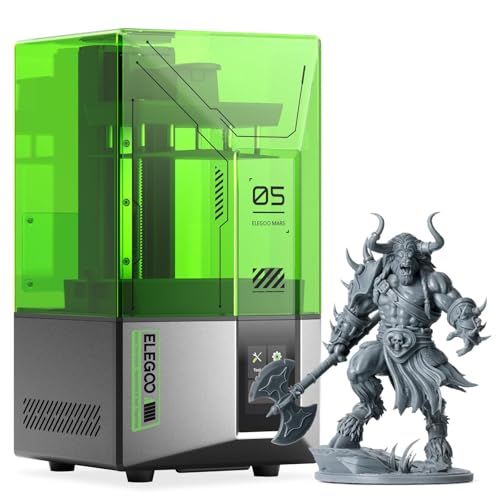
- One-click automatic leveling
- Self-check plus residue detection
- 4K mono LCD for detailed prints
Best For: classrooms and makerspaces wanting easier setup and safety checks
Tough Material Upgrade
Siraya Tech Blu Tough Resin, Easy Grey

- Tough resin for durable parts
- Lower odor and easier handling
- Good for models, bases, and prototypes
Best For: school labs needing durable, lower-odor resin for repeated handling
Dual-Material Classroom Choice
ANYCUBIC Photon P1 Resin 3D Printer

- Dual-color and dual-material printing
- Auto-leveling with AI monitoring
- Built for high-viscosity resins
Best For: schools wanting advanced creative printing and more automation
Easy-Clean Resin Pick
ANYCUBIC Water Washable Resin 2.0

- Cleans with water instead of alcohol
- Low odor for classroom use
- Compatible with most LCD resin printers
Best For: classrooms and STEM labs wanting simpler cleanup and lower odor
Post-Print Cleanup Choice
ELEGOO Mercury Plus 2.0 Wash and Cure Station
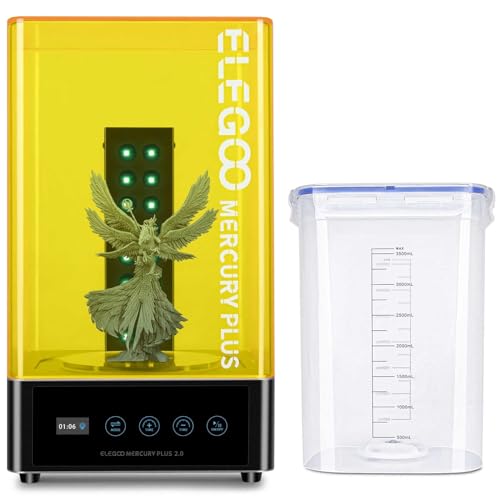
- Sealed washing helps limit alcohol volatilization.
- Anti-UV lid blocks 99.95% of UV rays.
- Cures with 16 UV LEDs and a 360° turntable.
Best For: School labs needing cleaner resin post-processing
Beginner Printer Pick
MALYAN S100 Mini Resin 3D Printer

- Auto-calibrates and levels at print start.
- 5.5-inch 2K LCD supports fine detail.
- Compact 115 x 65 x 110 mm build size.
Best For: Beginner classrooms and small makerspaces
All-in-One Post-Processing Station
Creality Wash and Cure Station UW-01

- Combines washing and curing in one unit.
- 18 UV LEDs with a 360° rotating tray.
- Large sealed wash container supports bigger models.
Best For: School labs needing larger-capacity post-processing
Classroom-Friendly Detail Printer

- 7" 10K mono LCD for high-detail prints
- Stable light source helps smooth surfaces
- Pre-calibrated for easier first-time setup
Best For: classroom makerspaces and detailed student projects
Low-Odor Tough Resin

- Fast curing helps improve print turnaround
- Non-brittle ABS-like formula adds durability
- Low odor and easy to clean in shared spaces
Best For: durable student models and school lab printing
General-Purpose School Resin

- Low shrinkage supports precise prints
- Quick curing and strong fluidity
- Compatible with all DLP/LCD printers
Best For: general classroom printing and beginner setups
Automatic, Safe Starter Pick – ELEGOO Mars 5 Resin 3D Printer
If you are comparing resin printers for schools, the ELEGOO Mars 5 is a practical entry point because it emphasizes automation and safety features that reduce setup friction. The one-click automatic leveling, self-check routine, and smart error alerts make it easier to keep classroom printing moving without constant manual calibration.
Best For: classrooms and makerspaces that want a beginner-friendly resin printer with simple setup and built-in safety checks.
Pros:
- One-click automatic leveling helps simplify setup for mixed skill levels.
- Self-check and residue detection can reduce failed prints and LCD damage risk.
- Resin shortage and leveling failure alarms help prevent wasted time and material.
- 4K mono LCD and COB light source support detailed prints.
Cons:
- As a resin printer, it still requires classroom-safe handling and cleanup procedures.
- The compact desktop format may not suit larger school production needs.
Overall, the Mars 5 is a sensible choice when your priority is simplifying resin printing for students while keeping an eye on reliability and safety. It is more about easy operation than high-volume throughput.
Tough Material Upgrade – Siraya Tech Blu Tough Resin, Easy Grey
For schools that already have resin printers and need a more durable material, Siraya Tech Blu Tough is a strong option. This resin is aimed at better workability, lower odor, and tougher parts, which can be useful for student models, shells, bases, and fragile structures that need to hold up in regular use.
Best For: school labs and classrooms that need a tougher, lower-odor resin for durable prints and prototypes.
Pros:
- Formulated for easier handling and faster curing.
- Lower viscosity than Original Blu for more convenient use.
- Less odor than the Original Blu resin for a more comfortable workspace.
- Tough enough for fragile parts, shells, playable models, and bases.
Cons:
- It is a material choice, not a printer, so it only helps if you already have a compatible machine.
- May be more than you need for simple display models or basic classroom demos.
In a school setting, this resin makes sense when print durability matters as much as detail. It is a versatile upgrade for projects that students will handle repeatedly.
Dual-Material Classroom Choice – ANYCUBIC Photon P1 Resin 3D Printer
Among resin printers for schools, the ANYCUBIC Photon P1 stands out for projects that need more creative flexibility. Its dual-color and dual-material printing can help students explore advanced design ideas, while auto-leveling, AI monitoring, and resin-level checks add convenience for classroom use.
Best For: schools that want a feature-rich resin printer for creative projects, mixed materials, and higher automation.
Pros:
- Dual-color and dual-material printing supports more creative student projects.
- Factory-calibrated Smart Leveling 3.0 reduces manual bed leveling.
- AI monitoring checks build plate installation, separation, resin level, and residue.
- Wave Release Technology is designed to reduce release force and improve success rates.
Cons:
- Its advanced feature set may be more than a basic classroom actually needs.
- The larger, heavier footprint may be less convenient in small labs.
For schools that want to push beyond simple single-material prints, the Photon P1 offers a lot of capability. It is best when automation and experimentation matter more than keeping the setup minimal.
Easy-Clean Resin Pick – ANYCUBIC Water Washable Resin 2.0
If you are looking at resin printers for schools, the cleanup workflow matters as much as the printer itself. ANYCUBIC Water Washable Resin 2.0 is designed to simplify post-processing with water cleanup instead of alcohol, while also offering low odor, fast printing, and broad compatibility with most LCD resin printers.
Best For: classrooms and STEM labs that want easier cleanup and a lower-odor resin workflow.
Pros:
- Water washable, so prints can be cleaned without extra alcohol use.
- Low odor makes the printing environment more comfortable.
- Low viscosity supports faster printing and shorter exposure times.
- Wide 365-405nm compatibility works with most LCD resin 3D printers.
Cons:
- It is still a resin product, so safe handling and cleanup procedures are still required.
- Compatibility is broad, but best results may vary by printer.
For schools trying to reduce mess and simplify student workflows, this resin is a practical consumable to pair with an LCD machine. It is especially appealing where cleanup time and odor are important concerns.
Post-Print Cleanup Choice – ELEGOO Mercury Plus 2.0 Wash and Cure Station
If you’re comparing resin printers for schools, a dedicated wash-and-cure unit like the ELEGOO Mercury Plus 2.0 can make post-processing more controlled and less messy. It combines sealed washing with curing in one compact station, helping staff handle resin prints with fewer open-container steps.
Best For: School labs that want a safer, more organized way to wash and cure resin prints.
Pros:
- Sealed washing helps reduce alcohol volatilization during cleaning.
- Anti-UV lid blocks 99.95% of ultraviolet rays for eye protection.
- Built-in 16-piece 405nm UV LED setup with a 360-degree rotating turntable.
- Flexible washing options support basket cleaning or washing prints on the build plate.
Cons:
- Washing is not ideal for water-washable resin.
- Designed as a post-processing accessory, not a printer itself.
For school environments, the Mercury Plus 2.0 is most useful when you want a simpler cleanup workflow after printing. Its enclosed design, intuitive screen, and flexible wash modes make it easier to supervise student projects without exposing everyone to unnecessary mess.
Beginner Printer Pick – MALYAN S100 Mini Resin 3D Printer
For schools looking at resin printers for schools, the MALYAN S100 is built around simplicity and compact size. Its one-click calibration and auto-leveling can help reduce setup friction, while the 2K LCD screen is aimed at producing fine detail in small models.
Best For: Beginner classrooms or makerspaces that want an easier resin printer to start with.
Pros:
- 5.5-inch 2K LCD screen with 2560×1440 resolution for detailed prints.
- Auto-calibrates and auto-levels whenever a print starts.
- Magnetic build plate makes removal and prep easier between jobs.
- 57W parallel LED array is designed for stable, uniform light.
Cons:
- Small build volume at 115 x 65 x 110 mm.
- Different resins require matching printing parameters for best results.
The S100 makes sense when ease of use matters more than large print capacity. In a school setting, its automatic setup features and compact footprint can help newer users get started with less trial and error.
All-in-One Post-Processing Station – Creality Wash and Cure Station UW-01
When evaluating resin printers for schools, it helps to pair them with equipment that keeps cleanup contained. The Creality UW-01 is an all-in-one wash and cure station that supports most resin printing platforms and combines a sealed wash container with a rotating curing tray.
Best For: School labs that want a larger-capacity washing and curing station in one machine.
Pros:
- All-in-one wash and cure design simplifies post-processing.
- 18 UV LED lights and a 360° rotating platform help with even curing.
- Large washing container supports bigger models and stores solution for reuse.
- Cover removal pauses curing to reduce glare and light pollution.
Cons:
- Like other post-processing units, it is not a standalone printer.
- Bulkier footprint than a printer-only setup.
The UW-01 is a strong fit for shared school workspaces where controlling spills and streamlining cleanup are priorities. Its larger washing container and flexible brackets make it practical for a range of resin prints without adding a lot of process complexity.
Classroom-Friendly Detail Printer – ANYCUBIC Photon Mono 4
For schools that need sharp, reliable results, this resin printer for schools offers a strong mix of detail, speed, and everyday ease of use. The Photon Mono 4 uses a 7″ 10K mono LCD, a stable light source, and a large enough build area for classroom projects, prototypes, and detailed models.
Best For: classroom makerspaces, art and design labs, and teachers who want high-detail prints with a simple start-up process.
Pros:
- 7″ 10K mono LCD with 9024 x 5120 resolution for fine detail
- LighTurbo matrix light source helps create smooth surfaces and clear layer results
- Large 153.4 x 87 x 165 mm build volume supports daily classroom tasks
- Assembled, calibrated, tuned, and tested before shipment for easier setup
Cons:
- Resin printing still requires post-processing and careful cleanup
- The 6.04″ x 3.42″ x 6.49″ build area may be limiting for larger school projects
Overall, this is a solid pick when your priority is highly detailed output with less initial setup friction. The resume-printing feature also adds a useful layer of protection against wasted resin and time during classroom use.
Low-Odor Tough Resin – Siraya Tech Fast ABS-Like 1kg
If you need a material choice for resin printers for schools, this ABS-like resin is aimed at practical classroom and lab use. It emphasizes fast printing and curing, low odor, easy cleaning, and a non-brittle finish that can better handle everyday handling than more fragile resins.
Best For: school labs, makerspaces, and educators printing durable tabletop models or small parts.
Pros:
- Fast printing and curing can improve print speed and success rate
- ABS-like formula is non-brittle with a stiffness-and-toughness balance
- Low odor and easy cleanup are helpful in shared spaces
- Wide compatibility with most LCD and DLP printers, including 8K-capable machines
Cons:
- Still requires alcohol-based cleaning after printing
- Best suited to small and half-length models rather than large builds
For schools that want a dependable general-purpose resin, this one focuses on practicality over specialty effects. It is especially appealing when you want cleaner handling, quicker turnaround, and parts that are less likely to snap during classroom use.
General-Purpose School Resin – ANYCUBIC Grey 500g
When you want a straightforward resin for resin printers for schools, this standard grey option focuses on precision, quick curing, and broad compatibility. It is designed for LCD/DLP printing and aims to deliver smooth surfaces, good stability after curing, and accurate details.
Best For: classrooms, beginner-friendly school setups, and general-purpose LCD/DLP printing.
Pros:
- Low shrinkage supports high-precision prints and smooth surfaces
- Quick curing and strong fluidity help reduce forming time
- Good rigidity and toughness make models easier to remove
- Compatible with all DLP/LCD 3D printers and works best with Anycubic machines
Cons:
- Requires a full shake before use to avoid uneven coloring
- The 500g bottle is a smaller supply for higher-volume classrooms
This is a sensible general-use resin if your school needs consistent results without moving into specialty materials. Its broad compatibility and balanced print characteristics make it an easy fit for classroom workflows.
How We Picked These Resin Printers for Schools
We prioritized models and materials that make sense for educational environments: straightforward operation, dependable print quality, strong part durability, and a workflow that can be supervised efficiently. For Resin Printers for Schools, ease of setup and consistent results matter as much as raw resolution.
We also looked at the support equipment schools typically need, including wash-and-cure stations and easy-to-clean resin options. That matters because a good classroom resin workflow is about more than the printer alone.
Quick Comparison for School Use
For beginners and younger students, compact printers with auto-leveling or simple interfaces are usually the best fit. For advanced programs, higher-resolution printers can support engineering, art, dental, or prototype work where surface detail matters. Durable resins are better for functional parts, while water-washable or low-odor options can simplify cleanup and reduce friction in shared spaces.
Key Buying Factors for Resin Printers for Schools
Safety and Cleanup
Schools should plan for ventilation, gloves, eye protection, and a dedicated cleanup area. Water-washable resin can reduce the need for alcohol, but it still requires careful handling and proper waste disposal. A wash-and-cure station helps keep post-processing organized and repeatable.
Ease of Use
Features such as auto-leveling, guided software, and simple calibration can save class time. In a school setting, reliable first prints are important because they reduce failed builds and keep students engaged.
Build Size and Resolution
Choose build volume based on typical student projects. Small printers are fine for miniatures, test pieces, and classroom demos, while larger models are better for multi-part prototypes. Higher resolution is useful when fine detail is part of the lesson, but it should not come at the expense of reliability.
Material Choice
Resins vary widely. Tough or ABS-like formulas are better for parts that need strength, while fast-curing or water-washable resins may suit high-turnover classroom workflows. Compatibility with common 405nm LCD printers is a practical plus for schools standardizing supplies.
Who Should Buy Which Resin Printers for Schools?
If you are running an intro-level STEM class, choose a compact, beginner-friendly printer and pair it with a simple wash-and-cure station. If your school focuses on engineering, product design, or advanced fabrication, a higher-resolution machine and stronger resin will give students more room to experiment with functional prototypes. Art and model-making programs may benefit most from printers and resins that emphasize detail, surface finish, and repeatable results.
For most schools, the smartest approach is to think in terms of a full workflow: printer, resin, post-processing, and safety procedures. That way, the equipment supports learning instead of creating extra work for instructors.