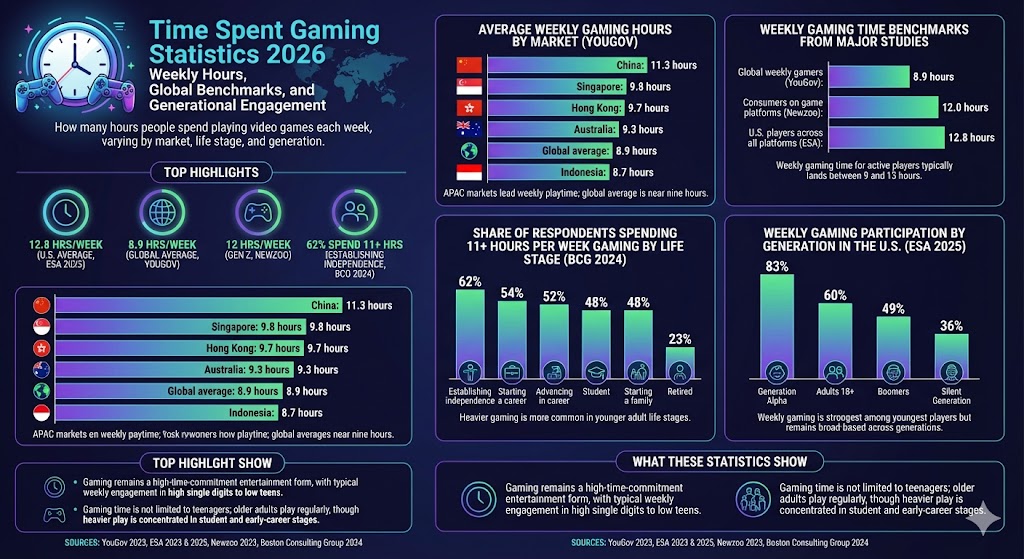
These time spent gaming statistics show how many hours people spend playing video games each week, how gaming time varies by market and life stage, and how weekly play still remains common across every generation.
ESA’s 2023 U.S. study found that video game players averaged 12.8 hours per week across all platforms.
75% of U.S. players said they play at least 4 hours per week.
Newzoo reported that consumers spend around 12 hours per week engaging with video games and virtual worlds.
Newzoo also found that Gen Z spends just over 12 hours per week on games and virtual worlds, slightly more than on TV.
YouGov found that weekly gamers average 8.9 hours per week globally, with China at 11.3 hours and Singapore at 9.8 hours.
In BCG’s 2024 gaming survey, 62% of respondents in the “establishing independence” life stage spent 11+ hours per week gaming, versus 23% of retired respondents.
ESA’s 2025 research found that 83% of Generation Alpha, 60% of adults 18+, 49% of boomers, and 36% of the Silent Generation play video games weekly.
Average weekly gaming hours by market
Label
Bar
Value
China
11.3 hours
Singapore
9.8 hours
Hong Kong
9.7 hours
Australia
9.3 hours
Global average
8.9 hours
Indonesia
8.7 hours
Max = 11.3 hours. Widths: China 100.00%, Singapore 86.73%, Hong Kong 85.84%, Australia 82.30%, Global average 78.76%, Indonesia 76.99%
YouGov’s cross-market data suggests that weekly gaming time is high across major regions, but the heaviest weekly playtime sits in several APAC markets. China leads this comparison, while the global average still comes in at nearly nine hours per week.
Weekly gaming time benchmarks from major studies
Label
Bar
Value
Global weekly gamers
8.9 hours
Consumers on game platforms
12.0 hours
U.S. players across all platforms
12.8 hours
Max = 12.8 hours. Widths: Global weekly gamers 69.53%, Consumers on game platforms 93.75%, U.S. players across all platforms 100.00%
These benchmarks are not perfectly identical because the surveys use different populations and methodologies, but they cluster into a fairly tight range. The pattern is clear: among active players and game-engaged consumers, weekly gaming time often lands somewhere between roughly 9 and 13 hours.
Share of respondents spending 11+ hours per week gaming by life stage
Label
Bar
Value
Establishing independence
62%
Starting a career
54%
Advancing in career
52%
Student
48%
Starting a family
48%
Retired
23%
Max = 62%. Widths: Establishing independence 100.00%, Starting a career 87.10%, Advancing in career 83.87%, Student 77.42%, Starting a family 77.42%, Retired 37.10%
These figures are derived from BCG’s hour-band data by adding together respondents who reported spending 11 to 20 hours, 21 to 50 hours, and more than 50 hours per week gaming. The result shows that heavier gaming is much more common in younger adult life stages than in retirement.
Weekly gaming participation by generation in the U.S.
Weekly gaming is still strongest among the youngest players, but ESA’s 2025 data shows the activity remains broad-based. Even older cohorts still participate at meaningful levels, which helps explain why total gaming time stays large at the population level.
What these time spent gaming statistics show
The clearest takeaway is that gaming remains a high-time-commitment form of entertainment for a large share of the audience. Depending on the survey and population, typical weekly engagement tends to sit in the high single digits to low teens, with younger and more active segments often climbing well beyond that.
The data also shows that gaming time is not limited to teenagers. Older adults still play regularly, but heavier play is concentrated more heavily in student, early-career, and early-family life stages. That mix helps explain why gaming continues to be both a mass-market activity and a deeply engaging habit for core players.
Sources
YouGov, APAC gamers lead the globe on most time spent gaming per week, 2023
Entertainment Software Association, Essential Facts About the U.S. Video Game Industry, 2023
Entertainment Software Association, Annual ESA Study Reveals Video Games’ Universal Appeal Across Generations, 2025
Newzoo, How much time do consumers spend on media platforms?, 2023
Boston Consulting Group, The Gaming Report: Leveling Up for the New Reality, 2024
Prepare for unforgettable summer fun as we unveil the 10 best giant inflatable unicorn floats that will transform your pool days into magical adventures.