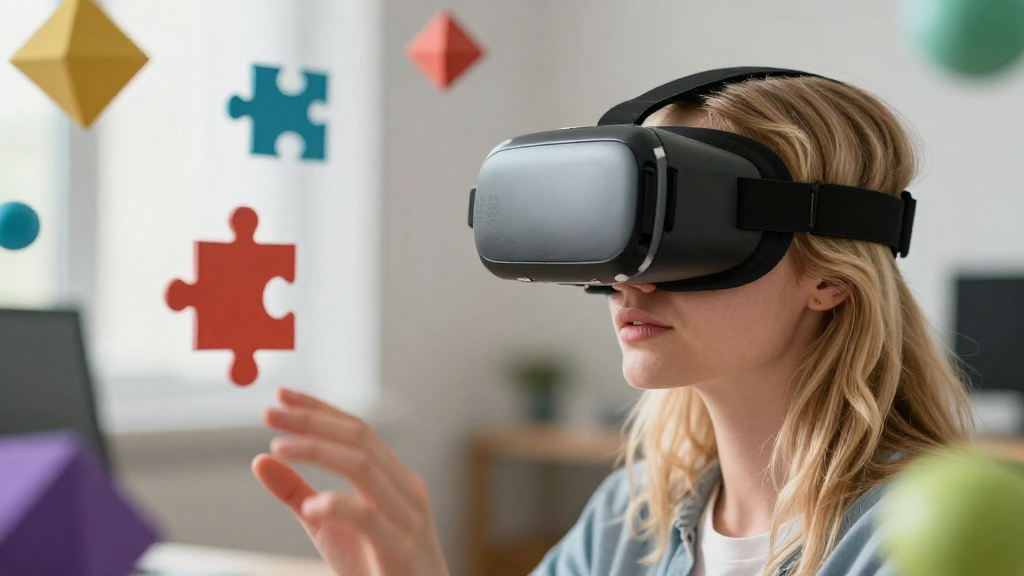
Can gaming and spatial reasoning be connected?
Recent studies suggest that gaming may significantly enhance our spatial reasoning skills.
But what does this mean for gamers and those interested in cognitive development?
What is Spatial Reasoning?
Spatial reasoning refers to the ability to visualize and manipulate objects in space.
This skill is crucial not only in gaming but also in everyday tasks and various professions.
Some key aspects include:
- Mental rotation: Imagining how objects can fit together when they are rotated.
- Visualization: Being able to picture a scenario or object in your mind.
- Navigation: Understanding how to move through space and remember locations.
Spatial reasoning impacts fields like architecture, engineering, art, and various sciences.
Improving these skills can lead to better problem-solving abilities and enhanced creativity.
So, how does gaming relate to spatial reasoning?
How Does Gaming Affect Spatial Reasoning Skills?
Studies reveal that gaming and spatial reasoning are indeed intertwined.
Different types of games can foster various cognitive skills.
Here are some categories of games that may enhance spatial reasoning:
1. Puzzle Games
Puzzle games like Tetris challenge players to visualize how shapes fit together.
As players rotate and place pieces, they practice mental rotation and visualization skills.
Benefits of puzzle games include:
- Improved problem-solving skills
- Enhanced ability to think in three dimensions
- Greater competence in quick decision-making
2. Action and Adventure Games
Action-adventure games such as The Legend of Zelda or Minecraft often require navigation through complex environments.
Players must assess distances, plan routes, and understand the layout of their surroundings.
These games help develop:
- Spatial awareness
- Quick reflex responses
- Strategic planning
3. Simulation Games
Simulation games, like The Sims or Cities: Skylines, require players to manage and organize spaces effectively.
Players engage in spatial reasoning by arranging buildings and planning cities.
Advantages of simulation games include:
- Enhanced understanding of spatial organization
- Better strategic thinking
- Improved resource management
4. Virtual Reality (VR) Games
VR games take immersion to another level, creating a fully interactive environment.
Players use their bodies to manipulate virtual spaces, which can enhance spatial awareness dramatically.
Key benefits of VR gaming include:
- Increased engagement with physical movement
- Real-time spatial problem-solving
- An intuitive understanding of depth and space
Can All Gamers Improve Their Spatial Reasoning?
It’s essential to note that not all gaming experiences are equal.
Factors influencing improvement include:
- Game type: Action and strategy games tend to offer more opportunities for spatial reasoning development.
- Amount of play: Frequent players may experience more substantial cognitive benefits.
- Age and background: Younger individuals with more flexible cognitive growth might benefit more.
So, while many can benefit from gaming, the extent to which one improves may vary.
What Challenges Does Gaming Present?
While gaming and spatial reasoning can have a positive relationship, there are also challenges to consider.
Potential downsides of excessive gaming include:
- Sedentary lifestyle: Prolonged gaming without breaks can impact physical health.
- Addiction: Some players may find it challenging to balance gaming with other responsibilities.
- Screen fatigue: Too much screen time can lead to fatigue and decreased focus over time.
Engagement in gaming should be balanced and complemented with physical activities and social interactions.
What Scientific Evidence Supports the Link Between Gaming and Spatial Reasoning?
Research studies have explored the potential cognitive benefits of gaming.
Some key findings include:
- A study published in Computers & Education found that video games significantly enhance players’ spatial reasoning skills.
- Research by the University of California showed that action video games can boost visual attention and spatial skills.
- In another study, children who played strategy games performed better in spatial tasks than those who did not.
These findings strongly support the notion that gaming can boost spatial reasoning skills.
How to Choose the Right Games for Improving Spatial Reasoning
If you’re interested in gaming and spatial reasoning enhancement, here are some tips for choosing the right games:
- Look for puzzle-based games: Games that require you to think critically about object placement.
- Explore action-adventure titles: These games require navigation and quick thinking.
- Try simulation games: They provide an excellent platform for organizing and managing virtual spaces.
- Consider VR games: The immersive experience can deeply enhance your spatial skills.
By consciously selecting the right games, you can effectively work on improving your spatial reasoning abilities.
Conclusion: Can Gaming Really Boost Spatial Reasoning?
In conclusion, the relationship between gaming and spatial reasoning is evident through various studies and observations.
From puzzle games to VR experiences, gamers can enhance their spatial skills significantly.
However, it’s vital to strike a balance between gaming and other activities to ensure overall health and well-being.
So, if you’re looking to improve your spatial reasoning, consider incorporating some gaming into your routine.
With the right games and a mindful approach, you can enjoy a fun and fulfilling way to enhance your cognitive abilities.
Happy gaming!