Powered USB switch boxes make it easier to share keyboards, mice, printers, scanners, and other peripherals between computers without repeatedly unplugging cables. The best option depends on your port needs, USB speed, power requirements, and whether you need simple switching or hub-style expansion.
We compared 10 USB switchers and powered hubs covering compact desktop setups, multi-device workstations, shared printers, and systems that need individual power controls.
Best 10 Powered USB Switch Boxes Picks for 2026
Best Compact Powered Hub

- Four USB 3.0 ports with individual switches
- Includes 5V/2.5A power adapter
- Compact plug-and-play design
Best For: Small desks, travel, and everyday peripheral control
Best Two-Computer Selector
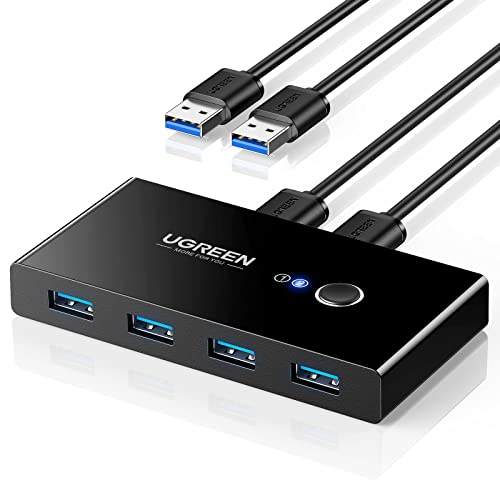
- Shares four USB devices between two computers
- One-button switching with LED status
- Optional USB-C power input for demanding devices
Best For: Work-and-personal computer peripheral sharing
Best High-Capacity Hub

- Ten USB 3.0 ports for extensive expansion
- Individual switches and blue LED indicators
- Includes a 60W power adapter
Best For: Busy workstations with many USB peripherals
Best Value Computer Switch

- Shares four USB devices between two computers
- 5Gbps USB 3.0 transfer support
- 18-month warranty and included charging cable
Best For: Driver-free USB sharing across multiple operating systems
Best for Easy Setup
10-Port Powered USB Switch Box
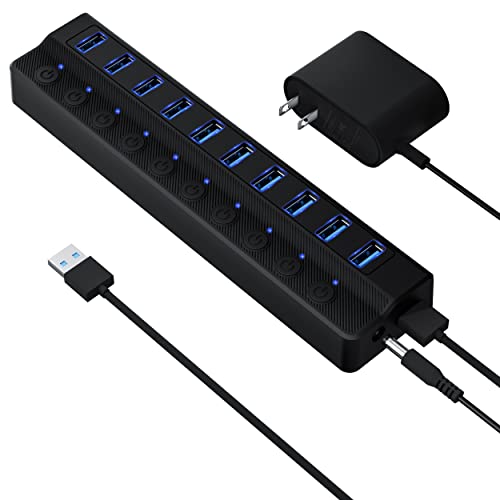
- 10 USB 3.0 data ports
- Individual switches with LED status lights
- Includes 12V/2A power adapter
Best For: Large desktop setups with many USB peripherals
Best for Two Computers

- Shares seven USB devices between two computers
- Includes USB-A, USB-C, and USB-C-to-A adapter support
- Switches via onboard button or external controller
Best For: Dual-computer workstations sharing USB peripherals
Best for Charging Extras
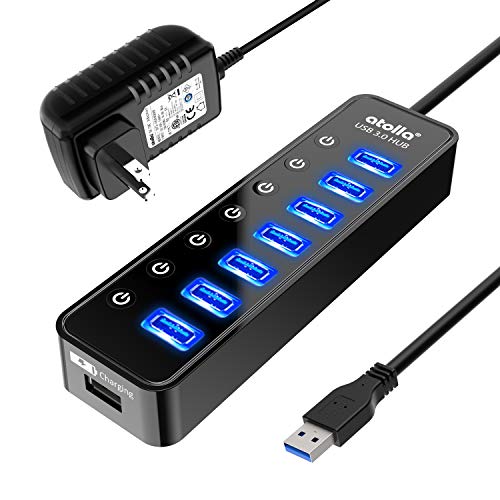
- Seven USB 3.0 data ports
- Dedicated smart charging port up to 2.4A
- Individual switches and 5V/4A adapter included
Best For: Desktop users needing data expansion and device charging
Best Multi-Device Pick

- Shares four USB peripherals between two computers
- One-button switching with active-computer LED
- Optional power input for multi-device stability
Best For: Two-computer desks sharing several USB peripherals
Best Printer-Focused Option
QIANRENON 2-to-1 USB Printer Switch

- Shares one USB printer between two computers
- Includes two 1.5-meter printer cables
- Push-button selection with computer-status LEDs
Best For: Basic two-computer printer sharing
Best High-Speed Pick

- 5Gbps USB 3.0 sharing for two computers
- One USB-C and three USB-A peripheral ports
- Button and wired-controller switching options
Best For: Modern workstations sharing faster USB peripherals
Best Compact Powered Hub – 4-Port Individual-Switch Hub
If you need powered USB switch boxes for a small desk or travel setup, the SABRENT HB-UMP3 adds four USB 3.0 ports with separate power controls. Its included 5V/2.5A adapter helps supply connected peripherals, while USB 3.0 supports transfers up to 5Gbps.
Best For: Users who want a compact, individually controlled USB hub for PCs, Macs, laptops, or other compatible devices.
Pros:
- Individual power switches and LED indicators for all four ports
- Includes a 5V/2.5A power adapter
- Supports USB 3.0 speeds up to 5Gbps and works with USB 2.0 and 1.1 devices
- Compact, lightweight plug-and-play design
Cons:
- Provides only four downstream ports
- Plastic construction may be less durable than metal alternatives
This is a practical choice when independent port control matters more than maximum capacity. Its small footprint and included power supply make it a straightforward everyday hub.
Best Two-Computer Selector – UGREEN 2-in-4 USB Switch
Among powered USB switch boxes, the UGREEN USB 3.0 Switch Selector stands out for sharing four peripherals between two computers. A single button switches the connected keyboard, mouse, printer, scanner, or other USB devices, while an optional USB-C power input can help stabilize higher-power accessories.
Best For: People switching one group of USB peripherals between a work computer and a personal computer.
Pros:
- Lets two computers share four USB devices
- One-button switching with an LED status indicator
- USB 3.0 data rates up to 5Gbps and backward compatibility with USB 2.0
- Includes two USB 3.0 data cables
Cons:
- Does not support monitors or video transmission
- Power adapter is not included
- High-power devices may require an additional 5V/2A power connection
Choose this model if your main goal is sharing USB accessories rather than expanding one computer. Remember that it is not a video-capable KVM switch, and additional power may be needed for demanding devices.
Best High-Capacity Hub – 10-Port 60W Powered USB Hub
For setups that need more connections, the SABRENT HB-BU10 is a 10-port powered USB 3.0 hub with individual switches and blue LEDs. Its included 60W, 12V/5A adapter is designed to support a larger collection of peripherals, while each port remains independently controllable.
Best For: Desktops and workstations with many USB peripherals, storage devices, phones, or card readers.
Pros:
- Provides ten USB 3.0 ports for high-capacity expansion
- Individual power switches and LED indicators simplify port management
- Includes a 60W, 12V/5A power adapter and USB 3.0 cable
- Supports up to 5Gbps and works with USB 2.0 and 1.1 devices
Cons:
- Larger than compact four-port hubs
- Designed for powered desktop use rather than minimal travel setups
This is the strongest fit when port count and available power are priorities. It offers convenient per-device control without requiring repeated unplugging, making it well suited to busy workstations.
Best Value Computer Switch – BENFEI 2-in-4 USB Switch
The BENFEI USB 3.0 Switch is one of the more flexible powered USB switch boxes for sharing four accessories between two computers. It uses a push button and LED indicator for quick switching, and its USB-C power input can provide extra stability for higher-consumption devices.
Best For: Users who need driver-free USB peripheral sharing across Windows, Mac, Linux, or Chrome OS computers.
Pros:
- Shares four USB devices between two computers
- Supports USB 3.0 transfer speeds up to 5Gbps
- Includes a USB-A to USB charging cable for the power input
- Backed by an 18-month warranty
Cons:
- Power adapter is not included
- Requires the supplied USB-A to USB-A cable for operation
- High-power devices may need an additional 5V/3A power source
The BENFEI is a sensible option for a two-computer desk that needs simple USB-only switching. It handles common peripherals well, but buyers should plan for a separate power adapter if using demanding devices.
Best for Easy Setup – 10-Port Powered USB Switch Box
If you need many individually controlled connections, this powered USB switch box expands one USB 3.0 port into 10 USB 3.0 data ports. Its included 12V/2A adapter supports connected peripherals, while individual switches let you disable devices without unplugging them.
Best For: Desktop users who need to connect and selectively control numerous USB peripherals.
Pros:
- Provides 10 USB 3.0 ports with data speeds up to 5Gbps.
- Individual on/off switches and LED indicators simplify device management.
- Includes a 12V/2A power adapter and supports USB 3.0, 2.0, 1.1, and 1.0 devices.
Cons:
- Uses a plastic enclosure.
- Its large port count may be more than a smaller setup requires.
This ONFINIO model is a practical choice when capacity and per-port control matter most. It is plug-and-play across Windows, Mac, Linux, and ChromeOS systems listed by the manufacturer.
Best for Two Computers – 2-in-7-Out USB Switch Box
Among powered USB switch boxes, the UGREEN 2-in-7-out switch stands out for sharing one group of USB devices between two computers. It combines four USB-A and three USB-C device ports with an included power adapter, USB-C-to-A adapter, and convenient switching controls.
Best For: Workspaces where two computers share keyboards, mice, printers, or other USB data devices.
Pros:
- Lets two computers share up to seven USB devices.
- Offers four USB-A and three USB-C device connections.
- Supports up to 5Gbps through its USB 3.0 ports and includes an external controller.
Cons:
- It is not a KVM and does not support HDMI or video transmission.
- USB ports are primarily for data transfer and are not recommended for charging.
This is a focused solution for switching USB peripherals between two systems rather than sharing displays. The included adapter helps accommodate both USB-C and USB-A computers in mixed setups.
Best for Charging Extras – Atolla Powered USB Switch Box
This Atolla powered USB switch box provides seven USB 3.0 data ports plus a dedicated smart charging port. Individual switches make it easy to turn peripherals on or off, while the included 5V/4A adapter supplies power for a practical desktop expansion setup.
Best For: Users who want individually switched USB data ports with a separate port for charging mobile devices.
Pros:
- Offers seven USB 3.0 data ports with transfer speeds up to 5Gbps.
- Dedicated charging port can provide up to 2.4A with the included adapter.
- Individual switches, indicator lights, and plug-and-play operation improve convenience.
Cons:
- Provides fewer data ports than a 10-port hub.
- The enclosure is plastic.
Atolla is a well-rounded option for a mixed desktop setup that needs both data expansion and a dedicated charging connection. Its listed compatibility includes Windows, Mac OS X, and Linux systems, with hot-swapping support.
Best Multi-Device Pick – UGREEN 2-in-4 USB 2.0 Switch
For shoppers comparing powered usb switch boxes, this UGREEN model is a practical choice when two computers need to share several USB peripherals. It connects up to four USB 2.0 devices and includes a separate micro-USB power input for setups that need additional power stability.
Best For: Home offices or workstations sharing a keyboard, mouse, printer, scanner, storage drive, or other USB peripherals between two computers.
Pros:
- Shares four USB devices between two computers with one-button switching.
- Includes two USB A-to-A data cables.
- Driver-free compatibility with Windows, macOS, Linux, and Chrome OS.
- LED indicator shows the active computer, and optional power supports multiple-device setups.
Cons:
- USB 2.0 limits transfer speeds compared with newer USB 3.0 switches.
- Does not support monitors or video transmission, so it is not a KVM switch.
- Power cable and charger are not included.
This is a flexible peripheral-sharing switch rather than a display-switching solution. Its four-device capacity and broad operating-system support make it a strong fit for a conventional two-computer desk, especially when optional power is useful.
Best Printer-Focused Option – QIANRENON 2-to-1 USB Printer Switch
Among powered usb switch boxes, this QIANRENON unit is a straightforward option for sharing one USB printer between two computers. Its manual push-button design keeps the setup simple, while the included printer cables reduce the need to purchase separate connections.
Best For: Small offices or home workspaces where two computers need access to a single USB printer.
Pros:
- Connects two computers to one USB printer.
- Includes two 1.5-meter USB 2.0 printer cables.
- Manual push-button switching is simple to operate.
- Separate LED indicators help identify the selected computer.
Cons:
- Designed for one printer rather than multiple USB peripherals.
- Manual switching is less convenient than a remote-controlled design.
- No external power supply is required or included, limiting its fit for higher-power devices.
This is a focused printer-sharing accessory, not a general-purpose USB hub or multi-device switch. Choose it when the main requirement is uncomplicated two-computer access to one USB printer.
Best High-Speed Pick – UGREEN USB 3.0 C/A Switch
For buyers seeking powered usb switch boxes with faster connectivity, this UGREEN USB 3.0 switch supports two computers sharing four peripherals at transfer rates up to 5Gbps. It combines three USB-A ports with one USB-C port and offers both button and wired-controller switching.
Best For: Modern workstations that share USB 3.0 peripherals, storage, cameras, keyboards, or mice between a work computer and a personal computer.
Pros:
- Supports USB 3.0 data transfer up to 5Gbps and USB 2.0 backward compatibility.
- Provides one USB-C port and three USB-A ports for varied peripherals.
- Includes two USB 3.0 cables and supports button or controller switching.
- Optional USB-C power input can improve stability with higher-power devices.
Cons:
- Does not support monitor connections or video transmission, so it is not a KVM switch.
- USB ports are intended mainly for data transfer and are not recommended for charging.
- A USB-C-to-USB adapter may be needed for computers with USB-C input ports.
This is the most capable choice of the three for speed and newer connector support. Its flexible switching options are useful on a busy desk, provided you need peripheral sharing rather than display switching.
How We Picked the Best Powered USB Switch Boxes
We focused on practical differences that affect everyday use: the number and type of USB ports, USB 2.0 versus USB 3.0 support, external power delivery, switching controls, device compatibility, and overall setup flexibility. We included both dedicated USB selector boxes and powered hubs because they solve related but different problems.
Dedicated selectors are designed to let two computers share one group of peripherals. Powered hubs add more ports to a single computer and can help maintain stable power for several connected devices. Models with physical buttons, LED indicators, or individual port switches earned attention for easier operation and troubleshooting.
Quick Comparison
| Best For | What to Look For |
|---|---|
| Basic keyboard and mouse sharing | Simple two-computer USB selector with one-touch switching |
| Shared printer or scanner | Reliable device switching and compatibility with USB peripherals |
| Many connected accessories | Powered hub with eight or more ports |
| Fast storage and data transfer | USB 3.0 support and suitable host-computer ports |
| Mixed modern devices | A combination of USB-A and USB-C outputs |
| Individual power control | Per-port switches and visible LED indicators |
Key Buying Factors for Powered USB Switch Boxes
Port Count and Layout
Count the peripherals you intend to connect now, then leave room for expansion. Four-port selectors suit a keyboard, mouse, printer, and scanner, while eight- and 10-port hubs are better for storage drives, webcams, controllers, and other accessories. Check whether the ports are USB-A, USB-C, or a combination.
USB Speed
USB 3.0 is preferable for external drives and other high-bandwidth devices. USB 2.0 can be sufficient for keyboards, mice, and many printers, but it may limit transfer speeds for storage. The computer, cable, and connected device must all support the desired standard.
Power and Stability
A powered hub uses an external adapter to reduce the load on the computer’s USB port. This is especially useful when several devices are connected or when using power-hungry accessories. Confirm the included adapter’s output and remember that charging performance may differ from data-transfer capability.
Switching Method
Physical buttons and LED indicators make it clear which computer or port is active. Some models switch an entire group of peripherals between two computers, while others provide individual on/off controls. Choose the arrangement that matches your workflow rather than assuming every USB switch works like a KVM.
Who Should Buy Which Powered USB Switch Boxes?
Choose a compact four-port USB 3.0 selector for a home office or desk setup where two computers share standard peripherals. Select a powered eight- or 10-port hub when one computer needs numerous connected devices and consistent external power. A USB-A and USB-C model is the better fit for mixed-device workstations.
For a printer-only setup, a simple USB 2.0 printer switch can be adequate and cost-effective. If you frequently move large files, prioritize USB 3.0 and verify that your computers support the same connector and speed. Finally, shoppers who value quick troubleshooting should favor physical controls, clear LEDs, and individual port switches.