A reliable network cable tester can quickly reveal whether a faulty connection comes from a damaged cable, incorrect wiring, or a loose termination. For home networks, the right tool can save time when setting up Ethernet runs, troubleshooting dead wall ports, or checking patch cables.
We selected 10 testers spanning simple RJ45 checkers, multifunction cable tracers, and advanced models with PoE, length, IP scan, or ping capabilities. Use the guide below to match features and complexity to your network projects.
Best 10 Network Cable Testers for Home Use Picks for 2026
Compact Essentials

- Tests RJ11/RJ12/RJ45 and CAT3 through CAT6A cables
- LEDs identify common cable faults
- Pocket-sized design with stored remote
Best For: Simple home cable checks and troubleshooting
Wire-Tracing Specialist
Klein Tools Tone and Probe Kit

- Traces open-ended low-voltage wires
- Includes clips and RJ45 test cable
- Work light and adjustable audio controls
Best For: Finding and identifying hidden home wiring
Multimedia Mapping Pick
- Tests voice, Ethernet, and coax cables
- Measures lengths up to 2,000 feet
- Backlit LCD shows faults and wire maps
Best For: Detailed home cable mapping across multiple cable types
Advanced Network Diagnostics
FNIRSI LPM-10C Ethernet Tester

- Adds IP scan, ping, PoE, and link-speed tests
- Measures wire maps and cable length
- Rechargeable kit with tracing probe and color screen
Best For: Home network, camera, and access-point troubleshooting
Best Budget Pick
Compact RJ45/RJ11 Cable Tester
- Automatically checks continuity, opens, shorts, and crossed pairs.
- Supports RJ11 and RJ45 cables from CAT5 through CAT7.
- LED display provides simple, visible test results.
Best For: Basic home Ethernet and telephone cable checks
Best LCD Tester

- Displays pin-to-pin wire maps on a large backlit LCD.
- Detects opens, shorts, miswires, split pairs, crossover, and shield faults.
- Includes a remote and batteries for CAT5e through CAT6A RJ45 testing.
Best For: Readable Ethernet diagnostics at home
Best Multifunction Kit

- Traces CAT5/CAT6, POE, shielded, and telephone cables.
- Checks continuity, sequence, faults, and RJ45 crimp quality.
- Includes NCV, alligator clips, case, cables, and two batteries.
Best For: Mixed home wiring and cable-tracing tasks
Most Capable
NOYAFA NF-8209 Network Cable Tester

- Tests continuity, faults, length, PoE, and ports
- Traces cables up to 600 meters with NCV
- Includes rechargeable transmitter and carrying bag
Best For: Advanced home Ethernet troubleshooting and PoE checks
Best Simple Choice

- Supports RJ45 Ethernet and RJ11 telephone cables
- Offers fast and slow test modes with LED indicators
- Detachable remote helps test long cable runs
Best For: Basic home wiring and continuity checks
Best Compact Option

- Tests CAT5 through CAT7 RJ45 and RJ11 cables
- Checks common wiring faults and shield status
- Pocket-sized split design includes remote unit
Best For: Portable DIY cable repairs and installations
Compact Essentials – LAN Explorer Cable Tester
For straightforward network cable testers for home use, the LAN Explorer is a compact option for checking common RJ11, RJ12, and RJ45 voice and data cables. Its one-button operation and quick LED feedback make basic cable verification easy.
Best For: Home users who need a simple tester for CAT3, CAT5e, CAT6, and CAT6A cables.
Pros:
- Tests RJ11, RJ12, RJ45, CAT3, CAT5e, and CAT6/6A cables
- Identifies pass, miswire, open, short, and shield conditions
- Compact design includes a securely stored remote and 9V battery
Cons:
- Provides LED status indications rather than a detailed display
- Designed for cable testing, without the advanced network diagnostics found on specialized kits
This is a practical pick for checking patch cables and terminated runs around the house. Auto power-off and a low-battery indicator add convenience for occasional testing.
Wire-Tracing Specialist – Klein Tools Tone and Probe Kit
The Klein Tools VDV500-705 is one of the more specialized network cable testers for home use, combining a tone generator with a probe for locating and identifying low-voltage wires. It is useful when the challenge is finding the right cable, not just checking its pinout.
Best For: Home network projects involving open-ended Ethernet, telephone, speaker, coax, video, or other low-voltage wiring.
Pros:
- Traces and maps compatible low-voltage wires under 60V
- Includes alligator clips and an RJ45-to-RJ45 test cable
- Probe has a work light, adjustable volume, and headphone jack
Cons:
- Analog tone tracing can work best when wires are separated and properly grounded
- More focused on tracing than on detailed cable certification or network performance testing
Choose this kit when cable identification and tracing are central to the job. Its accessories and probe controls make it adaptable in closets, walls, and dim utility spaces.
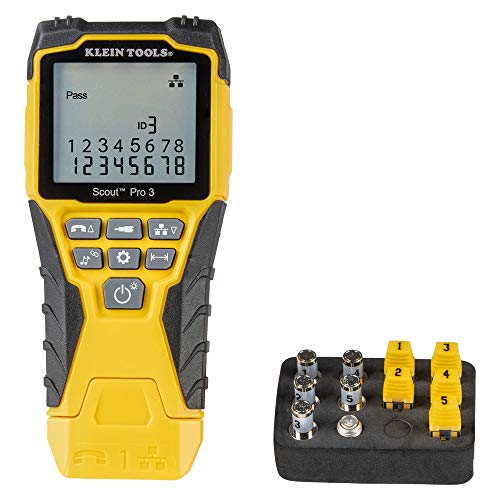
Multimedia Mapping Pick – Klein Tools Scout Pro 3
The Scout Pro 3 is a versatile choice among network cable testers for home use when a project includes Ethernet, telephone, and coax connections. Its backlit display reports wire maps, cable IDs, faults, and cable length on unenergized cables.
Best For: Home installers who want detailed testing across RJ11/RJ12, RJ45, and coax connections.
Pros:
- Detects opens, shorts, miswires, and split pairs
- Measures cable lengths up to 2,000 feet
- Backlit LCD displays length, wiremap, cable ID, and results
- Includes self-storing and locator remotes plus a coax adapter
Cons:
- Not designed to test PoE
- Analog cable tracing requires a separate probe sold separately
This starter set offers more informative results than a basic LED tester and covers both data and coaxial installations. It is particularly useful for labeling and troubleshooting multiple cable runs.
Advanced Network Diagnostics – FNIRSI LPM-10C Ethernet Tester
The FNIRSI LPM-10C goes beyond basic continuity checks, making it a strong advanced option among network cable testers for home use. Along with wire mapping and length measurement, it can scan IPs, run ping tests, check PoE, identify link speed, and help locate switch ports.
Best For: Home users setting up or troubleshooting IP cameras, access points, NVRs, and gigabit Ethernet connections.
Pros:
- Combines wiremap, cable length, IP scan, and ping testing
- Detects standard and non-standard PoE and checks 10/100/1000 Mbps links
- Includes cable tracing, port flash, adjustable probe sensitivity, and a color display
- Rechargeable USB-C design includes a probe flashlight and non-contact AC detection
Cons:
- Its broader feature set may be more than needed for occasional continuity checks
- The supplied notes do not specify a maximum cable-length measurement
This is the most capable option in the group for home network installation and active-device troubleshooting. It is a good fit when cable faults and network connectivity issues need to be investigated with one kit.
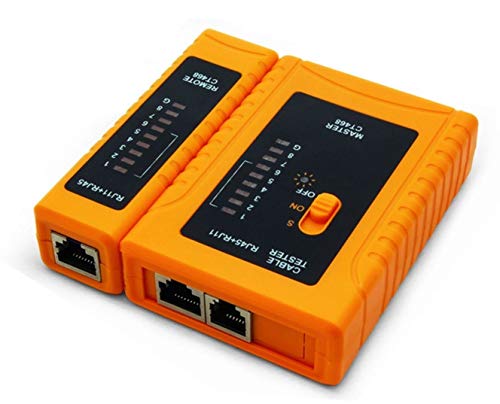
Best Budget Pick – Compact RJ45/RJ11 Cable Tester
iMBAPrice - RJ45 Network Cable Tester for Lan Phone RJ45/RJ11/RJ12/CAT5/CAT6/CAT7 UTP Wire Test Tool
Check Price On AmazonFor shoppers comparing network cable testers for home use, this compact iMBAPrice model covers common RJ45 and RJ11 testing needs without a complicated interface. Its LED display automatically runs checks for continuity, open pairs, shorts, and crossed wires.
Best For: Home users checking Ethernet and telephone cables across CAT5 through CAT7 and RJ11 connections.
Pros:
- Tests continuity, open, shorted, and crossed wire pairs automatically.
- Supports RJ45 LAN and RJ11 telephone cables, including CAT5, CAT5e, CAT6, and CAT7.
- Visible LED status display makes results easy to monitor.
Cons:
- Requires a 9V battery, which is not included.
- Provides a basic LED-based interface rather than a detailed LCD readout.
This is a straightforward choice for occasional home troubleshooting, especially if you need one tester for both Ethernet and telephone wiring. Its compact design and automatic testing keep the process simple.
Best LCD Tester – Klein Tools LAN Scout Jr.
The Klein Tools LAN Scout Jr. is a practical option among network cable testers for home use when readable results matter. Its large backlit LCD shows pin-to-pin wire maps and identifies several common wiring faults in RJ45 cables.
Best For: Home users who want clear LCD diagnostics for CAT5e, CAT6, and CAT6A Ethernet cables.
Pros:
- Detects opens, shorts, miswires, split pairs, crossover issues, and shield faults.
- Large backlit LCD is easier to read in low-light areas.
- Includes a remote and two batteries, with auto power-off for battery conservation.
- Compact design and simple three-button interface are convenient for portable testing.
Cons:
- Designed for RJ45 data cables rather than RJ11 telephone cables.
- Its tone generator requires the separately sold VDV500-123 probe.
Choose this model if you want more detailed feedback than a basic LED tester provides. The LCD wire map and broad fault detection make it especially useful when diagnosing incorrectly terminated Ethernet cables.
Best Multifunction Kit – TESMEN TLP-900AR Cable Tracer
For broader troubleshooting, the TESMEN TLP-900AR goes beyond basic continuity checks. This multifunction option among network cable testers for home use can trace cables, check pair sequence, inspect RJ45 crimping, test telephone-line states, and support CAT5, CAT6, POE, and shielded cables.
Best For: Home network maintenance involving cable tracing, unterminated wires, telephone lines, and mixed Ethernet installations.
Pros:
- Traces and locates cables in bundles, under carpets, and inside walls or ceilings.
- Checks continuity, wire sequence, shorts, opens, and RJ45 crystal-head crimp quality.
- Includes NCV detection, telephone-line polarity and state testing, and a probe work light.
- Comes with alligator clips, cables, a storage box, manual, and two 9V batteries.
Cons:
- Its many functions may be more than needed for simple home cable checks.
- Uses 9V batteries, and the supplied notes do not indicate rechargeable operation.
This kit is the most versatile choice of the three for users who maintain varied wiring. The included adapters and tracing features are particularly helpful when cables are hidden, bundled, or not terminated with a standard connector.
Most Capable – NOYAFA NF-8209 Network Cable Tester
For shoppers comparing network cable testers for home use, the NOYAFA NF-8209 is a feature-rich option for troubleshooting Ethernet runs, telephone lines, and PoE equipment. It combines wire mapping, fault detection, cable-length measurement, cable tracing, and port testing in one kit.
Best For: Home users who want advanced tracing, PoE checks, and cable-length measurements alongside basic continuity testing.
Pros:
- Tests for open circuits, shorts, miswiring, and normal connections on RJ45 cables.
- Measures CAT5/CAT6 cable lengths from 2.5 to 200 meters.
- Supports PoE testing, port flash/link testing, and anti-interference tracing with NCV.
- Includes a rechargeable transmitter, receiver, remote adapter, accessories, and carrying bag.
Cons:
- More equipment and functions than needed for simple continuity checks.
- The transmitter and receiver use different power sources: rechargeable battery and 9V battery.
The NF-8209 is the strongest fit when home network troubleshooting involves long cable runs, PoE devices, or locating a cable through walls. If you only need a basic wiring check, its expanded feature set may be unnecessary.
Best Simple Choice – TESMEN TLP-528A Cable Tester
The TESMEN TLP-528A is a straightforward pick among network cable testers for home use, supporting both RJ45 Ethernet cables and RJ11 telephone lines. Its detachable remote, LED results, and fast or slow test modes make routine wiring checks easy to follow.
Best For: Home wiring, LAN setup, telephone-line checks, and users who prefer a compact tester with clear LED indicators.
Pros:
- Tests RJ45 and RJ11 cables for continuity and shielding status.
- Fast and slow test modes provide flexibility for different troubleshooting needs.
- Detachable main and remote units can test both ends of long or wall-mounted cables.
- Compact housing with non-slip silicone is designed for portability and durability.
Cons:
- Does not list advanced features such as cable-length measurement or PoE testing.
- Uses two AAA batteries rather than a rechargeable power system.
Choose the TLP-528A when your priority is confirming cable continuity and shielding without navigating a more advanced tester. It is a practical, focused tool for basic home and small-office cable maintenance.
Best Compact Option – HT812A Ethernet Cable Tester
The HT812A keeps network cable testing for home use simple and portable while covering common RJ45 and RJ11 wiring problems. It identifies continuity issues, shorts, opens, miswiring, and shielding status, with LEDs on both the main and remote units to show wire order.
Best For: DIYers and home users testing Ethernet or telephone cables during installations, repairs, and upgrades.
Pros:
- Supports RJ45 cables from CAT5 through CAT7 plus RJ11 telephone lines.
- Detects continuity, shorts, open wires, miswiring, and shielding status.
- Offers fast and slow scan modes with LED indicators on the master and remote units.
- Compact split design is suitable for long runs, wall ports, and structured cabling.
Cons:
- Does not include the NF-8209’s listed length measurement, PoE, or cable-tracing functions.
- Its one-button, LED-based design may be less informative for users seeking detailed measurements.
The HT812A is a sensible everyday tester if you need clear wiring verification in a pocket-sized package. Its broad cable compatibility and remote unit cover most basic home repair scenarios without adding advanced test features.
How We Picked the Best Network Cable Testers for Home Use
We focused on testers that support common home-network connections, especially RJ45 Ethernet cables, while also considering models compatible with RJ11, RJ12, coax, or speaker wiring. Each pick was evaluated for practical troubleshooting features, ease of use, portability, included remotes or probes, and the types of cable faults it can help identify.
Simple continuity testers are useful for basic patch-cable checks, while advanced tools may add cable-length measurement, wire tracing, PoE detection, non-contact voltage sensing, IP scanning, or ping testing. The best choice depends on whether you need occasional verification or a broader diagnostic toolkit.
Quick Comparison
| Best For | Look For | Typical Advantage |
|---|---|---|
| Occasional home checks | RJ45 continuity and wire-map testing | Low cost and simple operation |
| Multiple cable types | RJ11, RJ45, coax, or speaker support | More versatile household troubleshooting |
| Finding cables | Tone generator, probe, and remote units | Identifies cables in walls or wiring bundles |
| PoE networks | PoE detection and voltage awareness | Helps investigate powered Ethernet setups |
| Advanced diagnostics | Length, ping, IP scan, or fault-location tools | More information when basic tests are insufficient |
Key Buying Factors for Network Cable Testers for Home Use
Supported Connectors and Cable Categories
Confirm that the tester supports the connectors you actually use. RJ45 is standard for Ethernet, but RJ11 and RJ12 compatibility is useful for telephone wiring. Also check whether the tool handles CAT5e, CAT6, CAT6A, CAT7, shielded cable, or coax. Compatibility labels do not always mean every advanced test works across every cable type.
Test Functions
For most homes, continuity and wire-map testing are the essentials. These functions can identify open conductors, shorts, crossed pairs, and reversed wiring. Cable-length testing is helpful for estimating runs, while tone tracing is better when you need to locate one cable among several. PoE, NCV, ping, and IP features are valuable for users managing switches, access points, cameras, or more complex networks.
Remote Units and Usability
A detachable remote lets you test installed cables when both ends are in different rooms. Look for clear LEDs or a readable display, intuitive controls, durable leads, and a compact design. If you work in dim areas, a backlit screen or bright indicators can make a noticeable difference.
Safety and Limitations
Follow the manufacturer’s instructions before connecting a tester to active equipment. Some basic cable checkers are intended for passive wiring and should not be used on energized circuits. Advanced testers may detect PoE or voltage, but those features do not replace proper electrical safety practices.
Who Should Buy Which Network Cable Testers for Home Use?
Choose a basic RJ45 tester if you only need to verify homemade patch cables or diagnose an occasional dead Ethernet link. A model with RJ11 and RJ12 support makes more sense for homes that still use telephone wiring. If cables disappear into walls, ceilings, or crowded network cabinets, select a kit with a tone generator, probe, and remote.
For smart-home installations, security cameras, access points, or PoE switches, prioritize PoE-aware testing and clear fault information. Users who manage larger home networks or regularly install cable should consider length measurement, ping, IP scanning, or other advanced diagnostics. In short, buy the simplest tester that covers your current wiring and the next project you realistically expect to tackle.