Reliable power is easy to overlook until a voltage problem, wiring fault, or overloaded circuit interrupts a show. The best rack power conditioners for live sound help organize connections, reduce electrical noise, protect equipment, and simplify power-up procedures.
This roundup compares 10 rack-mount options with different outlet counts, current ratings, sequencing controls, filtering features, and form factors so you can match your power setup to your rig and venue needs.
Best 10 Rack Power Conditioners for Live Sound Picks for 2026
Budget-Friendly Rack Control

- 10 outlets with two always-on front connections
- 1U rackmount design with LCD voltage display
- 2,000W capacity with surge and overload protection
Best For: Compact live sound, studio, and home-theater racks
Noise-Filtering Professional Pick

- Nine outlets for pro-audio and electronic equipment
- Noise filtering and surge protection included
- Stainless-steel enclosure with LED illumination
Best For: Professional racks prioritizing filtering and durability
High-Control Sequencing

- Eight independently controlled sequenced outlets
- 20A, 2,000W design with 10 total outlets
- LCD voltage display, bypass, and remote-switch support
Best For: Complex audio racks needing detailed power control
Simple High-Capacity Distribution

- 11 outlets for consolidating rack equipment
- Noise filtering and surge protection
- Stainless-steel construction
Best For: Audio racks needing many connections and basic protection
Clean Power Choice

- PG-90 filtering with Panasonic and Wima capacitors
- Eight rear outlets plus one front outlet
- Front USB port and 2-year warranty
Best For: Rack-based live sound systems prioritizing filtering and organized power access
Maximum Outlet Capacity
Pyle PCO885.5 18-Outlet Rack Conditioner

- 18 total outlets with four on the front
- RFI/EMI filtering and spike protection
- 2U rackmount design with two USB ports
Best For: Large live sound racks needing many outlets and convenient front-panel access
Sequenced Rack Control
Professional ST-368 Power Sequencer

- Sequential startup with independent channel switches
- Eight rear and two front sockets
- LCD voltage display plus USB and Type-C charging
Best For: Multi-device audio racks needing power sequencing and status monitoring
Flexible Rack Power Hub
Pyle PCO860 19-Outlet Rackmount PDU
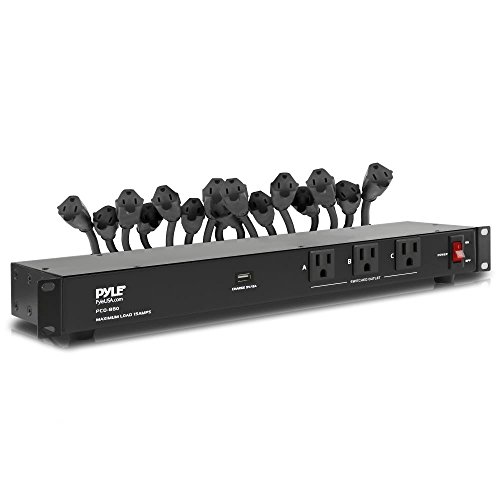
- 19 total outlets with spaced front and rear connections
- 15-amp breaker and covered power switch
- 15-foot cord plus detachable mounting flanges
Best For: High-capacity live sound racks and flexible installations
Monitored Rack Power Controller
FL-1000 2000W Rack Power Conditioner

- LCD display monitors voltage in real time
- 10 sockets with two front always-on outlets
- Surge, overload, and noise protection
Best For: DJ, stage, and studio setups needing voltage visibility
Compact Noise-Filtering Protector

- Surge protection for connected electronics
- Noise filtering for audio equipment
- Two pull-out front-panel LED lights
Best For: Compact audio racks without sequencing requirements
Budget-Friendly Rack Control – Pyle PCO875
For shoppers comparing rack power conditioners for live sound, the Pyle PCO875 is a practical 1U option with 10 outlets, power sequencing, surge protection, and a front-panel voltage readout. Its 2,000W rating and USB charging port suit compact stage, studio, and home-theater racks.
Best For: Small live sound or studio rigs needing affordable rack power distribution and basic monitoring.
Pros:
- Provides eight rear outlets and two always-on front outlets.
- Includes a digital LCD display, USB port, and one-button operation.
- Offers 1U rack mounting with built-in spike, surge, and overload protection.
Cons:
- Its 2,000W capacity and 13A rating may be limiting for larger systems.
- The supplied notes do not specify advanced noise-filtering performance.
The PCO875 delivers a useful mix of sequencing, outlet capacity, and basic protection in a compact enclosure. It is a sensible choice when straightforward rack power management matters more than higher-current or specialized control features.
Noise-Filtering Professional Pick – Radial Power-2
The Radial Power-2 is a sturdy choice among rack power conditioners for live sound, combining nine outlets with noise filtering, surge protection, and LED illumination. Its 15A design and stainless-steel enclosure are suited to pro-audio equipment and other rack-based electronics.
Best For: Live sound users who want a durable professional power supply with noise filtering and clear rack illumination.
Pros:
- Provides nine outlets for pro-audio, computer, and office equipment.
- Combines noise filtering with surge protection.
- Uses a stainless-steel enclosure and includes LED illumination.
Cons:
- Its nine-outlet layout offers less capacity than some 10-outlet alternatives.
- The supplied notes do not mention power sequencing or voltage display.
The Power-2 focuses on durable construction and cleaner power delivery rather than extensive sequencing controls. It is a strong fit for straightforward professional rack distribution where noise filtering is a priority.
High-Control Sequencing – MICNAUX 20A Rack Conditioner
For complex live sound systems, this MICNAUX unit stands out among rack power conditioners for live sound with 20A operation, eight independently controlled sequenced outlets, voltage monitoring, and remote-switch support. It also provides bypass mode and universal 110–230V compatibility.
Best For: Larger or more complex audio racks that need individually controlled power sequencing and remote operation.
Pros:
- Offers eight rear sequenced outlets with dedicated switches and indicators.
- Supports up to 2,000W and 20A output with 10 total outlets.
- Includes an LCD voltage display, bypass mode, and external dry-contact switch.
- Supports 110–230V input compatibility and has a metal rack-mount enclosure.
Cons:
- Its advanced controls may be more than needed for a simple rack.
- The supplied specifications identify a 110V input while also listing universal compatibility, so installation requirements should be verified.
This is the most control-oriented option in the group, with independent sequencing and remote functionality that can simplify larger setups. Its feature set is particularly useful when power-up order and real-time voltage checks are important.
Simple High-Capacity Distribution – Radial Power-1
The Radial Power-1 offers a straightforward approach to rack power management for live sound, with 11 outlets, noise filtering, and surge protection. Its stainless-steel construction makes it a practical option when outlet count and durable materials are more important than sequencing features.
Best For: Audio racks that need many connections with basic filtering and surge protection.
Pros:
- Provides 11 outlets, the highest listed outlet count in this roundup.
- Includes noise filtering and surge protection.
- Uses stainless-steel construction for a durable enclosure.
Cons:
- The supplied notes do not specify power sequencing or voltage monitoring.
- Its listed dimensions are relatively large, so rack and installation space should be checked.
The Power-1 is a simple, outlet-rich solution for consolidating rack equipment. Choose it when dependable distribution, filtering, and surge protection are the main goals and advanced sequencing is not required.
Clean Power Choice – Black Lion Audio PG-X
For live rigs that need dependable rack organization and cleaner AC delivery, the Black Lion Audio PG-X is a focused option among rack power conditioners for live sound. Its PG-90 Filtering Technology, Panasonic and Wima capacitors, and rackmount enclosure are suited to installed or mobile audio systems.
Best For: Rack-based live sound setups that need dedicated filtering, nine total outlets, and front-panel USB access.
Pros:
- Uses PG-90 Filtering Technology with Panasonic and Wima capacitors.
- Provides eight rear-panel outlets plus one front-panel outlet.
- Includes a front-panel USB port and a 2-year warranty.
Cons:
- Provides fewer outlets than some larger power distribution units.
- Its rackmount form factor may be unnecessary for compact or non-rack setups.
The PG-X is a straightforward choice when filtering quality and rack integration matter more than maximum outlet count. Its stainless-steel enclosure and front-access features add practical value for organized live audio systems.
Maximum Outlet Capacity – Pyle PCO885.5 18-Outlet Rack Conditioner
The Pyle PCO885.5 is built for live sound systems with many devices to power from one rack location. As rack power conditioners for live sound go, it combines 18 outlets, AC noise filtering, triple-mode varistor spike protection, and a 2U rackmount design.
Best For: Larger rack setups that need extensive outlet capacity, front-panel charging, and a master power switch.
Pros:
- Offers 14 rear outlets and four front outlets, plus two USB ports.
- Built-in filters target unwanted RFI and EMI interference.
- Includes triple-mode varistor spike protection, a 15-amp rating, and a 6.56-foot power cord.
- Steel front panel and chassis support rack installation.
Cons:
- Uses 2U of rack space, more than a 1U power unit.
- The supplied notes do not specify a detailed filtering technology or voltage display.
Choose the PCO885.5 when outlet count and convenient access are the priorities. Its 18-outlet layout can simplify cable management for busy audio racks, while the front USB ports help charge compatible devices.
Sequenced Rack Control – Professional ST-368 Power Sequencer
The ST-368 adds sequencing and monitoring features to a rack power setup, making it a versatile candidate among rack power conditioners for live sound. It provides eight rear sockets, two front normally open sockets, channel controls, USB and Type-C charging, and an LCD voltage display.
Best For: Audio racks that benefit from staged power-up, independent channel switching, and real-time voltage monitoring.
Pros:
- Provides eight rear sockets and two front sockets.
- Supports one-key sequential startup and independent channel switching.
- Includes AC noise filtering, USB and Type-C charging, and an LCD display.
- Uses a standard 1U rackmount metal structure with an aluminum-alloy front panel.
Cons:
- The supplied specifications contain different maximum-output figures, so buyers should verify the exact rating.
- Channel sequencing and controls may be more functionality than a simple rack needs.
The ST-368 stands out for control rather than simply adding outlets. Its sequencing, status indicators, and voltage display make it appealing for users who want a more managed power-up routine for multi-device audio equipment.
Flexible Rack Power Hub – Pyle PCO860 19-Outlet Rackmount PDU
For live sound rigs that need plenty of accessible outlets, the Pyle PCO860 combines a 1U rack format with 19 total outlets, a 15-amp circuit breaker, and a long 15-foot cord. Its detachable flanges also allow rack-, wall-, or under-counter installation.
Best For: Live sound and studio setups needing high outlet capacity and flexible mounting.
Pros:
- Provides 19 outlets, including three spaced front outlets and 16 rear-facing outlets.
- Includes a built-in 15-amp circuit breaker and covered front-panel power switch.
- 15-foot cord helps reach power sources away from the rack.
- Includes a USB charging port and supports 110/240V use.
Cons:
- The unit weighs 7.1 pounds, which may add noticeable rack weight.
- Its enclosure material is listed as plastic.
The PCO860 is a practical choice when outlet quantity and installation flexibility matter more than advanced monitoring features. Its long cable and transformer-friendly outlet layout suit crowded live sound racks.
Monitored Rack Power Controller – FL-1000 2000W Rack Power Conditioner
This FL-1000 is a strong contender among rack power conditioners for live sound when real-time voltage visibility is useful. The 1U unit offers a 2000W power supply, 10 sockets, an LCD voltage display, USB connectivity, and surge and overload protection.
Best For: DJ, stage, studio, and home-theater systems that benefit from voltage monitoring.
Pros:
- LCD screen provides real-time voltage monitoring.
- Offers eight rear sockets and two front always-on sockets.
- Includes surge, overload, and noise protection features.
- 1U metal rack housing saves space and includes a USB/international power interface.
Cons:
- The supplied information does not specify detailed sequencing behavior despite the product positioning.
- It is rated for 2000W, so connected equipment must remain within that limit.
With its display and protection features, the FL-1000 gives operators more information than a basic distribution strip. Verify the outlet and voltage requirements of your equipment before using its international-style connections.
Compact Noise-Filtering Protector – PMX-800 1U Power Conditioner
The PMX-800 is a straightforward 1U rack-mount option for live sound systems that need surge protection and noise filtering without a sequencer function. Its two front-panel pull-out LED lights can also help illuminate equipment controls in a rack.
Best For: Compact audio racks needing basic surge protection, noise filtering, and front-panel lighting.
Pros:
- Provides surge protection for connected electronics.
- Includes noise filtering for audio equipment.
- Two front-panel pull-out LED lights improve rack visibility.
- Uses a space-saving 1U rack-mount design.
Cons:
- No sequencer function.
- The supplied notes do not specify outlet count, cord length, or electrical rating.
- At 7.04 pounds, it is not an especially lightweight rack accessory.
The PMX-800 focuses on core protection and convenience rather than advanced power sequencing or monitoring. It is worth considering for a compact rig, but confirm its outlet layout and ratings before purchase.
How We Picked the Best Rack Power Conditioners for Live Sound
We focused on rack-mount units intended for audio systems, mobile rigs, DJ setups, rehearsal spaces, and small venue installations. The selection includes basic surge-protection and filtering units, higher-capacity distribution centers, and sequencers that can help power connected equipment in a controlled order.
We compared outlet count and layout, stated wattage and amperage, rack-space requirements, front-panel convenience features, voltage monitoring, USB charging, independent controls, and whether each model includes sequencing. Because venue wiring and protection requirements vary, published capacity should be treated as a limit—not a target to exceed.
Quick Comparison
- For basic rack protection: Choose a straightforward conditioner with surge protection and noise filtering.
- For larger rigs: Look for 15- or 20-amp capacity, higher wattage ratings, and ample rear outlets.
- For controlled startup: Select a power sequencer with timed or independently controlled outlet groups.
- For mobile convenience: Front USB ports, pull-out lights, voltage displays, and accessible switches can be useful during setup.
- For compact systems: A 1U unit can preserve rack space, while a 2U model may provide more controls and outlet capacity.
Key Buying Factors for Rack Power Conditioners for Live Sound
Capacity and Circuit Compatibility
Check both the conditioner’s amperage and the venue circuit before connecting amplifiers, powered speakers, mixers, lighting, or other high-draw equipment. A 15-amp unit cannot create additional circuit capacity, and a 20-amp model requires a properly rated supply and connector. Leave headroom for startup surges and avoid daisy-chaining power strips.
Sequencing and Controls
Sequencing can reduce the chance of loud pops by turning equipment on and off in a planned order. It is most valuable in permanent or semi-permanent systems with several devices. If you only need distribution and basic protection, paying extra for sequencing may not be necessary.
Filtering, Surge Protection, and Monitoring
Noise filtering may help reduce interference caused by connected equipment, although it cannot fix poor grounding or faulty venue wiring. A voltage display can make unusual supply conditions easier to spot, while surge protection provides another layer of defense. Neither feature replaces a properly wired circuit, appropriate grounding, or an uninterruptible power supply when uninterrupted operation is essential.
Rack Layout and Everyday Usability
Confirm the unit’s rack height, outlet orientation, cord length, and access to front-panel controls. Front outlets and USB ports are convenient for temporary connections, while rear outlets usually produce a cleaner permanent installation. Built-in lights can also make cable management easier in dark venues.
Who Should Buy Which Rack Power Conditioners for Live Sound?
Touring musicians and mobile DJs should prioritize rugged construction, manageable size, clear controls, and enough outlets for the complete rig. Installed venue systems may benefit more from sequencing, higher current capacity, and independent outlet control. Home studios and rehearsal rooms can often use a simpler filtered conditioner unless they operate several high-draw devices. Large powered-audio setups should verify total load with the venue or an electrician before choosing a high-capacity distribution unit.
Before buying, list every device you plan to connect, add its rated power draw, identify the available circuit, and decide whether sequencing or monitoring is genuinely useful. That checklist will narrow the options more reliably than outlet count alone.