Wet filament can cause stringing, popping, weak layers, and inconsistent surfaces—especially with hygroscopic materials such as nylon, TPU, and polycarbonate. The right dryer helps restore filament performance and keeps spools ready for reliable printing.
This roundup compares 10 filament dryers for Bambu Lab, including AMS heater upgrades and standalone multi-spool drying boxes. The best choice depends on your AMS generation, filament types, spool capacity, and whether you need to dry while printing.
Best 10 Filament Dryer for Bambu Lab Picks for 2026
Best Independent-Chamber Upgrade
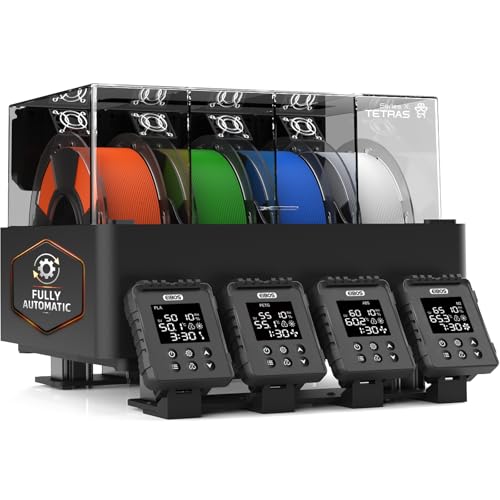
- Four independently controlled drying chambers
- Dries while printing with Gen 1 AMS
- Automatically vents, seals, and monitors humidity
Best For: Multi-material Bambu Lab AMS Gen 1 users
Best Standalone Four-Spool Dryer

- Holds four 1 kg or two 2 kg spools
- Dual 200 W chambers reach 85°C
- Sealed enclosure supports moisture-free storage
Best For: High-volume standalone filament drying
Best Value Single-Spool Dryer

- 360° hot-air circulation
- 45–65°C adjustable range
- Fits one 1 kg spool
Best For: Budget-conscious Bambu Lab users drying one spool at a time
Best AMS Upgrade

- Two independent drying chambers
- Dries while printing
- Stores four spools with automatic sealing
Best For: Bambu Lab AMS Gen 1 owners running multiple materials
Best Two-Spool Standalone Dryer
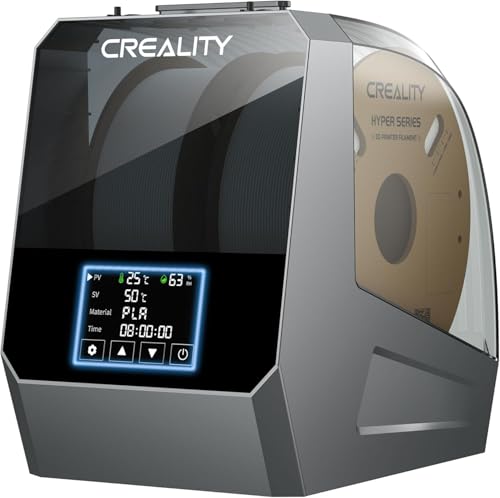
- Dries two 1 kg spools
- 160W dual PTC heating
- 4-inch touchscreen with 12 presets
Best For: Bambu Lab users preparing two spools or feeding two printers
Best Budget Two-Spool Option

- Holds two 1kg spools
- 40–50°C adjustable range
- Supports 1.75mm and 2.85mm filament
Best For: Routine drying and storage of common filaments
Best High-Capacity Choice
Creality Space Pi X4 Filament Dryer
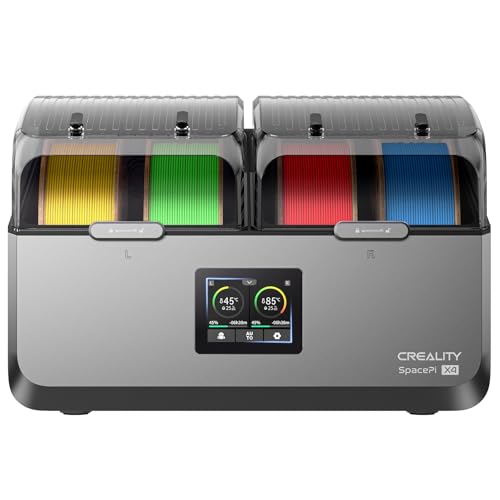
- Dries and prints four spools
- Independent dual-chamber temperatures
- Reaches up to 85°C
Best For: Multi-spool and engineering-filament workflows
Best Easy-Control Dryer
Creality Space Pi Filament Dryer

- 360° hot-air heating
- Presets for up to 12 filament types
- 0–48-hour timer with power-off memory
Best For: Convenient drying of common and composite filaments
Best Independent-Chamber Upgrade – EIBOS Tetras AMS Dryer
If you want a filament dryer for Bambu Lab that can dry multiple materials independently, the EIBOS Tetras upgrades a Gen 1 AMS with four separately controlled drying chambers. It can dry while printing and also functions as sealed filament storage.
Best For: Bambu Lab AMS Gen 1 owners who print several filament types and want independent temperature and humidity control.
Pros:
- Four independent chambers with separate heaters, fans, sensors, and temperature controls.
- Supports drying while printing, with temperatures from 20°C to 65°C and cycles from 30 minutes to 24 hours or unlimited.
- Automatically vents during drying and seals the chambers afterward for storage.
- Supports materials including PLA, ABS, PETG, TPU, and Nylon.
Cons:
- Designed as an add-on for Bambu Lab AMS Gen 1; the AMS itself is not included.
- Requires its own power supply and weighs 8.8 pounds.
The Tetras is the most configurable option here, especially for multi-material workflows. Its independent controls and automatic sealing make it a strong choice when drying and storage matter as much as capacity.
Best Simple AMS Lid Upgrade – SUNLU AMS Heater
The SUNLU AMS Heater is a straightforward filament dryer for Bambu Lab AMS Gen 1 users. It replaces the original lid, preserves AMS functionality, and heats up to 70°C in about 20 minutes for simultaneous drying and printing.
Best For: AMS Gen 1 owners who want a quick, non-destructive four-spool heating upgrade.
Pros:
- Enables printing and drying at the same time.
- Reaches 70°C in approximately 20 minutes.
- Three-step installation replaces the original lid without modifying the AMS.
- Airflow is directed toward the filament area while helping protect the feeding motor from overheating.
Cons:
- Compatible with AMS Gen 1 only, not the second-generation AMS.
- The Bambu Lab AMS is not included.
This SUNLU model is appealing if you want the simplest installation and fast heating rather than separate controls for each spool. Check your AMS generation carefully before buying.
Best Standalone Four-Spool Dryer – Creality Space Pi X4
The Creality Space Pi X4 is a standalone filament dryer for Bambu Lab users who do not need an AMS-integrated upgrade. Its four-spool capacity, dual heating chambers, and sealed storage design suit high-volume printing with common and higher-temperature materials.
Best For: High-volume users who need a separate dryer for four standard spools or two large 2 kg spools.
Pros:
- Holds four standard 1 kg spools or two large 2 kg spools.
- Dual independent 200 W heating chambers reach up to 85°C.
- Supports 1.75 mm and 2.85 mm filament.
- Silicone-sealed storage helps limit moisture re-absorption during pauses.
Cons:
- It is a separate dryer box rather than an AMS-integrated heater upgrade.
- The supplied notes do not specify automatic drying while a Bambu Lab AMS feeds filament.
Choose the Space Pi X4 when capacity and material range are more important than a built-in AMS fit. Its 85°C maximum and sealed enclosure give it broader standalone drying and storage utility.
Best Automatic Gen 1 AMS Heater – SUNLU 70°C AMS Dryer
This SUNLU filament dryer for Bambu Lab AMS 1.0 adds active drying without replacing the complete AMS. It uses PTC heating, dual airflow, and automatic humidity sensing to dry all four rolls while printing.
Best For: Bambu Lab AMS 1.0 owners seeking automatic operation, even heating, and a two-minute installation.
Pros:
- Dries all four AMS spools while the printer is running.
- Reaches 70°C in approximately 20 minutes.
- Humidity sensing can automatically start and stop drying as needed.
- Installs by swapping the original AMS top cover and preserves AMS functions.
Cons:
- Compatible with AMS 1.0; the AMS is not included.
- The supplied notes do not indicate independent temperature control for each spool.
This is a practical pick for users who want hands-off drying in the existing AMS footprint. Its automatic humidity response adds convenience, while the four-roll capacity supports routine multi-spool printing.
Best Value Single-Spool Dryer – Creality Space Pi SE
If you need a practical filament dryer for Bambu Lab without adding a large multi-spool system, the Creality Space Pi SE offers straightforward single-spool drying. Its 360° hot-air circulation, adjustable 45–65°C range, and humidity display make it suitable for routine PLA, PETG, ABS, ASA, and TPU maintenance.
Best For: Bambu Lab users who want an affordable standalone dryer for one 1 kg spool at a time.
Pros:
- Heats to 65°C in about 15 minutes with 360° hot-air circulation.
- Adjustable temperature and drying time from 0–24 hours.
- Supports 1.75 mm and 2.85 mm filament, including PLA, PETG, ABS, ASA, TPU, and nylon.
- Display shows humidity and a drying countdown, with no assembly required.
Cons:
- Holds only one 1 kg spool.
- Its 45–65°C range may be limiting for some specialized drying requirements.
The Space Pi SE is a sensible entry point for Bambu Lab owners who primarily need dependable single-spool moisture control. Pairing it with PTFE tubing can also support smoother feeding during printing.
Best AMS Upgrade – EIBOS Dyas AMS Heater
For Bambu Lab AMS owners seeking an integrated filament dryer for Bambu Lab, the EIBOS Dyas is designed as a drop-in AMS Gen 1 add-on. It provides two independently controlled chambers for four spools, allowing active drying while printing rather than requiring a separate pre-drying step.
Best For: Bambu Lab AMS Gen 1 users who print with multiple materials and want drying, storage, and feeding in one setup.
Pros:
- Two independent chambers can dry four spools with separate controls.
- Supports drying while printing with adjustable 20–65°C temperatures.
- Automatic venting, sealing, and humidity-based reactivation help maintain dry storage.
- Independent power and installation keep operation separate from Bambu Lab firmware updates.
Cons:
- It is an add-on for Bambu Lab AMS Gen 1; the AMS is not included.
- Its installation and operation are more specialized than a standalone dryer.
The Dyas is the most integrated option here for multi-material Bambu Lab workflows. Its dual-chamber design is particularly useful when different filaments need separate temperature settings, although compatibility requirements should be checked before purchase.
Best Two-Spool Standalone Dryer – Creality Space Pi Plus
The Creality Space Pi Plus is a strong standalone filament dryer for Bambu Lab users who want to prepare two spools simultaneously. Its dual 160W PTC heating system, 360° circulation, touchscreen controls, and support for temperatures up to 70°C make it useful for both common and higher-performance filaments.
Best For: Bambu Lab users who regularly need to dry two 1 kg spools or feed two printers at once.
Pros:
- Holds two 1 kg rolls and includes four filament holes with two PTFE pipes.
- Dual 160W PTC heating provides 360° hot-air circulation.
- 4-inch LCD touchscreen offers one-key settings for up to 12 filament types.
- Adjustable temperature range reaches 45–70°C and supports multiple filament diameters.
Cons:
- Larger and heavier than a single-spool dryer.
- It is a standalone box rather than an AMS-integrated upgrade.
Choose the Space Pi Plus when capacity and convenience matter more than AMS integration. It gives Bambu Lab owners room to dry two spools at once and offers broad material support through its preset and manual temperature controls.
Best Budget Two-Spool Option – Comgrow SH01 Filament Dryer
If you need a practical filament dryer for Bambu Lab printing, the Comgrow SH01 focuses on keeping up to two 1kg spools dry while printing. Its adjustable 40–50°C range and sealed design suit common PLA, ABS, and similar materials, though its temperature ceiling is relatively modest.
Best For: Bambu Lab users who want two-spool storage, basic moisture control, and support for 1.75mm and 2.85mm filament.
Pros:
- Stores up to two 1kg spools.
- Supports standard 1.75mm and 2.85mm filament diameters.
- Offers adjustable 40–50°C heating, six- to 12-hour timing, and temperature and humidity monitoring.
- Sealed outlet design includes a silicone cable sheath and Teflon tube.
Cons:
- The 50°C maximum is less suitable for higher-temperature engineering filaments.
- Operation requires the work state to appear on the screen or the motherboard may shut down after three minutes.
- The vent must be opened during drying and closed afterward.
The SH01 is a straightforward choice when two-spool capacity matters more than high-temperature drying. Its simple controls and monitoring features make it useful for routine filament maintenance alongside a Bambu Lab printer.
Best High-Capacity Choice – Creality Space Pi X4 Filament Dryer
For Bambu Lab setups using multiple materials or printers, the Creality Space Pi X4 offers four-spool drying and printing in one unit. Its dual chambers can run at independent temperatures, while the 85°C maximum makes it more suitable for demanding materials than lower-temperature dryers.
Best For: Multi-material workflows that need four-spool capacity, separate chamber control, and higher-temperature drying.
Pros:
- Dries and feeds four spools at once through eight filament holes and PTFE tubing.
- Dual chambers provide independent temperature control for two filament types.
- Dual 200W PTC heaters reach up to 85°C for materials such as PA, PAHT, PC, and flexible filaments.
- Single-chamber operation can save up to 40% energy compared with dual-chamber use.
Cons:
- The manufacturer advises using heat-resistant plastic trays, particularly with non-Creality filament.
- Its four-spool design may be more capacity than a single-printer user needs.
The Space Pi X4 stands out for capacity and flexibility. It is a strong match for a Bambu Lab workspace running several spools or printers, especially when different materials require different drying temperatures.
Best Easy-Control Dryer – Creality Space Pi Filament Dryer
The Creality Space Pi is a versatile filament dryer for Bambu Lab users who want even heating and simple touchscreen control. Its 360° hot-air circulation, 45–70°C adjustable range, and material presets support common filaments as well as options such as PLA-CF, PA-CF, and ASA.
Best For: Users seeking guided settings, long timed drying, and broad 1.75mm/2.85mm filament compatibility.
Pros:
- 360° hot-air circulation is designed to provide more uniform heating.
- 3.7-inch LCD touch screen supports easy operation and Celsius/Fahrenheit switching.
- Offers one-key settings for up to 12 filament types and manual adjustment from 45–70°C.
- Includes a 0–48-hour timer and power-off memory for material and temperature settings.
Cons:
- The maximum temperature is 70°C, below the 85°C offered by the Space Pi X4.
- It is specified for a single filament dryer unit rather than four-spool operation.
The Space Pi balances convenience and versatility. Its presets, long timer, and power-loss memory reduce setup work, while the 360° heating design makes it a sensible general-purpose option for Bambu Lab printing.
How We Picked the Best Filament Dryer for Bambu Lab
We focused on products designed to work with Bambu Lab workflows, particularly AMS-compatible heater upgrades and dryers that can feed filament while a spool is being treated. We also considered heating range, chamber layout, spool capacity, temperature control, sensor design, circulation, display usability, and practical storage features.
Because filament needs vary, the list includes compact AMS accessories as well as standalone boxes for two or four spools. Product claims such as maximum temperature and heating power should be treated as specifications rather than a guarantee of identical real-world drying performance.
Quick Comparison
| Type | Best for | Main advantage | Key limitation |
|---|---|---|---|
| AMS heater upgrade | Bambu Lab AMS owners | Dry while printing without a separate enclosure | Requires compatible AMS hardware and power setup |
| Two-spool dryer | Routine household printing | Compact footprint and simpler operation | Less capacity for active spool rotation |
| Four-spool dryer | Frequent or multi-material printing | More capacity and independent chamber options | Larger size and higher energy use |
| Storage-focused dryer | Keeping opened filament usable | Useful for ongoing moisture control | May dry more slowly than dedicated high-output units |
Key Buying Factors for a Filament Dryer for Bambu Lab
AMS Compatibility and Installation
Check whether the unit is intended for AMS Gen 1, a newer AMS version, or standalone use. An AMS heater upgrade may be convenient, but it can occupy internal space and may require careful cable routing or setup. Confirm compatibility before buying.
Temperature Range and Material Support
PLA generally needs gentler drying than nylon, PETG, TPU, or polycarbonate. Choose adjustable temperature control rather than relying only on the advertised maximum. Follow the filament manufacturer’s recommended drying temperature and time.
Spool Capacity and Chamber Separation
Two- and four-spool dryers are useful when you print frequently, but independent chambers matter if different materials need different settings. Verify that the chamber accepts your spool diameter, width, and material.
Drying While Printing
If you want a Filament Dryer for Bambu Lab that supports uninterrupted production, prioritize sealed filament paths, outlet placement, and compatibility with your AMS or printer setup. A dryer that cannot feed smoothly is less useful during long jobs.
Controls, Sensors, and Safety
Look for clear temperature displays, reliable sensors, automatic shutoff, thermal protection, and stable airflow. Higher wattage can shorten warm-up time, but insulation and circulation also affect results.
Who Should Buy Which Filament Dryer for Bambu Lab?
Choose an AMS heater upgrade if you already own a compatible Bambu Lab AMS and value drying while printing. Choose a two-spool dryer for a compact, straightforward setup and regular PLA or PETG use. Choose a four-spool model if you maintain several materials or print continuously. Choose a storage-oriented dryer if your priority is keeping opened spools protected between jobs.